PART 3
The two ledgers lay open beneath the yellow glow of the kitchen lamp.
One was green, narrow, and worn from being carried in a widow's apron pocket.
The other was thick leather, filled with cattle counts, weather records, and the careful handwriting of a rancher who trusted numbers more than promises.
Gus Kitridge stood beside the table.
Letty Vaneir sat with her hands folded tightly in her lap.
Neither spoke.
On the page dated October 18, 1886, Gus had written:
Cook quit. Nine men to feed. Prayed for a cook before the snow. Felt a fool.
Letty looked at the words.
Then she turned her own ledger toward him.
In the margin beside her husband's debts, written in small, careful letters, was another entry.
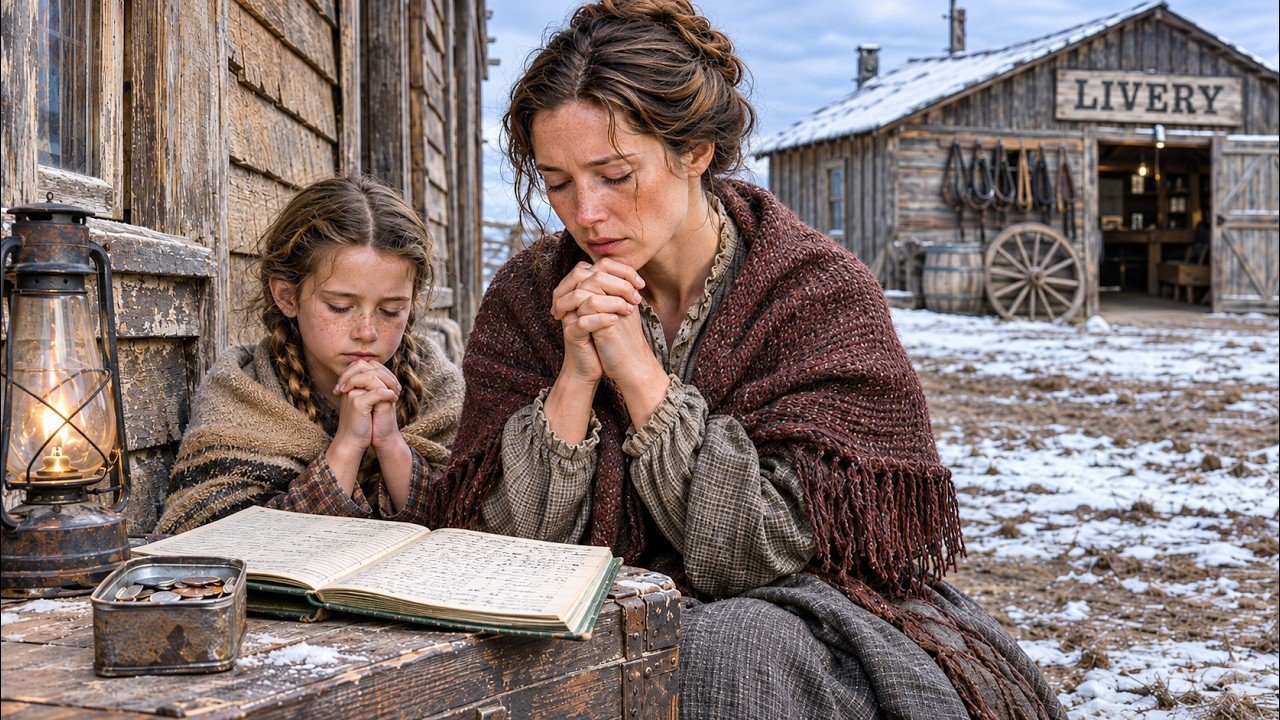
October 18. Asked God for honest work before the snow, and a roof for Bess.
Gus read it twice.
Then he looked at her.
"That was the night before you came."
Letty nodded.
"The very night."
He sat down slowly.
For three years, Gus had believed that God had abandoned him.
He had buried his wife, Levvenia, during a bitter winter, and afterward the ranch house had become a place of silence.
He still worked.
Still paid his men.
Still tended his cattle and cared for his aging father.
But he had stopped expecting anything good to happen.
Then, on one cold October evening, he had spoken a reluctant prayer over an empty coffee pot.
And twelve miles away, a desperate widow had been praying for exactly the work he needed done.
Gus stared at the two books.
"I don't know what to make of this."
Letty smiled through her tears.
"Neither do I."
Outside, the wind moved softly across the snow-covered yard.
The bunkhouse lamps were going dark one by one.
Somewhere in the back room, old Ransom Kitridge began snoring loudly enough to be heard through the wall.
Letty laughed.
It was an unexpected sound.
Warm.
Unrestrained.
The kind of laughter that came from somewhere deeper than amusement.
Gus looked at her.
And for the first time in three years, he felt something inside his chest loosen.
He smiled.
"Father sounds like a sawmill."
Letty laughed harder.
"He certainly does."
Gus leaned back in his chair.
"He's been asking about you."
"Has he?"
"Every day."
"What does he ask?"
Gus hesitated.
"Mostly whether I've got enough sense to keep you here."
Letty's smile softened.
"Well, you've hired me through winter."
"Yes."
He looked down at the ledger.
"But I was hoping you might stay longer."
Her laughter faded.
"Gus..."
He cleared his throat.
"I mean, the men eat better than they ever have. Father thinks you're the finest woman in the territory. And Bess seems happy here."
Letty studied his face.
"And you?"
He looked up.
The question seemed to catch him unprepared.
"I am happier than I was."
She lowered her eyes.
"So am I."
For a moment, neither knew what to say.
Then Letty touched the old tally book.
"Tell me about the mare."
Gus nodded.
"Your husband came through here in the spring of 1884. He was hauling freight toward Maiden."
"I remember."
"He stopped to water his team. Father was down by the river, checking the crossing."
Gus paused.
"The current was high that year. Father slipped from the bank and went into the water."
Letty's expression changed.
"He never told me."
"Amos jumped in after him."
Gus looked toward the dark window.
"Father was nearly seventy then. He couldn't swim against the current. Amos caught him before the river carried him into the deeper channel."
Letty covered her mouth.
"He pulled Father out. Nearly drowned himself doing it."
Gus smiled faintly.
"When I tried to thank him, he said he hadn't done anything another decent man wouldn't do."
"That sounds like Amos."
"He needed a mare for his freight team. I had a gray one I could spare. He offered to buy her on credit."
Gus tapped the ledger.
"I told him the mare was his. No charge. Father was worth more than sixty-four dollars."
Letty stared at the page.
"But Amos wrote it down."
"Apparently."
She shook her head slowly.
"He never liked accepting gifts."
"Neither do you."
Letty smiled sadly.
"No."
Gus reached for the green ledger.
"May I?"
She nodded.
He took his pencil and drew a careful line through the final entry.
Kitridge. Gray mare. $64.
Beside it, he wrote:
Debt forgiven in 1884. No payment owed.
Letty watched him.
For months, that final name had weighed on her.
She had worried over it while washing shirts.
While sewing by lamplight.
While counting the money in her tobacco tin.
And all along, the debt had never existed.
She pressed her fingers against the page.
"Amos would have argued with you."
Gus smiled.
"I expect he would."
"He'd have insisted on paying."
"Then I'd have insisted on refusing."
Letty laughed softly.
"You would have liked him."
"I did."
She looked up.
Gus's expression was serious.
"He was a good man, Letty."
Her eyes filled again.
"I know."
And for the first time since her husband's death, she heard those words from someone who had known him without needing to explain his mistakes.
It was a gift she hadn't realized she needed.
The days before Christmas passed slowly.
The winter grew harsher.
Snowdrifts rose against the bunkhouse walls.
The Judith River froze along its shallower banks.
Cattle stood with their backs to the wind, conserving what strength they could.
Gus and his men spent long days cutting paths through the snow and hauling hay to the sheltered pastures.
There was little rest.
And less money.
But the cookhouse remained warm.
Letty made bread from flour carefully measured.
She stretched beef into stew with barley and potatoes.
She saved bacon grease for frying and used every scrap of food that could be made useful.
The men began calling her Mrs. Kettle Springs.
She pretended to dislike it.
Bess adored it.
One afternoon, Letty found her daughter sitting beside old Ransom's chair.
The old man was teaching her to play checkers.
"You've moved that piece three times," Bess complained.
Ransom grinned.
"That's called experience."
"That's called cheating."
He laughed so hard he began coughing.
Letty hurried forward.
"Mr. Kitridge, are you all right?"
Ransom waved her away.
"Fine, woman. Fine."
Then he looked at Bess.
"She's got her mother's tongue."
Bess smiled proudly.
Ransom turned toward Letty.
"And her father's eyes, I reckon."
Letty's expression softened.
"Yes."
The old man reached for her hand.
"That girl needs a place to grow up."
Letty nodded.
"I know."
"And you need somewhere you can stop running yourself ragged."
She smiled faintly.
"That's easier said than done."
Ransom looked toward the window.
"Augustus has been lonely a long time."
Letty glanced at him.
The old man's voice softened.
"He loved Levvenia. Loved her something fierce."
"I know."
"But loving somebody who's gone doesn't mean a man has to spend the rest of his life alone."
Letty looked down.
"Mr. Kitridge..."
"Ransom."
She smiled.
"Ransom."
He squeezed her hand.
"Just something to think about."
That evening, Gus came into the cookhouse carrying a small wooden box.
Letty was kneading bread.
"What's that?"
"Something I found in the storeroom."
He set the box on the table.
Inside were several small wooden toys.
A horse.
A wagon.
A little painted doll with a blue dress.
Letty looked at him.
"Where did these come from?"
"Father made them years ago."
"For whom?"
Gus hesitated.
"Levvenia and I hoped to have children."
The room grew quiet.
Letty looked at the toys again.
"They're beautiful."
"They've been sitting in that box a long time."
He cleared his throat.
"I wondered whether Bess might like them."
Letty touched the little wooden horse.
"She would love them."
Gus nodded.
"Good."
He started toward the door.
"Gus?"
He turned.
"Thank you."
His expression softened.
"You're welcome."
Then Letty added quietly, "She needs more than toys."
He waited.
"She needs to know she's wanted."
Gus looked at her for a long moment.
"She is."
Letty's eyes filled.
He stepped closer.
"And so are you."
Neither moved.
Then Gus gently touched her flour-covered hand.
For a brief moment, the world outside the cookhouse seemed very far away.
Christmas Eve arrived beneath a clear, bitter sky.
The snow was deep, but the road to the little Utica church remained passable.
Gus ordered two bobsleds prepared.
The men bundled themselves in buffalo robes.
Dutch Flannery, still recovering from his broken leg, insisted on attending despite the doctor's warnings.
Old Ransom was wrapped so thoroughly in blankets that only his nose and beard remained visible.
Bess wore her best dress.
Letty had made it from the blue wool she had earned by sewing for Mrs. Orm.
She had trimmed the sleeves with a little lace saved from an old garment.
When Bess stepped into the kitchen, Gus stopped speaking.
"Well," he said, "aren't you a fine young lady?"
Bess twirled.
"Do I look grown up?"
"Very nearly."
She grinned.
"Then perhaps I should drive the sled."
Dutch snorted.
"Not with me in it."
Bess laughed.
The ride to church was cold but beautiful.
Stars shone above the mountains.
Snow glittered across the fields.
The horses' bells rang softly through the still air.
Letty sat beside Gus beneath a heavy buffalo robe.
Bess rode with Ransom and the others.
For several miles, neither Gus nor Letty spoke.
Then he glanced at her.
"Cold?"
"A little."
He tucked the robe more securely around her shoulders.
"Better?"
"Yes."
She smiled.
"Thank you."
He nodded.
Then, after another mile, he said, "I've been thinking about something."
Letty looked at him.
"That sounds dangerous."
He laughed.
"Perhaps."
"What is it?"
Gus kept his eyes on the road.
"I've been thinking about the night you came to Kettle Springs."
"The night after our prayers?"
"Yes."
He paused.
"I was so certain God had stopped listening that I nearly refused to believe what was right in front of me."
Letty looked toward the mountains.
"Sometimes answers don't arrive the way we expect."
"No."
He glanced at her.
"Sometimes they arrive in a borrowed buggy with a little girl and a green ledger."
Letty smiled.
"And sometimes they come disguised as a stubborn rancher who can't boil an egg."
Gus laughed.
"I still can't."
"I know."
He looked at her.
"That's why I need you."
Her smile faded slightly.
"Only for cooking?"
Gus's hands tightened around the reins.
"No."
He spoke the word quietly.
Then he added, "Not anymore."
Letty looked away, her cheeks warming despite the cold.
The church was full.
Ranch families had come from miles around.
Children crowded near the stove.
Men removed their hats and stamped snow from their boots.
The congregation sang Christmas hymns.
Bess sang loudly and confidently.
Dutch sang badly.
Puit sang louder than everyone.
And old Ransom fell asleep halfway through the sermon.
Letty sat beside Gus, listening to the familiar words about hope arriving in darkness.
She thought of the room above the livery stable.
Of the cold floor beneath her knees.
Of Bess sleeping beneath every blanket they owned.
She thought of the green ledger.
Of the debts she had feared she would never finish paying.
And she thought of the man beside her.
The man who had offered her work when she needed it most.
The man who had stood silently beside her in the root cellar while she cried.
The man who had given her daughter wooden toys that had once been meant for children he never had.
She looked down at her hands.
For the first time in years, she allowed herself to imagine a future that wasn't built entirely around survival.
After the service, Gus asked Letty to walk with him toward the sleds.
The night was still.
Stars burned above the snow-covered town.
He reached into his coat and withdrew her green ledger.
Letty frowned.
"Why do you have that?"
"I borrowed it."
"Without asking?"
He smiled nervously.
"I was hoping you'd forgive me."
She raised an eyebrow.
"That depends."
Gus opened the book.
On the final page, beneath the last crossed-out debt, he had written something in his careful square handwriting.
Letty leaned closer to read.
Owed to Mrs. Letty Vaneir by Augustus Kitridge: One lifetime of wages, payable in whatever coin she chooses.
She stared at the words.
Then she looked up.
"Gus..."
He cleared his throat.
"I know I'm not much at speeches."
Letty's eyes filled.
"I've noticed."
He smiled.
"I've spent most of my life counting cattle, measuring feed, and trying to keep a ranch alive."
He took her hand.
"After Levvenia died, I thought the best part of my life was finished."
Letty squeezed his fingers.
"I understand."
"I know you do."
He looked toward the church, where Bess was laughing with Ransom.
"Then you came."
His voice grew softer.
"You brought warmth into my kitchen. You brought laughter back to my father. You gave my men something to look forward to besides payday."
He paused.
"And you gave me a reason to come home before dark."
Letty covered her mouth.
Gus stepped closer.
"I don't want to hire you for another winter."
Her heart seemed to stop.
"I want you to stay for every winter after this one."
He took a breath.
"Letty Vaneir, will you marry me?"
For a moment, she couldn't speak.
She thought of Amos.
Of the good years they had shared.
Of the grief that had followed his death.
She had never expected to love another man.
And she had certainly never expected another man to love both her and her daughter.
"Gus," she whispered, "are you certain?"
He smiled.
"More certain than I've ever been about anything."
"What about Bess?"
He glanced toward the church.
"I was hoping she'd let me be part of her life too."
Letty began crying.
Gus looked alarmed.
"Did I say something wrong?"
She shook her head.
"No."
He waited.
Then she laughed through her tears.
"You said everything right."
His shoulders relaxed.
"Then is that a yes?"
Letty stepped into his arms.
"Yes, Gus."
He held her close.
"Yes?"
"Yes."
He laughed.
Then he kissed her gently beneath the Montana stars.
From behind the church door came a loud voice.
"ABOUT TIME!"
They turned.
Old Ransom stood in the doorway, grinning beneath his buffalo robe.
Bess was beside him.
Dutch leaned on his crutch.
The entire Kettle Springs crew had gathered behind them.
Letty covered her face.
"Oh, mercy."
Ransom laughed.
"Don't mind us. We've only been waiting two months."
Bess ran toward them.
"Mama! Did he ask?"
Letty knelt and gathered her daughter into her arms.
"Yes, sweetheart."
Bess looked at Gus.
"And did she say yes?"
Gus smiled.
"She did."
The little girl threw her arms around him.
"Good!"
He lifted her carefully.
"Good?"
She nodded fiercely.
"Because I already told Grandpa Ransom I'd like to stay forever."
Gus looked at Letty over the child's shoulder.
His eyes were bright.
"Then I suppose it's settled."
They were married in March of 1887.
The roads were still buried beneath snow, so the ceremony took place in the ranch house.
Old Ransom gave Letty away.
Dutch Flannery served as best man, leaning heavily on his crutch.
Puit cried openly.
Tob Sandival tried not to.
Bess wore her blue wool dress and carried a small bouquet of dried flowers.
Letty wore a simple cream-colored gown she had sewn herself.
When Gus saw her, he forgot the words he had practiced.
She smiled.
"You're supposed to say something."
He swallowed.
"You're beautiful."
She laughed softly.
"That wasn't in the ceremony."
"It should have been."
The minister smiled.
And they were married.
The winter had been cruel.
By spring, Kettle Springs had lost nearly half its herd.
Many neighboring ranches had suffered worse.
There were lean years ahead.
Years when the kitchen table held more beans than beef.
Years when every dollar had to be counted.
Years when Gus worried over the cattle and Letty worried over the pantry.
But they faced those years together.
Bess grew into a bright, capable young woman.
Tob Sandival eventually became foreman.
Dutch never stopped complaining, though he never again questioned whether a woman belonged on a cattle ranch.
Old Ransom lived long enough to hold two of Gus and Letty's children on his knee.
And every Christmas, Puit proposed marriage to Letty as a joke, just as he had on her first morning in the cookhouse.
Gus always answered, "You'll have to wait your turn."
Puit would grin.
"I've been waiting since breakfast in 1886."
The ranch recovered slowly.
Grass returned.
Calves were born.
The cattle herds grew.
But Gus and Letty never forgot that first winter.
They kept the two ledgers together on the mantel.
The green book that had carried a widow's debts.
And the leather book that had recorded a widower's reluctant prayer.
Years later, when Bess was old enough to write in ink, she added one final entry to her mother's ledger.
All debts paid. All prayers answered. Even the one Mr. Kitridge didn't think God would hear.
Letty discovered the words one Christmas morning.
She read them aloud to Gus.
He sat beside the fire, holding their youngest child.
For a long moment, he said nothing.
Then he smiled.
"That girl always did understand things better than I do."
Letty closed the ledger.
She looked around the room.
At the children.
At the warm fire.
At the man who had once believed his life was finished.
And she remembered the cold October night when she had knelt beside a narrow bed and asked God for work.
She had prayed for a roof.
She had prayed for wages.
She had prayed for enough to feed her daughter.
She had never dared to pray for love.
But sometimes, the greatest blessings arrive quietly, hidden inside the ordinary things we think we need.
A job.
A warm kitchen.
A second chance.
And two lonely hearts learning that their stories are not finished yet.
What moved you most about Letty and Gus's story: the two prayers spoken on the same night, the debt that had already been forgiven, or the love that neither expected to find again?