PART 3
The door opened only a few inches before Margaret caught it with her shoulder.
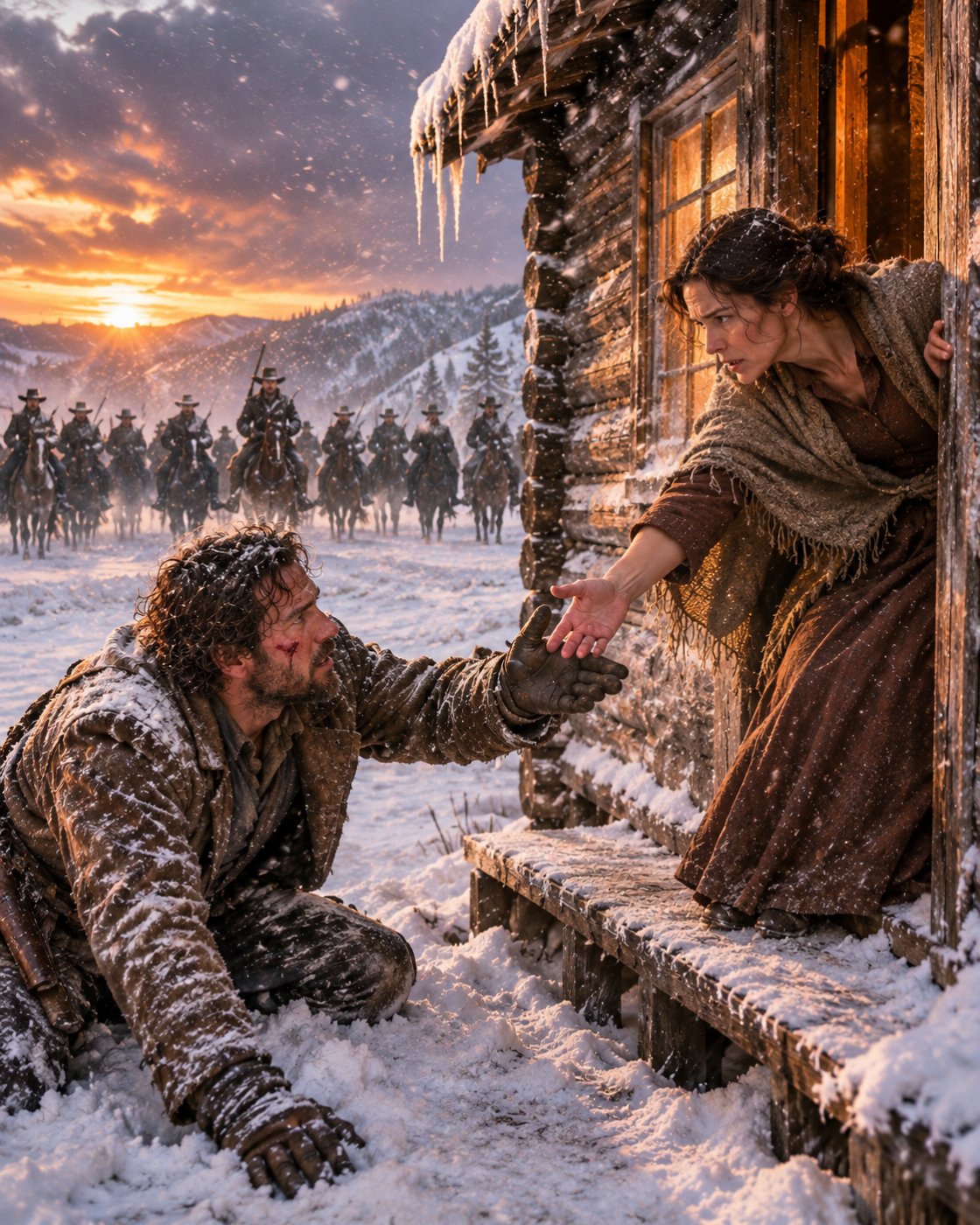
Sheriff Silas Boone stood on the porch, his heavy winter coat covered in snow. Behind him, twelve horses shifted restlessly beneath the pine trees. The riders accompanying him were cold, tired, and increasingly impatient.
Boone removed his gloves.
“Let's stop pretending, Margaret.”
She kept one hand against the door.
“Pretending about what?”
“You know perfectly well.”
“Then perhaps you should explain it.”
His eyes narrowed.
For three years, Margaret had addressed him respectfully. She had accepted his explanations concerning Thomas's death, thanked him for bringing occasional supplies, and listened when he advised her against asking too many questions about the mine.
He was accustomed to her obedience.
The woman standing before him tonight was different.
“Elias Cole is a wanted man,” Boone said.
“Wanted for what?”
“You know what happened to your husband.”
“I know what you told me happened.”
The sheriff studied her face.
Then he smiled.
“Grief can make people confused.”
Margaret thought of the letter hidden inside her dress.
Thomas's handwriting.
His desperate request for forgiveness.
The twelve names recorded on the tiny paper Elias had removed from the watch.
“Three years is a long time to be confused, Sheriff.”
Boone placed his hand against the door.
“Let me inside.”
Margaret stepped backward.
Not because she trusted him, but because she knew there was little point in pretending she could physically prevent him from entering.
Boone walked into the cabin and removed his hat.
His eyes immediately traveled toward the fireplace.
Elias stood beside it, pale from his wound but upright.
The sheriff stopped.
“Well, well.”
Elias said nothing.
Boone looked at Margaret.
“I thought you hadn't seen anyone.”
“I changed my mind about helping you.”
“That's a dangerous decision.”
“Perhaps.”
Boone laughed softly.
“You always were a stubborn woman.”
Margaret folded her arms.
“And Thomas always said stubbornness was useful when a person knew she was right.”
At the mention of Thomas, Boone's expression changed.
Only briefly.
But Margaret noticed.
Elias noticed too.
The sheriff walked toward the table and pulled out a chair.
“Where's the watch?”
Margaret remained silent.
“Don't make this harder than necessary.”
“Why do you want it?”
“It's evidence.”
“Of what?”
“Your husband's death.”
Margaret looked directly at him.
“Then tell me how he died.”
Boone sighed.
“I've already told you.”
“No. You've told me that Elias was responsible for an accident. You've told me Thomas was an innocent victim. You've told me the twelve miners who died before him were unfortunate men who happened to be working in the wrong place.”
She stepped closer.
“Tonight, I want the truth.”
Boone looked toward Elias.
“You've been filling her head with nonsense.”
Elias answered quietly.
“I told her what Thomas asked me to tell her.”
“Thomas should have kept his mouth shut.”
The words escaped before Boone appeared to realize their significance.
Margaret felt her stomach tighten.
“What did you say?”
Boone leaned back.
“Your husband involved himself in matters he didn't understand.”
“He understood the accounts.”
“He understood numbers. He didn't understand business.”
“Twelve men died.”
“Mining is dangerous work.”
“And their families?”
The sheriff shrugged.
“Unfortunate circumstances.”
Margaret stared at him.
She remembered attending the funerals. The widows standing beneath a gray sky. Children too young to understand why their fathers would never return. The little envelopes containing compensation that barely covered burial expenses.
She had carried casseroles to those families.
She had prayed beside them.
And all that time, Boone had known something she hadn't.
“Were their lives worth so little to you?”
The sheriff's expression hardened.
“The mine was worth more than any of those men could comprehend.”
“They were human beings.”
“And the world doesn't stop because human beings die.”
Margaret felt tears rising.
Not tears of weakness.
Tears of anger so deep she could hardly contain them.
“Did you arrange Thomas's death?”
Boone glanced toward Elias.
Then toward the window.
His confidence returned.
There were twelve armed men outside. A wounded fugitive stood beside the fireplace. An impoverished widow occupied a cabin miles from the nearest town.
He believed he had nothing to fear.
“Thomas was given an opportunity to walk away,” he said.
Margaret's fingers tightened.
“He refused?”
“He became unreasonable.”
“Did you kill him?”
Boone looked at her.
“I arranged what happened.”
The room became terribly quiet.
Margaret could hear the wind moving against the shutters.
She could hear the stove crackling.
She could hear Elias breathing behind her.
But for several seconds, she could not speak.
Three years.
Three winters spent sleeping alone.
Three Christmas mornings with Thomas's empty chair beside the fireplace.
Three years believing that her husband's final moments had been nothing more than a terrible accident.
And now the man responsible sat at her kitchen table as though discussing the price of cattle.
“Why blame Elias?” she whispered.
Boone smiled without warmth.
“Because he was convenient.”
Elias lowered his head.
Margaret looked toward him.
She imagined what the previous three years must have been like. Hiding in the mountains, unable to return to town, carrying the blame for the death of a man who had trusted him.
She had hated Elias Cole without ever meeting him.
She had repeated Boone's accusations.
She had prayed that the man responsible for Thomas's death would someday be punished.
And the entire time, she had been praying against the wrong man.
Boone rose.
“Now give me the watch.”
Margaret wiped her cheeks.
“No.”
The sheriff stared.
“What?”
“No.”
He took a step toward her.
Elias immediately moved closer.
Boone looked at him.
“You can barely stand.”
“I'm standing.”
The sheriff turned back to Margaret.
“You're making a mistake.”
“I made a mistake three years ago when I believed you.”
She straightened her shoulders.
“I'm not making it again.”
Boone's face darkened.
Then, from somewhere outside, came the unmistakable sound of a bell.
One deep, resonant note.
Followed by another.
And another.
Margaret looked toward the window.
The old mining warning bell.
Thomas had installed it years earlier after a winter storm nearly trapped several neighboring families without assistance. Its sound carried across the valley even when visibility was poor.
Earlier that evening, while Boone's men were searching the surrounding property, Margaret had quietly asked one of the riders she recognized to help her.
His name was Daniel Foster.
He was the son of one of the twelve miners who had died.
She had told him only that the evidence concerning his father's death was inside her cabin.
And that if he still wanted answers, he should ring the bell when he heard Boone admit what had happened.
Now the bell was ringing.
Boone rushed toward the window.
“What in God's name is that?”
Outside, voices began rising above the wind.
Several of the riders had dismounted.
Daniel Foster stood near the bell, his face pale with anger.
Another man was shouting at Boone's deputy.
Then Margaret heard unfamiliar voices.
“State investigation office!”
Boone turned toward the door.
Elias closed his eyes briefly.
“They made it.”
The sheriff stared at him.
“What did you do?”
Elias looked up.
“Kept my promise.”
Moments later, three state investigators entered the cabin accompanied by a county deputy from a neighboring jurisdiction. They had received Elias's earlier documents and traveled toward the mining settlement before the blizzard intensified.
The bell had helped them locate the occupied cabin through the storm.
The senior investigator, a gray-haired man named Arthur Bennett, removed his hat.
“Sheriff Boone?”
Boone attempted to recover his composure.
“Gentlemen. I'm conducting an official search.”
Bennett looked toward Margaret.
“Mrs. Hayes?”
“Yes.”
“Are you being threatened?”
Margaret looked at Boone.
Then at Elias.
“Yes.”
Bennett nodded.
“We've received documents concerning the Silver Ridge Mining Company and several suspicious deaths.”
Boone laughed.
“From a fugitive?”
“From multiple sources.”
The sheriff's smile faded.
Bennett continued.
“We need you to accompany us and answer some questions.”
“On whose authority?”
Bennett produced the relevant paperwork.
Boone examined it.
For the first time that evening, Margaret saw genuine uncertainty in his expression.
Daniel Foster entered behind the investigators.
His eyes were red.
“Did you hear him?” Margaret asked.
Daniel nodded.
“Enough of it.”
He looked at Boone.
“My father was one of those men.”
Boone said nothing.
Daniel's voice shook.
“My mother worked herself nearly to death after he was gone.”
The sheriff turned away.
Bennett stepped between them.
“There will be a proper investigation. We need everyone to cooperate.”
Margaret retrieved Thomas's pocket watch.
She held it for several moments before placing it in Bennett's hands.
“This belonged to my husband.”
He examined it carefully.
“Mr. Cole told us about it.”
“There are records inside. And I have a letter.”
She touched her dress.
“Please don't let them disappear again.”
Bennett looked at her.
“We'll document everything we receive.”
Margaret nodded.
Then she handed him the letter.
It was the most difficult thing she had done that evening.
Not because she doubted its importance.
But because it was the last letter Thomas had ever written to her.
Bennett promised that she would receive it back when the necessary copies and examination were completed.
Outside, the storm continued.
Boone was escorted from the cabin.
Some of his riders were questioned. Others, who had believed they were participating in a legitimate search for a dangerous fugitive, expressed shock at what they had heard.
Daniel Foster remained beside the doorway.
He looked at Margaret.
“Do you think they'll finally tell us what happened?”
She swallowed.
“I think we have to make certain they do.”
Daniel nodded.
Then stepped outside to assist the investigators.
When the door finally closed, Margaret leaned against the kitchen table.
Her knees suddenly felt weak.
Elias approached her.
“Margaret?”
She looked at him.
And began crying.
He caught her before she fell.
For a long time, neither spoke.
She held his coat with both hands while three years of grief, anger, confusion, and loneliness finally escaped her.
Elias did not tell her to be strong.
He did not tell her that everything would be all right.
He simply held her.
And when Margaret finally lifted her head, she realized that the man she had once believed responsible for destroying her life was the only person who understood what she had just lost.
Not Thomas.
She had lost Thomas three years earlier.
Tonight, she had lost the comfortable explanation that had allowed her to remember him without questions.
And somehow, that hurt almost as much.
By morning, the blizzard had weakened.
Snow covered the valley in a thick white blanket. The trees stood motionless beneath the weight of ice, and the mountains emerged slowly from the clouds.
The investigators had taken Boone to the neighboring county under guard. Several men remained temporarily at the abandoned mining settlement while the weather improved.
Margaret's cabin was quiet again.
She stood beside the stove preparing breakfast when Elias attempted to rise from the chair.
He immediately winced.
“Sit down.”
“I'm all right.”
“You're bleeding through your bandage.”
He looked down.
“Oh.”
Margaret pointed toward the chair.
“Sit.”
He obeyed.
She brought fresh cloth, warm water, and the small medical supplies she kept in a wooden box.
When she removed his old bandage, she frowned.
“You've made it worse.”
“I've had worse.”
“That doesn't make this better.”
Elias smiled faintly.
Margaret looked at him.
“Something amusing?”
“Thomas used to say you had a way of making a man feel foolish without raising your voice.”
Her hands stopped.
“He said that?”
“Frequently.”
She almost smiled.
Then sadness returned.
Elias noticed.
“I'm sorry.”
“Don't be.”
She resumed cleaning the wound.
“I want to hear about him.”
Elias looked uncertain.
“Are you sure?”
“Yes.”
She tied the fresh bandage carefully.
“I've spent three years remembering the same handful of things. I'd like to know something new.”
Elias leaned back.
For several moments, he thought.
“Thomas was terrible at cards.”
Margaret laughed unexpectedly.
“He told me he was quite good.”
“He lied.”
She shook her head.
“That sounds like him.”
“He'd lose fifty cents and spend the rest of the evening explaining how the cards had been against him.”
Margaret smiled.
“He used to do that when he lost at checkers.”
Elias continued.
“He always carried peppermint candies in his coat.”
“For his stomach.”
“No. For the children near the mine.”
Margaret looked up.
“He never told me that.”
“He'd pretend he didn't like sweets. Then give them away whenever he saw a child.”
She swallowed.
“That sounds like him too.”
Elias watched her finish the bandage.
Then said quietly, “He loved you very much.”
Margaret lowered her eyes.
“I know.”
She gathered the cloths.
“At least, I thought I knew.”
Elias understood the distinction.
He waited.
Margaret sat across from him.
“Did he really sign that report?”
“Yes.”
“Knowing those men hadn't died accidentally?”
Elias nodded reluctantly.
She closed her eyes.
“Why didn't he come home and tell me?”
“He was ashamed.”
“He should have trusted me.”
“Yes.”
Margaret looked surprised.
She had expected Elias to defend Thomas.
Instead, he continued.
“He should have told you. He should have refused to sign. And he should have gone to the authorities sooner.”
Margaret studied him.
“You don't think I'm wrong for being angry?”
“No.”
She pressed her lips together.
“I loved him.”
“I know.”
“And I'm furious with him.”
Elias nodded.
“You can be both.”
Margaret stared at the table.
Nobody had ever given her permission to remember Thomas as anything other than a wonderful husband who had suffered an unfortunate death.
She had protected that memory fiercely.
But Thomas had been a man.
Not a saint.
A man capable of kindness, courage, fear, and terrible mistakes.
Perhaps loving him honestly meant acknowledging all of it.
“Did he regret signing?” she asked.
“Every day afterward.”
Elias looked toward the fireplace.
“He started visiting the miners' families. Bringing food. Helping repair things. I think he was trying to make up for what he'd done without telling anyone why.”
Margaret remembered those evenings.
Thomas coming home late.
His coat smelling of smoke and cold air.
His explanation that a neighbor needed assistance.
She had thought him generous.
Now she understood that guilt had accompanied every act of kindness.
“Then he decided to confess?”
“Yes.”
Elias reached toward his coat and removed a small, battered notebook.
“He gave me this before everything went wrong.”
Margaret accepted it.
The pages contained figures, dates, and several short entries written in Thomas's hand.
Near the end, she found a sentence that made her eyes fill.
If I cannot undo what I have done, I can at least stop helping them hide it.
She read it twice.
Then closed the notebook.
“He was trying.”
Elias nodded.
“He was.”
Margaret held the notebook against her chest.
For the first time since learning the truth, she felt something resembling peace.