PART 3
Curtis said sure, take the night.
He left the chalk number on his boot when he went.
Irene walked him to the door because you walk people to the door.
When she came back, she did not sit down.
She stood at the sink with her back to the kitchen and ran water over a cup that was already clean.
Elsie sat at the table and looked at the bills.
Her mother had spread them out after supper like a bad hand of cards: the roofer's estimate, the light bill, and the county letter with its red stamp across the top.
Beside them lay Elsie's own sheet of notebook paper, the one she had been keeping since the sale.
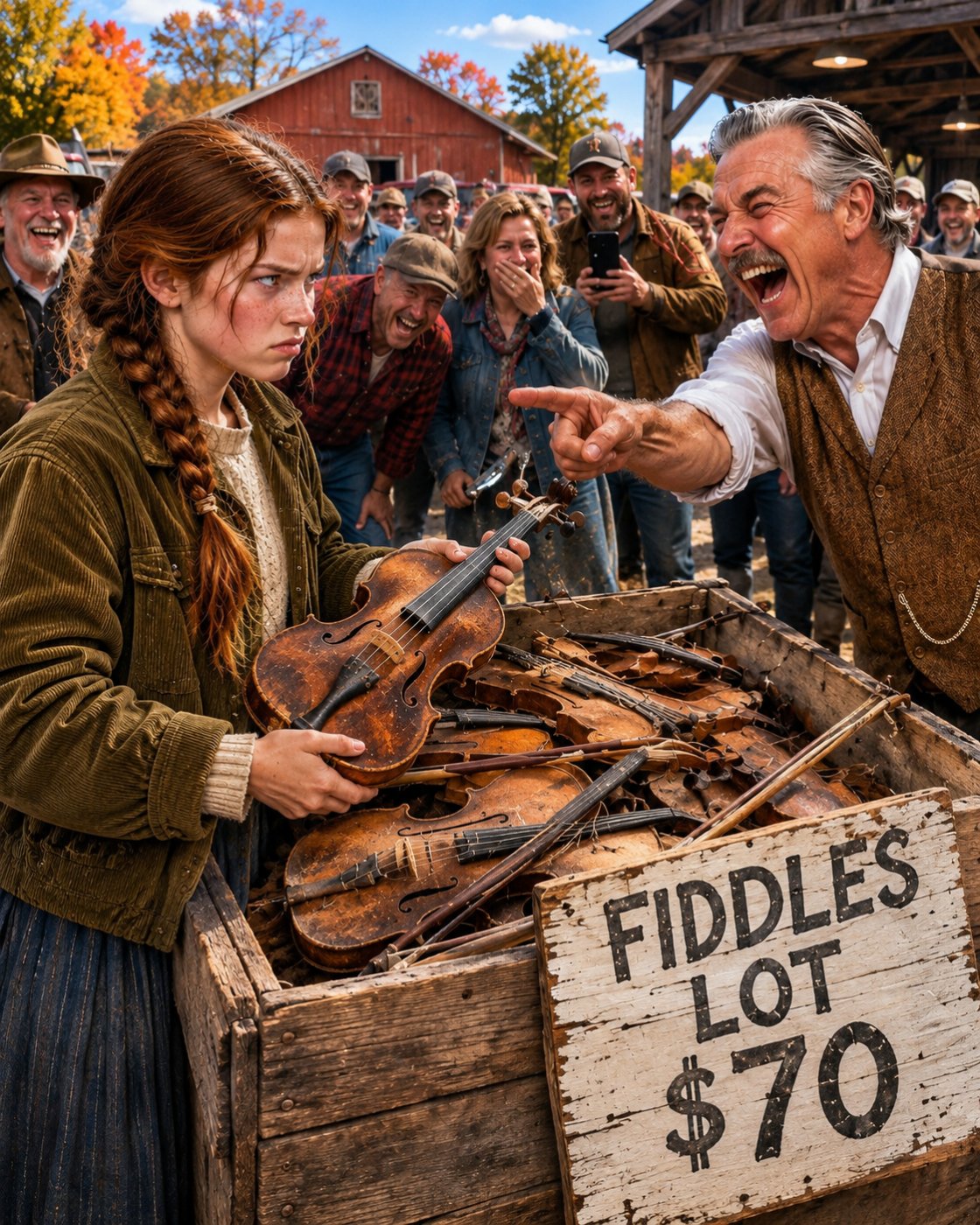
Seventy dollars for the crate.
Forty for Imani's gas.
Six for the thermometer.
One hundred and sixteen dollars gone out of two hundred and twelve, and nothing to show for it but a pine box in a cold room.
Her mother had looked at that list a long time earlier in the week and said nothing at all.
That had been worse than if she'd said something.
"Mama," Elsie said.
"Not tonight, baby".
Irene turned off the water.
"I've got Mr. Coker at six.
You decide.
You bought it.
You decide.
Whatever you say in the morning, I'll stand behind it".
She kissed the top of Elsie's head and went down the hall to the couch in the front room, because her own bedroom was still under a blue tarp.
Elsie sat alone in the kitchen for a long time.
She thought about the snap at five in the morning.
She thought about the wax beading up along the seams like sweat.
Maybe she had already ruined whatever was in there.
Maybe there had never been anything in there at all.
Maybe she was just a girl who had bought a box of junk because her grandmother used to tap things on her knee.
And now she was going to cost her mother the house because she was too proud to say she was wrong.
Fifteen hundred dollars.
She did the arithmetic three times.
It came out the same every time.
At last she got up and went down the hall to the north room without turning on the light.
It was cold in there.
The thermometer on its nail said fifty degrees.
The dishpan of water sat on the floor beside the crate, and her sheet of numbers hung pale on the wall, morning and night, morning and night, in her careful handwriting.
Nobody had asked her to keep it.
She had kept it anyway, because that was what her grandmother would have done.
Elsie sat down on the floor beside the crate in her coat.
The fork had belonged to Imogene Quintero, who tuned pianos in four counties for forty-one years.
Church uprights.
School spinets.
One concert grand at a college in Florence that she used to talk about the way some women talk about an old boyfriend.
She had died this past April, at seventy-nine, in her own bed, with the fork on the nightstand beside her.
The day Elsie remembered best was a hot Saturday when she was nine years old, at a little Methodist church out past Guntersville.
The deacons had already decided to haul their old upright piano to the dump.
They had a truck backed up to the church door with the ramp down.
Imogene had asked them for five minutes.
She struck the fork on her knee.
Never on the piano, because a piano is not a table.
She set the stem flat on the lid and bent down and put her ear to the wood.
Then she made Elsie do it.
Elsie heard it hum.
"That one's alive," Imogene told the deacons.
She spent three Saturdays bringing it back, and as far as Elsie knew, it was still playing hymns out past Guntersville.
On the drive home that day, her grandmother had explained it.
If the wood is alive, it sings back.
If the glue has let go, or the board has split, or it's been wet too long, it just sits there.
"A dead board doesn't answer, baby," she'd said.
"It's the most honest thing in the house".
Elsie had heard her say it a couple of hundred times since.
Now she struck the fork on her knee in the dark.
She set the stem on the lid of the crate, the way she had in the cellar, and bent down, half afraid of what she would hear.
The crate answered.
It was fainter, maybe.
Maybe she only thought so.
But it answered.
Elsie sat up slowly.
She stayed there on the cold floor for a while with the fork in her hand.
Then she reached over, thumbed back the lid of the Prince Albert tin, and took out the letter.
The letterhead said Calder Brothers Violin Shop, Birmingham, Alabama, and there was a telephone number printed under the address.
Five digits.
It was foolish.
A shop that wrote letters in 1941 had to be long gone.
She took out her mother's phone anyway and typed the name and the city into it.
Calder Brothers came up in an old newspaper notice about a shop being sold in 1979.
The buyer's name was in the notice.
When she searched that name, it led her to a third name and a phone number for Ivy Violin Repair, on the south side of Birmingham.
It was nine o'clock at night.
Elsie called anyway.
A man answered on the fourth ring.
He sounded like he'd been reading something.
His name was Daryl Ivy.
Yes, he said, this was the old Calder shop, more or less.
The man who trained him had bought it from the last Calder brother and left it to Daryl, along with forty years of ledgers in banker's boxes in the back room that Daryl had never had the heart to throw out.
Elsie told him who she was.
She told him about the crate.
Then she read him the letter, word for word, in the dark.
There was a long pause on the line.
"Miss Ewing," Daryl said finally.
His voice was kind but very plain.
"I'm going to tell you something, and I want you to hear it the right way.
I get about thirty calls a year from people who've found a Stradivarius in an attic.
Every one of them, every single one, has been a German factory fiddle with a paper label.
They made them by the boxcar load a hundred years ago and sold them out of catalogs for six dollars with the bow thrown in.
I don't want you getting your hopes up".
"Yes, sir," Elsie said.
"I understand".
Another pause.
"Read me that letter again," Daryl said.
"Slowly".
She did.
He called back at seven the next morning, while she was pulling on her boots for the stable.
"I went through the ledgers last night," he said.
He sounded tired, as if he hadn't slept much.
"Nineteen forty-one.
Took me till about two.
It's in there.
Pencil, in old Mr. Calder's hand.
Toliver, Vance Springs.
Wrote re instrument.
Advised bring in.
Did not come".
Elsie stood in the kitchen with one boot on.
"That doesn't tell me what it is," Daryl said.
"I want to be clear.
It tells me the letter's real, and it tells me he never brought it.
That's all it tells me".
He was quiet a moment.
"Don't move that box again.
Don't let anybody touch it.
Don't open it, not even to look.
I'll be down tomorrow".
She told Curtis no that morning at the gate of the salvage yard, before school.
The yard was forty acres of pickups and pallets and things that used to be washing machines, all of it white with frost.
Curtis was out front with a cup of coffee, watching one of his men load a car battery into somebody's trunk.
He saw her coming up the road in her barn coat and waited.
"No, sir," Elsie said.
"Thank you.
But no".
Curtis looked at her a long time.
Then he looked down at his boot, at the 1,500 still chalked on the sole.
"Your funeral, kid," he said.
He didn't say it unkindly.
He said it the way a man says the weather is turning.
Then he went back inside his office, and Elsie walked to school.
That afternoon, an old man knocked on the Ewings' door with the head of his cane.
His granddaughter waited at the curb in a white car with the engine running.
The old man was small and stooped, in a brown hat and a tweed coat that had been made for a bigger version of him.
His name was Lyall Haskins, he said, and he was ninety-one years old, and he had heard about the crate at the barbershop.
"Mind if I come in, young lady? It's a story better told sitting down".
Elsie made him coffee.
He sat at the kitchen table holding the cup in both spotted hands.
"When I was eight years old," he said, "my daddy took me out to the Toliver place with a fiddle that had a busted neck.
Daddy played at the Grange Hall dances, same as Amos.
Amos fixed that neck for a dollar while we waited.
And while he was doing it, he showed us a fiddle lying in pieces on a flannel cloth on his bench".
He set down his cup.
"Dark thing.
Darker than any fiddle I ever saw.
Amos said a widow sold it to him.
Italian lady.
Her husband cut marble down at the quarries in Sylacauga, and he'd brought that fiddle over from the old country.
After he passed, she hung it on the wall by her cookstove one winter, and the top split clean through.
Amos bought it from her for what she asked.
He took it all apart.
Said he wouldn't glue it back till he found old spruce for the inside.
Said new wood would ruin it".
Mr. Haskins shook his head slowly.
"Then the war came.
Amos went off to work at a powder plant up the river in forty-two.
Told my daddy he'd be back in a year.
Took pneumonia up there the next winter and never came home".
The kitchen was quiet.
Outside, a mockingbird was going through everything it knew.
Then the old man's mouth twitched under his mustache.
"Now, I'll tell you," he said.
"Amos also told my daddy his dog could count to five.
So I wouldn't put too much on it".
Elsie laughed for the first time in a week.
Daryl Ivy came the next day in a gray Subaru with a toolbox in the back and a thermometer of his own.
He was a lean man in his sixties, with reading glasses pushed up on his head and big, careful hands.
He did not tell any stories about himself.
He shook Irene's hand and then Elsie's, the same way, and asked to see the room.
In the north room, he did not look at the crate first.
He looked at the wall.
He read Elsie's sheet of numbers from top to bottom, every morning and every night, the date and the time and the temperature and the humidity.
He took his own thermometer out of his coat pocket and held it beside hers on the nail and waited until both of them settled.
"Yours reads a degree high," he said.
"Doesn't matter.
What matters is you wrote it down".
He tapped the sheet once with his finger.
"Nobody told you to do that?"
"No, sir".
He nodded slowly and turned to the crate.
He crouched beside it for a long time.
He studied the brass screws, all twenty-two of them, and the wax in their slots, smooth and unbroken.
He ran his thumbnail along the edge of a cloth strip where the beeswax had softened and gone hard again.