PART 3
In case you missed it: widow Hannah Prior took a cook's job on Wade Callister's ranch at Sage Creek, Wyoming Territory, after he startled her at the door by saying he needed a wife.
At Christmas she discovered that her late mother had once fed and sheltered Wade when he was a starving nineteen-year-old.
Then, on a trip to Rawlins in February, her brother-in-law Ambrose Prior appeared with a deputy, accused her of stealing forty dollars and a valuable book, and offered to drop the charge if she came home and married him.
Hadley's store had gone so quiet that Hannah could hear the stove ticking.
Two ranch wives by the dry goods counter were no longer pretending to look at calico.
Mr. Hadley stood frozen behind his counter with a paper sack in one hand.
The spool of brown thread Hannah had been holding lay on the floor where it had rolled away from her, and she did not remember dropping it.
"Mrs. Hannah Prior," said the deputy.
He was a thin, tired-looking man with a drooping mustache, and he sounded as though he would much rather be somewhere else.
"I'm Deputy Haney.
Mr. Prior here has sworn out a complaint before Judge Corwin.
He says you left his house in November with forty dollars of his money and certain property belonging to the family farm".
His eyes went to the brown calfskin book tucked under her arm.
She had brought it to town to match a recipe to the spices on Mr. Hadley's shelf.
"A book of some value, he says".
"That is my mother's book," Hannah said.
Her voice sounded strange to her, very far away.
"It came to me from her, and to her from her mother.
There is nothing in it that belongs to the Prior farm".
"The money, then," said Ambrose.
"The money was mine.
I sold my own eggs for eight years".
"Eggs from hens fed on my grain," Ambrose said, "in my henhouse, on my land".
He spoke reasonably, almost kindly, the way a man explains something simple to a child, and it was far worse than if he had shouted.
"Everything on that farm belongs to the farm, Hannah.
You know that.
Mother always said so".
"Your mother gave me those hens".
"Did she?" Ambrose spread his big hands.
"Mother's been in her grave three years.
Strange she never mentioned it to me".
The back door of the store banged open.
Wade Callister came in with a fifty-pound sack of flour on his shoulder, stamping snow off his boots, saying something to Pete over his shoulder about the price of coffee.
Then he looked up and saw her face.
He took in the scene in a single glance.
Hannah, white as paper.
The big man in the black Sunday coat.
The deputy's tin star.
He set the flour down on the counter very slowly and came across the store to stand beside her.
He didn't touch her.
He just stood close enough that she could feel him there.
"Is there trouble here?" he said.
Ambrose looked him up and down, from his worn boots to the darned elbow of his coat.
"And who might you be?"
"Wade Callister.
Mrs. Prior cooks for my outfit".
"Cooks," said Ambrose.
He let the word hang in the air.
Then he said it again, slower, so that everyone in the store could taste it.
"A widow, alone on a ranch eighteen miles from town, with a bachelor and a bunkhouse full of hired men.
Cooks".
He turned to the deputy and shook his head sorrowfully.
"You see how it is, Haney.
She's fallen in with bad company.
My brother would turn in his grave".
One of the ranch wives drew in her breath.
Hannah felt the heat climb up her neck and into her face until it burned.
She wanted the floor to open.
She wanted to be anywhere on God's earth but standing in Hadley's store with every eye in Rawlins on her.
Beside her, Wade's hands had closed into fists.
But he did not raise them.
He only said, very quietly, "You'll want to be careful what you say about her, mister".
"Or what?" Ambrose smiled.
"I have the law on my side, Mr. Callister.
What have you got?"
Deputy Haney stepped between them, looking more tired than ever.
"That'll do.
Both of you".
He turned to Hannah, and his voice softened a little.
"Judge Corwin's gone to Fort Steele and won't be back till Friday.
Hearing's set for Friday morning at ten o'clock, at the courthouse on Front Street.
You'll appear, Mrs. Prior, or I'll have to come out and fetch you.
And I'd sooner not, ma'am, with the roads the way they are".
"I'll be there," Hannah said.
Ambrose put his hat back on.
"I'm at the Railroad Hotel," he said.
"If you come to your senses before Friday, you know where to find me.
The offer stands, Hannah.
It always will".
They drove home in silence.
Pete sat in the back of the sled among the flour sacks, looking from one of them to the other with frightened eyes.
The sun went down behind the Sierra Madre in a long red smear, and the cold came up out of the snow like water rising.
Hannah sat with her mother's book in her lap and her hands folded on top of it, very straight, the way she had learned to sit through six years of supper tables where nobody spoke to her except to ask for the salt.
Five miles from the ranch, Wade spoke at last.
"Marry me," he said.
Hannah turned and stared at him.
He didn't look at her.
He kept his eyes fixed on the horses' ears, and his voice was low and rough and in a hurry, as though he had been saying the words to himself for five miles and needed to get them out before he lost his nerve.
"Before Friday.
Preacher Ostrander would do it tomorrow.
If you're my wife, Prior's got no claim on you.
He can't drag you back to Nebraska, and every tongue in Rawlins would have to hush".
He swallowed.
"It'd be a shield, Hannah.
That's all it would need to be".
Something cold went through her that had nothing to do with the weather.
"A shield," she said.
"I didn't mean.
.
".
"I know exactly what you meant".
She was shaking now, and she could not stop.
"Jonas Prior married me because his mother needed another pair of hands on the farm.
She told me so herself, Wade, without any malice at all, as though it were the most natural thing in the world.
Ambrose means to marry me because it keeps things tidy.
And now you would marry me because it's useful.
Because it solves a problem".
Her voice cracked.
"I will not be married for a reason again.
Not ever.
Not even by you".
The words came out sharper than she had meant them to.
She saw them strike him.
His jaw went tight, and his hands closed hard on the reins, and he did not say another word.
The rest of the drive passed in a silence so heavy she could hardly breathe through it.
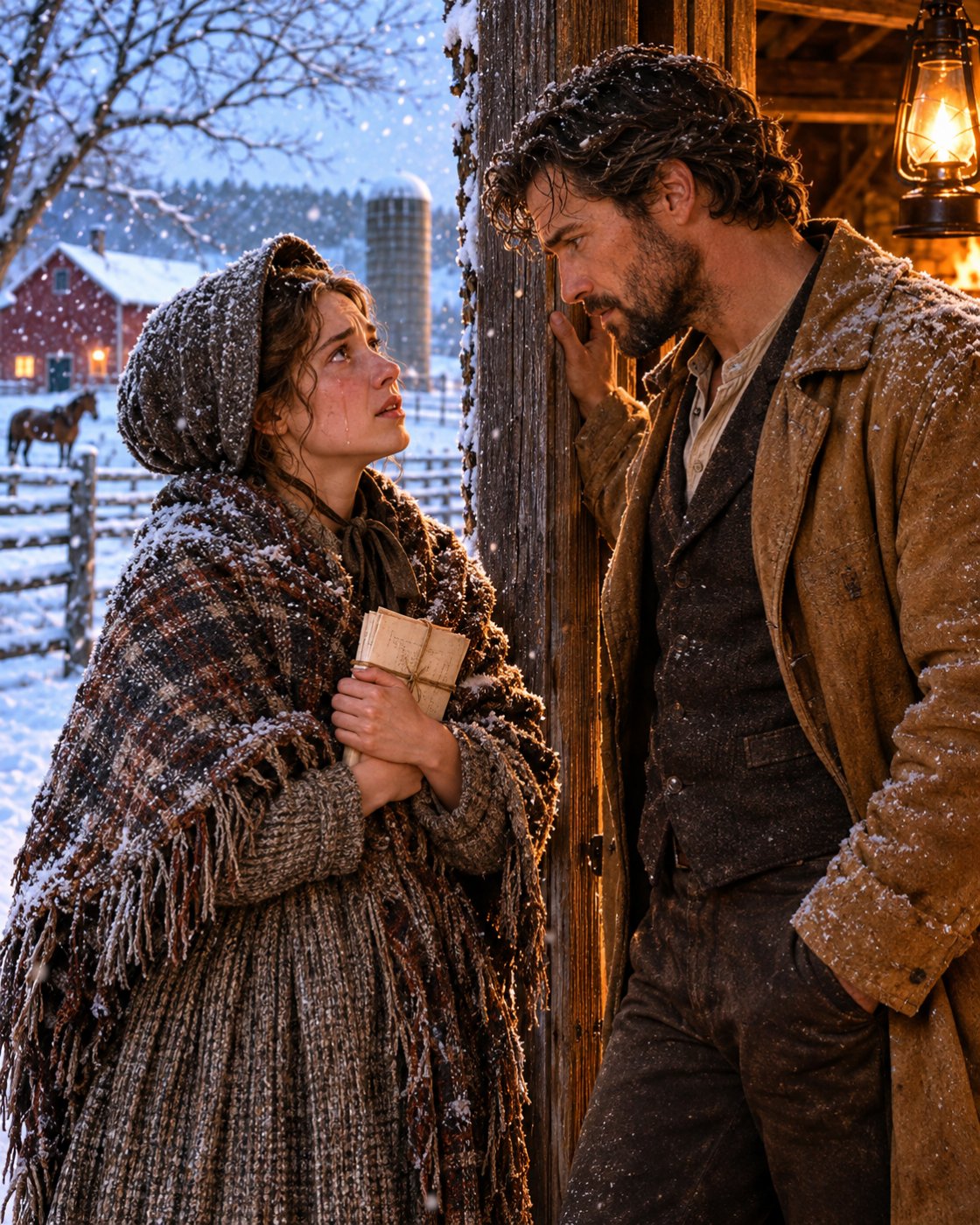
That night, Hannah did not sleep at all.
She sat at the kitchen table with the lamp turned low and her mother's letters spread out in front of her, and she thought it through over and over, the way a person worries at a sore tooth.
She thought about the farm outside Grand Island, Nebraska.
About Jonas, who had been decent the way a fence post is decent, upright and silent and not much given to warmth, and who had died in the summer of 1879 when a threshing machine on a neighbor's place threw a belt.
About his mother, Martha, a small, tired, sharp-tongued woman who had nonetheless pressed six good laying hens into Hannah's hands on her wedding morning and said, "A woman ought to have something that's hers.
Mind you keep it".
About Ambrose, who had taken over the farm after Jonas died and let her work from four in the morning until long after dark, cooking for the hired men, keeping the house, churning the butter, raising the chickens, without ever paying her a cent, because she was family.
She thought about the evening last autumn when Ambrose had told her over supper, the way a man announces that he means to buy a new plow, that they would be married in the spring.
She had not argued.
She had waited until he drove to town on a Tuesday.
Then she had taken the forty dollars she had saved from eight years of selling her own eggs, put it in her stocking, and walked four miles to the depot with her mother's recipe book and her mother's letters.
And now Ambrose had followed her eight hundred miles to stand in a store and call her a thief and worse.
If she stayed, he would stand up in that courthouse on Friday and say what he had said in Hadley's store, only louder, in front of the whole town.
He would say it about her.
And he would say it about Wade, who had never done one thing but carry wood and fix dampers and keep his word.
That talk would follow Wade into every store and church and saloon in Carbon County for the rest of his life.
And Pete would hear every word of it.
Pete.
She thought about the boy, the way he had been in December, eating with his arm curled around his plate like a dog that had been kicked.
Dutch had told her the story one afternoon while peeling potatoes.
Wade had found Pete two winters ago, sleeping in the stock pens at the railroad yards in Rawlins.
His mother had died of lung fever in a boardinghouse, and the landlady had put the boy out the same day for the back rent.
He was ten.
Wade had brought him home on the back of his saddle and given him a job with the horses, and never once called it charity.
She thought about the first afternoon Pete had come to her kitchen with his hair wet and combed, for his first reading lesson.
How he had traced the words in her mother's book with one finger that was not quite clean.
Soda biscuits.
Johnnycake.
Vinegar pie.
"Vinegar pie," he'd said, frowning.
"That can't be real".
She had told him to read every word on every page, slowly, all the way to the bottom, because a person who skipped words would never learn what a page was really saying.
And he had done exactly that.
By the end of the second week, he could read the whole recipe for gingerbread.
By the end of the third, he had started saying thank you.
She could not let Ambrose's ugliness touch that boy.
She could not let it touch any of them.
At half past four, there was no step on the porch and no wood in the box.
For the first time since December, Wade did not come.
Hannah understood.
She had hurt him, and he was keeping his distance the way a hurt animal does.
She could not blame him.
An hour before dawn, she tore a blank page from the back of her own small notebook and wrote by the light of the lamp.