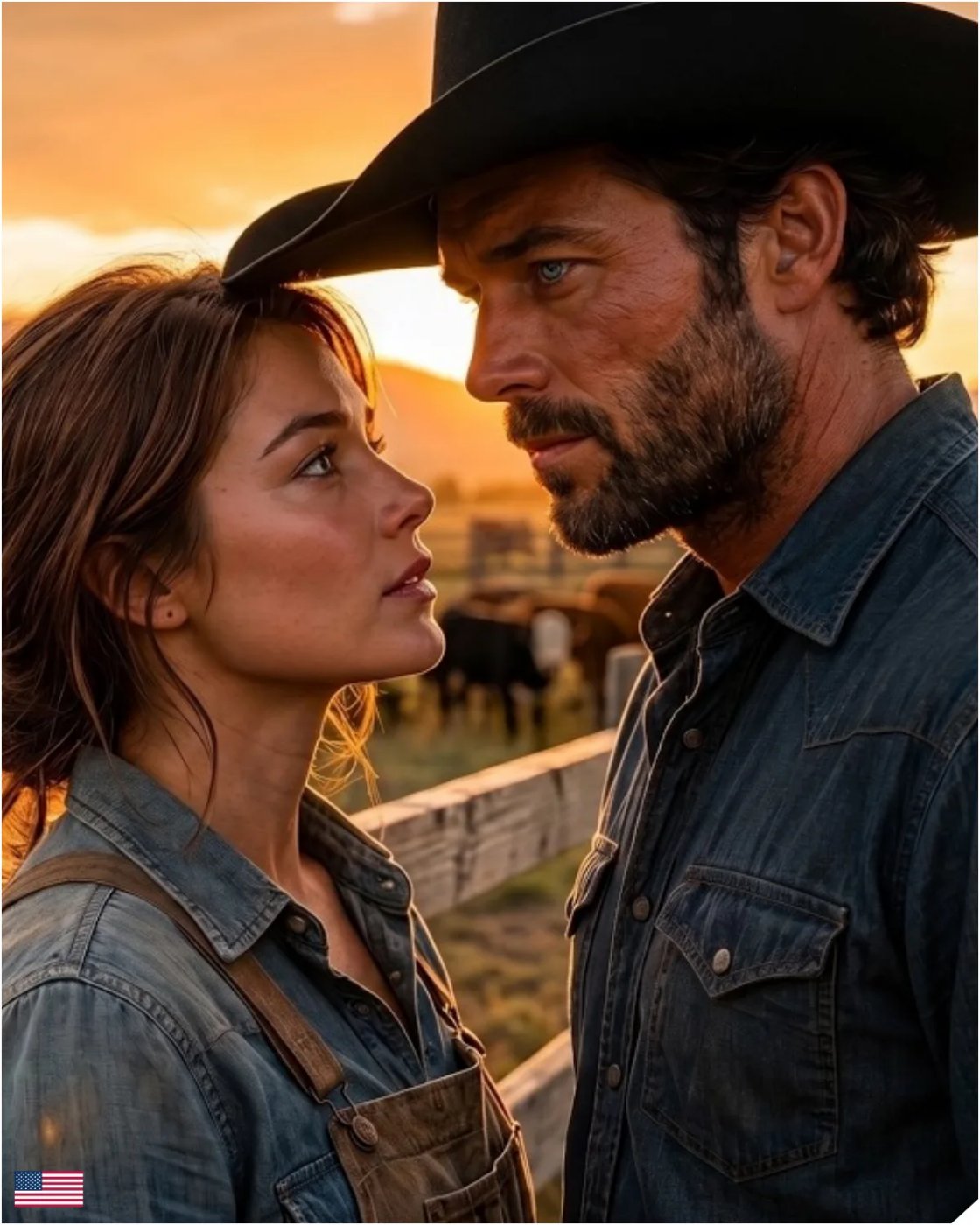
Widowed at 25, She Took a Cooking Job on a Ranch—Then the Trail Boss Changed Her Life
...
He reads weather before it happens.
He knows which cattle will spook and which ones will lead.
And on a drive that can stretch for days or weeks across open range, the camp cook isn't some afterthought.
The cook is the one who keeps 12 to 20 hungry, exhausted men fed, hydrated, and functioning.
A bad cook can break morale faster than bad weather.
A good cook can hold a whole operation together.
That's exactly what Cally May became.
Her first week at Larkspur was rough.
The kitchen was small, the equipment was older than she was, and the hands, men with names like Dutch Ramirez and Old Pete Sorenson, weren't exactly warm to a young widow who talked too fast and cried when she thought nobody was watching.
But, Callie May had one gift that couldn't be taught.
She listened.
She noticed that Dutch missed his mama's tamales and started making them from scratch every other Sunday.
She noticed Old Pete's hands shook too much some mornings to butter his own toast, so she started buttering it for him without ever mentioning why.
Wyatt noticed all of it.
Three weeks into her job, the ranch prepared for their fall drive, moving 400 head of cattle from the high summer pasture down to the winter range, a 14-mile trip that would take 3 days across rough country.
Callie May would be cooking out of a converted horse trailer they called the chuck wagon, though it hadn't seen an actual horse pull it in decades.
If you've ever wondered where the phrase chuck wagon even comes from, it's actually American history hiding in plain sight.
Back in 1866, a Texas rancher named Charles Goodnight built the very first chuck wagon by modifying an army surplus wagon, adding a hinged box on the back with drawers and shelves for food storage, and a fold-down cooking surface.
Chuck was old slang for food.
Goodnight built that wagon because he was about to run the first major cattle drive up what became known as the Goodnight-Loving Trail, and he knew that starving cowboys couldn't drive cattle a thousand miles.
That single invention changed how the American West functioned.
It made long cattle drives possible, and cattle drives are the reason states like Wyoming, Kansas, and Montana built their entire economies around beef.
The whole cowboy way of life that America romanticizes in movies, it exists because one rancher figured out you can't move an economy on an empty stomach.
Callie May learned all of this from Old Pete on the second night of that drive, sitting around a fire with a pot of beans and cornbread, the stars so thick above the Bighorns that it looked like somebody had spilled sugar across black velvet.
"You're a good night woman".
Old Pete told her, half joking, half serious.
"Feed a man right and he'll ride through hell for you".
Wyatt was sitting across that fire, quiet as always, but Callie May caught him looking at her in a way that wasn't quiet at all.
On the third day of the drive, disaster nearly hit.
A young steer got spooked by a rocky rattlesnake near a rocky wash and in the chaos that followed, nearly 60 head of cattle broke off from the herd and scattered toward a canyon that dropped off into nothing.
Wyatt spurred his horse without hesitation, riding hard along the edge of that canyon, cutting the cattle off one by one.
His horse's hooves inches from a fall that could have killed them both.
Callie May watched the whole thing from the chuck wagon, her heart in her throat, and something inside her broke open in a way she hadn't felt since before Danny got sick.
It wasn't romance, not yet.
It was recognition.
She recognized a man who threw himself into danger without a second thought for the sake of protecting something, someone that mattered to him.
When Wyatt rode back into camp that evening, dust caked on his face, his hands still shaking slightly from adrenaline, Callie May didn't say a word.
She just handed him a plate of food and sat down beside him, close enough that their shoulders touched.
"You could have died out there".
She finally said.
"Wouldn't have been the first time I risked something for this ranch".
Wyatt said.
Then quieter, "But it might have been the first time I had a reason to come back in one piece that wasn't just the job".
Callie May didn't sleep much that night, but for the first time in over a year, it wasn't grief keeping her awake.
The drive ended successfully.
400 head minus none delivered safely to winter range.
The Harmon family was pleased.
The hands were exhausted but proud, and something between Cally May and Wyatt had shifted into a slow, careful kind of courtship, the kind built on shared silence and mutual respect rather than grand gestures.
Over the following months, Cally May settled into life at Larkspur in a way she hadn't expected to settle into anything again.
She learned the rhythms of ranch life, the way morning chores started before sunrise, the way winter calving season could keep a person up for 72 hours straight, the way a single spring storm could wipe out a season's profit if you weren't careful.
She also learned something else, something that connected her grief to her new life in a way she hadn't seen coming.
Danny had grown up on a small family farm in Eastern Wyoming before it got swallowed up by drought and debt back in the early 2000s.
A lot of family ranches across America went through the same thing during that era, crushed between rising land costs, falling cattle prices, and banks that weren't always fair about who got approved for agricultural loans.
Danny's family lost their land the same way thousands of small ranching families did, and it was part of why he'd ended up working oil rigs instead of following his daddy's boots into ranching.
Cally May realized, standing in that Larkspur kitchen one winter morning with flour on her hands, that in some strange way she was living the life Danny never got to have.
And instead of that feeling like a betrayal of his memory, it felt like she was carrying a piece of him forward into something whole.
Wyatt proposed to her the following autumn, almost exactly a year after she'd first driven onto that ranch with a suitcase and a box of cast iron.
He didn't do it with fireworks or a fancy restaurant.
He did it at sunrise out by the horse corral, holding a ring that had belonged to his own grandmother, a woman who'd run cattle in that same country back when women weren't even allowed to hold ranch leases in their own name in most states until well into the 20th century.
"I'm not real good with big speeches," Wyatt told her.
"But I know what it looks like when somebody's meant to be somewhere.
You were meant to be here, Callie May.
Not just cooking in that kitchen.
Building a life.
My life, if you'll have me".
Callie May cried so hard she could barely say yes, but she managed it twice just to make sure he heard her.
They got married the following spring, right there on the ranch under a tent strung with white lights, with Dutch Ramirez playing guitar and Old Pete walking her down a makeshift aisle because her own father had passed years before.
Every hand on that ranch showed up along with half the small town nearby because word travels fast in ranching country and everybody loves a story about a woman who lost everything and somehow found her way to something even better.
Today, Callie May Calloway still runs that same kitchen at Larkspur Ranch, though it's been renovated twice since she first arrived.
She's trained three other cooks over the years and she still makes Duchess' tamales every other Sunday, a tradition that's outlasted Dutch himself, who eventually retired down to Arizona but still calls every Christmas to ask if she's kept the recipe right.
Wyatt still runs cattle drives every fall, though these days he brings their two kids along for the shorter routes, teaching them the same quiet, careful leadership that first caught Callie May's attention around a campfire years ago.
What strikes people most about Callie May and Wyatt's story isn't just the romance of it, though there's plenty of that.
It's the reminder that some of the deepest healing doesn't come from running away from pain.
It comes from running straight into something new, something hard, something that demands everything you've got.
Callie May didn't take that cooking job because she was looking for love.
She took it because she needed to survive, because she needed purpose, because an $82 bank account and a broken heart don't leave much room for anything except moving forward.
But sometimes, when you move forward with enough courage, life has a way of meeting you halfway.
She often tells young women who write to her, women going through their own version of losing everything, the same thing old Pete once told her around that fire under the Bighorn stars.
Feed your own life the way you'd feed someone you love.
Show up for it even when it's hard, even when you don't feel ready, even when grief makes you feel like nothing will ever taste like joy again.
Because somewhere out past the pain, there's still a table being set.
There's still a fire being lit.
And there's still, somehow, against every reasonable expectation, a whole new life waiting to be built, one meal, one sunrise, one small act of courage at a time.
And if you take anything away from Callie Mae's story today, let it be this.
Starting over doesn't mean you're starting from nothing.
Sometimes it means you're finally starting from exactly who you were always to become.