PART 3
For a long moment, Mabel Whitcomb could hear nothing but the soft creaking of the carriage and the distant ringing of the church bell.
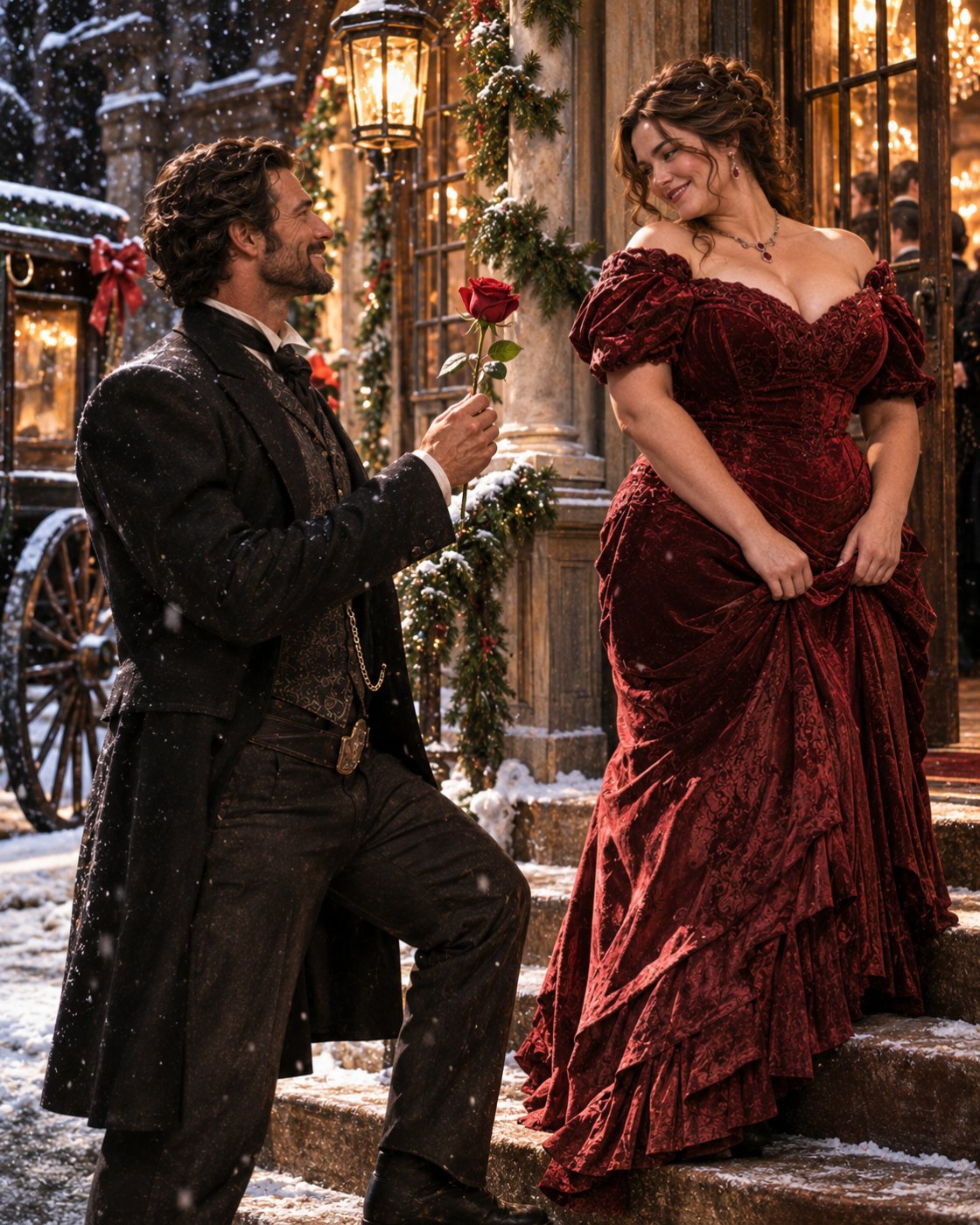
Snow settled on the evergreen garlands Adam Sullivan had tied around the carriage rails. The red rose he'd given her rested in her lap, its petals dark against the velvet of her Christmas dress.
Only minutes earlier, she had been the happiest woman in Willow Creek.
Now she was looking at the man who had made her feel beautiful for the first time in years, wondering whether she was about to become the reason he lost everything.
“His name is Everett Hale,” Adam said quietly. “He's my late wife's older brother.”
Mabel swallowed.
“And he owns your ranch?”
“The land, yes. I own the horses, most of the equipment, and the training business. But the house and pastures belong to the Hale family.”
“Why would he object to you courting someone?”
Adam looked down at his gloved hands.
“Because he believes I should spend the rest of my life mourning his sister.”
Mabel's heart tightened.
“How long has she been gone?”
“Five years.”
He said the words without bitterness, but there was a sadness in his voice that made her want to reach for him.
“What was her name?”
“Eleanor.”
Mabel repeated it softly.
“Eleanor.”
Adam nodded.
“She was a good woman. Gentle. Loved music and horses, though she was never particularly fond of the cold.”
A faint smile crossed his face.
“She used to say Wyoming had been invented to test a woman's patience.”
Mabel laughed.
Adam looked at her.
“I'm not ashamed of having loved her.”
“You shouldn't be.”
“And I won't pretend she never existed.”
“I wouldn't want you to.”
He was quiet for a moment.
Then he said, “But I don't believe honoring someone means refusing to live after they're gone.”
Mabel looked toward the snowy street.
She understood something about being trapped by other people's expectations.
Her whole life, she had been told what women like her should wear, where they should sit, how loudly they should laugh, and what kind of attention they could reasonably hope to receive.
Now she wondered whether Adam had been living inside a different sort of prison.
One built from grief.
And guilt.
And a dead woman's brother who believed sorrow should last forever.
“Adam,” she said carefully, “I don't want you to lose your livelihood because of me.”
He turned toward her.
“Mabel, I didn't tell you so you'd feel responsible.”
“Then why?”
“Because if we're going to spend time together, I want you to know what may come.”
She studied his face.
“Do you expect me to step aside?”
His expression changed immediately.
“No.”
“Are you certain?”
He took her hand.
“I spent five years believing the best part of my life was behind me. Then I walked into a millinery shop to have my father's coat repaired, and a woman with flour on her sleeve told me my stitching looked like something a drunk spider might have done.”
Mabel laughed in surprise.
“It did.”
“I know.”
He smiled.
“And I began finding reasons to come back.”
Her eyes filled.
Adam continued.
“I didn't ask you to the Christmas ball because I wanted one pleasant evening. I asked because I've been wanting to spend time with you for months.”
Mabel looked down at their joined hands.
“Then what happens tomorrow?”
“We take our walk.”
“Even if Everett arrives?”
“Especially then.”
She smiled faintly.
“You make it sound simple.”
“It won't be.”
He paused.
“But I won't ask you to hide.”
Mabel felt something warm and unfamiliar settle inside her.
Not certainty.
Not yet.
But the beginning of trust.
Adam stepped down from the carriage and helped her onto the snowy walkway.
At her door, he removed his hat.
“Good night, Miss Whitcomb.”
She smiled.
“Good night, Mr. Sullivan.”
He looked at her for a moment.
Then asked, “May I kiss your hand?”
Her cheeks warmed.
“Yes.”
He lifted her gloved fingers to his lips.
It was a small gesture.
Almost old-fashioned.
But Mabel felt it all the way to her heart.
When Adam drove away, she stood in the doorway until the carriage disappeared around the corner.
Then she went upstairs, carefully removed her red velvet dress, and hung it where she could see it from her bed.
For the first time in her life, she did not hide the beautiful thing she had made for herself.
Christmas morning arrived beneath a pale blue sky.
Mabel woke early, though she had slept very little.
She made tea, fed the little orange cat that had adopted her shop, and stood for several minutes before her wardrobe.
Her everyday dresses were practical.
Brown wool.
Gray cotton.
Dark green serge.
Clothes suitable for working women who needed to climb ladders, carry boxes, and spend long hours leaning over sewing machines.
She had never disliked them.
But after the previous evening, she wanted something different.
Finally, she chose a cream blouse with delicate embroidery and a dark blue skirt she'd made the previous spring.
She pinned her chestnut hair into a soft arrangement at the back of her head, leaving a few curls near her cheeks.
Then she looked in the mirror.
Her face was round.
Her waist was broad.
Her figure was full and soft.
All the things she had spent years trying to disguise were still there.
Yet she remembered Adam's expression when he'd seen her in red velvet.
You're beautiful, Mabel.
She smiled at her reflection.
“Perhaps,” she whispered, “I might start believing him.”
At nine o'clock, someone knocked.
Adam stood outside carrying a small basket.
“Merry Christmas.”
She smiled.
“Merry Christmas.”
He held up the basket.
“I brought breakfast.”
“What kind?”
“Biscuits.”
“Did you make them?”
He hesitated.
Mabel laughed.
“Oh, Adam.”
“They're edible.”
“That's not the same thing.”
“I had one.”
“And?”
He looked solemn.
“I still have all my teeth.”
She laughed so hard she had to lean against the doorframe.
Adam grinned.
Then his expression softened.
“There it is.”
“What?”
“That laugh.”
Mabel blushed.
He looked at her as though her happiness were something precious.
And she realized that she wanted to hear him laugh just as often.
They walked through town, sharing the questionable biscuits and stopping beside the frozen creek.
Children raced past carrying wooden sleds.
Church bells rang.
Smoke rose from chimneys beneath the white mountains.
For a while, everything felt peaceful.
Then Adam grew quiet.
Mabel followed his gaze.
A dark carriage had stopped outside the Willow Creek Hotel.
A tall man in a black overcoat stepped down.
He had sharp features, silver at his temples, and the stiff bearing of someone accustomed to being obeyed.
Adam's expression changed.
“Everett.”
The man turned.
His eyes moved from Adam to Mabel.
Then to their joined hands.
He approached without smiling.
“Adam.”
“Everett.”
The men shook hands briefly.
Everett looked at Mabel.
“And this is?”
Adam stood a little straighter.
“Miss Mabel Whitcomb.”
Mabel offered a polite smile.
“How do you do?”
Everett examined her with the detached expression of a man evaluating an unfamiliar purchase.
“Whitcomb,” he repeated. “The dressmaker?”
“I own the millinery and dress shop on Main Street.”
“I see.”
His gaze returned to Adam.
“May I have a word with you?”
Adam did not release Mabel's hand.
“You may speak in front of her.”
Everett's mouth tightened.
“This concerns family business.”
“Then it can wait until tomorrow.”
Everett looked offended.
“You knew I was coming.”
“Yes.”
“And yet you're occupied?”
Adam's voice remained calm.
“I'm taking Miss Whitcomb for a Christmas walk.”
Everett stared at him.
Then said, “Eleanor has been dead five years, Adam. I would have thought you'd developed better judgment than this.”
Mabel felt the words strike her.
Adam's face hardened.
“Choose your next words carefully.”
Everett glanced toward her again.
“I mean no offense.”
Mabel knew that tone.
She had heard it from customers who began insults with no offense and finished them by explaining why a woman of her size should avoid certain colors.
She lifted her chin.
“Then perhaps you should say what you mean plainly, Mr. Hale.”
Everett looked surprised.
Adam turned toward her, and something like admiration appeared in his eyes.
Everett straightened.
“Very well. My family has supported Adam's business for years. We expect him to conduct himself in a manner that respects my sister's memory.”
Mabel held his gaze.
“I fail to see how taking a walk with me dishonors your sister.”
Everett's expression chilled.
“You wouldn't understand.”
“Perhaps not,” she answered. “But I understand that your sister was a person, not a reason to punish someone who survived her.”
Adam looked at her.
Everett's face reddened.
“I see you've become quite familiar with family matters.”
“Only what Adam has chosen to tell me.”
A long silence followed.
Then Everett turned toward Adam.
“We'll speak tomorrow.”
He walked away without another word.
Mabel watched him enter the hotel.
Only then did she release the breath she'd been holding.
Adam looked at her.
“I'm sorry.”
She shook her head.
“You warned me.”
“That doesn't excuse his rudeness.”
“No.”
He studied her.
“Are you all right?”
Mabel considered the question.
Then nodded.
“I believe I am.”
He smiled faintly.
“You handled him better than I usually do.”
She looked toward the hotel.
“He seems accustomed to making people feel small.”
Adam's expression softened.
“He is.”
Mabel turned toward him.
“Then perhaps it's time someone stopped letting him.”
The following week brought bitter cold.
Adam returned to his training ranch each morning, while Mabel reopened her shop after Christmas.
The town was quieter now.
The ball gowns had been delivered.
The ribbons put away.
And the women who had spent weeks preparing for Christmas returned to their ordinary routines.
But Mabel's life no longer felt ordinary.
Adam visited whenever he could.
Sometimes he brought coffee.
Sometimes he brought a horse blanket that needed mending.
Once, he arrived with a perfectly sound pair of gloves and claimed one finger had become loose.
Mabel examined them.
“Adam Sullivan, there's nothing wrong with these.”
He looked thoughtful.
“Is that so?”
“Yes.”
“Then I suppose I'll have to come back when something does go wrong.”
She laughed.
“You are a terrible liar.”
“I've been told.”
He smiled.
“But I am an excellent admirer.”
Her cheeks warmed.
Their courtship grew through small moments.
He learned that Mabel loved old hymns because her mother used to sing while sewing.
She learned that Adam disliked cinnamon in his coffee but would drink it without complaint if she made it.
He discovered she could identify nearly every woman in town by the way she tied her bonnet.
She discovered he spoke to difficult horses in a low, patient voice that seemed to settle even the most nervous animals.
One afternoon, Adam invited her to see his training ranch.
Mabel had never visited.
She knew it lay several miles beyond town, where the hills opened into broad pasture.
She arrived in a hired carriage wearing a warm brown coat and sturdy boots.
Adam met her at the gate.
“Welcome to Sullivan Horse Training.”
She looked around.
The ranch was smaller than she'd imagined.
There was a modest white house, two barns, several paddocks, and a long training track bordered by snow-covered fencing.
Horses stood beneath the shelter, their breath rising in white clouds.
“It's lovely,” she said.
Adam smiled.
“It's not much.”
Mabel turned toward him.
“Adam, you've built a life here.”
His expression softened.
“Yes.”
He showed her the stables.
Introduced her to the horses.
Explained how he trained carriage teams to work together without fear or harsh treatment.
Mabel watched him approach a nervous young gelding.
The horse tossed its head.
Adam did not raise his voice.
He waited.
Spoke quietly.
Held out his hand.
After several moments, the animal lowered its head and allowed him to touch its neck.
Mabel smiled.
“You really do have a gift.”
Adam shrugged.
“Patience helps.”
She looked at him.
“You're patient with people too.”
He gave her a crooked smile.
“Not always.”
“More than you realize.”
They walked toward the house.
Inside, everything was clean but plain.
A small stove warmed the sitting room.
Books stood on a shelf.
A faded quilt lay across the back of a chair.
And above the mantel hung a portrait of a young woman with light hair and a gentle smile.
Mabel stopped.
“Eleanor?”
Adam nodded.
“Yes.”
She studied the portrait.
“She was beautiful.”
“She was.”
For a moment, Adam looked uncertain.
Mabel turned toward him.
“You don't have to put it away because I'm here.”
His eyes filled with surprise.
“I hadn't intended to.”
“Good.”
She smiled.
“Someone you loved deserves to be remembered.”
Adam looked at her for a long moment.
Then whispered, “Thank you.”
They sat beside the stove and drank tea.
As the afternoon light faded, Adam told her about his marriage.
Eleanor had been twenty-seven when she died after a sudden illness.
They had been married eight years.
They had wanted children, but none had come.
After her death, Adam had thrown himself into work because silence was easier to bear when he was exhausted.
Everett had helped him secure the lease on the training ranch.
At first, Adam had been grateful.
But as the years passed, Everett began treating that assistance as a debt that could never be repaid.
“He doesn't want me to forget Eleanor,” Adam said.
Mabel shook her head.
“He wants to decide how you remember her.”
Adam looked up.
She continued.
“Those aren't the same thing.”
He sat quietly.
Then smiled sadly.
“You have a way of making things sound clear.”
Mabel laughed.
“I spend my days untangling thread.”
“Perhaps you should take up untangling stubborn cowboys.”
She smiled.
“I might make an exception for one.”
Adam reached across the table.
She took his hand.
And for a moment, the little house felt warmer than it had in years.
Everett's first serious threat arrived three days later.
Adam came to Mabel's shop carrying a letter.
She knew something was wrong before he spoke.
His shoulders were tense.
His face looked tired.
“Adam?”
He removed his hat.
“Everett has given me ninety days to vacate the ranch.”
Mabel stared.
“What?”
“He says the family intends to sell the property.”
“Is that true?”
Adam shook his head.
“I don't know. He's never mentioned selling before.”
She looked at the letter.
“May I?”
He handed it to her.
The notice was formal and cold.
It stated that the Hale family would not renew Adam's lease when the current term expired.
Mabel read it twice.
Then looked up.
“Does he have the right?”
“Possibly. The lease expires in March.”
“Have you spoken with a lawyer?”
“Not yet.”
“Then you should.”
Adam looked weary.
“I've been thinking about moving the business farther west.”
Mabel felt a sudden ache.
“How far?”
“Maybe Idaho. Maybe Oregon.”
She lowered her eyes.
He stepped closer.
“Mabel.”
She shook her head.
“I'm sorry. I know this is your livelihood.”
He took her hand.
“And you're part of the reason I don't want to leave.”
She looked up.
For a moment, hope and fear tangled painfully inside her.
Then she said, “You mustn't stay somewhere you can't earn a living just because of me.”
Adam smiled sadly.
“And you mustn't decide what matters most to me.”
She stared at him.
He continued.
“I know the horses matter. The business matters. But so do you.”
Her eyes filled.
He squeezed her hand.
“I don't know how this will end.”
“Neither do I.”
“But I don't intend to disappear without trying.”
She nodded.
“Then we try.”
Adam looked surprised.
“We?”
Mabel smiled faintly.
“You're not the only stubborn person in Wyoming.”