March 30th, 1944. 0020 hours. Somewhere between Wetzlar and Fulda, Germany. Oberleutnant Martin Becker’s gloved hands gripped the control column of his Messerschmitt Bf 110 G-4 as his radar operator, Karl Ludwig Johansson, called
out the range. “300 m, 250, target confirmed, Lancaster.” Through the darkness, Becker could just make out the massive silhouette against the moonlit clouds. It was his third kill of the night.
By 0050, 30 minutes later, he would have six. But something about these bombers bothered him. Each one absorbed punishment that should have sent it spiraling to Earth. Each one required multiple cannon strikes to actually destroy.
And each time his 20-mm shells found their mark, the Lancaster crews fought back with a ferocity that left his own aircraft peppered with holes. This wasn’t supposed to happen. German night fighter doctrine had evolved specifically to kill heavy bombers efficiently.
Single passes, devastating firepower, quick kills. The Lancaster was changing those calculations in ways that made Becker and his fellow night fighter aces increasingly uncomfortable. What the Germans were discovering, engagement by engagement through the dark skies over
the Reich, was that RAF Bomber Command had built something extraordinary. Not through advanced technology or secret weapons, but through ruthless engineering that prioritized one thing above all else, getting bombs to German cities regardless of cost.
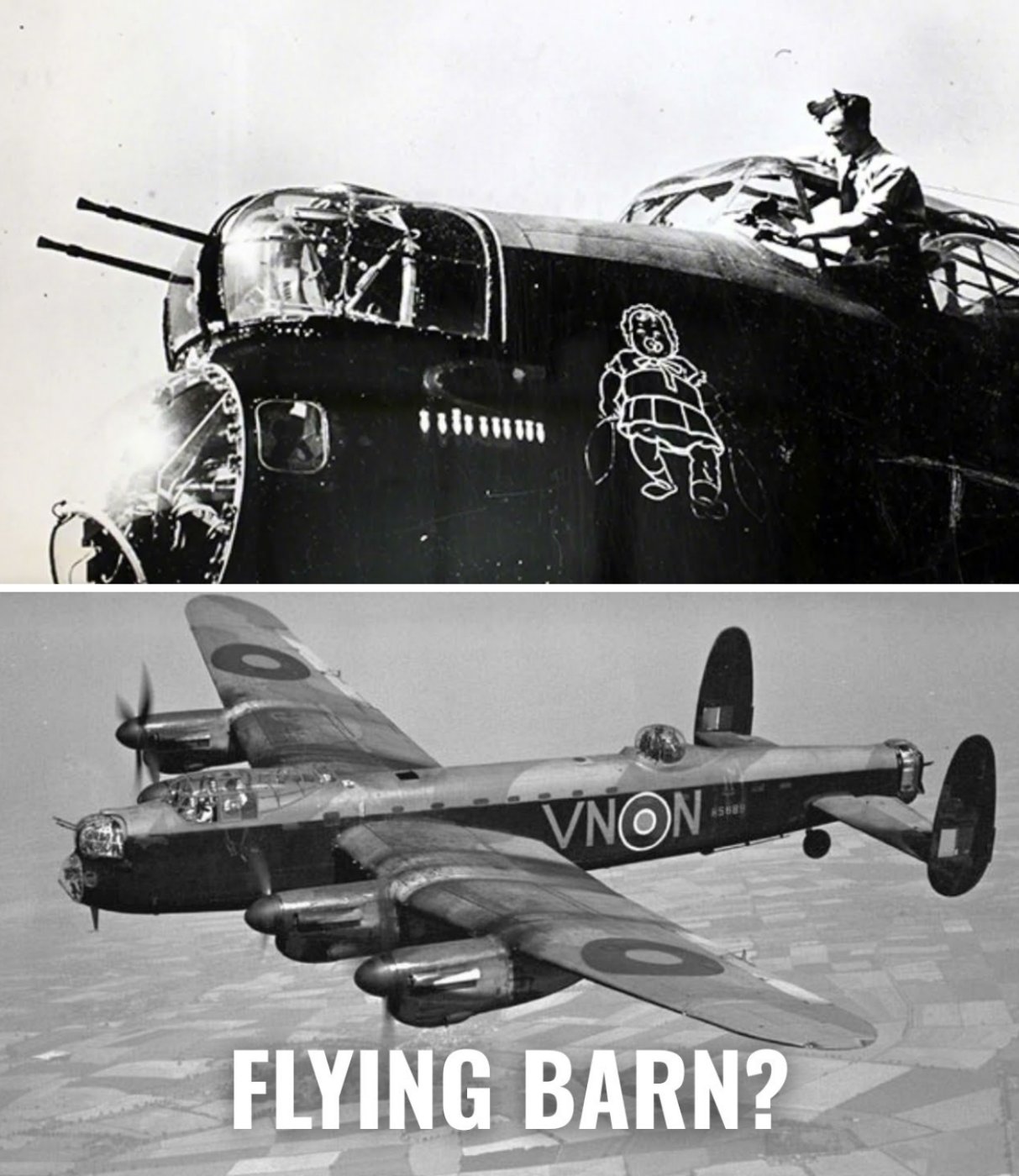
The Lancaster wouldn’t just challenge German tactics, it would force them to completely rethink how they hunted heavy bombers. The first Lancasters entered RAF service in March 1942, replacing the troubled Manchester bomber that had suffered chronic engine failures.
German intelligence received reports of a new four-engine British heavy bomber, but initial assessments were dismissive. Luftwaffe technical analysts studying reconnaissance photographs and intercepted RAF communications filed reports that characterized the Lancaster
as merely an enlarged Manchester. Same basic design, they concluded, just with more engines. The assumption was that it would inherit the Manchester’s problems. What they failed to grasp was that Avro’s engineers had redesigned nearly everything except the outer wing
sections. The Lancaster that emerged was fundamentally different, powered by four Rolls-Royce Merlin engines producing 5,120 horsepower combined. More importantly, it featured an unobstructed bomb bay measuring 33 ft
long capable of carrying payloads no other Allied bomber could match. But these facts remained abstract until German pilots actually encountered them in combat. Wilhelm Johnen, a Luftwaffe night fighter pilot with Nachtjagdgeschwader 1, described his first Lancaster
engagement in his post-war memoir Duel Under the Stars. The encounter occurred during a raid on Hamburg in July 1942. Johnen had successfully intercepted Wellingtons and Sterlings before, understanding their defensive patterns and vulnerabilities.
When his radar operator guided him toward a Lancaster formation, he approached with the confidence of a hunter knew his prey. The approach was textbook. Johnen positioned his Bf 110 below and behind the Lancaster, exploiting the bomber’s blind spot beneath the tail.
At 150 m, he pulled up slightly and opened fire with his nose-mounted 20 mm cannons and 7.92 mm machine guns. The tracers converged on the Lancaster’s belly, right where the wing roots met the fuselage.
Fuel tanks should have ruptured. The bomber should have fallen. Instead, the Lancaster’s rear gunner immediately returned fire, forcing Johnen to break away as .303 caliber rounds stitched across his canopy.
When he repositioned for a second pass, the Lancaster was still flying, still in formation, showing no signs of distress. “I had struck it cleanly,” Johnen wrote years later. “I saw my cannon shells explode against the fuselage.
Yet it continued as though I’d merely annoyed it rather than delivered what should have been a fatal blow. The British simply maintained course and speed. I was forced to disengage due to fuel limitations, knowing that bomber would likely complete its mission and return home.”
This experience, multiplied across dozens of night fighter units during summer and fall 1942, began changing German perceptions. The Lancaster wasn’t just another heavy bomber. It was something more durable.
The technical reasons became clear through intelligence analysis of crashed Lancasters. German engineers examining wreckage discovered construction methods that explained the durability. The airframe used a geodetic lattice structure reinforced with heavy stringers and formers.
Self-sealing fuel tanks installed as standard equipment prevented the catastrophic fires that doomed other bombers after fuel system hits. Most significantly, the four Merlin engines provided redundancy that German twin-engine bombers completely lacked.
A Lancaster could fly on three engines, fight on three engines, even maintain formation on three engines under certain conditions. Oberst Victor von Lossberg, commanding Nachtjagdgeschwader 2, circulated a tactical assessment in November 1942
based on accumulated combat reports. The document, captured after the war and now held in the Bundesarchiv, outlined the challenge precisely. The Lancaster bomber presents significantly greater resistance to destruction than previous British types.
Our pilots report requiring multiple attack passes to achieve confirmed kills. Standard tactics of single devastating strikes prove insufficient. The aircraft’s structural integrity and engine redundancy mean damage that would fell a Wellington or Stirling merely
wounds a Lancaster. The assessment continued with uncomfortable mathematics. A typical Bf 110 carried 360 rounds of 20-mm millimeter ammunition across its four cannons, enough for roughly 30 seconds of sustained fire.
German pilots were trained to deliver two-second bursts, meaning they carried ammunition for 15 individual attacks. Against Lancasters, pilots were now reporting three, four, sometimes five attack passes before achieving kills.
The arithmetic was brutal. Each additional pass consumed fuel, exposed the fighter to defensive fire, and reduced the pilot’s ability to engage other targets. Time spent destroying one Lancaster meant other Lancasters escaped unmolested.
The defensive armament forced tactical adaptations. Early Lancasters carried 8.303 caliber Browning machine guns in three turrets, two in the nose, four in the tail, and two in a dorsal turret amidships.
Later variants increased this to 10 guns. While individually less powerful than German 20 mm cannons, the combined weight of fire from a Lancaster formation created zones where attacking fighters faced concentrated defensive barrages from multiple bombers
simultaneously. Hauptmann Werner Streib, one of Germany’s first night fighter aces with 66 confirmed victories, developed the Schräge Musik tactic specifically to counter this defensive fire.
The technique involved mounting cannons at a 70° upward angle behind the cockpit, allowing the fighter to position directly beneath the bomber, match its speed, and fire upward into the fuselage without exposing itself to return fire.
The concept worked brilliantly against most British bombers. Against Lancasters, results were mixed. The problem was structural integrity. Schräge Musik targeted the bomber’s center fuselage, aiming to sever control cables, rupture fuel tanks, or detonate
bomb loads. But the Lancaster’s robust construction meant cannon shells that would tear apart a Halifax or Stirling often caused damage the Lancaster could absorb. Multiple pilots reported watching their upward firing cannons strike Lancasters,
seeing flames erupt, only to have the bomber continue flying. The geodetic construction distributed stresses efficiently, meaning localized damage didn’t compromise overall structural integrity. Major Heinz Wolfgang Schnaufer, who would become Germany’s highest scoring night fighter
ace with 121 confirmed victories, 1.5 eight of them Lancasters, described the type in post-war interviews with a respect that bordered on frustration. You could never assume a Lancaster was finished until you saw it falling. I
remember putting 30 20 mm rounds into one near Brunswick. The tail caught fire, pieces flew off, yet it maintained altitude for another 10 km before finally going down. Their crews had discipline, their aircraft had strength. The combination
made them dangerous opponents. The night of March 30th, 1944, demonstrated both the Lancaster’s vulnerability and its resilience in ways that defined the entire strategic bombing campaign.
RAF Bomber Command dispatched 795 aircraft to attack Nuremberg, including 572 Lancasters. Weather conditions favored the defenders, clear skies, bright moonlight, and contrails that marked bomber positions from miles away.
German ground controllers vectored night fighters into the bomber stream with unprecedented accuracy. Martin Becker, by then commanding 2/Nachtjagdgeschwader 6, intercepted the stream between Wetzlar and Fulda.
His first contact came at 00:20. The Lancaster loomed in his gunsight, caught by moonlight. Becker opened fire from 200 m, watching his cannons tear into the bomber’s wing root.
The port outer engine erupted in flames. The Lancaster didn’t fall. Instead, the crew feathered the burning engine and maintained formation. Becker had to close again, firing a second burst that finally sent the bomber down.
Between 0020 and 0050, Becker destroyed three Halifaxes and three Lancasters. The Halifaxes required one, maybe two passes. The Lancasters demanded sustained attention. His combat report, filed the following morning, noted the
discrepancy. Halifax bombers typically fell after initial engagement. Lancaster types required extended combat and multiple attack passes. Ammunition consumption notably higher against Lancaster targets. What made that night remarkable wasn’t just Becker’s success, but the
broader German achievement. Luftwaffe night fighters destroyed 95 bombers total, the highest single night loss bomber command would suffer during the war. Of those 95, 71 were Lancasters.
The Nuremberg raid should have validated German night fighter tactics, proven that concentrated defensive efforts could make strategic bombing unsustainable. Instead, it revealed the opposite. Within 2 weeks, Lancaster squadrons were flying again with loss rates back below
3%. The 71 Lancasters destroyed on March 30th represented barely 10% of bomber command’s Lancaster strength. British factories were producing approximately 270 Lancasters per month by spring 1944,
meaning the entire night’s losses could be replaced in just 8 days of production. German night fighter units, meanwhile, had expended enormous resources, lost aircraft and crews, and exhausted pilots for a tactical victory that achieved no strategic effect. The mathematics
haunted German commanders throughout 1944. Generalmajor Josef Schmid, commanding I Jagd Korps, responsible for Reich air defense, received monthly reports showing the disconnect between tactical success and strategic failure.
Night fighters were destroying 40 to 50 bombers monthly. British production replaced those losses while adding 150 to 200 additional Lancasters to operational squadrons. Every graph showed the same trend.
German defensive capabilities declining, British offensive capabilities increasing, Lancaster numbers growing regardless of losses. The Battle of Hamburg in July 1943 had crystallized these realities.
RAF Bomber Command launched Operation Gomorrah, four massive night raids plus two daylight raids by American forces over 10 days. The raids employed a new countermeasure called window, strips of aluminum foil dropped in massive quantities that completely
overwhelmed German radar. Suddenly, night fighter tactics built around radar-guided interception became nearly useless. Pilots reverted to visual hunting, searching for bombers by moonlight and engine exhaust. On the night of July 27th to 28th, 787 bombers attacked
Hamburg, including 353 Lancasters. German night fighters managed only 17 kills despite desperate efforts. The Lancaster formations pressed through with minimal losses, creating a firestorm that killed over 40,000 civilians.
For German night fighter crews watching from the air, unable to intercept effectively, the psychological impact was devastating. All their training, all their experience, rendered irrelevant by aluminum foil and disciplined British crews flying aircraft tough enough to
absorb the hits that did connect. By autumn 1944, German night fighter forces faced resource exhaustion. Fuel shortages limited training flights and operational sorties. Replacement aircraft arrived slowly as Allied bombing disrupted production.
Most critically, experienced pilots were dying faster than training programs could replace them. The average night fighter pilot in late 1944 had perhaps 20 operational missions before being killed, wounded, or withdrawn from combat fatigue.
Veterans like Schnaufer, Becker, and Streib became increasingly rare. The Lancaster, meanwhile, kept evolving. The BI special variant, modified to carry the 22,000 lb Grand Slam earthquake bomb, entered service in 1945.
These weapons could destroy targets conventional bombing couldn’t touch. U-boat pens with reinforced concrete roofs, railway viaducts deep in valleys, underground facilities. German engineers studying the raids realized with growing horror that
British ingenuity, combined with Lancaster capability, meant no target was truly safe. Martin Becker’s final Lancaster victory came on March the 16th, 1945, his 58th and last kill.
By then, the war was clearly lost. Allied armies were crossing the Rhine, Soviet forces were advancing toward Berlin, and German fuel stocks were so depleted that many Luftwaffe units couldn’t fly.
Becker’s achievement on the night of March 14th to 15th, when he destroyed nine Lancasters in a single mission, set a Nachtjagd record that would never be broken. But it was meaningless strategically. Those nine Lancasters represented less than one day’s British production. The final statistics tell a story of German
tactical skill crushed by Allied industrial capacity. Luftwaffe night fighters destroyed approximately 2,600 Lancasters during the war, an impressive number representing genuine skill and courage.
But Britain built 7,377 Lancasters total. Even if every German kill claim was accurate, and post-war analysis suggests over claiming of 10 to 15%, they destroyed roughly 1/3 of Lancaster production, while Britain simply built
more. The replacement rate exceeded the destruction rate throughout the war. More tellingly, the Lancaster loss rate per sortie actually declined as the war progressed. In 1943, Lancasters lost approximately 4.1% of aircraft dispatched. By 1944,
this fell to 2.2%. In the war’s final months, it dropped below 1%. German defensive capabilities were collapsing faster than British offensive capabilities were degrading.
The Lancaster didn’t just survive German night fighter opposition, it thrived despite it, flying more sorties, dropping more bombs, achieving better accuracy with each passing month. Wilhelm Johnen, the pilot who first encountered Lancasters over Hamburg in
1942, flew his last combat mission in March 1945. His final score stood at 34 confirmed victories earned over nearly 4 years of night fighting.
In post-war interviews, he spoke about the Lancaster with a mixture of respect and frustration. “We learned to fight them. We developed tactics. We achieved kills, but there were always more, always more Lancasters, always more bombs, always
more raids. We were trying to empty an ocean with a bucket.” That metaphor captured the essential reality. German night fighters weren’t ineffective. They weren’t poorly trained or badly equipped. They simply faced an opponent whose industrial capacity made tactical victories
strategically irrelevant. Every Lancaster they destroyed was replaced within days. Every pilot they killed was replaced within weeks. The British could sustain 44% loss rates, the Lancaster’s overall wartime loss percentage, because their training pipeline and production
capacity exceeded German attrition capabilities. The Lancaster’s true weapon wasn’t its defensive armament or structural toughness, though both mattered. Its weapon was sustainability. Britain could build them faster than Germany could destroy them, crew them faster than German night fighters could
kill their crews, and deploy them in numbers that overwhelmed any defense Germany could mount. The mathematics were unforgiving. 7,377 Lancasters produced versus 2,600 destroyed equals 4,777
that survived to continue the bombing campaign. For German civilians watching Lancasters pass overhead night after night, untouchable at altitude, the psychological impact matched the physical destruction.
The Luftwaffe’s inability to stop the bombers undermined faith in German defensive capability, revealed the lie of Nazi propaganda promising invincible protection, and demonstrated that Germany was losing the war regardless of battlefield successes.
The Lancaster became a symbol of British determination and German inability to counter it. In the end, the Germans weren’t wrong about the Lancasters’ vulnerabilities. It could be shot down. It did suffer losses. Its defensive armament had blind spots that skilled
pilots exploited, but they were wrong about what mattered strategically. The Lancaster didn’t need to be invulnerable. It just needed to be sustainable. And that quality, forged in British factories rather than engineering offices, proved more valuable than any
tactical advantage German night fighters possessed. The last Lancaster combat mission flew on April 25th, 1945, not dropping bombs, but delivering food to starving Dutch civilians in Operation Manna.
German night fighters, grounded by fuel shortages, watched from airfields as their former adversaries passed overhead on mercy missions. The irony was complete. The aircraft they’d hunted for 3 years, the bomber that had frustrated their best efforts and survived their best
pilots, was now saving lives instead of taking them. Martin Becker died in 2006, long after most of his fellow night fighter aces. In his final years, he gave occasional interviews about his wartime experiences.
When asked about the Lancaster, his assessment was characteristically direct. It was the most difficult opponent we faced. Not because it was impossible to destroy, but because there were so many and they kept coming, regardless of how many we killed. That wasn’t tactics or
technology. That was industrial power. And against such power, we had no answer. The Lancaster proved that sometimes in war, being good enough to keep fighting matters more than being perfect. It wasn’t the fastest bomber, the best defended, or the most technologically
advanced. But it could absorb punishment, carry massive payloads, and most importantly, be produced in numbers that overwhelmed any defense. German night fighter pilots learned this lesson the hardest way. By fighting brilliantly, achieving impressive scores, and still losing because the
other side simply had more. 79 years later, only two Lancasters remain airworthy. When they fly at air shows, the deep rumble of four Merlin engines still commands attention. German veterans who heard that sound in the darkness over the Reich never forgot