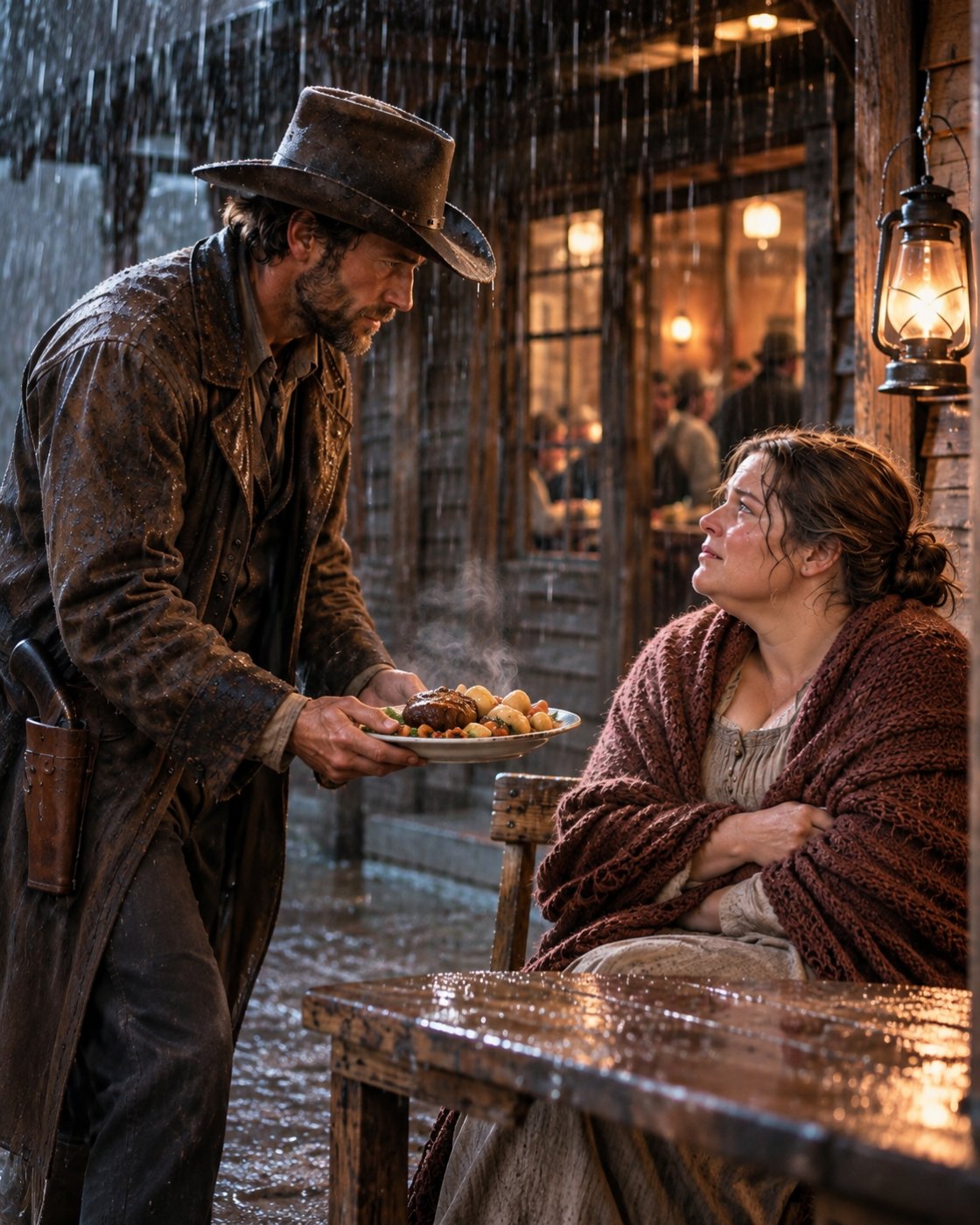
PART 3
The rider's horse was still blowing hard when Caleb Mercer reached the meeting hall doors.
“Who opened the gate?” he demanded.
The young man, a ranch hand named Owen Briggs, shook his head.
“I don't know, boss. I found the north chain hanging loose. Nearly a hundred head had already gone through.”
Caleb felt the blood drain from his face.
The north pasture bordered a long stretch of broken country where the land dropped sharply toward the creek. In ordinary weather, cattle rarely ventured there. But the freezing rain had turned the upper grasslands slick, and a frightened herd could easily crowd into the ravine.
Once they started down that narrow slope, there would be no room to turn them.
“How long ago?”
“Maybe an hour.”
Caleb looked toward the darkening sky.
An hour.
With night coming.
He turned to Eli Turner.
“Get every mounted hand we have. Bring ropes and lanterns.”
Eli was already moving.
Then Martha stepped beside Caleb.
“The north ravine has two entrances,” she said. “The lower one follows the creek.”
Caleb looked at her.
“I know.”
“Then you know the cattle will follow the easiest ground until they reach the drop.”
He nodded grimly.
“That's what I'm afraid of.”
Martha took the old map from beneath her shawl.
“There is another trail.”
Caleb stared at the faded markings.
“Daniel's timber road?”
“Not the main road. A service path he used when the upper crossing flooded. It comes out below the ravine.”
“Can a horse get through?”
“One at a time.”
“Can you find it in the dark?”
Martha looked toward the mountains.
“I helped cut that trail.”
Caleb hesitated.
He remembered the rain-soaked porch.
The accusations.
The argument beside the unfinished crossing.
He had already asked too much of her.
“Martha, you don't owe me—”
“I know.”
She met his eyes.
“That's why I'm choosing to help.”
For a moment, neither moved.
Then Caleb nodded.
“Tell me what you need.”
“Two lanterns. Three riders. And somebody who knows how to keep frightened cattle from turning back on themselves.”
Caleb gave the first genuine smile he had managed all evening.
“That last part I can handle.”
They left Silver Creek beneath a sky the color of iron.
The rain had become sleet.
Cold wind swept through the cottonwoods.
Martha rode a sturdy bay mare borrowed from Nora Whitcomb, while Caleb and Eli followed with two experienced ranch hands.
The others took the upper trail toward the pasture.
Martha led her group east.
The forgotten service path disappeared between low sandstone walls and thick brush.
Twice, Eli thought they had reached a dead end.
Twice, Martha found an opening almost invisible in the darkness.
At one narrow bend, Caleb dismounted to clear fallen branches.
Martha climbed down beside him.
“Watch the left bank,” she warned. “The ground gives way after heavy rain.”
Caleb examined the slope.
“How do you remember all this?”
“Because Daniel nearly lost a wagon here once.”
She smiled faintly.
“He insisted the trail was perfectly safe. Then the left wheel sank halfway into the mud.”
“What happened?”
“I told him to unload the wagon.”
“And did he?”
“Eventually.”
Caleb looked at her.
“Eventually?”
“He was a stubborn man.”
Caleb almost laughed.
“Sounds familiar.”
Martha glanced at him.
“More than you know.”
For a moment, the danger ahead seemed less overwhelming.
Then a distant lowing carried through the darkness.
The cattle.
They hurried onward.
By the time they reached the lower ravine, the herd had begun crowding toward the narrowest section.
Lanterns bobbed along the upper ridge where Caleb's other hands were trying to turn the animals.
But the cattle were frightened.
The freezing rain had made the slope slippery.
One animal stumbled.
Another pushed against it.
A dangerous ripple moved through the herd.
Caleb understood immediately.
If the front animals panicked, those behind would drive them over the edge.
He turned to Martha.
“Where does that service trail come out?”
She pointed toward a break in the rocks.
“Right there.”
“Can we get behind the leaders?”
“Not without driving them farther down.”
Caleb looked toward the herd.
Then he noticed the old stone wall beside the service path.
“What if we open that gap?”
Martha followed his gaze.
The wall had once guided timber wagons around a sharp bend.
Now it formed a narrow barrier between the ravine and a grassy shelf above the creek.
She studied the ground.
“If we remove the loose stones, the cattle could turn onto the shelf.”
“Would it hold them?”
“The shelf is solid sandstone underneath.”
Caleb nodded.
“Then that's our chance.”
They worked quickly.
Eli and the ranch hands pulled loose stones away from the wall.
Caleb rode toward the herd, shouting instructions to the men above.
Martha remained at the opening, holding a lantern high.
The first cattle approached.
Their eyes flashed in the darkness.
They hesitated.
Then one old red cow turned toward the opening.
Another followed.
Caleb moved along the edge of the herd, using his horse to keep the animals from pressing toward the ravine.
“Easy now,” he called.
“Easy.”
The red cow stepped onto the grassy shelf.
Then another.
And another.
The herd began turning.
Martha felt hope rise in her chest.
But halfway through the maneuver, a young steer slipped on the wet slope.
Its hind legs slid toward the drop.
Several cattle crowded behind it.
Caleb urged his horse forward.
“Eli! Hold that line!”
Eli moved to block the animals.
Caleb dismounted near the fallen steer.
Martha saw what he intended.
“Caleb, don't!”
He grabbed a rope and looped it around the animal's shoulders.
The steer struggled.
Its hooves scraped against the rocks.
Caleb pulled.
The animal lunged upward.
Then the ground beneath Caleb's boots gave way.
He fell hard against the slope.
Martha screamed his name.
For one terrible moment, he disappeared behind the struggling animal.
Eli jumped from his horse.
The ranch hands rushed forward.
Martha dropped her lantern and ran.
She reached the edge just as Caleb caught a protruding root with one hand.
Below him, the ravine fell into darkness.
“Don't move!” she shouted.
Caleb looked up.
His face was pale.
“Martha—”
“Don't you dare tell me to go back.”
She dropped to her knees.
Eli threw her a rope.
She tied it around the thick trunk of a nearby cottonwood.
Then she lowered the other end.
“Take it!”
Caleb caught the rope.
His boots scraped against the slope.
Martha braced herself.
“Eli, pull!”
Together, they hauled him upward.
The ranch hands joined them.
At last, Caleb rolled onto solid ground.
He lay there breathing hard.
Martha knelt beside him.
For several seconds, she could not speak.
Then she struck his shoulder lightly.
“You foolish man.”
Caleb winced.
“I've been called worse.”
“You could have died.”
“I know.”
She stared at him.
He looked back.
Something unspoken passed between them.
Then Caleb reached for her hand.
“Thank you.”
Martha's fingers tightened around his.
“You're welcome.”
Behind them, the last cattle moved through the opening.
The herd was safe.
By the time they returned to the ranch, dawn had begun spreading across the eastern sky.
The freezing rain had stopped.
A thin crust of ice covered the fences.
Caleb's men were exhausted, but the cattle had been gathered into a secure pasture.
Only three animals were injured, none seriously.
Eli counted them twice.
Then he approached Caleb.
“Boss, we've got nearly every head accounted for.”
Caleb nodded.
“Good work.”
Eli looked toward Martha, who was helping one of the men wrap a strained wrist.
“Mrs. Bell knew exactly where to take us.”
Caleb watched her.
“Yes,” he said quietly.
“She did.”
That morning, Caleb ordered everyone to rest.
He sent Eli into town to report the incident to Sheriff Amos Fletcher, who had recently taken over the office after the previous sheriff retired.
He also asked Eli to find out whether anyone had seen strangers near the north pasture gate.
Caleb did not believe the chain had opened itself.
The gate had been secured with a heavy iron latch.
It took deliberate effort to release it.
Someone had wanted his cattle to escape.
But he refused to accuse anyone without evidence.
Martha had taught him that lesson.
And he intended to remember it.
Later that morning, Martha stood in Caleb's kitchen with a cup of coffee.
The ranch house was large but plain.
A stone fireplace dominated one wall.
Heavy wooden furniture filled the rooms.
The windows looked toward the corrals and distant mountains.
Martha noticed how little decoration there was.
No flowers.
No embroidered curtains.
No photographs on the mantel.
The house looked as though someone had built it for a family and then forgotten how to live inside it.
Caleb entered carrying a fresh pot of coffee.
“You should be sleeping.”
“So should you.”
He smiled.
“Fair enough.”
He filled her cup.
For a moment, they sat in silence.
Then Martha looked at him.
“Why did you sit beside me that night?”
Caleb considered the question.
“I told you.”
“You told me you saw them send me outside.”
“That was true.”
“But it wasn't the whole answer.”
He looked down at his hands.
“No.”
Martha waited.
Caleb took a slow breath.
“My wife, Rebecca, died six years ago.”
Martha softened.
“I know.”
“She was sick for nearly a year. At first, everybody came to visit. Brought food. Offered help.”
He paused.
“Then the months passed. The visits stopped. People got tired of hearing that she wasn't getting better.”
Martha said nothing.
“After she died, I remember sitting alone at a church supper. Everyone was kind enough. But nobody knew what to say to me.”
He looked toward the window.
“So they said nothing.”
Martha understood.
“Loneliness can be very loud in a crowded room.”
Caleb looked at her.
“Yes.”
He turned his cup slowly.
“That night at the meeting hall, I saw you standing with your plate. I knew what it was like to be surrounded by people and still feel invisible.”
Martha lowered her eyes.
“And yet you waited so long.”
“I did.”
“Why?”
Caleb's expression tightened.
“Because I was afraid of what people would say.”
She looked at him.
He continued.
“Not because of your size. Not because you were Daniel's widow. Because Pike controlled the hauling road, and I had men depending on me.”
Martha nodded slowly.
“That was a real responsibility.”
“Yes.”
“But you still made a choice.”
“I did.”
He met her eyes.
“And I should have made it sooner.”
Martha studied him.
She had heard many apologies since Daniel's death.
Most were offered only when someone wanted something from her.
Caleb's was different.
He was not asking her to excuse him.
He was simply admitting the truth.
At last, she nodded.
“Thank you.”
Caleb looked relieved.
Then Martha smiled faintly.
“Your coffee is terrible.”
He stared.
She took another sip.
“Truly terrible.”
Caleb laughed.
It was a deep, surprised laugh.
The sound filled the quiet kitchen.
Martha found herself laughing too.
For the first time in fourteen months, she laughed without immediately feeling guilty afterward.
Outside, the ranch hands began moving toward the bunkhouse.
Inside, two lonely people sat together over bad coffee.
And something gentle began to grow between them.
Three days later, Sheriff Fletcher arrived at the Mercer ranch.
He brought troubling news.
A freight driver had seen two men riding near Caleb's north pasture shortly before the gate was opened.
One wore a dark coat.
The other rode a chestnut horse with a white blaze.
Both had been seen near Pike's warehouse earlier that week.
Caleb listened carefully.
“Did the driver recognize them?”
“No.”
“Then we don't know who they were.”
The sheriff nodded.
“Not yet.”
Martha stood near the kitchen doorway.
“Did he see them touch the gate?”
“No, ma'am.”
“Then the sighting isn't proof.”
Fletcher studied her.
“No.”
She folded her arms.
“Good.”
Caleb looked at her.
He understood what she was thinking.
Daniel had been condemned by rumors.
She would not allow another man to suffer the same injustice, even if that man was Harlan Pike.
The sheriff removed his hat.
“I'll keep asking questions.”
Caleb nodded.
“Thank you.”
After he left, Martha turned toward Caleb.
“You think Pike did it.”
“I think he had a reason.”
“That's not the same thing.”
“I know.”
She studied him.
“Do you?”
Caleb smiled faintly.
“I'm learning.”
The following week, Silver Creek began preparing for winter in earnest.
Snow covered the upper ridges.
The days grew shorter.
Ranchers hurried to bring in the last loads of hay.
The eastern creek crossing remained unfinished, but Martha's revised design had given the men a safer plan.
Caleb called a meeting of the smaller ranchers.
He offered to share the labor and cost of rebuilding the road.
In return, everyone who contributed would have access to it.
No single rancher would control the route.
No committee would be allowed to punish a family by denying passage.
At first, the men hesitated.
Some feared Pike's anger.
Others doubted the crossing could be repaired before the heavy snow.
But Martha stood beside the map and explained the measurements.
She showed them the foundation.
The required timber supports.
The reduced wagon loads.
The drainage channels that would prevent spring floods from undermining the eastern bank.
She spoke with calm confidence.
And slowly, the men began to listen.
One rancher offered timber.
Another offered stone.
A third promised six men for two days.
By the end of the meeting, they had enough help to begin.
Caleb looked around the room.
For years, Pike had controlled the valley road because everyone believed they had no alternative.
Now they were building one.
Together.
The work began the next morning.
Martha arrived before sunrise.
She wore a thick brown coat and sturdy boots.
Her hair was pinned beneath a wool scarf.
Caleb met her beside the wagon.
“You're early.”
“So are you.”
He smiled.
“Seems we're both stubborn.”
She handed him a measuring cord.
“Then let's put it to good use.”
For four days, the crossing echoed with hammers, axes, and shouted instructions.
Men hauled stone from the creek.
Others cut timber supports.
Martha inspected each section before allowing the next to be built.
When a ranch hand suggested skipping a reinforcement to save time, she refused.
“We don't build a road that holds until the first heavy wagon breaks it.”
The man grumbled.
Caleb backed her.
“Do it her way.”
By the third day, even the skeptics had stopped arguing.
They had begun asking Martha for instructions.
And she answered every question.
Not because she wanted admiration.
But because she knew the work.
On the fourth afternoon, Nora Whitcomb arrived with hot food for the men.
She found Martha standing beside the new crossing, studying the eastern bank.
“You look tired.”
“I am.”
Nora smiled.
“Then eat.”
Martha accepted a bowl of stew.
They sat on a fallen log.
For a while, neither spoke.
Then Nora said quietly, “I found something.”
Martha looked at her.
“What?”
“The committee ledger.”
Martha's spoon stopped.
Nora continued.
“Pike's old clerk left town last spring. His replacement was cleaning the office and found a box of records.”
Martha felt her heart begin to pound.
“Daniel's warning?”
Nora nodded.
“It's there.”
Martha stared.
For fourteen months, she had lived beneath the weight of a lie.
She had watched people turn away from her.
Heard them whisper about Daniel.
Seen doors close.
And now, somewhere in a dusty ledger, there was proof that her husband had warned Pike about the dangerous lamps.
“Have you seen it?”
“Yes.”
“Does it have Daniel's signature?”
“Yes.”
Martha closed her eyes.
Nora reached for her hand.
“It's real, Martha.”
For a long moment, Martha could not speak.
Then she whispered, “He told the truth.”
Nora squeezed her fingers.
“Yes.”
Martha looked toward the mountains.
She remembered Daniel sitting at their kitchen table, exhausted and angry, explaining that he had warned Pike about the lamps.
She remembered him saying the clerk had written everything down.
She remembered the way people laughed when he tried to defend himself.
And she remembered how his shoulders had slowly bent beneath the weight of being disbelieved.
Now, fourteen months after his death, the truth had finally surfaced.
Martha began to cry.
Nora put an arm around her.
Neither woman spoke.
They sat together while the sounds of construction continued around them.
At last, Martha wiped her eyes.
“Where is the ledger?”
“With the sheriff.”
Martha looked up.
“Why?”
“Because there's more.”
Her heart tightened.
“What more?”
Nora hesitated.
“The clerk also recorded who inspected the lamps after Daniel's warning.”
Martha stared.
“Who?”
Nora lowered her voice.
“Harlan Pike himself.”
Martha felt cold.
“He knew?”
Nora nodded.
“He knew the lamps were dangerous.”
Martha looked toward the crossing.
For months, she had imagined that Daniel's warning had been lost.
Now she learned that it had been received.
Recorded.
And ignored.
The fire had destroyed three ranchers' winter hay.
Daniel had been blamed.
But the man who controlled the barn had known about the danger.
Martha stood.
“I want to see that ledger.”
Nora nodded.
“I thought you would.”
That evening, Martha rode into Silver Creek with Caleb.
They went directly to the sheriff's office.
Sheriff Fletcher had the ledger open on his desk.
He turned it toward Martha.
She recognized Daniel's handwriting immediately.
His signature stood beneath a short written warning about the placement of oil lamps near stored hay.
The date was three days before the fire.
Below it, the clerk had recorded that the warning was delivered to Harlan Pike.
And beside that entry was Pike's acknowledgment.
Martha touched the page.
Her fingers trembled.
Caleb stood quietly beside her.
The sheriff waited.
At last, Martha whispered, “He tried to stop it.”
Fletcher nodded.
“Yes, ma'am.”
She looked at the next page.
There was another entry.
A note stating that Pike had inspected the barn and decided no changes were necessary.
Martha stared.
Then she looked up.
“Why didn't anyone show this before?”
The sheriff sighed.
“The records were stored after the committee changed clerks. The original inquiry relied on statements from Pike and the men who worked there.”
Martha's expression hardened.
“And nobody asked to see the ledger.”
“No, ma'am.”
Caleb felt anger rise.
He remembered the rumors.
The cold shoulders.
The empty seats.
The way Martha had been forced outside in freezing rain.
All because people had accepted a story without checking the evidence.
He turned toward the sheriff.
“What happens now?”
Fletcher closed the ledger.
“I'll reopen the inquiry.”
Martha looked at him.
“Will it clear Daniel?”
“It establishes that he warned Pike about the hazard. It doesn't tell us exactly how the fire started.”
She nodded.
That distinction mattered.
She did not need a convenient lie to replace the old one.
She needed the truth.
“And the gate?” Caleb asked.
Fletcher hesitated.
“We're still investigating.”
He looked at Martha.
“But this ledger gives us reason to ask Pike some difficult questions.”
The following morning, Harlan Pike was summoned to the sheriff's office.
Word spread quickly.
By noon, half of Silver Creek knew that Daniel Bell's warning had been found.
Some people were shocked.
Others were embarrassed.
A few insisted that the ledger proved nothing.
But the evidence was clear on one point.
Daniel had warned Pike about the dangerous lamps.
He had not been silent.
He had not ignored the risk.
And the accusation that he had failed to report the danger was false.
That afternoon, Martha walked down Main Street.
For the first time in fourteen months, people looked at her differently.
Some nodded.
Others stepped aside.
A woman who had refused to serve her at the meeting hall approached.
“Mrs. Bell?”
Martha stopped.
The woman twisted her hands.
“I heard about the ledger.”
Martha waited.
“I suppose we were wrong about Daniel.”
Martha looked at her.
“You were.”
The woman flushed.
“I didn't mean—”
“I know.”
Martha's voice remained calm.
“But you still let me sit outside in the rain.”
The woman lowered her eyes.
Martha continued walking.
She had no desire to humiliate anyone.
But she was no longer willing to make other people comfortable by pretending their cruelty had not mattered.
That evening, Caleb found her sitting alone on the porch of Nora's boarding house.
He approached quietly.
“Mind if I sit?”
Martha looked up.
A small smile touched her lips.
“You seem to have a habit of asking that.”
He smiled.
“Only when the company is worth having.”
She moved aside.
He sat.
For a while, they watched the snow begin falling over Silver Creek.
Then Martha said, “I thought finding the ledger would make everything better.”
Caleb looked at her.
“Didn't it?”
“Some things.”
She stared toward the street.
“But Daniel is still gone.”
Caleb nodded.
“I know.”
“And those fourteen months are still gone.”
“Yes.”
She looked at him.
“I don't know what to do with that.”
Caleb considered her words.
Then he said, “Maybe you don't have to do anything tonight.”
Martha looked surprised.
He continued.
“Maybe you can just be sad.”
Her eyes filled.
For so long, she had been strong because she had no choice.
She had defended Daniel.
Worked for whatever wages she could find.
Endured whispers.
And carried herself through each day with a dignity that cost more than anyone understood.
Now someone was telling her she did not have to be strong every moment.
Martha began to cry.
Caleb did not rush to comfort her.
He simply sat beside her.
After a while, she reached for his hand.
He took it gently.
And they remained together as snow settled on the porch railing.
The next morning, the sheriff's investigation took an unexpected turn.
One of Pike's former freight workers came forward.
His name was Jonas Redd.
He had worked at Pike's warehouse for six years.
He told Fletcher that two men had been paid to inspect Caleb's north pasture gate shortly before the cattle escaped.
One of them had returned to the warehouse boasting that the chain had been easy to remove.
Fletcher questioned both men.
At first, they denied everything.
Then one admitted that Pike had ordered them to frighten Caleb into abandoning the eastern road project.
Pike had not instructed them to kill cattle, he claimed.
Only to create enough trouble that Caleb would return to the hauling committee.
The sheriff listened carefully.
Then he placed both men under arrest.
When confronted with their statements, Pike denied responsibility.
But the evidence continued to grow.
A payment entry in his freight ledger matched the date of the incident.
One of the men identified the exact gate.
And the other described the chain he had removed.
By the end of the week, Pike faced charges connected to the deliberate release of Caleb's cattle.
The barn fire remained a separate matter.
The recovered warning showed that Pike had ignored a documented hazard, but the sheriff would not claim to know who had started the blaze without further proof.
Martha was grateful for that.
She had spent too long suffering because people confused suspicion with certainty.
Now she wanted the truth handled carefully.
Not because Pike deserved special kindness.
But because justice meant more than revenge.
The news spread through Silver Creek.
Ranchers who had once defended Pike began questioning his control over the hauling road.
Several demanded that the committee's records be opened for inspection.
Others called for new rules governing access.
Caleb attended the meeting but refused to turn it into a personal victory.
When asked whether he wanted Pike removed from the committee, he answered simply.
“I want the roads managed fairly.”
A rancher near the stove frowned.
“After what he did to you?”
Caleb nodded.
“Especially after what he did.”
He looked around the room.
“No man should be able to threaten another man's livelihood because he doesn't like where that man sits at supper.”
The room fell silent.
Then an older rancher stood.
“I agree.”
Another followed.
By the end of the meeting, the committee had voted to review its rules and establish equal access for ranchers who paid their dues.
The eastern road would remain open as a shared route once the repairs were completed and the crossing passed inspection.
No single man would control it.
Martha listened from the back of the room.
She did not applaud.
She simply felt something loosen inside her.
The road Daniel had once helped build was becoming useful again.
And this time, people were finally listening to the woman who knew how it worked.
The following days were filled with work.
The ranchers returned to the crossing.
They strengthened the eastern foundation.
Added drainage channels.
Replaced the temporary timber supports.
And tested the road with empty wagons before allowing heavier loads.
Martha supervised every stage.
When the first loaded hay wagon crossed safely, the men cheered.
Eli threw his hat into the air.
Caleb laughed.
Martha stood beside the road, watching the wagon roll toward the valley.
She felt Daniel's presence in the memory of the stones.
He had believed in this route.
He had worked on it.
Measured it.
Argued over it.
And now it was carrying hay again.
Caleb approached her.
“Well, Mrs. Bell?”
She looked at him.
“Well what?”
“Think it'll hold?”
She studied the crossing.
“Ask me after the next ten wagons.”
Caleb laughed.
“Fair enough.”
The next ten crossed safely.
Then another five.
By sunset, enough hay had reached the valley to ease the fears of several ranchers.
Caleb's own cattle were no longer in immediate danger.
His ranch would survive the winter.
But the victory had cost him dearly.
He had paid wages, purchased timber, replaced damaged equipment, and lost valuable time.
His savings were nearly gone.
That evening, Eli approached him outside the barn.
“Boss?”
Caleb turned.
“What is it?”
“My wages are due Friday.”
Caleb nodded.
“I know.”
Eli hesitated.
“My mother needs medicine.”
Caleb looked at the young man.
He remembered the first morning after Pike removed his name from the hauling list.
He had promised Eli that his wages would be paid.
Now Friday was approaching.
And Caleb had barely enough money left to buy supplies for the ranch.
He looked toward the stable.
Two spare saddles hung on the wall.
An old wagon stood beneath the shed.
He made his decision.
“You'll have your wages.”
Eli looked relieved.
“Thank you, boss.”
Caleb smiled.
“Go home. Get some rest.”
The following morning, Caleb rode into town.
He sold the spare saddles.
Then he sold the old wagon.
The money was enough to pay his men and purchase the supplies they needed.
When Eli received his wages on Friday, he stared at the coins.
“Boss, I heard what you sold.”
Caleb buttoned his coat.
“Did you?”
“You didn't have to.”
Caleb looked at him.
“Your mother can't buy medicine with my promises.”
Eli's eyes filled.
“Thank you.”
Caleb nodded.
“Take care of her.”
That afternoon, Martha heard what he had done.
She found him repairing a fence near the barn.
“You sold your wagon.”
Caleb looked up.
“An old one.”
“And two saddles.”
“Spare ones.”
She folded her arms.
“You're not very good at accepting help.”
He smiled faintly.
“I've been told.”
Martha stepped closer.
“Caleb, you've spent weeks trying to save everyone else.”
He set down his hammer.
“That's what a rancher does.”
“No.”
She shook her head.
“That's what you do.”
He looked at her.
For a moment, neither spoke.
Then Martha reached into her coat and pulled out a folded paper.
“What is that?” he asked.
“A proposal.”
Caleb raised an eyebrow.
“That sounds serious.”
“It is.”
She unfolded the paper.
It contained a list of winter supply costs, hay quantities, and projected expenses.
Caleb studied it.
“Where did you get these figures?”
“From Eli. And from the men who helped rebuild the crossing.”
He looked up.
“You've been keeping accounts?”
“I've been helping ranchers keep accounts for years.”
Caleb smiled.
“Of course you have.”
Martha pointed to a column.
“You're paying too much for feed delivery because you order in small loads.”
He frowned.
“That's how we've always done it.”
“Then you've always done it expensively.”
Caleb laughed.
She continued.
“If three ranches combine their winter orders, you can reduce the hauling cost. And if you sell two of the older cattle before the worst weather, you'll have enough money to cover the remaining wages.”
Caleb studied the figures.
They made sense.
Every line.
Every calculation.
He looked at Martha.
“You did all this?”
She nodded.
“Your cattle didn't insult me.”
He smiled.
“I remember.”
“And neither did your men.”
He folded the paper carefully.
“Thank you.”
Martha looked at him.
“You're welcome.”
Then she added, “And don't sell another wagon without asking someone who knows the numbers.”
Caleb laughed.
“Yes, ma'am.”
By the first week of December, the ranch was stable again.
The cattle had enough hay.
The men were paid.
The crossing was holding.
And the valley had begun settling into winter.
Martha returned to Silver Creek, where Nora Whitcomb had offered her a position managing the inn's kitchen.
The work was steady.
The wages were fair.
And for the first time since Daniel's death, Martha was being asked to take charge rather than merely help.
Nora showed her the agreement.
“You'd run the kitchen.”
Martha stared.
“Run it?”
“Order supplies. Plan meals. Hire help when needed.”
“And the wages?”
Nora named an amount.
Martha blinked.
“That much?”
Nora smiled.
“You've been underpaid for years.”
Martha looked down at the paper.
She had spent fourteen months accepting whatever work she could find.
Now someone was offering her responsibility.
Respect.
And a future.
“I'll take it,” she said.
Nora beamed.
“I hoped you would.”
That evening, Martha sat alone in her small room.
She placed the employment agreement beside Daniel's photograph.
For a long time, she looked at his face.
He had been a good man.
Not perfect.
Sometimes stubborn.
Sometimes impatient.
But kind.
Honest.
And willing to work harder than anyone she had known.
She touched the edge of the photograph.
“I wish you could see this,” she whispered.
The room was quiet.
Then she smiled through tears.
“Maybe you can.”
She set the photograph beside the window.
Outside, snow began falling.
Martha felt sadness.
But she also felt hope.
And for the first time, she did not believe one feeling had to erase the other.
The following afternoon, Caleb arrived at the inn with Martha's repaired delivery wagon.
He had replaced a broken wheel spoke and tightened the iron fittings.
Martha met him outside.
“You fixed it.”
Caleb nodded.
“Eli helped.”
She examined the repairs.
“Looks good.”
“Should hold through winter.”
She smiled.
“Thank you.”
Caleb handed her the reins.
Then he hesitated.
“I heard about the job.”
Martha nodded.
“Nora offered me the kitchen.”
“Congratulations.”
She studied him.
He seemed genuinely pleased.
Not disappointed that she would no longer be spending her days at his ranch.
Not annoyed that she had chosen work of her own.
Just pleased.
That mattered.
More than he knew.
“Would you like to come inside for coffee?” she asked.
Caleb smiled.
“Is it better than mine?”
“Considerably.”
He laughed.
“Then I'd be honored.”
They sat near the kitchen stove while Nora prepared supper.
Martha told him about her plans.
She wanted to improve the menu.
Offer affordable meals to freight drivers.
Hire a young widow who had been struggling to find work.
And make sure no one was ever turned away from a warm dining room because of their name or appearance.
Caleb listened.
He did not interrupt.
When she finished, he smiled.
“Sounds like a fine place.”
Martha looked at him.
“I hope so.”
He took a sip of coffee.
“Will there be room for a rancher who makes terrible coffee?”
She laughed.
“I suppose we can find a chair.”
He smiled.
“Good.”
Then his expression grew thoughtful.
“Martha, may I ask you something?”
She nodded.
“Of course.”
“Would you mind if I came by again?”
She looked at him.
“Why?”
He considered his answer carefully.
“Because I enjoy your company.”
She waited.
“And because I think about you when you're not there.”
Martha felt warmth rise in her cheeks.
Caleb continued.
“I don't want to make you uncomfortable.”
“You haven't.”
“I know Daniel meant a great deal to you.”
“He did.”
“And I know you're building a life of your own.”
“Yes.”
He nodded.
“I respect that.”
Martha studied him.
Then she smiled.
“Sunday afternoon?”
Caleb's face brightened.
“Sunday would be fine.”
She nodded.
“Then come Sunday.”
He smiled.
“I will.”
After he left, Nora appeared beside the stove.
“Well?”
Martha looked up.
“Well what?”
Nora folded her arms.
“Don't pretend you don't know.”
Martha laughed.
“Nora.”
The older woman smiled.
“He's a good man.”
Martha looked toward the door.
“Yes,” she said softly.
“I believe he is.”
The days before Christmas passed quickly.
The inn's dining room filled with ranch hands, freight drivers, and families traveling through Silver Creek.
Martha worked long hours.
She prepared meals.
Managed supplies.
Trained her new assistant.
And slowly transformed the kitchen into a place known for warm food and fair treatment.
One evening, a young woman arrived with two small children.
Her husband had died the previous spring.
She had little money and nowhere to stay.
Nora hesitated when she heard the woman's circumstances.
Martha stepped forward.
“There's a room upstairs.”
The woman looked embarrassed.
“I can't pay much.”
Martha smiled.
“Can you help in the kitchen?”
The woman nodded.
“Yes, ma'am.”
“Then we'll work something out.”
The woman's eyes filled.
“Thank you.”
Martha looked at the children.
They were cold and hungry.
She remembered the night she had been forced to eat outside.
Then she opened the dining room door.
“Come in,” she said.
“There's room.”
On Christmas Eve, the inn was full.
Lanterns glowed above the tables.
The smell of roast beef, potatoes, fresh bread, and cinnamon filled the air.
Snow drifted past the windows.
Families gathered around the stove.
Ranch hands laughed over coffee.
Freight drivers shared stories from the road.
Martha had arranged the tables into two long rows.
There were no special seats for wealthy ranchers.
No benches reserved for people others considered respectable.
Everyone who entered was offered a warm place.
Near sunset, Harlan Pike appeared in the doorway.
Conversation quieted.
Martha looked up from the counter.
Pike stood with his hat in his hands.
His expensive coat was dusted with snow.
He looked older than he had only weeks before.
The investigation into the cattle gate incident was still moving through the courts.
His control over the hauling committee had ended.
And the discovery of Daniel's warning had damaged his reputation.
He approached the counter.
“Mrs. Bell.”
Martha met his eyes.
“Mr. Pike.”
He placed his payment on the wood.
“One supper, please.”
She nodded.
“Roast beef or stew?”
He hesitated.
“Roast beef.”
She served him a full plate.
The same portion everyone received.
He looked at it.
Then at her.
For a moment, neither spoke.
At last, he said, “The eastern road held.”
Martha nodded.
“Yes.”
He looked down.
“Daniel built it well.”
Martha felt something tighten in her chest.
“He did.”
Pike swallowed.
Then he lifted his plate.
“Thank you.”
He carried it to an empty chair.
Martha watched him go.
It was not an apology.
Not a proper one.
She would not pretend otherwise.
But she no longer needed his approval to know what Daniel's work had been worth.
And she no longer needed his permission to take up space in her own town.
A little later, Caleb arrived.
Snow melted across his shoulders.
He removed his hat and looked around the crowded room.
Every table was nearly full.
Martha saw him from the kitchen doorway.
She smiled.
Then she carried a plate of supper to a small table near the window.
She placed it opposite her own.
Caleb approached.
“Evening, Martha.”
“Evening, Caleb.”
He looked at the plate.
“Is that for me?”
“If you want it.”
He smiled.
“Are you sure?”
Martha laughed softly.
“I wouldn't have put it there otherwise.”
Caleb sat.
For a moment, they looked at one another across the table.
Martha remembered the freezing rain.
The dark porch.
The laughter inside the meeting hall.
The way Caleb had sat beside her when everyone else turned away.
Now the room was warm.
The food was good.
And nobody had to ask permission to stay.
Caleb lifted his cup.
“To the eastern road.”
Martha smiled.
“To the people who built it.”
He nodded.
“And to the woman who knew how.”
She laughed.
They ate together while snow fell beyond the windows.
After supper, Caleb helped carry empty plates to the kitchen.
Martha protested.
“You're a guest.”
He smiled.
“Then I'm a guest who can carry plates.”
She shook her head.
“You're stubborn.”
“So I've been told.”
They worked side by side until the last dishes were cleared.
Then Caleb offered to walk her home.
The streets of Silver Creek were quiet beneath the snow.
Lanterns glowed in windows.
Church bells rang softly in the distance.
Martha walked beside him, her shawl wrapped tightly around her shoulders.
At her doorstep, Caleb stopped.
“Martha.”
She turned.
“Yes?”
He removed his hat.
“I'd like to keep seeing you.”
She looked at him.
He continued.
“Not because I need help at the ranch.”
She smiled faintly.
“Good.”
“And not because I think you need someone to take care of you.”
Her expression softened.
“Good.”
Caleb took a breath.
“Because I like who I am when I'm with you.”
Martha's eyes filled.
“And because I like you.”
He paused.
“Even when you tell me I'm wrong.”
She laughed.
“That's often.”
“Yes, ma'am.”
Then her smile faded slightly.
“Caleb, I loved Daniel.”
“I know.”
“I still do.”
“I know.”
She looked down.
“And I'm not ready to promise another marriage.”
Caleb nodded.
“I'm not asking for one tonight.”
She lifted her eyes.
“Then what are you asking?”
He smiled gently.
“Could I come by Sunday?”
Martha looked at the man standing patiently in the snow.
The man who had sat beside her when no one else would.
The man who had learned to listen.
The man who had risked his livelihood but never once asked her to repay him with affection.
And she smiled.
“Sunday would be fine.”
Caleb's face brightened.
“Then I'll see you Sunday.”
He put on his hat.
“Good night, Martha.”
“Good night, Caleb.”
She watched him walk away.
Then she stepped inside.
For a moment, she stood beside the stove, smiling to herself.
She had not forgotten Daniel.
She never would.
But she was beginning to understand that loving someone new did not mean betraying someone she had lost.
It meant allowing her heart to live again.
On Sunday morning, Caleb arrived carrying a small bundle of dried wildflowers tied with twine.
Martha opened the door before he knocked.
Inside, two cups waited beside the stove.
She looked at the flowers.
“They're lovely.”
Caleb smiled.
“I remembered you said you liked wildflowers.”
She took them gently.
“Thank you.”
He stepped inside.
The room was warm.
Coffee simmered on the stove.
Snow rested on the windowsill.
Martha placed the flowers in a jar.
Then she turned toward him.
“There's something I want you to know.”
Caleb looked at her.
“What is it?”
She took a slow breath.
“For fourteen months, I believed this town had decided who I was.”
He waited.
“I thought I would always be Daniel Bell's widow. The woman nobody wanted at their table.”
Her voice trembled slightly.
“But then you sat beside me.”
Caleb lowered his eyes.
“Martha—”
She shook her head gently.
“Let me finish.”
He nodded.
“You didn't save me, Caleb.”
He looked up.
“I know.”
“I was still standing. Still working. Still finding a way.”
“Yes.”
“But you reminded me that I didn't have to stand alone.”
His eyes filled.
Martha smiled.
“And I think that's something worth remembering.”
Caleb reached for her hand.
She took it.
For a moment, they stood together beside the stove.
Then he smiled.
“May I ask you something?”
She laughed softly.
“You do ask a lot of questions.”
“I know.”
“What is it?”
He looked at the two cups on the table.
“Is one of those for me?”
Martha laughed.
“Yes, Caleb.”
He smiled.
“Good.”
She led him to the table.
They sat together.
Outside, the winter wind moved through Silver Creek.
Inside, the coffee was hot.
The room was warm.
And Martha Bell, who had once been forced to eat alone in the freezing rain, had finally built a life in which she would never again have to wonder whether she deserved a place at the table.
Because she did.
She always had.
And the man sitting across from her knew it.