PART 3
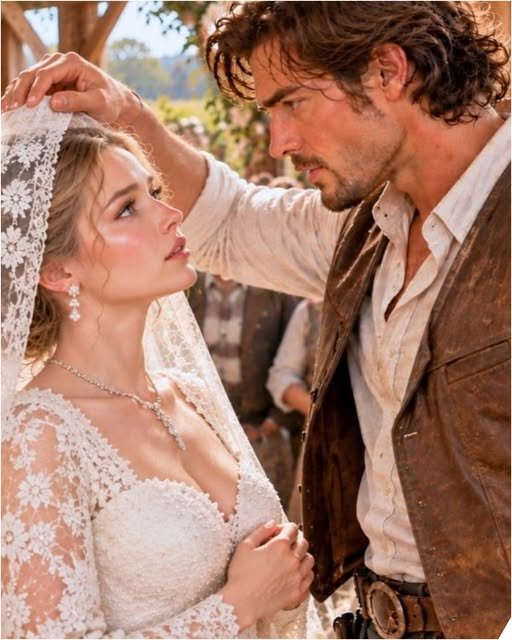
And Wyatt felt her hand begin to shake violently in his…
For the first time since he had lifted her veil, Grace looked as though she wanted to disappear. Her fingers tightened around Wyatt's, and her eyes moved from the stranger in the bowler hat to Silas Rourke, then to the crowded pews where nearly a hundred people waited for her to defend her own existence. She had endured their laughter. She had endured the whispers about her face. But this was something different. These men were trying to take away her name.
Wyatt stepped closer. "Grace," he said quietly, "look at me."
She turned toward him, her brown eyes filling again.
"Whatever that man says, I know who held my hand in that fever tent. I know who stayed when everyone else walked away. And I know who I married today."
"But the ranch—"
"To hell with the ranch."
A murmur passed through the church. Wyatt had spent twelve years building his life at the Silver Spur. Every fence post, every horse, every acre of grazing land carried some memory of Henry Dawes. Yet he had spoken without hesitation, and Grace knew he meant every word.
Silas Rourke gave a short, ugly laugh. "A touching performance, Kincaid. Unfortunately, sentiment doesn't establish a woman's identity."
"No," Wyatt answered. "But neither does a stranger walking into a church and announcing that somebody is dead."
He faced the man in the bowler hat.
"You say you attended Grace Dawes's funeral?"
"I did."
"Then tell us where she's buried."
The man's expression changed almost imperceptibly.
"Denver Cemetery."
"Which one?"
A pause.
"The municipal grounds."
"And what was written on her headstone?"
Mr. Pruett adjusted his collar. "I hardly remember every inscription I've ever seen, young man."
"Then perhaps you remember who buried her."
Silas interrupted. "This is ridiculous. The man has given his testimony."
"And I'm asking him to finish it."
The preacher, Reverend Samuel Whitcomb, stepped forward from behind the pulpit. He was an elderly man with silver hair and a voice that rarely rose above conversation, but when he spoke, the room listened.
"Mr. Rourke, this is a house of God. If you intend to accuse a woman of stealing another person's identity, you will permit her the courtesy of answering."
Silas's jaw tightened. "Very well."
Reverend Whitcomb turned to Grace. "My dear, is there anything you wish to tell us?"
Grace tried to speak. Nothing came. Her throat felt as though it had closed around every word she had ever swallowed in silence.
Then Wyatt did something that surprised her more than anything else that morning.
He stepped aside.
Not away from her. Not abandoning her. Simply giving her room to stand on her own.
"You don't have to hide behind me," he whispered. "But I'm right here."
Grace looked at him for a long moment. Then she slowly removed the ivory veil from her hair.
The movement was so unexpected that even Lorena Rourke stopped smiling.
Grace folded the lace carefully and placed it beside her bouquet on the altar. For twenty-six years, she had been taught to conceal the left side of her face whenever strangers were present. Her mother had called it protection. Other people had called it kindness. But Grace had always known what it really meant: the world would be more comfortable if it didn't have to look at her.
Now she stood before the entire town with nothing covering her face.
"My name," she said, her voice trembling but audible, "is Grace Eleanor Dawes. My father was Jonathan Dawes, Henry's younger brother. My mother was Margaret O'Connell Dawes. I was born in Denver on November seventeenth, 1853."
Pruett shifted his weight.
"My father died when I was fourteen. My mother died three years later. I trained as a volunteer nurse because I had no money for formal schooling, and because the women who cared for my mother showed me what kindness could accomplish when medicine could do no more."
She swallowed.
"In 1876, I worked at the railroad fever camp outside Cheyenne. That was where I met Wyatt Kincaid."
She turned toward her husband. He nodded, encouraging her to continue.
"I remember a young cowboy who kept apologizing whenever I had to help him drink water. Even when he was burning with fever, he worried that he was making trouble for someone else."
A faint smile touched Wyatt's mouth.
"I remember telling him that a man who was dying had better things to do than apologize."
Several people in the church smiled despite themselves.
"And I remember the night the doctor said he wouldn't survive. I stayed beside him because I couldn't bear the thought of him waking alone, if he woke at all."
Her voice grew stronger.
"When he recovered, I was already gone. I had been sent to another camp. I never expected to see him again."
Silas folded his arms. "A charming account. Anyone who knew the story could repeat it."
"That's true," Grace said.
The simplicity of her agreement unsettled him.
"But I haven't finished."
She looked directly at Mr. Pruett.
"You said Grace Dawes died in Denver two years ago. Tell me, sir, was the deceased woman buried under the name Grace Eleanor Dawes?"
Pruett hesitated.
"I believe so."
"Then you should know that my cousin, Grace Margaret Dawes, died in Denver in February of 1878."
The church became very quiet.
"My father's older brother had a daughter named Grace as well. We were named after the same grandmother. She was thirty-one when she died. She had lived in Denver all her life, and for a time we shared the same household."
Grace drew a steadying breath.
"Her funeral was held at Saint Mark's Chapel. I attended it. I helped dress her for burial."
Pruett's face had lost its color.
"You may have attended a Grace Dawes funeral, Mr. Pruett. But you attended the wrong one."
A low murmur rolled through the congregation.
Lorena looked sharply at her father.
Silas raised his voice. "That proves nothing! She could have invented another cousin."
"Perhaps," said Reverend Whitcomb. "But I suspect there may be a simpler way to settle this."
He reached beneath the pulpit and brought out a thick envelope tied with faded blue ribbon.
Wyatt stared.
He recognized the handwriting on the front.
Henry Dawes.
The preacher held it carefully, as though it were something precious.
"Henry gave me this envelope six weeks before he died," he said. "He instructed me to open it only if someone challenged the identity of the woman Wyatt married."
Silas took a step forward. "You expect us to believe that?"
"I expect you to listen."
The preacher untied the ribbon.
Inside were three documents and a letter.
The first was a certified copy of Grace Eleanor Dawes's birth record, bearing her parents' names and the seal of the Denver county clerk. The second was a sworn statement from a physician who had supervised her nursing work in Cheyenne. The third was a letter from Henry's longtime attorney confirming that Grace Eleanor Dawes, daughter of Jonathan Dawes, was the niece named in the will.
Reverend Whitcomb placed them on the altar where anyone could examine them.
Then he unfolded the letter.
"My dear Wyatt," he began.
At the sound of Henry's words, Wyatt felt something tighten in his chest.
"If you are hearing this letter read aloud, then I fear the world has been less kind to Grace than I hoped it would be. I also fear that some man has decided my property matters more than my wishes."
The preacher paused.
"First, let there be no confusion. Grace Eleanor Dawes is my niece, the daughter of my beloved brother Jonathan. She is the lawful beneficiary named in my testament, and no other person bearing the Dawes name was intended."
Silas looked toward the church doors.
But Reverend Whitcomb continued.
"Second, Wyatt, there is something I should have told you while I was alive. Four years ago, you returned from Cheyenne and spoke to me of a nurse who saved your life. You said you had never seen her face, but that you would know her voice anywhere. You said she sang when you were frightened, and that she made you believe you were worth saving."
Wyatt's eyes filled.
"I remembered those words when Grace wrote to me the following winter. She had heard from another nurse that the young cowboy from Cheyenne had survived. She asked if I knew anything of him, never imagining that he had become the son of my heart."
Grace pressed a hand over her mouth.
"I told her that I did. And when she confessed she was afraid you would reject her because of the mark on her face, I made a decision that may have been foolish. I placed a condition in my will that would bring you together. I hoped the two kindest people I knew might discover what I had already begun to suspect."
The preacher's voice softened.
"I did wrong to make marriage a condition of inheritance. Love ought never to be demanded. If either of you feels trapped by my decision, I ask your forgiveness. The Silver Spur is land, and land can be bought again. A good heart is harder to find."
Wyatt lowered his head.
Henry had known. All those years, the old man had carried the secret of the nurse in the fever tent.
And he had tried, in his stubborn, imperfect way, to bring them together.
The preacher reached the final lines.
"Wyatt, I taught you to judge a horse by its spirit and a man by his word. I hope I also taught you that beauty is not something a crowd gets to vote upon. Grace, my dear girl, I wish you had never been made to feel that your face was something to apologize for. Whatever happens today, remember that you were loved before you arrived, and you are worthy of love whether Wyatt marries you or not."
Reverend Whitcomb folded the letter.
Nobody spoke.
Even the people who had come to laugh seemed uncertain where to look.
Finally, Silas Rourke cleared his throat. "An emotional letter doesn't change the fact that the marriage was arranged under questionable circumstances."
"No," Wyatt said. "It doesn't."
He turned toward Grace.
"And that is something we ought to put right."
For one terrible second, Grace thought he was about to reject her.
Her heart seemed to stop.
Wyatt took both her hands.
"Grace, I made a promise this afternoon because I believed I owed Henry everything I had. I didn't know who you were. I didn't know why you wore that veil. And I certainly didn't know you were the woman I've been searching for."
His voice grew rough.
"But now I do."
He looked toward the preacher.
"Reverend, is there any law that prevents a man from asking his wife to marry him again?"
A few people laughed softly, not cruelly this time.
"I don't believe there is, son."
Wyatt turned back to Grace.
"Then I want to ask properly."
He lowered himself onto one knee before her.
A gasp passed through the church.
Lorena stared in disbelief.
Wyatt Kincaid, the proud cowboy who had never bowed his head to Silas Rourke or any other powerful man in the county, was kneeling before the woman everyone had called too ugly to marry.
"Grace Eleanor Dawes," he said, "if there were no will, no ranch, no inheritance, and no one watching us today, I would still want to know the woman who sat beside a dying stranger and refused to let him face the dark alone."
Grace began to cry.
"I can't promise you a life without hard winters or difficult days. I can't promise I'll always say the right thing. But I can promise that you will never have to cover your face for my sake."
He smiled through the emotion gathering in his eyes.
"And I can promise that if you'll have me, I'll spend the rest of my life trying to be worthy of the kindness you gave me when I had nothing to offer you."
He squeezed her hands.
"So I'm asking you now, with nothing but my heart in the bargain. Grace, will you choose me?"
She looked down at him, tears falling freely.
For years, she had imagined what it might feel like to have a man look at her without pity. She had imagined being wanted, being cherished, being introduced proudly as someone's wife.
But she had never imagined this.
A man kneeling before her, in front of an entire town, asking for the privilege of loving her.
"Yes," she whispered.
Wyatt smiled.
Grace laughed through her tears.
"Yes, Wyatt. I choose you."
He rose and gathered her into his arms.
And this time, when he kissed her, he did not hide her face behind his hat or turn her away from the congregation. He kissed her gently, openly, as though there were nothing in the world he was prouder to do.
The first applause came from an elderly woman near the back.
Then the blacksmith stood.
Then the schoolteacher.
Within moments, most of the church was on its feet.
But Grace barely heard them.
For the first time in her life, she was not thinking about what strangers saw when they looked at her.
She was thinking about the man holding her.
And how warm his hands felt against her cheeks.
Silas Rourke did not applaud.
Neither did Lorena.
The rancher turned toward Mr. Pruett, his expression furious. "You assured me the woman was dead."
Pruett backed away. "I told you I attended a funeral for someone named Grace Dawes. You were the one who said—"
"Enough!"
The word echoed through the church.
Everyone turned.
Silas realized too late what he had revealed.
Wyatt stepped toward him.
"You knew there were two women named Grace Dawes?"
Silas said nothing.
"You knew there might be a mistake, and you brought that man here anyway."
Lorena grabbed her father's sleeve. "Papa, let's leave."
But Reverend Whitcomb had already stepped between them and the door.
"Mr. Rourke," he said calmly, "I think you owe Mrs. Kincaid an apology."
Silas's face reddened.
"I owe that woman nothing."
Wyatt took a step forward, but Grace touched his arm.
"Let him go," she said.
Wyatt looked at her.
"Grace—"
"Please."
She turned toward Silas.
"I have spent most of my life believing that if I could only be pleasant enough, useful enough, quiet enough, people would eventually stop being cruel."
Her voice was gentle, but there was no weakness in it.
"I know now that some people will never be satisfied, no matter how small I make myself."
Silas stared at her.
"So I won't make myself smaller anymore. You may leave, Mr. Rourke. But you will not decide whether I deserve to stand beside my husband."
For a moment, nobody moved.
Then Silas turned sharply and walked out, Lorena following with her pink skirts gathered in both hands.
Mr. Pruett hurried after them.
The church doors slammed.
Grace let out a long breath.
Wyatt leaned close.
"Remind me never to get on your bad side."
She laughed.
It was a small, surprised laugh, the kind that escapes when a person has been holding back tears for too long.
And Wyatt thought he had never heard anything lovelier.
By the time the newlyweds stepped outside, the June sunlight had softened over Laramie. The same townspeople who had gathered at the railway station to stare now stood along the church steps, offering congratulations with varying degrees of embarrassment.
Some were sincere.
Some were merely ashamed of having been caught behaving badly.
Grace could tell the difference.
A woman who had laughed at the rumors approached with her young daughter beside her.
"Mrs. Kincaid," she began awkwardly, "I wanted to say that I'm sorry for what was said about you."
Grace looked at her.
"Thank you."
The woman glanced at Grace's birthmark and then quickly looked away.
Her daughter, perhaps seven years old, tugged at her sleeve.
"Mama?"
"Not now, Ellen."
"But Mama, why did everybody say she was ugly?"
The woman went scarlet.
Grace knelt so she was eye level with the child.
"Sometimes," she said, "people are frightened of things they haven't seen before. And sometimes they say unkind things because everyone around them is saying them."
The little girl studied her face.
"Does it hurt?"
"No, sweetheart. It never has."
Ellen considered that.
"It looks like a flower."
Grace blinked.
"A flower?"
"Like the red ones growing by the creek. The ones with purple in the middle."
The child's mother covered her mouth.
Grace felt tears rise again, but this time they came with a smile.
"That's a very lovely way to see it."
Ellen grinned.
Wyatt helped Grace to her feet.
As they walked toward the waiting wagon, he leaned close.
"She's right, you know."
"About what?"
"The flowers."
Grace looked at him sideways.
"You don't have to flatter me, Mr. Kincaid. We're already married."
He smiled.
"Good. Then I'll have plenty of time to convince you."
The ride to the Silver Spur took nearly two hours. For the first few miles, Grace sat with her hands folded tightly in her lap, as though she were still waiting for the day to turn against her. Wyatt did not press her to speak. He pointed out the creek where the cattle watered, the cottonwood grove Henry had planted, and the distant hills that turned violet when the sun began to set.
Eventually, Grace relaxed enough to ask questions.
"Did Uncle Henry really teach you everything about ranching?"
"Nearly everything."
"What didn't he teach you?"
"How to cook a decent supper."
She smiled.
"Then I suppose we'll have to learn together."
Wyatt glanced at her.
"Together?"
"Unless you intend to keep me indoors while you do all the work."
"Wouldn't dream of it."
"Good. Because I know very little about cattle, but I'm willing to learn."
He considered her for a moment.
"And I know very little about nursing."
"Then perhaps we'll make a useful pair."
He laughed, and the sound seemed to loosen something in her chest.
When the ranch house finally came into view, Grace leaned forward. It was a sturdy two-story building with a wide porch and climbing roses along the south wall. Beyond it stood a red barn, several fenced pastures, and a windmill turning slowly against the evening sky.
"Henry planted those roses for my mother," Wyatt told her. "Said they reminded him of the garden she kept in Denver."
Grace pressed her fingertips against her lips.
"He remembered her?"
"Every spring."
She was quiet for a long moment.
Then she whispered, "I wish I'd come to see him before he died."
Wyatt pulled the wagon to a stop.
"Grace, he knew you loved him."
"How can you be sure?"
"Because he kept every letter you ever sent."
She turned toward him.
"What?"
"There's a box in his study. He told me once that if anything happened to him, I was to make certain it reached the right person."
Wyatt looked toward the house.
"I think I finally know who that is."
That evening, after the horses had been fed and supper had been made from bread, potatoes, and the last of Henry's preserved peaches, Wyatt brought a small wooden box to the kitchen table.
Grace recognized it immediately.
It had belonged to her father.
The hinges were tarnished, and a tiny brass plate on the lid bore the initials J.D.
"My father made this," she whispered.
Wyatt set it before her.
Inside were dozens of letters tied with twine, a faded photograph of her parents, and a small velvet pouch.
Grace opened the pouch.
A silver locket fell into her palm.
She knew it at once.
Her mother had worn it every day.
Inside was a miniature portrait of two young brothers standing beside a wagon. Jonathan and Henry Dawes, long before either had grown old enough to understand how quickly families could be scattered by distance and death.
Grace held the locket against her chest.
Wyatt sat quietly across from her.
After a while, she looked up.
"Did he ever tell you why he never married?"
Wyatt shook his head.
"Only that he'd loved someone once, and afterward the ranch kept him busy."
Grace smiled sadly.
"He always sounded lonely in his letters."
"He was," Wyatt admitted. "Until I came along, I suppose. Though he'd never have said it that way."
She reached across the table and touched his hand.
"You were his family."
"So were you."
They sat together in the lamplight, with Henry's letters between them, and understood something neither had seen clearly before. The old man had not merely been trying to protect his ranch. He had been trying to bring the two people he loved into the same home.
He had chosen the wrong way to arrange it.
But he had been right about one thing.
They had more in common than either of them had imagined.
The first weeks of marriage were not perfect. Grace was accustomed to doing everything herself, and Wyatt had lived alone long enough to forget that another person might have opinions about how a household should be run. They disagreed over the pantry shelves, the placement of the kitchen table, and whether a woman who had never ridden a horse should be allowed to attempt the spirited chestnut mare in the south paddock.
Grace won the argument about the shelves.
Wyatt won the argument about the mare.
The kitchen table ended up beside the window, which made them both happy.
At night, they talked.
Grace told him about the hospitals, the frightened children, the exhausted mothers, and the long hours spent sitting beside people who had no family nearby. Wyatt told her about the first winter at the Silver Spur, when he and Henry had nearly lost half the herd to a blizzard, and how the old man had refused to sleep until every animal had been accounted for.
Sometimes they spoke of the fever tent.
More often, they spoke of ordinary things.
And slowly, Grace began to understand that love did not always arrive in grand declarations. Sometimes it was a cup of tea waiting beside her chair. Sometimes it was a husband repairing a loose stair before she could trip on it. Sometimes it was the way Wyatt said her name across the yard, as though he were genuinely pleased simply to see her.
One evening in late July, Grace found him sitting on the porch with a folded paper in his hand.
"What is it?"
"A letter from the lawyer."
Her stomach tightened.
"The will?"
Wyatt nodded.
"The ninety-day condition has been satisfied. The property transfer is complete."
Grace sat beside him.
"So the ranch is yours."
He looked at her.
"Ours."
She shook her head gently.
"Wyatt, you earned this place. I won't pretend I did."
He took her hand.
"Henry gave me a home when I had none. You gave me my life when I was dying. I think we've both put something into the Silver Spur."
Grace leaned against his shoulder.
For a long time, neither spoke.
Then she said quietly, "Do you ever regret it?"
He looked down at her.
"Regret what?"
"Marrying a woman you had never seen. A woman the whole town laughed at."
Wyatt turned toward her fully.
"Grace, do you remember what I said when I lifted your veil?"
She nodded.
"It's you."
"I'd been looking for you for four years. And there you were, standing right in front of me."
He brushed a loose strand of hair away from her cheek.
"I didn't recognize a birthmark. I recognized the eyes that watched over me when I thought I was going to die."
Her eyes filled.
"And now," he continued, "I know a great deal more than your eyes. I know how you hum when you're kneading bread. I know you read the last page of a book before you finish the first chapter. I know you worry about every sick animal on this ranch and pretend you aren't worried about yourself."
She laughed softly.
"And I know," he said, "that when you smile, I forget what I was going to say."
Grace looked away, embarrassed.
Wyatt gently turned her face back toward him.
"Don't hide from me."
She held his gaze.
For the first time, she believed she never would again.
Autumn brought a difficult season. A fever spread through several ranch families along the valley, and the nearest physician was often a day's ride away. Grace began helping wherever she was needed, carrying medicines and clean linens in the wagon while Wyatt drove her from one homestead to another.
At first, some families were reluctant to receive her.
Then a little boy from the Miller ranch developed a dangerous fever, and Grace stayed through two nights while his parents waited desperately for the doctor.
The child survived.
His mother came to the Silver Spur a week later with a basket of fresh bread and tears in her eyes.
"I don't know what we would have done without you, Mrs. Kincaid."
Grace accepted the bread with both hands.
"You would have done the same for my family."
Soon people began coming to her for help with small injuries, childbirth preparations, and illnesses that required someone with experience and a steady hand.
The woman they had mocked at the train station became the woman they asked for when someone they loved was suffering.
But not everyone changed.
Lorena Rourke continued to avoid Grace in public. Silas remained bitter over losing any hope of acquiring the Silver Spur. Neither offered an apology.
One afternoon, Lorena passed Grace outside the general store and muttered, "I suppose people will praise anyone if she's useful enough."
Grace stopped.
A year earlier, she would have lowered her head and pretended not to hear.
Instead, she turned.
"Miss Rourke, I hope someday you find something in your life that makes you happy enough to stop worrying about mine."
Lorena stared at her.
Grace picked up her parcel and walked away.
When she told Wyatt that evening, he laughed so hard he nearly spilled his coffee.
"You said that to Lorena Rourke?"
"I did."
"Grace Kincaid, remind me never to quarrel with you."
"You quarrel with me nearly every day."
"Yes," he said, smiling. "And I'm beginning to enjoy it."
Winter arrived early that year. Snow settled over the pastures, the creek froze at its edges, and the ranch house filled with the smell of woodsmoke and warm bread. Wyatt and Grace spent long evenings by the fire, reading Henry's old books and talking about the future.
One night, Wyatt brought out a small parcel wrapped in brown paper.
"What's this?" Grace asked.
"Something I should have given you on our wedding day."
Inside was a delicate gold chain.
Hanging from it was a small oval pendant, plain except for two words engraved on the back.
My Grace.
She looked at him.
"Wyatt..."
"I had it made in Cheyenne."
She turned it over in her hands.
"Why those words?"
He sat beside her.
"Because when I was sick, I kept asking the nurses whether Gracie was coming back. And when they told me she'd gone, I thought I'd lost the only person who had ever stayed beside me when I had nothing to offer."
His voice softened.
"Then Henry brought you back into my life. And I realized I hadn't lost you after all."
Grace held the pendant against her heart.
"I used to think," she whispered, "that if anyone ever loved me, it would have to be despite my face."
Wyatt waited.
"But you don't love me despite it."
"No."
"You love all of me."
He smiled.
"Every bit."
She put her arms around his neck and kissed him.
Outside, snow fell silently over the Silver Spur. Inside, the fire burned low, and two people who had spent years believing they were destined for loneliness held each other in the quiet warmth of the home they were building.
The following spring, Grace returned to Laramie for the anniversary of their wedding.
Not because the town had invited her.
Not because she needed to prove anything.
But because the church was holding a gathering to raise money for families who could not afford medical care, and she had agreed to speak about the need for a small community infirmary.
She wore a soft blue dress and a straw hat decorated with white flowers.
There was no veil.
When she entered the church, several women rose to greet her. The schoolteacher embraced her. Mrs. Miller brought her son forward to thank her again. Even people who had once whispered about her face now spoke to her with genuine warmth.
Wyatt stood near the doorway, watching.
Reverend Whitcomb approached him.
"You look pleased with yourself, son."
Wyatt smiled.
"I am."
"Because your wife is becoming a respected woman in this town?"
Wyatt shook his head.
"No, Reverend. Because the town is finally beginning to see what was there all along."
Across the room, Grace looked up and caught his eye.
She smiled.
And Wyatt felt the same quiet certainty he had felt the day he lifted her veil.
Not surprise at her appearance.
Not relief that she was someone from his past.
Simply the recognition that he was looking at the woman he loved.
Later, when the gathering ended, they walked down the church steps together.
Grace paused at the bottom.
"This is where everyone stared at me," she said.
Wyatt looked around.
"I remember."
"I was so frightened that day. I thought if you saw my face, you might turn away."
He took her hand.
"And I thought I was about to marry a stranger."
She smiled.
"Neither of us knew very much."
"No," he agreed. "But we learned."
Grace looked at the street, at the people passing, at the ordinary life of a town that had once seemed so cruel.
"Do you know what I wish I could tell the girl I was that morning?"
"What?"
She thought for a moment.
"That she didn't need to become beautiful enough to be loved. She needed to stop believing the people who told her she wasn't."
Wyatt kissed her forehead.
"I think she'd be proud of you."
Grace leaned against him.
"I think she would."
They walked toward their wagon, hand in hand.
And when Wyatt helped her onto the seat, she laughed and said, "You know, Mr. Kincaid, you never did tell me what you thought when you first saw my face."
He climbed up beside her.
"I told you."
"You said, 'It's you.'"
"That's right."
"But what did you think?"
Wyatt gathered the reins, then turned toward her with a smile.
"I thought God had given me a second chance to thank the woman who saved my life."
Grace's eyes softened.
"And now?"
He looked at her for a long moment.
"Now I think she saved it twice."
The wagon rolled away from the church, past the general store and the railway station where the town had first gathered to mock her. The spring sun shone over the valley, and the road home stretched open before them.
Years later, people in Laramie would still tell the story of the cowboy who married a veiled bride and lifted her veil before the whole town.
Some remembered the birthmark.
Some remembered the laughter.
Some remembered the two words he whispered when he recognized her.
But Grace remembered something else.
She remembered that when she begged Wyatt not to lift her veil, he had looked at her with tenderness rather than impatience. She remembered that when the crowd laughed, he had not joined them. And she remembered that when someone tried to steal her name, he had stood beside her without taking away her right to speak for herself.
The Silver Spur Ranch prospered in the years that followed. Grace helped establish a small infirmary in Laramie, and Wyatt remained her most devoted supporter, driving her through snowstorms when someone needed care and waiting patiently whenever she stayed longer than expected.
They argued sometimes, as married people do. They had difficult seasons, losses, worries, and days when nothing went according to plan.
But Wyatt never once asked her to wear a veil.
And Grace never again believed she needed one.
On warm summer evenings, they sat together on the porch Henry Dawes had built, watching the sun disappear beyond the western hills.
Sometimes Wyatt would take her hand and kiss it, just as he had done on their wedding day.
And sometimes Grace would smile and ask, "Still glad you married the woman nobody wanted to see?"
Wyatt would look at her as though the answer were the simplest truth in the world.
"Grace, you're the woman I've wanted to see every day since the moment I met you."
And she would rest her head against his shoulder, knowing that she was loved not because someone had overlooked her differences, but because someone had finally seen her completely.
The whole town had called her too ugly to show her face. But the cowboy who lifted her veil discovered the face of the woman who had once saved his life—and the heart he would choose for the rest of his.
❤️ If you were Grace, could you forgive the people who laughed at you on your wedding day, or would their cruelty be impossible to forget?