The Stranger Who Slept in Her Barn — On the Fourth Night, the Lonely Widow Discovered a Secret That Changed Both Their Lives
Wyoming Territory, Winter of 1892.
The coldest winter anyone could remember came to the little town of Silver Creek in late November, burying the roads beneath snow and turning the surrounding prairie into a white wilderness.
For thirty-two-year-old Eleanor Whitmore, winter had always been a season of loneliness.
Her husband, Thomas, had died three years earlier when his horse stumbled during a cattle drive. Since then, Eleanor had lived alone on their small ranch, four miles outside town, tending six chickens, two aging horses, and a stubborn milk cow named Daisy.
The ranch was all she had left of the life they had built together.
Every morning, she rose before sunrise, broke the ice in the watering trough, gathered whatever eggs the hens had managed to lay, and worked until her fingers ached.
Every evening, she ate supper at a table set for one.
People in Silver Creek had stopped asking when she intended to marry again.
They had also stopped visiting.
Eleanor had learned that loneliness was not always the absence of people. Sometimes it was the knowledge that nobody expected to find you anywhere else.
Then, on the coldest night of December, a stranger appeared in her barn.
She discovered him just after sunset.
She had gone outside to check on the horses when she noticed unfamiliar boot prints leading through the snow toward the barn doors.
Her first instinct was fear.
She reached for the shotgun Thomas had kept beside the kitchen door and approached cautiously.
Inside, beneath the hayloft, a man lay curled against a pile of straw.
He wore a torn brown coat, faded trousers, and boots that looked as though they had walked across half the territory. His dark hair was streaked with frost. A thick beard covered most of his face.
He appeared to be about forty.
One hand rested protectively against his ribs.
The other held an old leather satchel.
Eleanor raised the shotgun.
"Get up."
The man opened his eyes immediately.
They were gray, clear, and strangely calm.
He looked at the gun, then at her face.
"Ma'am," he said quietly. "I didn't mean to frighten you."
"You're trespassing."
"Yes, ma'am."
"Then why are you here?"
He glanced toward the open barn door, where the wind was driving snow across the yard.
"My horse died two miles east of here. I couldn't make it to town."
"You could have knocked."
"I saw the smoke from your chimney. Figured somebody lived here. Didn't want to trouble them."
Eleanor tightened her grip.
"What's your name?"
The stranger hesitated.
"Does it matter?"
"It matters when a strange man is sleeping on my property."
He lowered his eyes.
"Then I reckon you ought to send me away."
Something about his answer unsettled her.
He did not plead.
He did not threaten.
He simply began struggling to his feet.
When he stood, Eleanor noticed that his left leg trembled beneath him.
He was taller than Thomas had been, broad across the shoulders, though hunger had hollowed his cheeks.
"Wait," she said.
He stopped.
"There's a blanket hanging behind the stall. You can use it tonight."
His eyes returned to hers.
"That's mighty kind."
"Only tonight," Eleanor warned. "And don't come near the house."
He nodded.
"You have my word."
She walked away before she could change her mind.
But later, as she sat beside the kitchen stove with a plate of cornbread and a pot of coffee, she kept thinking about the stranger.
The temperature had fallen below zero.
Even inside the house, the wind found its way through the cracks.
Finally, she wrapped three pieces of bread in a clean cloth, filled a tin cup with coffee, and carried them to the barn.
She left them outside the door.
"There's food here," she called.
For a moment, there was silence.
Then a rough voice answered.
"Thank you, ma'am."
Eleanor hurried back inside.
She told herself it was merely Christian charity.
Nothing more.
The following morning, the plate was empty.
And the broken fence beside the eastern pasture had been repaired.
Eleanor stood staring at the new wooden rails.
For weeks, she had been struggling to fix that fence. The posts were heavy, and the frozen ground made the work nearly impossible.
Yet someone had straightened the crooked section, replaced two rotten boards, and secured everything with wire.
She turned toward the barn.
The stranger stood beside the water trough, holding a hammer.
"You did this?"
He nodded.
"Didn't seem right eating your food without earning it."
"You didn't have to."
"Neither did you."
Their eyes met.
For the first time, Eleanor noticed something behind his tired expression.
Not arrogance.
Not danger.
Sadness.
A sadness so familiar that she recognized it immediately.
She had seen it in her own mirror for three years.
"There's more coffee in the kitchen," she said.
The stranger shook his head.
"I'll stay out here."
"Suit yourself."
That afternoon, Eleanor rode into Silver Creek for flour and lamp oil.
She made the mistake of mentioning the stranger to Mrs. Bellamy, the shopkeeper's wife.
By the time Eleanor reached the counter, three people were already listening.
"A man in your barn?" Mrs. Bellamy exclaimed.
"A traveler caught in the storm."
"A traveler with no name?"
"He hasn't told me."
The shopkeeper frowned.
"Eleanor, you know what kind of men drift through these parts. Horse thieves. Outlaws. Deserters."
"He's fixed my fence."
"That's how they gain your trust."
Even Reverend Collins, who happened to be purchasing candles, stepped closer.
"A woman alone must be careful," he said solemnly. "Kindness is admirable, Mrs. Whitmore, but foolishness can wear the same face."
Eleanor felt heat rise in her cheeks.
"I appreciate your concern."
"Send him away," the preacher insisted. "Before you regret it."
She returned home troubled.
That evening, she found the stranger splitting firewood behind the barn.
He had stacked enough logs to last several weeks.
His movements were slow, but precise.
She watched him for a moment before speaking.
"People in town say I should send you away."
The ax stopped.
He did not look surprised.
"They're probably right."
"Are you dangerous?"
He leaned the ax against the chopping block.
"I have been."
Eleanor's breath caught.
"To women?"
His head lifted sharply.
"Never."
"To innocent people?"
He looked away.
"That's a harder question."
The silence between them grew heavy.
Finally, Eleanor said, "You can stay another night. But if you lie to me, you leave."
He nodded.
"Fair enough."
On the second night, she left him beef stew.
On the third morning, the leak above her kitchen window had been repaired.
The stranger had climbed onto the roof in freezing weather and replaced the damaged shingles.
Eleanor found him afterward sitting on a fence rail, pressing a bloodstained cloth against his side.
"You're hurt."
"Old injury."
"Let me see."
"No need."
"You're bleeding."
He pulled his coat closed.
"It'll mend."
She wanted to argue, but something in his expression stopped her.
That evening, she brought him fresh bandages and a jar of salve.
He accepted them without meeting her eyes.
"Why won't you come inside?" she asked.
His answer was barely audible.
"Because I don't belong in a decent woman's house."
Eleanor stood there for a long moment.
"That's a strange thing for a decent man to say."
He looked at her then.
And for one fleeting instant, she saw tears shining beneath his lashes.
On the fourth night, the storm returned.
Snow hammered against the windows, and the wind howled across the prairie like a wounded animal.
Eleanor had just finished washing her supper dishes when she heard a sound from the barn.
A cry.
Not loud.
Not even clearly human.
But full of such terrible anguish that she froze.
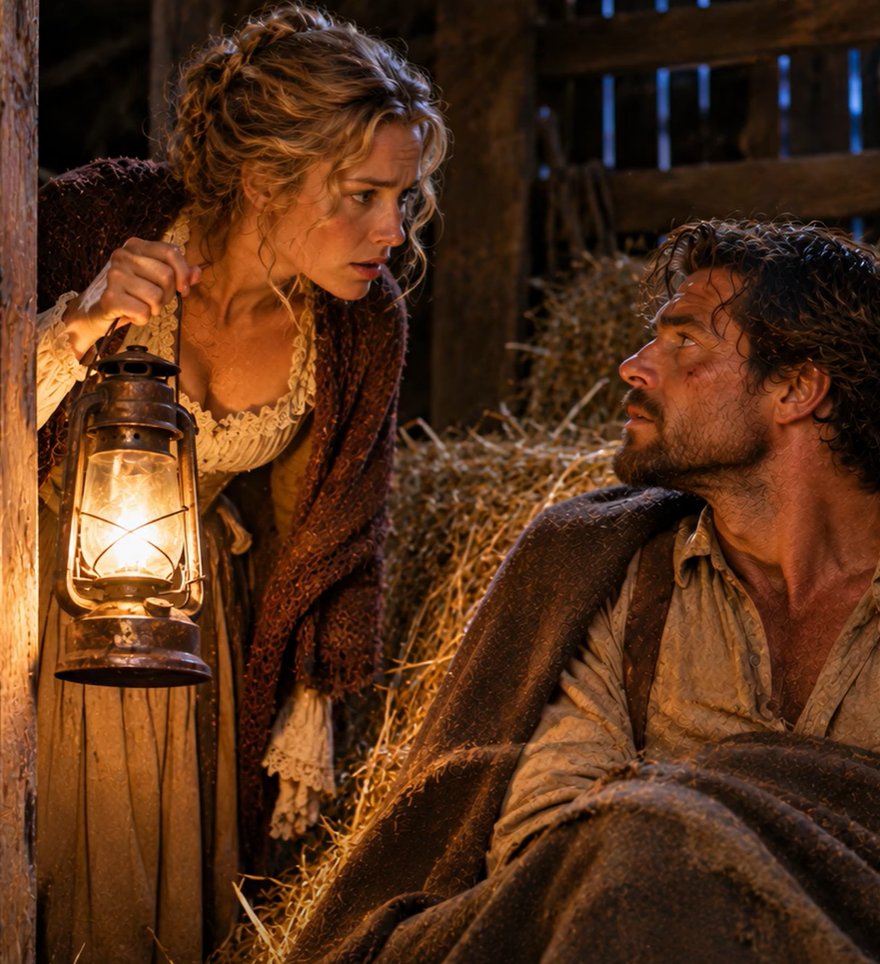
She took the lantern from its hook and pulled on her coat.
Outside, the snow reached her ankles.
She crossed the yard, pushed open the barn door, and lifted the lantern.
The stranger was kneeling beside the hay.
His satchel lay open.
In his hands was a small, faded photograph.
He was speaking softly to it.
"I'm sorry, sweetheart. I tried. God knows I tried."
Eleanor stepped closer.
The man turned.
For the first time, she saw genuine fear in his eyes.
Not fear of her.
Fear of what she might discover.
"What happened?" she whispered.
He tried to hide the photograph.
But she had already seen it.
A young woman sat in a wooden chair, holding a little girl with dark curls.
The child could not have been older than five.
Both were smiling.
Eleanor's gaze moved to the open satchel.
Inside lay a tiny blue mitten.
A silver hair ribbon.
And a newspaper clipping.
The headline was faded, but she could still read it.
"FAMILY PERISHES IN RAILWAY FIRE — FORMER DEPUTY ACCUSED OF NEGLIGENCE."
The stranger closed his eyes.
"My name is Samuel Bennett," he said.
His voice broke.
"And I buried my wife and daughter six years ago."
Eleanor lowered the lantern.
Samuel stared at the photograph.
"I was a deputy marshal in Kansas. My wife, Mary, and our little girl, Lily, were traveling to visit her sister. I was supposed to meet them at the station."
He swallowed.
"But there was a prisoner transport that morning. Three armed men. My superior ordered me to escort them."
He looked down at his hands.
"I chose my duty."
Outside, the wind battered the barn walls.
"The train caught fire near the crossing. They said a broken axle caused the derailment. Mary and Lily were in the second carriage."
Eleanor could barely breathe.
"Samuel..."
"I got there after midnight. By then, there was nothing left to save."
He pressed the photograph against his chest.
"The newspaper blamed the deputies for failing to secure the crossing. People needed someone to hate. I didn't argue. I hated myself more than they ever could."
"That wasn't your fault."
"You don't know that."
"I know you couldn't be in two places at once."
His face twisted.
"I promised Lily I'd bring her a wooden horse for Christmas. She stood on the porch waving when I rode away."
He opened his palm.
A tiny carved horse rested there.
"I still carry it."
Eleanor felt tears gathering.
She thought of Thomas's boots beneath her bed, untouched for three years.
His hat still hanging by the door.
The wedding ring she wore even while sleeping.
She understood then why Samuel had never asked to enter her house.
He believed he had forfeited the right to warmth.
To comfort.
To kindness.
Perhaps even to life itself.
She set the lantern on a barrel.
Then she knelt beside him.
"Samuel, look at me."
He resisted.
"Please."
Slowly, he raised his eyes.
"My husband died three winters ago," she said. "The morning he left, we argued about money. I told him he cared more about cattle than he did about me."
Samuel remained silent.
"Those were the last words I ever spoke to him."
Her voice trembled.
"For three years, I've wondered whether he died believing I didn't love him."
Samuel's expression softened.
"He knew."
"You can't know that."
"No," Samuel whispered. "But a marriage isn't measured by its last argument. It's measured by all the days that came before."
Eleanor stared at him.
No one had ever said those words to her.
She began to cry.
Samuel reached toward her, then hesitated.
Eleanor took his hand.
They remained there together, kneeling in the cold barn, two strangers holding the pieces of lives that had once been whole.
Finally, Eleanor stood.
"Come inside."
Samuel shook his head.
"Mrs. Whitmore..."
"There's a fire burning. There's supper on the stove. And you're bleeding through your coat."
"I don't want your pity."
"Good," she said. "Because I'm not offering pity."
She extended her hand.
"I'm offering you a chair."
He stared at her for several seconds.
Then he took it.
That night, Samuel Bennett entered Eleanor Whitmore's house for the first time.
He removed his boots by the door and stood awkwardly in the kitchen, as though afraid to touch anything.
Eleanor poured coffee into two cups.
She placed one across from her.
Samuel sat.
For a while, neither spoke.
Then he looked around the room.
"Your husband built this place?"
"Most of it."
"He was a fine carpenter."
"He was a terrible carpenter," Eleanor replied. "The shelves lean, the bedroom door sticks, and the pantry floor squeaks."
Samuel smiled.
It was a small smile.
But it transformed his face.
Eleanor found herself smiling back.
Over the next two weeks, Samuel stayed.
He repaired the barn doors, reinforced the chicken coop, and helped Eleanor bring in enough wood to survive the winter.
She cooked breakfast for two.
At first, they spoke only about ordinary things.
The weather.
The horses.
The price of grain.
But slowly, the silences between them changed.
They were no longer uncomfortable.
Sometimes Eleanor would look up from kneading bread and find Samuel watching the snow through the window.
"What are you thinking about?" she would ask.
"Nothing worth troubling you with."
"Then it must be something important."
Eventually, he began telling her stories.
About Kansas.
About his daughter, who had loved wildflowers and hated thunderstorms.
About Mary, who had laughed whenever he tried to sing.
Eleanor listened.
And when she spoke of Thomas, Samuel listened too.
Neither asked the other to forget.
That was what made their companionship different from anything Eleanor had known since becoming a widow.
They did not pretend the past had never happened.
They simply allowed room for something beyond it.
One evening, Samuel found Eleanor struggling to carry a heavy sack of flour.
He took it from her.
"You ought to let somebody help you once in a while."
"I've managed alone for three years."
"That doesn't mean you have to keep doing it."
She looked at him.
"And what about you?"
"What about me?"
"You've been punishing yourself for six."
Samuel said nothing.
But the following morning, he moved his few belongings from the barn into the small room beside the kitchen.
Eleanor did not mention it.
She merely placed a clean quilt on the bed.
By Christmas Eve, the town had begun talking.
Mrs. Bellamy declared that Eleanor was behaving disgracefully.
Reverend Collins came to the ranch and demanded to know whether Samuel intended to leave.
Samuel stood quietly beside the porch.
"I'll go if Mrs. Whitmore asks me."
The preacher turned to Eleanor.
"You must consider your reputation."
Eleanor folded her arms.
"My reputation hasn't chopped a single log, Reverend. It hasn't fixed my roof or fed my animals."
"That isn't the point."
"Then perhaps it's time somebody explained what the point is."
The preacher left without finishing his tea.
Samuel watched his wagon disappear down the road.
"You shouldn't have defended me."
"I wasn't defending you."
He looked puzzled.
"I was defending my right to decide who sits at my table."
That night, they decorated a small pine branch with ribbons and dried berries.
Samuel carved a wooden star for the top.
When Eleanor admired it, he looked embarrassed.
"Just something to pass the time."
"It's beautiful."
He turned away, but she saw the pleased expression he tried to hide.
Later, as they sat beside the fire, Eleanor noticed that Samuel was holding the little wooden horse again.
"Would you like to put it on the tree?" she asked gently.
He stared at her.
"I don't think I can."
"Then don't."
She reached for his hand.
"There's no hurry."
For a long time, he remained motionless.
Then he stood, walked to the little tree, and carefully hung the horse from a ribbon.
When he turned around, tears were running down his face.
Eleanor rose and embraced him.
He held her as though he had forgotten what it felt like to be held.
Outside, Christmas snow fell silently across the prairie.
Inside, for the first time in years, neither of them felt entirely alone.
But happiness, Eleanor soon discovered, could be as frightening as grief.
In January, a stranger rode into Silver Creek asking questions about Samuel Bennett.
His name was Deputy Marshal Frank Dorsey.
He had known Samuel in Kansas.
When he arrived at Eleanor's ranch, Samuel went pale.
Dorsey dismounted and removed his hat.
"Been looking for you a long time, Sam."
Samuel stepped forward.
"If you've come to arrest me, let's get it over with."
Dorsey frowned.
"Arrest you? For what?"
"The train."
The deputy stared at him.
"Good Lord, Sam. Haven't you heard?"
Samuel's hands began to shake.
"Heard what?"
Dorsey reached into his coat and withdrew a folded document.
"The railroad investigation was reopened last spring. They found the original maintenance records."
He handed Samuel the paper.
"The axle had been reported defective two weeks before the accident. The company ignored the warning. Then they altered the records."
Samuel read the document slowly.
His lips moved, but no words came.
Dorsey continued.
"The report clears you and the other deputies. Officially. Completely."
Samuel looked up.
"Six years."
"I know."
"Six years I've believed..."
His voice disappeared.
Dorsey placed a hand on his shoulder.
"You did your duty, Sam. You didn't cause that accident."
Samuel staggered backward.
Eleanor caught his arm.
He looked at her with the expression of a man watching the walls of his prison vanish.
Then he broke.
He sank onto the porch steps, buried his face in his hands, and wept.
Eleanor sat beside him.
She did not tell him to stop crying.
She did not say everything would be all right.
She simply held him until the shaking passed.
Dorsey stayed for supper.
Before leaving, he offered Samuel a position with the marshal's office in Cheyenne.
"Good pay. Steady work. You'd have your badge back."
Samuel looked at Eleanor.
She smiled, though her heart tightened.
"You should think about it."
After Dorsey departed, Samuel remained unusually quiet.
For three days, he considered the offer.
Eleanor tried not to imagine the ranch without him.
She told herself she had survived loneliness before.
She could survive it again.
But she had forgotten how much more painful an empty chair could become once someone had filled it.
On the fourth morning, she found Samuel packing his satchel.
Her stomach dropped.
"So you're leaving."
He turned.
"Eleanor..."
"You don't have to explain."
"I haven't decided."
"Your things are packed."
He looked down.
"I thought I ought to be ready."
She forced herself to nod.
"Then I hope Cheyenne treats you kindly."
She walked toward the door.
Samuel caught her hand.
"Wait."
Eleanor stopped but did not turn.
"I need to ask you something."
She stared at the floor.
"Go ahead."
"Would you miss me?"
The question was so simple that it nearly undid her.
She turned slowly.
"Every morning."
Samuel's expression changed.
"And every evening," she continued. "And every time the wind rattled the barn doors. Every time I poured coffee. Every time I looked at that crooked shelf you promised to fix."
A tear slipped down her cheek.
"I'd miss you terribly, Samuel Bennett."
He stepped closer.
"Then why are you letting me go?"
"Because loving someone doesn't mean keeping them where they don't want to be."
Samuel went still.
"Did you say loving?"
Eleanor closed her eyes.
She had not meant to say it.
But the truth was already standing between them.
"Yes."
Samuel reached up and gently brushed the tear from her cheek.
"Eleanor, I've spent six years wandering because I believed I didn't deserve a home."
His voice trembled.
"Then you found me in your barn and gave me bread when you had barely enough for yourself. You trusted me when you had every reason not to."
He took both her hands.
"I thought the best thing I could do was repair your fence and leave before I brought more sorrow into your life."
"And now?"
"Now I know I don't want a badge. I don't want Cheyenne. I don't want another road."
He swallowed.
"I want this kitchen. This ranch. Your stubborn cow. Your terrible coffee."
Eleanor laughed through her tears.
"My coffee is excellent."
"It's the worst coffee in Wyoming."
"Then why do you drink three cups every morning?"
"Because you're sitting across from me."
She began to cry again.
Samuel drew her gently into his arms.
"I love you, Eleanor. And if you'll have me, I'd like to spend whatever years God gives me proving it."
She lifted her face.
"You don't have to prove anything."
Then she kissed him.
It was not the desperate kiss of young lovers.
It was slow and trembling, filled with gratitude, grief, hope, and the astonishment of discovering that a heart could begin again.
That spring, Samuel planted wildflowers beside the porch.
He said they were for Lily.
Eleanor helped him choose the seeds.
Together, they repaired the ranch, expanded the vegetable garden, and bought two young horses.
When summer came, they married beneath the cottonwood tree behind the house.
Reverend Collins performed the ceremony.
Mrs. Bellamy brought a blackberry pie.
And Deputy Dorsey traveled from Cheyenne to stand beside Samuel.
There were no expensive flowers or grand decorations.
Only a simple white dress, a clean dark suit, and two people who had once believed their happiest days were behind them.
After the ceremony, Samuel carried Eleanor across the threshold.
She laughed and protested that he would hurt his back.
He kissed her forehead.
"Ma'am, I've carried heavier things than you."
"Such as?"
He paused.
"Regret."
Eleanor touched his cheek.
"Then it's a good thing you don't have to carry it alone anymore."
Years later, when travelers passed through Silver Creek, they often heard the story of the widow who had allowed a nameless stranger to sleep in her barn.
Some said she had been foolish.
Others called her brave.
But the people who knew Eleanor and Samuel understood that the truth was simpler.
On a freezing December night, one lonely soul had offered another a piece of bread.
In return, he had repaired a broken fence.
Neither could have known that, in the months that followed, they would help mend something far more precious.
Two broken hearts.
On every Christmas Eve, Samuel placed the little wooden horse on their tree.
Beside it hung a silver ribbon that had once belonged to Lily.
And beneath them, Eleanor always placed two cups of coffee.
One for herself.
One for the man who had arrived with nothing but sorrow and stayed to build a life with her.
Sometimes, when the winter wind howled across the prairie, Eleanor would look toward the old barn and remember the stranger lying alone in the straw.
She would reach for Samuel's hand.
And he would squeeze it gently.
Because the greatest love stories do not always begin with flowers, promises, or beautiful words.
Sometimes they begin with a broken fence.
A warm cup of coffee.
And a woman brave enough to open her door when the whole world tells her to keep it closed.
And sometimes, the person who comes into your life needing shelter becomes the very person who teaches your heart how to feel at home again.