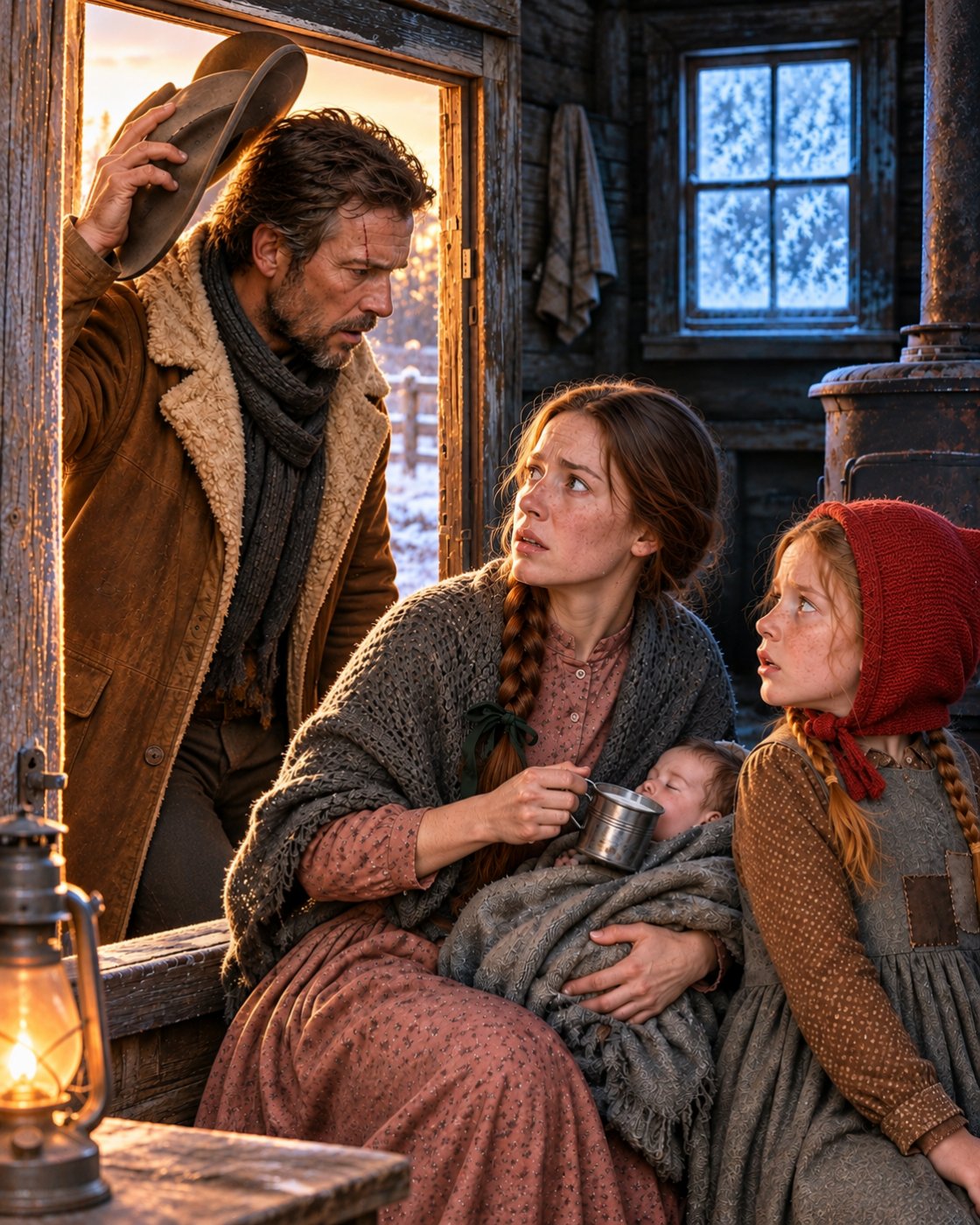
PART 3
The Widow Who Saved a Stranger’s Baby—and Found the Home She Thought She Had Lost Forever
Delia Sorrel's eyes closed.
For one terrible moment, the only sound in Jesse Corwin's kitchen was the wind battering the windows.
“Delia?”
Ambrose leaned over his wife.
“Delia, look at me.”
She did not answer.
His voice rose.
“Lena! Do something!”
Lena Sorrel stood beside the bed, her hands trembling.
The room seemed to disappear.
She was no longer in a warm ranch house in Nebraska.
She was back in St. Louis, years earlier, standing beside another bed, listening to another desperate husband begging her to save the woman he loved.
She remembered the bloodless face.
The terrible silence.
The moment she had realized that all her training, all her experience, and all her determination could not guarantee that every mother and child would survive.
For years, she had carried that memory like a punishment.
Now it threatened to paralyze her when another woman needed her most.
“Lena.”
Jesse's voice reached her through the fear.
She turned.
He stood beside the bed holding a basin of warm water.
His expression was serious but steady.
“Tell me what to do.”
Lena swallowed.
“I…”
He stepped closer.
“Look at me.”
She did.
“You know what you're doing.”
Her eyes filled.
“Jesse, the last time—”
“I know.”
“I lost them.”
“I know.”
He set the basin down.
“But Delia is here now. And she needs you.”
Lena looked toward the bed.
Ambrose was holding his wife's hand.
His expensive coat lay forgotten on the floor.
His face had lost every trace of the confidence he had carried into the house.
He was simply a frightened husband.
“Please,” he whispered. “Please help her.”
Lena drew a slow breath.
Then she moved.
“Jesse, bring the lamp closer.”
He obeyed.
“Ambrose, keep talking to her. Tell her you're here.”
Ambrose leaned toward Delia.
“Darling, I'm right beside you.”
“Pearl,” Lena called toward the doorway, “take your brother into the sitting room.”
The little girl stood clutching the baby's blanket.
“Is Aunt Delia going to die?”
Lena knelt briefly before her.
“We're doing everything we can to help her.”
Pearl's eyes filled.
“Like Papa?”
The question struck Lena deeply.
Walter's death had been sudden.
One week he had been laughing with Pearl beside the kitchen table.
The next, typhoid fever had taken him.
Pearl had never fully understood why her father could not come home.
Lena touched her daughter's cheek.
“Sweetheart, I need you to be brave for your little brother.”
Pearl nodded.
“Can I pray?”
“Of course.”
The girl disappeared into the sitting room.
Lena turned back toward Delia.
There was no time left for fear.
Only work.
Outside, the ice storm intensified.
Branches snapped beneath the weight of freezing rain.
The barn roof groaned.
The wind drove snow across the yard in thick white sheets.
Inside, Jesse kept the fire burning.
He carried water.
He warmed clean cloths.
He moved furniture to give Lena room.
And whenever she asked for something, he brought it without argument.
Ambrose remained beside Delia.
At first, he tried to give instructions.
He asked whether the doctor could be summoned.
He demanded to know how long the delivery would take.
He questioned whether Lena was certain of what she was doing.
Finally, she looked directly at him.
“Mr. Sorrel.”
He stopped.
“Your wife needs you calm.”
His mouth opened.
Then closed.
Lena continued.
“I know you're frightened. But she needs to hear your voice, not your fear.”
Ambrose stared at her.
Then he nodded.
“All right.”
He bent toward Delia.
“I'm here, my love.”
Delia stirred.
Her eyes opened slightly.
“Ambrose?”
He nearly collapsed with relief.
“Yes. Yes, I'm here.”
She looked toward Lena.
“I'm frightened.”
Lena took her hand.
“I know.”
“Will the baby be all right?”
“We're going to help you through this.”
Delia began crying.
“I lost two before this one.”
Ambrose lowered his head.
Lena looked between them.
“Two?”
Delia nodded weakly.
“Two little boys. Neither lived a week.”
Lena felt her heart tighten.
She had known Ambrose and Delia had no surviving children.
She had not known why.
Delia continued through tears.
“When Walter died, Ambrose said we should bring Pearl and the baby home.”
Ambrose looked away.
“We thought…”
His voice broke.
“We thought we could give them everything.”
Lena understood.
Their attempt to take her children had not come only from arrogance.
It had come from grief.
They had lost two babies.
They feared losing another.
And they had convinced themselves that bringing Walter's children into their home would somehow fill the emptiness.
Lena felt compassion.
But she also felt a fierce certainty.
Their grief did not give them the right to take her children.
“Delia,” she said gently, “you need to save your strength.”
The woman nodded.
Lena returned to her work.
For another hour, the room was filled with quiet instructions, strained breathing, and the steady sound of Jesse moving between the kitchen and the fire.
Then Delia cried out.
Ambrose tightened his grip on her hand.
“Lena!”
“I know.”
Lena leaned closer.
“Delia, listen to me.”
The woman looked at her.
“We're close.”
“I can't.”
“You can.”
“I can't do it.”
Lena remembered every mother she had helped in St. Louis.
The frightened young women.
The exhausted wives.
The women who had believed their strength was gone.
She remembered the joy of hearing a newborn cry.
And she remembered the one terrible night that had made her forget all the others.
“Delia,” she said firmly, “look at me.”
The woman obeyed.
“You've come this far.”
Tears ran down Delia's cheeks.
“I'm so tired.”
“I know.”
Lena squeezed her hand.
“But you're not alone.”
Jesse stood beside the bed.
“Neither of you is.”
Delia looked toward him.
For a moment, she seemed surprised that this quiet rancher, a man she had met only hours earlier, was standing there helping her through the most frightening night of her life.
Then she nodded.
Lena returned to her work.
“Now, one more effort.”
Delia cried out.
Ambrose held her hand.
Jesse steadied the lamp.
And suddenly, through the wind and the storm, a new sound filled the room.
A baby's cry.
For one stunned moment, nobody moved.
Then Lena lifted the newborn carefully.
“A girl,” she whispered.
Delia began sobbing.
“A girl?”
Lena smiled through tears.
“A strong little girl.”
Ambrose stared.
His face crumpled.
“She's alive?”
“Yes.”
He covered his mouth.
Then he began crying openly.
Delia reached toward the baby.
Lena placed the child against her mother's chest.
The tiny girl moved and cried again.
Delia kissed her forehead.
“Oh, my darling.”
Ambrose knelt beside the bed.
He touched one tiny hand with his finger.
The baby curled her fingers around it.
He laughed through tears.
“She's holding me.”
Delia smiled weakly.
“She knows her father.”
Ambrose bent his head and kissed his wife's hair.
For several minutes, nobody spoke.
There was nothing to say.
The storm still raged outside.
The roads were still closed.
The future remained uncertain.
But a little girl had entered the world.
And she was alive.
Lena stepped into the kitchen after making sure Delia and the baby were resting comfortably.
Her hands were shaking.
She sat beside the table.
For a moment, she stared at the empty cup before her.
Then she began crying.
Jesse entered carrying fresh firewood.
He stopped.
“Lena?”
She covered her face.
“I thought I couldn't do it.”
He set down the wood.
Then he knelt beside her.
“But you did.”
She shook her head.
“I was so afraid.”
“I know.”
“I kept seeing that mother in St. Louis.”
Jesse waited.
Lena looked at him through tears.
“She was young. Younger than I was. Her husband had been saving money for a cradle.”
Her voice trembled.
“I remember the little blanket he brought.”
Jesse sat beside her.
“I remember every detail.”
He did not interrupt.
“I remember thinking that if I had done one thing differently, perhaps…”
She stopped.
Jesse took her hand.
“You don't know that.”
“No.”
She looked down.
“But I blamed myself anyway.”
For a long moment, neither spoke.
Then Jesse said something she had not expected.
“When Abigail died, I blamed myself.”
Lena turned.
“I thought if I'd sent for the doctor earlier, he'd have arrived before the storm.”
“Jesse…”
“I thought if I'd built the house closer to town, she'd have survived.”
He swallowed.
“I thought if I'd been a better husband, a better man, somehow I could have kept her alive.”
Lena's eyes filled.
“You couldn't control the storm.”
“No.”
He looked at her.
“And you couldn't control every life you were asked to help bring into the world.”
The words settled between them.
Lena looked toward the bedroom where Delia rested with her newborn.
For years, she had believed that one terrible loss defined her.
Now she had helped another mother survive.
It did not erase the past.
But it reminded her that the past was not the whole story.
Jesse squeezed her hand.
“You gave that family something precious tonight.”
Lena looked at him.
“So did you.”
He smiled faintly.
“I mostly carried water.”
“You stayed.”
His expression changed.
She continued softly.
“When I was frightened, you stayed.”
Jesse looked down at their joined hands.
For four years, he had lived alone in a house that seemed too large for one man.
He had kept the guest rooms closed.
He had avoided the little cradle he had built for a child who never came.
He had told himself that loneliness was easier than risking another heartbreak.
Then an eight-year-old girl had stolen milk from his cow.
And everything had changed.
The next morning, the storm had weakened.
Snow covered the fields.
The sky remained gray, but the wind had finally settled.
Pearl woke before sunrise.
She crept into the kitchen carrying her baby brother.
Jesse was sitting beside the stove, drinking coffee.
“Mr. Corwin?”
He looked up.
“Morning, Pearl.”
“Is Aunt Delia all right?”
He smiled.
“She is.”
“And the baby?”
“She's sleeping.”
Pearl looked relieved.
Then she climbed into the chair beside him.
“Can I ask something?”
“Go ahead.”
“Did Mama save the baby?”
Jesse nodded.
“She did.”
Pearl smiled proudly.
“I knew she could.”
Jesse looked at her.
“You did?”
“Mama can do anything.”
He laughed softly.
Pearl studied his face.
“Mr. Corwin?”
“Yes?”
“Are you going to marry my mama?”
Jesse nearly spilled his coffee.
He set the cup down.
“That's a serious question for this early in the morning.”
Pearl shrugged.
“I'm serious.”
He looked toward the hallway.
“Your mother has to decide what she wants.”
Pearl considered that.
“Do you want to?”
Jesse was silent.
Then he smiled.
“More than anything.”
Pearl grinned.
“Then you should ask her nicely.”
Jesse laughed.
“I'll remember that.”
She climbed down from the chair.
“And don't offer her a house.”
He blinked.
“Why not?”
“Because Mama gets cross when people think she needs rescuing.”
Jesse stared at her.
Then he laughed harder than he had in years.
“You're a clever girl, Pearl Sorrel.”
She smiled.
“Mama says I get it from Papa.”
Jesse's expression softened.
“I believe her.”
Pearl hurried toward the bedroom to see the newborn.
Jesse remained beside the stove.
He looked at the small tin cup resting on the shelf.
The cup Pearl had used to steal milk from Duchess.
He had kept it because it reminded him of the day his lonely life had changed.
Now he wondered whether he would ever find the courage to tell Lena what she meant to him.
Ambrose entered the kitchen shortly after breakfast.
He looked exhausted.
His expensive clothes were wrinkled.
His eyes were red.
But there was something different about him.
The sharp confidence had softened.
“Mr. Corwin.”
Jesse stood.
“Morning.”
Ambrose glanced toward the hallway.
“Delia and the baby are sleeping.”
“Good.”
He hesitated.
“I owe you thanks.”
Jesse shook his head.
“Your wife did the hard work.”
Ambrose smiled faintly.
“Yes.”
He looked toward the stove.
“And Lena.”
Jesse nodded.
“She knows what she's doing.”
Ambrose sat.
For a while, he stared at the table.
Then he spoke quietly.
“I thought I was doing the right thing.”
Jesse waited.
“Walter was my younger brother.”
“I know.”
“He was always the gentler one.”
Ambrose smiled sadly.
“He married for love. I married for stability.”
Jesse said nothing.
“When he died, I thought the least I could do was protect his children.”
“They have a mother.”
Ambrose lowered his eyes.
“I know that now.”
He swallowed.
“I saw Lena last night.”
Jesse looked at him.
“Not just as Walter's widow. Not as a woman with no money.”
Ambrose's voice broke.
“I saw what she could do.”
Jesse nodded.
Ambrose continued.
“She saved my wife.”
“And your daughter.”
Ambrose looked toward the hallway.
“Yes.”
For a moment, he could not speak.
Then he reached into his coat.
He removed the folded guardianship order.
Jesse's expression hardened.
Ambrose noticed.
“I came here believing this paper made me the better guardian.”
He unfolded it.
Then he stared at the words.
“I thought a large house and warm rooms were enough.”
Jesse remained silent.
Ambrose slowly tore the paper in half.
Then again.
And again.
He placed the pieces on the table.
“I'll withdraw the petition.”
Jesse exhaled.
“Have you told Lena?”
“Not yet.”
“Then you should.”
Ambrose nodded.
“I will.”
He looked toward the doorway.
“And Mr. Corwin?”
“Yes?”
“Thank you for giving us shelter.”
Jesse smiled.
“Duchess has a habit of bringing people together.”
Ambrose frowned.
“The cow?”
Jesse laughed.
“The very same.”
When Lena entered the kitchen, Ambrose stood.
She stopped immediately.
Her eyes moved toward the torn paper on the table.
“What is that?”
Ambrose took a slow breath.
“The guardianship order.”
Lena went still.
“What have you done?”
“I've withdrawn my claim.”
She stared.
“Ambrose…”
He stepped closer.
“I was wrong.”
Her eyes filled.
He continued.
“I thought because you were poor, you couldn't care for Walter's children.”
Lena lowered her gaze.
“I know.”
“I thought I was helping.”
“You were taking them away.”
The words were quiet.
But they struck him deeply.
Ambrose nodded.
“Yes.”
For a moment, neither spoke.
Then he looked at her.
“Delia and I lost two babies.”
Lena nodded.
“She told me.”
“We thought…”
His voice broke.
“We thought perhaps raising Pearl and the baby would make the house feel less empty.”
Lena's expression softened.
“I understand your grief, Ambrose.”
He looked up.
“But my children aren't something you can use to fill it.”
He closed his eyes.
“No.”
She stepped closer.
“They are Walter's children. And mine.”
Ambrose nodded.
“I know.”
Tears ran down his face.
“I'm sorry.”
Lena stood silently.
Then she reached for his hand.
“I don't want you out of their lives.”
He looked at her.
“You don't?”
“Of course not.”
She smiled through tears.
“Pearl needs to know her father's family. And my son deserves to know the people who loved Walter.”
Ambrose began crying.
“But they belong with me.”
He nodded.
“Yes.”
Lena squeezed his hand.
“They always did.”
For the first time since Walter's death, she felt the fear that had followed her across the country begin to loosen.
She would not have to run.
She would not have to hide.
She would not have to surrender her children to prove that she loved them.
They were hers.
And she could finally begin building a future instead of merely surviving the present.
The roads reopened two days later.
Ambrose and Delia prepared to return to St. Louis with their newborn daughter.
Before leaving, Delia asked Lena to visit her room.
The baby slept in a small basket beside the bed.
Delia looked tired but happy.
“Lena.”
“Yes?”
“I don't know how to thank you.”
Lena smiled.
“You already have.”
Delia shook her head.
“You gave me my daughter.”
“You brought her into the world.”
“With your help.”
Lena sat beside her.
For a moment, they watched the sleeping child.
Then Delia reached for Lena's hand.
“I want to name her after you.”
Lena stared.
“What?”
“Lena.”
Her eyes filled.
“Delia…”
“I want her to know the woman who helped her arrive.”
Lena covered her mouth.
For years, she had believed that her work as a midwife had ended in failure.
Now a child would carry her name.
Not because she had been perfect.
But because she had found the courage to try again.
Delia smiled.
“Will you allow it?”
Lena nodded through tears.
“Yes.”
The women embraced.
And in that moment, the last of the shame Lena had carried from St. Louis began to fade.
That afternoon, the family gathered beside the wagon.
Ambrose held his newborn daughter carefully.
Delia sat wrapped in blankets.
Pearl stood beside Lena, holding her baby brother's hand.
Jesse carried the luggage.
Ambrose approached him.
“Mr. Corwin.”
Jesse nodded.
“Sir.”
Ambrose extended his hand.
“I hope you'll write.”
Jesse smiled.
“I reckon Lena will.”
Ambrose looked toward her.
“Every month?”
Lena nodded.
“Every month.”
Delia smiled.
“And perhaps we'll visit in the spring.”
Pearl brightened.
“Can you meet Duchess?”
Ambrose laughed.
“I suppose we must.”
Jesse leaned toward him.
“Just don't try to milk her.”
Ambrose looked puzzled.
Pearl giggled.
“She doesn't like men with whiskers.”
Jesse touched his beard.
“Apparently not.”
Everyone laughed.
For the first time, the two families stood together without fear or resentment.
Then Ambrose climbed into the wagon.
He looked toward Lena.
“Take care of yourself.”
She smiled.
“You too.”
The wagon rolled slowly down the snowy road.
Pearl waved until it disappeared beyond the cottonwood trees.
Then she turned toward Jesse.
“Mr. Corwin?”
“Yes?”
“Can we go see Duchess?”
He smiled.
“Of course.”
Pearl ran toward the barn.
Lena watched her go.
Then she looked at Jesse.
For a moment, neither spoke.
The air was cold.
The fields were white.
The ranch house stood warm and welcoming behind them.
Lena knew she could remain in the line shack until spring.
She had work.
She had money saved from selling butter.
Her children were safe.
For the first time in months, she had choices.
And one of those choices frightened her more than any court order ever had.
Jesse stepped closer.
“Lena.”
She looked up.
“Yes?”
“There's something I need to say.”
Her heart began beating faster.
He glanced toward the barn.
Then back at her.
“I know I asked you to marry me before.”
She nodded.
“And I know you said no.”
“Yes.”
“I don't blame you.”
She looked down.
“I was afraid.”
“I know.”
“I thought if I accepted, I'd owe you for the rest of my life.”
Jesse smiled sadly.
“I remember.”
She raised her eyes.
“But you never treated me like I owed you.”
“No.”
“You gave me work.”
“Yes.”
“You let me bargain.”
He laughed.
“You bargain like a horse trader.”
She smiled.
“And you never asked me to be grateful.”
Jesse shook his head.
“Because you earned everything you were given.”
Lena felt tears rising.
He continued.
“I don't want you to marry me because you need a roof.”
She swallowed.
“I know.”
“And I don't want you to marry me because your children need a father.”
She looked toward the barn.
Pearl was laughing as Duchess snorted at her.
Jesse's voice softened.
“I want you to stay because I love you.”
Lena closed her eyes.
For a moment, she saw Walter.
His kind face.
His gentle smile.
The way he had held their daughter when she was born.
She had loved him deeply.
She always would.
But love, she was beginning to understand, did not end simply because life changed.
It could remain as memory.
And it could begin again.
She opened her eyes.
“Jesse…”
He waited.
“I thought I would never love another man.”
His expression softened.
“So did I.”
She smiled through tears.
“But I do.”
Jesse stared.
“You do?”
Lena nodded.
“I love you.”
For a moment, he looked as though he had forgotten how to breathe.
Then he laughed softly.
A sound filled with disbelief and joy.
He reached for her hand.
“Then stay.”
She smiled.
“I will.”
“Not just until spring?”
She shook her head.
“No.”
“For good?”
“For good.”
Jesse drew her gently into his arms.
Lena rested her head against his chest.
For the first time since Walter's death, she allowed herself to imagine a future that did not begin with fear.
A home.
A family.
A man who loved her.
And children who would grow up knowing that kindness could change the course of a life.
Jesse kissed her forehead.
“I reckon I'll owe you every day for the rest of my life.”
Lena laughed.
“Good.”
He smiled.
“Good?”
“Yes.”
She looked up at him.
“Because I'll owe you, too.”
Spring arrived slowly that year.
The snow melted from the fields.
The creek began flowing again.
Grass appeared along the fences.
And Duchess, who had once kicked every pail Jesse placed beneath her, finally began allowing him to approach without complaint.
Pearl declared it a miracle.
Jesse insisted the cow had simply become more reasonable.
Lena laughed.
“Perhaps she finally decided you weren't so frightening.”
Jesse looked offended.
“I've never frightened that cow.”
Pearl giggled.
“She frightened you.”
Jesse sighed.
“I'm surrounded by difficult women.”
Lena smiled.
“And you love every one of us.”
He looked at her.
“Yes.”
His voice softened.
“I do.”
They were married beneath the cottonwood trees in late April.
The ceremony was small.
Pearl carried wildflowers.
The baby slept in Lena's arms until the minister began speaking, then woke and cried loudly enough to make everyone laugh.
Jesse stood beside Lena wearing his best coat.
His beard was neatly trimmed.
His hands were rough from work.
But his eyes shone with a happiness he had not felt in four years.
When the minister asked whether he would love and honor Lena, Jesse answered without hesitation.
“I will.”
Lena looked at him.
For a moment, she remembered the first time she had seen him.
A stern rancher standing in the doorway of a freezing line shack.
She had been frightened.
Proud.
Determined not to accept charity.
Now she understood that he had never wanted to make her dependent.
He had wanted to give her a chance.
And she had given him one in return.
When the minister pronounced them husband and wife, Jesse kissed her gently.
Pearl clapped.
The baby cried again.
And Duchess let out a loud moo from the nearby pasture.
Everyone laughed.
That evening, after the guests had gone, Jesse carried something into the house.
It was a wooden cradle.
The same one Pearl had discovered months earlier.
Lena stopped in the doorway.
“Jesse…”
He set it beside the fireplace.
“I built it for Abigail.”
Lena nodded.
“I know.”
He ran one hand along the polished wood.
“For years, I couldn't bear to look at it.”
She stepped closer.
“I understand.”
He looked at her.
“But now there's a baby in this house.”
Lena's eyes filled.
Jesse smiled.
“And he needs somewhere to sleep.”
She reached for his hand.
“Are you certain?”
He nodded.
“Abigail would have wanted it used.”
Lena looked at the cradle.
For a moment, she thought of all the grief that had lived inside the ranch house.
The empty rooms.
The silent kitchen.
The cradle that had never held a child.
Then she looked toward the doorway.
Pearl stood there holding her baby brother.
“Can he sleep in it, Mama?”
Lena smiled.
“Yes, sweetheart.”
Pearl carried the baby carefully toward the cradle.
Jesse helped her lower him onto the soft blanket.
The little boy stirred.
Then settled.
Pearl looked up.
“He likes it.”
Jesse smiled.
“I reckon he does.”
Lena stood beside him.
Her eyes were wet.
“Thank you.”
He shook his head.
“No.”
He looked toward the sleeping child.
“Thank you.”
Years later, people in Kearney still told the story of the little girl who had stolen milk from a lonely rancher's cow.
Some remembered how Jesse Corwin had followed her footprints through the snow.
Others remembered the widow who had refused charity but agreed to churn butter.
And some remembered the ice storm that trapped two families beneath one roof and brought a newborn child safely into the world.
But Pearl remembered something simpler.
She remembered being cold.
She remembered being hungry.
She remembered holding a tin cup beneath Duchess and praying that nobody would catch her.
And she remembered the tall rancher who found her.
He had not shouted.
He had not punished her.
He had followed her home.
And when he saw her mother and baby brother, he had chosen kindness.
That kindness had changed everything.
One warm summer morning, Pearl stood beside Duchess with a pail in her hands.
Jesse approached.
“Need help?”
She grinned.
“Are you sure?”
He raised an eyebrow.
“What's that supposed to mean?”
“She doesn't like you.”
Jesse looked at the cow.
Duchess flicked her tail.
“I believe we've settled our differences.”
Pearl laughed.
“Then prove it.”
Jesse knelt beside the cow.
He placed the pail carefully.
Duchess stood still.
Pearl stared.
“She lets you!”
Jesse smiled.
“Apparently.”
Lena appeared in the barn doorway carrying the baby.
She watched her husband and daughter laughing beside the cow.
For a moment, she remembered the frightened widow she had once been.
The woman who believed she had nothing left to offer.
The woman who had been willing to walk away from warmth rather than accept something she could not repay.
Now she understood that love was not a debt.
It was a gift freely given.
And sometimes, the greatest kindness came from someone who needed healing just as badly as the person he helped.
Pearl looked toward her.
“Mama!”
“Yes, sweetheart?”
“Duchess finally likes Jesse!”
Lena smiled.
“Took her long enough.”
Jesse laughed.
“Four years.”
Lena walked toward him.
She touched his cheek.
“Some hearts take longer to trust.”
He looked at her.
“And some are worth waiting for.”
She kissed him.
Pearl made a disgusted face.
“Mama!”
They laughed.
Outside, the Nebraska sun rose over the fields.
The creek sparkled.
The ranch house stood warm and full of life.
And the little tin cup that had once carried stolen milk now rested on the kitchen shelf.
Jesse had kept it.
Not as evidence of a theft.
But as a reminder of the morning a hungry child had led him toward the family he never expected to find.
Because sometimes, the smallest act of desperation opens the door to the greatest love.
And sometimes, a lonely man discovers that the home he thought was empty was simply waiting for the right people to arrive.