PART 3
The courthouse in Larkspur Flats had never held so many people.
Farmers crowded the benches. Merchants stood along the walls. Two women shared a chair near the back, while several men remained in the doorway because there was nowhere else to sit.
At the front of the room, Elias Hartwell stood beneath the stern gaze of the territorial examiner.
Across the aisle, Edmund Voss watched with the satisfied expression of a man who believed he had already won.
Ivy Caldwell sat beside her daughter, her father's notebook pressed against her knees.
Nell's small hand slipped into hers.
“Is Mr. Elias in trouble, Mama?”
Ivy looked toward the man who had arrived in her barn with nothing but a battered leather case and a desperate need for shelter.
“I don't know, sweetheart.”
Nell frowned.
“But he told the truth.”
“I know.”
“Then why would anybody punish him?”
Ivy had spent years printing questions that powerful men disliked.
She had never struggled so much to answer one.
The examiner called Elias forward.
He wore a freshly washed shirt borrowed from Sheriff Pruitt and a dark coat that still showed signs of hard traveling. His beard had been trimmed, revealing a strong jaw and a face more handsome than Ivy had first realized.
But it was his eyes that held her attention.
Those steady gray-blue eyes were searching for hers.
When their gazes met, he gave the smallest nod.
Ivy returned it.
Then the questioning began.
“Mr. Hartwell, were you employed by the Wyoming and Platte Central Railway?”
“Yes, sir.”
“Did you remove survey drawings and notebooks from company custody without authorization?”
Elias hesitated.
The room became very still.
“Yes.”
A murmur passed through the crowd.
Voss leaned back.
His attorney, Mr. Bellamy, stepped forward.
“So you admit taking documents that did not belong to you?”
“I admit removing the original drawings I prepared while employed by the company.”
“Without permission?”
“Yes.”
“And you subsequently concealed yourself on Mrs. Caldwell's property?”
“I sought shelter there.”
“Because you feared arrest?”
“Because two men had followed me across three towns, and I believed they intended to take the drawings before anyone could examine them.”
Bellamy smiled.
“Believed, Mr. Hartwell? Or knew?”
“Believed.”
“Then you have no proof those men intended to harm you?”
“No direct proof.”
Voss's smile widened.
Ivy felt her stomach tighten.
Elias was answering honestly, but each answer seemed to strengthen the accusation against him.
Bellamy lifted one of the survey sheets.
“Isn't it possible that you altered these maps yourself after being dismissed?”
“No.”
“Can you prove that?”
“Yes.”
For the first time, Elias's voice grew firm.
“My field notebooks contain measurements made during the original survey. Those measurements correspond to physical markers placed in the ground before the route was changed.”
Bellamy waved dismissively.
“Measurements written by the accused himself.”
“Measurements that can be independently verified.”
The examiner leaned forward.
“Explain.”
Elias described the original railroad route along the ridge, the altered route crossing the farms, and the numbered iron marker beside Ivy's spring.
Then Sheriff Pruitt was called.
The sheriff removed his hat and spoke slowly.
“I rode to the spring with a county engineer. We found marker number forty-two where Mr. Hartwell's notes said it would be.”
“And the measurements?” asked the examiner.
“They matched the original field records.”
The county engineer confirmed the sheriff's account.
More importantly, he explained that the published railroad route did not correspond to the established markers and distances.
The maps were not simply different artistic interpretations.
They represented conflicting surveys.
And one had been altered.
Voss shifted in his chair.
Bellamy objected that no evidence established who had ordered the change.
The examiner agreed that the question remained open.
But the evidence was enough to justify further investigation.
Then Ivy was called.
She walked to the front carrying her father's notebook.
Bellamy examined her with thinly disguised contempt.
“Mrs. Caldwell, you publish a newspaper?”
“I do.”
“And you've printed articles criticizing the railroad?”
“I've printed questions about its proposed route.”
“Questions designed to stir public anger?”
“Questions designed to receive answers.”
A few people chuckled.
Bellamy's expression tightened.
“Isn't it true that you offered shelter to Mr. Hartwell after learning he was wanted for removing company documents?”
“I sheltered a man who told me he had evidence that my neighbors and I were being deceived.”
“Despite knowing he might be a criminal?”
“I knew there was a complaint against him. I did not know whether it was justified.”
“Yet you believed him?”
“I examined his evidence.”
Bellamy stepped closer.
“Or perhaps you believed him because you had become personally attached to him?”
The room fell silent.
Ivy felt heat rise into her cheeks.
Across the aisle, Elias stiffened.
Bellamy continued.
“A widow living alone, a mysterious stranger appearing at her farm, several nights spent together examining documents. Would you describe your relationship as entirely professional?”
Ivy straightened.
“I'm not a widow, Mr. Bellamy. My former husband abandoned our family, and our marriage was legally dissolved. I have raised my daughter and supported my farm without his assistance.”
Bellamy looked briefly uncomfortable.
“That does not answer my question.”
“No,” Ivy said. “It answers the suggestion beneath it.”
A ripple of approval moved through the room.
The examiner struck his desk lightly.
“Order.”
Ivy turned toward him.
“Sir, whether I care for Mr. Hartwell has no bearing on where the railroad's survey markers stand. You may question my judgment, but you cannot move an iron pin by questioning my character.”
This time, the laughter was impossible to suppress.
Even Sheriff Pruitt lowered his head to hide a smile.
Elias looked at Ivy as though he had never seen anyone quite like her.
And perhaps he hadn't.
The hearing continued for hours.
Mr. Fenn, the feed-store owner, produced a purchase offer from Voss's office dated weeks before the railroad route became public.
A neighboring widow presented another.
A farmer from the southern valley testified that he had been warned his property would become worthless unless he sold immediately.
Each account added another piece to the troubling pattern.
Then Ivy produced the special edition of the Larkspur Weekly.
Four hundred copies had already circulated throughout the county.
The newspaper did not accuse Voss of crimes that had not been proven.
Instead, it displayed the two railroad routes, the recorded measurements, the land offers, and the questions that remained unanswered.
The examiner studied the pages for a long time.
Finally, he adjourned the hearing.
His decision would come the following week.
Outside the courthouse, the crowd broke into anxious conversations.
Some people shook Ivy's hand.
Others congratulated Elias.
But when Sheriff Pruitt approached, the relief faded.
“The complaint against Mr. Hartwell hasn't been dismissed,” he explained. “Until the examiner decides how the documents are to be handled, Elias remains in my custody.”
Nell's face crumpled.
“But he told the truth!”
The sheriff crouched beside her.
“That he did, little lady.”
“Then why can't he come home?”
Pruitt looked toward Elias.
“Sometimes the law takes longer to catch up with the truth than we'd like.”
Elias knelt before Nell.
“Remember the map I drew you?”
She nodded.
“Remember what I said about finding the ocean?”
“You said you'd show me someday.”
“I still want to.”
Her eyes filled.
“People always say someday.”
The words struck him harder than anything Bellamy had said inside the courthouse.
Elias glanced at Ivy.
She stood very still.
Then he took Nell's hands.
“I won't promise you a day I cannot guarantee,” he said gently. “But I can promise I won't disappear without telling you where I'm going.”
Nell studied his face.
“That's better,” she whispered.
Ivy turned away before either of them saw her tears.
That night, she returned to the farm alone with her daughter.
The kitchen felt strangely empty.
Elias's pencils were gone from the table.
His coat no longer hung beside the back door.
Even the neat stack of maps he had arranged seemed to leave a space in the room.
Nell sat on a crate beside the printing press.
“Are you going to make another newspaper?”
“Yes.”
“About Mr. Elias?”
“About what happened today.”
Nell considered this.
“Will you put in the part where he told the truth even though it made him look bad?”
Ivy stopped setting type.
“Yes,” she said softly. “I think that's the most important part.”
For the next six days, Ivy worked harder than she ever had.
She interviewed witnesses, checked dates, and printed every confirmed detail she could establish.
She refused to exaggerate.
She refused to turn suspicion into certainty.
And she refused to let the town forget the four families whose farms remained threatened.
By the time the examiner returned, nearly everyone in the valley knew what was at stake.
The ruling came on a cold Tuesday morning.
The territorial authorities would open a formal investigation into the disputed survey and the land transactions surrounding it.
All proposed seizures affecting the four farms were suspended pending review.
The railroad was ordered to preserve its original records.
And the complaint against Elias would not be pursued while investigators examined the circumstances under which he had removed the maps.
It was not a complete victory.
The investigation could take months.
But Ivy's farm was safe for the moment.
The spring would remain untouched.
And Elias could return home.
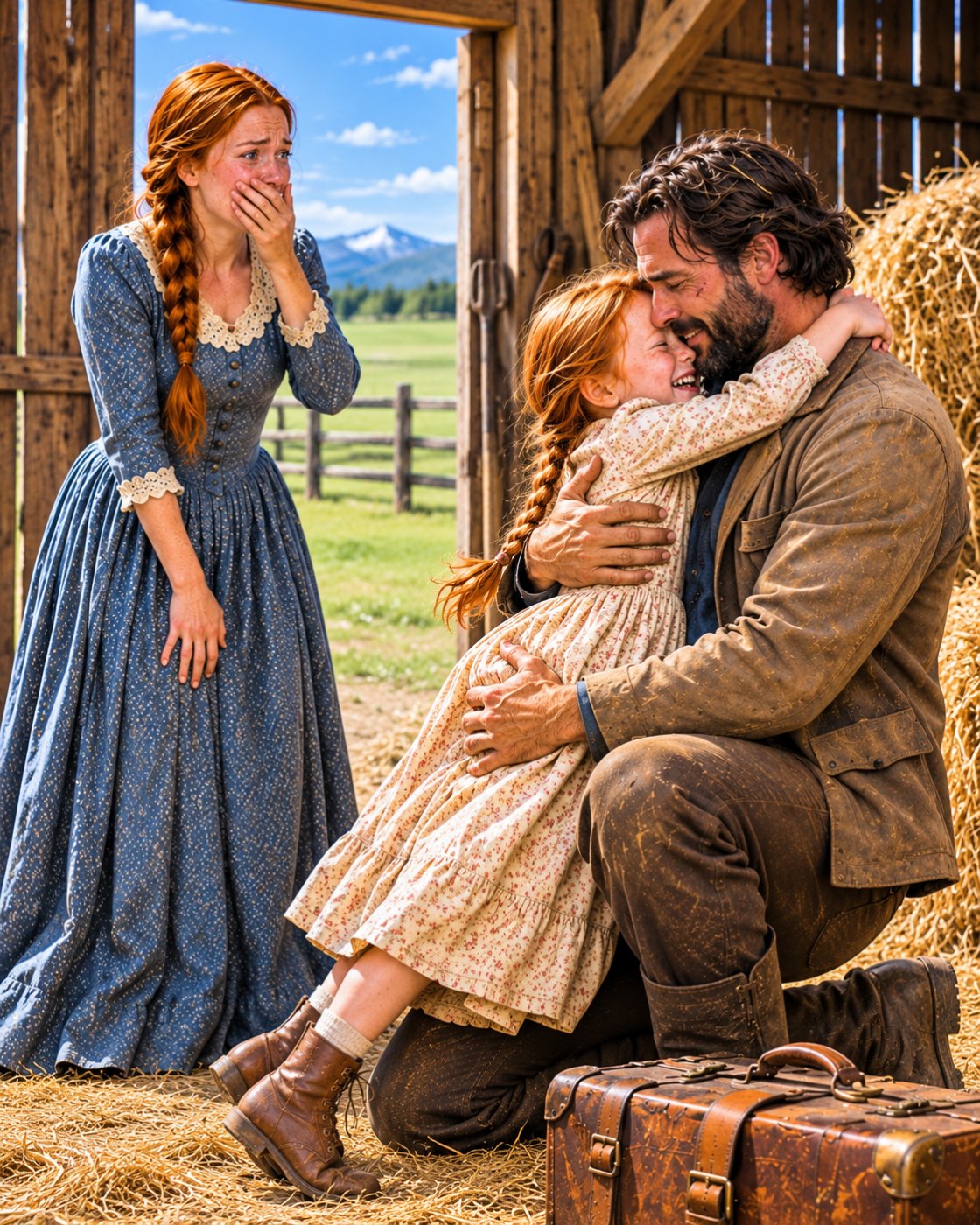
When Nell heard the news, she ran straight through the courthouse crowd and collided with his legs.
“You're coming back!”
Elias caught her.
“Yes, little one.”
“For supper?”
He laughed.
“For supper.”
“And breakfast?”
“If your mother will have me.”
Nell turned toward Ivy.
“Mama?”
Ivy folded her arms.
“He still hasn't fixed the barn door.”
Elias smiled.
“I suppose I'd better stay until it's done.”
But something had changed between them.
That evening, after Nell was asleep, Ivy found Elias standing on the porch.
The stars hung bright above the Wyoming hills.
For a long time, neither spoke.
Then Elias said, “You defended me today.”
“I defended the truth.”
“You defended more than that.”
Ivy leaned against the porch railing.
“You would have done the same for me.”
“Yes.”
The certainty in his voice made her turn.
He stepped closer.
“Ivy, when I first arrived here, I thought I was looking for somewhere to hide.”
“And now?”
“Now I'm afraid I've found something I don't know how to leave.”
Her breath caught.
“Then don't.”
The words escaped before she could stop them.
Elias stared at her.
Ivy looked away.
“I mean, there's still work to be done. The railroad investigation, the farm, the spring—”
“Ivy.”
She fell silent.
“I don't want to stay because you need someone to repair your fences.”
“Good,” she whispered. “Because you're rather slow at it.”
He laughed softly.
Then he took her hand.
“I want to stay because I love the way you argue with people who frighten everyone else. I love that your kitchen is covered in ink and newspapers. I love that you never let me pretend my mistakes weren't mistakes.”
His thumb brushed her knuckles.
“And I love the way you look at Nell as though the whole world begins and ends with her.”
Ivy's eyes burned.
“Elias…”
“I think I'm falling in love with you.”
She had imagined hearing those words again.
Sometimes, in the loneliest hours, she had wondered whether anyone would ever say them and mean them.
Now they frightened her more than she expected.
“My husband said he loved me,” she whispered. “Then one morning he rode away.”
Elias's expression softened.
“I know.”
“I spent years wondering what I had done wrong.”
“You did nothing wrong.”
“You can't know that.”
“I know that a man who leaves a child waiting without explanation has failed to keep a responsibility that belongs to him.”
Ivy looked at him.
“And what if you leave?”
“Then I'll tell you where I'm going, why I'm going, and when I expect to return. And if I can't keep that date, I'll find a way to send word.”
She swallowed.
“That sounds very practical.”
“I'm a surveyor.”
A reluctant smile touched her lips.
He lifted her hand and kissed her fingers.
“I can't promise a life without disappointment, Ivy. But I can promise not to use your love as an excuse to be careless with your trust.”
For a moment, she wanted to step into his arms.
Instead, she whispered, “Give me time.”
He nodded.
“As much as you need.”
And he meant it.
Over the following weeks, Elias repaired fences, helped Nell with her drawings, and assisted Ivy in organizing evidence for the continuing investigation.
He learned that Deacon the goose could not be bribed with corn when he had already decided to dislike someone.
He learned that Nell believed every important question deserved at least three follow-up questions.
And he learned that Ivy hummed softly when she worked at the printing press, though she always denied doing so.
One rainy evening, Elias discovered her asleep at the kitchen table.
Her head rested on a stack of proofs.
A smear of ink marked her cheek.
He stood watching her for a moment before gently draping a blanket around her shoulders.
Ivy stirred.
“Elias?”
“Go back to sleep.”
“Did you finish checking the county notices?”
“Yes.”
“And the broken hinge?”
“Yes.”
“And Nell's arithmetic?”
He smiled.
“She informed me my method was unnecessarily complicated.”
“That sounds like her.”
Her eyes opened fully.
He was still standing beside her.
“Why are you looking at me like that?”
“Because I've never been happier in a room full of unfinished work.”
Ivy reached for his hand.
This time, she didn't let go.
Their first kiss happened beneath the kitchen lamp.
It was gentle, hesitant, and so unexpectedly tender that Ivy felt the years of loneliness rise in her throat.
When Elias drew back, she rested her forehead against his.
“I've forgotten how to do this,” she admitted.
“Then we'll learn.”
Together, they did.
But their happiness soon faced another test.
Three weeks after the hearing, a letter arrived from a surveying firm in Dakota Territory.
Elias read it twice.
The firm had heard about his testimony and wanted to employ him to conduct independent surveys for settlers and territorial authorities.
The position offered excellent wages.
It also required extensive travel.
For a man who had spent twenty years drifting from one assignment to another, it was the opportunity he had always wanted.
Ivy knew it immediately.
She also knew what accepting it might mean.
“You should take it,” she said.
Elias looked up.
“You haven't even asked where it is.”
“I saw the letterhead.”
“Ivy—”
“You've earned this.”
He set the paper down.
“What about us?”
Her heart twisted.
“Us?”
“You know what I mean.”
She turned toward the stove.
“I won't ask you to sacrifice your future because my daughter and I have grown fond of you.”
“Fond?”
She closed her eyes.
“Don't make this harder.”
Elias stood.
“Ivy, I love you.”
“And I love you!”
The words burst from her before she could stop them.
They stared at each other.
It was the first time she had said it.
For one beautiful instant, everything seemed possible.
Then Ivy shook her head.
“But love isn't supposed to become a chain. I won't keep you here because I'm afraid of being alone again.”
Elias approached her.
“What if staying is what I want?”
“Then choose it freely.”
She looked into his eyes.
“Not because Nell needs a father. Not because I need help with the farm. And not because you feel guilty about a promise you made at a county fair.”
Her voice trembled.
“Choose us because this is the life you want.”
Elias had no answer.
Not because he doubted his love.
Because for the first time in his life, someone was asking him to decide where he belonged.
And he had never learned how.
Two days later, Nell found his leather case open on the bed.
His shirts were folded inside.
His instruments lay wrapped in cloth.
She stood in the doorway.
“You're leaving.”
Elias turned.
“Nell…”
“You promised.”
He knelt.
“I promised I wouldn't disappear without telling you.”
“That's not the same as staying.”
“No,” he admitted. “It isn't.”
Her lower lip trembled.
“I thought you liked our house.”
“I love your house.”
“And Mama?”
He swallowed.
“I love your mama very much.”
“Then why are your shirts in the case?”
It was such a simple question.
And he had no simple answer.
Nell stepped backward.
“I don't want another map.”
Then she ran down the hallway.
Elias remained kneeling beside the open case.
For the first time, the familiar sight of his packed belongings made him feel ashamed.
Not because traveling was wrong.
But because he had spent so many years leaving places before they could become home.
That night, Ivy found him sitting in the barn.
The same barn where she had first discovered him hiding behind the hay.
A lantern glowed beside his boots.
Deacon watched suspiciously from the rafters.
“I thought you might be here,” Ivy said.
Elias looked up.
“I've been thinking.”
“About Dakota?”
“About every place I've ever lived.”
She sat beside him.
He rubbed his hands together.
“When I was twenty, I told myself I'd settle down after one more job. At twenty-five, I said the same thing. At thirty, I stopped pretending I was serious.”
Ivy listened.
“I've drawn roads across half the West,” he continued. “I've measured mountains, rivers, and land people would spend their whole lives trying to make their own.”
He turned toward her.
“But I never once asked where I wanted my own road to end.”
“And now?”
He reached into his coat and removed the letter.
“I wrote back.”
Ivy's heart sank.
“I see.”
“I told them I'd accept the work on one condition.”
She looked up.
“That I establish my home and office in Larkspur Flats. I'll travel when a survey requires it, but I won't relocate permanently.”
“Elias…”
“They may refuse. If they do, I'll find other work.”
“You can't throw away your opportunity.”
“I'm not throwing it away.”
He took her hands.
“I'm finally choosing what I want.”
Tears filled her eyes.
“And what is that?”
“You.”
His voice broke slightly.
“You and Nell. The printing press. That impossible goose. The crooked barn. The sound of your voice when you're angry about something that matters.”
He smiled through his emotion.
“I want to come home to you, Ivy. Not because I'm needed. Because I can't imagine a better place to belong.”
She covered her mouth.
For years, she had believed that love meant waiting for someone to return.
Now she understood something different.
Love could also mean being chosen.
Again and again.
Even when leaving would be easier.
She stepped into his arms.
“Yes,” she whispered.
Elias held her close.
“Yes to what?”
“To building a life together.”
He kissed her.
And this time, neither hesitated.
Above them, Deacon made a disapproving noise.
Ivy laughed against Elias's shoulder.
“He'll get used to you.”
“I wouldn't count on it.”
A month later, the surveying firm accepted Elias's conditions.
He would establish a small office in Larkspur Flats, conducting local work and traveling for larger assignments.
For the first time, his journeys would have a destination waiting at the end.
Home.
The territorial investigation continued through winter.
Additional records supported the conclusion that the railroad route had been improperly altered. Edmund Voss was removed from the company's negotiations, and authorities pursued further examination of the land transactions.
Elias was formally cleared of the outstanding complaint.
By spring, the railroad company announced that it would proceed with the original ridge route, subject to the remaining engineering approvals.
The four farms were no longer threatened by the altered line.
And Ivy's spring remained untouched.
On a bright morning in May, Elias asked Ivy to walk with him to the north pasture.
The grass was green.
The creek ran clear.
Wildflowers had begun to appear beside the fence.
They stopped near the spring, where water emerged from the rocks and flowed toward the valley.
Ivy smiled.
“This is where we found marker forty-two.”
“I remember.”
“You were so happy you nearly kissed me.”
“I was trying to be respectful.”
“You were being foolish.”
He laughed.
Then he reached into his coat.
“I drew you something.”
He unfolded a small sheet of paper.
It was a map.
Not a complicated survey filled with bearings and measurements.
A simple drawing showing three places.
The Caldwell farmhouse.
Nell's school.
And the spring.
Thin lines connected them.
At the center, in Elias's careful handwriting, were the words:
“Every road I want to travel begins and ends with you.”
Ivy read the sentence twice.
Then she began to cry.
Elias took her hand.
“Ivy Caldwell, will you marry me?”
She looked up.
“I have a daughter who asks too many questions.”
“I know.”
“A newspaper that keeps me awake half the night.”
“I know.”
“A farm that needs constant repairs.”
“I've noticed.”
“And a goose who may never accept you.”
Elias sighed.
“That is the one obstacle I cannot promise to overcome.”
Ivy laughed through her tears.
Then she threw her arms around him.
“Yes.”
He held her tightly.
“Yes?”
“Yes, Elias Hartwell. I'll marry you.”
They were married in June.
The ceremony took place in the Caldwell farmhouse because Nell insisted the house had been waiting for a wedding longer than anyone else.
The neighbors crowded into the kitchen.
Mr. Fenn brought flowers.
Sheriff Pruitt wore his best coat.
Aunt Winifred cried before the minister had even begun speaking.
Nell wore a blue dress and carried a bunch of wild larkspur.
When the minister asked who would give the bride away, Nell raised her hand.
“I will.”
Everyone laughed.
She stepped beside Ivy.
“But I want everyone to know Mama isn't being given away because nobody wants her.”
The room grew quiet.
Nell looked at Elias.
“She's being married because somebody finally knew how to stay.”
Ivy's eyes filled.
Elias knelt and kissed Nell's forehead.
“That's exactly right.”
Then he stood and took Ivy's hand.
Their vows were simple.
There were no grand promises of a life without sorrow.
Only promises to tell the truth, face difficult days together, and keep choosing one another.
When the minister pronounced them husband and wife, Elias kissed Ivy beneath the same roof where she had once sworn she would never trust another man.
Outside, Deacon honked loudly.
Nell declared that he approved.
Nobody believed her.
Five years passed.
The Caldwell-Hartwell farm grew louder, warmer, and more crowded.
The barn was finally straightened.
A new room was added to the farmhouse.
The Larkspur Weekly expanded to five hundred subscribers and moved into a proper shop near the town square.
Ivy continued publishing uncomfortable questions.
Elias continued drawing honest maps.
And Nell, now twelve, had become an accomplished young artist who could sketch the surrounding mountains with astonishing precision.
There was also Toby.
Nearly three years old, he had his father's gray-blue eyes, his mother's red hair, and a determination to climb anything taller than himself.
He had been born during a snowstorm, with Elias pacing the hallway and Nell announcing that she would personally supervise the arrival of her younger brother.
When she finally saw the baby, she studied him seriously.
“He'll do,” she declared.
And he had.
On a golden afternoon in late summer, Ivy sat on the porch mending a small shirt.
Toby played beside her.
Nell sat on the steps drawing the mountains.
Elias was repairing the gate.
Suddenly, Nell looked up.
“Papa?”
Elias stopped working.
“Yes, sweetheart?”
“Would you have come back if I hadn't kept your map?”
He set down his screwdriver.
For a moment, he said nothing.
Then he sat beside her.
“I don't know.”
Nell frowned.
“You don't?”
“I'd like to tell you I would have. But the truth is, I was frightened, tired, and unsure where to go.”
He looked toward the distant hills.
“I might have kept walking.”
Nell considered this.
“But you remembered me?”
Elias smiled.
“Every time I saw a map, I remembered the little girl who wanted to know how to reach the ocean.”
“And the goose?”
“Especially the goose.”
She laughed.
Then Elias grew serious.
“When I had nowhere else to go, I remembered someone had once believed I would return.”
Nell leaned against him.
“I knew you would.”
He kissed the top of her head.
“Yes,” he whispered. “You did.”
Inside the farmhouse, above the stove, hung a small wooden frame.
Behind its glass was a faded sheet of paper.
A little house.
A winding blue river.
Mountains.
The distant ocean.
And one very badly drawn goose.
It was the first map Elias had ever given Nell.
The paper had grown soft at the folds, but the drawing remained.
Ivy looked at it every morning.
Not because it had helped expose a dishonest railroad scheme.
Not because the survey measurements on its reverse had helped protect their land.
But because it reminded her that the smallest promises sometimes carried the greatest weight.
Elias came up the porch steps and sat beside her.
Toby immediately climbed into his lap.
Ivy reached for her husband's hand.
“You know,” she said, “I almost hit you with a spade the morning we met.”
“I remember.”
“You were hiding in my barn.”
“I remember that, too.”
“And you looked terrible.”
“I was hoping you'd forgotten that part.”
She smiled.
“Not a chance.”
Elias leaned over and kissed her.
Across the yard, Nell suddenly shouted.
“Papa! Deacon's in the kitchen again!”
Elias closed his eyes.
“That bird has been trying to ruin my life for five years.”
Ivy laughed.
“Go rescue supper.”
He stood with Toby in his arms.
Then he paused and looked back at her.
The same crooked smile.
The same steady eyes.
Only now, there was no fear of leaving in them.
“I'll be right back,” he said.
Ivy watched him disappear into the house.
Once, those words would have frightened her.
Once, she would have wondered whether they were another promise waiting to be broken.
Now she simply smiled.
Because she knew he meant them.
And somewhere inside, a little boy laughed, a goose protested, and the man who had once wandered across the West called for his daughter to help him save the kitchen.
Ivy put down her mending and went inside.
She had finally found something more precious than a perfect promise.
A life in which love was proven every ordinary day.
And the map that mattered most had never been drawn on paper.
It had been drawn through kindness, courage, forgiveness, and the choice to stay.
Perhaps the greatest love stories don't begin with a kiss or a wedding, but with one frightened stranger discovering that someone has been waiting for him all along.
Would you have trusted Elias after finding him in your barn, or would you have sent him away before learning the truth?