PART 3
The storm did not stop when Halvor Ingram carried Colm Rooney through the kitchen door.
It grew worse.
Outside, the Nebraska Sandhills had disappeared beneath a swirling wall of white. The wind struck the sod house so violently that Odessa feared the roof might lift from its beams.
Halvor stood just inside the doorway, his beard crusted with ice and his arms trembling beneath the weight of the nineteen-year-old ranch hand.
Colm's face was pale.
His lips were nearly blue.
But he was breathing.
“Help me get him beside the stove,” Odessa said.
Halvor obeyed immediately.
Together, they removed the boy's frozen outer garments and wrapped him in dry blankets.
Odessa warmed water, prepared hot broth, and watched carefully as feeling slowly returned to Colm's fingers.
For nearly an hour, the boy said nothing.
Then he opened his eyes.
“Did we lose the cattle?”
Halvor laughed shakily.
“You nearly froze to death, boy, and that's your first question?”
Colm attempted a smile.
“Didn't want you thinking I'd neglected my work.”
Odessa knelt beside him.
“You're going to rest. The cattle can wait.”
Colm looked at her.
Then at the gray coat drying beside the stove.
Its red stripe was still visible beneath the melting snow.
“I thought nobody would find me,” he whispered.
Halvor sat heavily in a chair.
“I almost didn't.”
He looked toward Odessa.
“If you hadn't stitched that red cloth onto his hood, I would have walked right past him.”
She reached for his hand.
“Then I'm glad I did.”
Halvor held her fingers tightly.
Neither spoke about how close he had come to returning home alone.
They didn't need to.
By morning, news reached the ranch that twenty-three children remained trapped inside the Plum Bluff schoolhouse.
The schoolteacher, Ottoline Fenwick, had kept them together through the night.
But the building's coal supply was nearly exhausted.
The children were frightened, hungry, and increasingly cold.
Their parents had attempted to reach them, but the blizzard had driven everyone back.
Odessa listened as a messenger explained the situation.
Then she looked toward the barn.
“How many coats are still hanging in the loft?”
Halvor frowned.
“Perhaps forty.”
“And how many have already gone to families?”
“More than a hundred.”
She considered the numbers.
“Then there should be enough for the rescue parties.”
Halvor understood immediately.
“You're thinking of the red stripes.”
“They helped you find Colm.”
“That doesn't mean men can safely cross ten miles in this weather.”
“No,” Odessa admitted. “But it means they might have a better chance of staying together.”
Halvor looked toward the window.
The snow was still falling sideways.
Every instinct told him to remain inside.
He had nearly lost Colm.
He had nearly lost his own life.
And now his wife was asking him to consider venturing back into the storm.
Odessa stepped closer.
“I'm not asking you to be reckless.”
“I know.”
“I'm asking you to tell the men what happened. Let them decide whether the coats can help.”
Halvor studied her face.
Then he nodded.
“I'll go as far as the Lindquist place. Dagny's husband can send word to the others.”
Odessa squeezed his hand.
“And you'll come back?”
He looked at her for a long moment.
“There's nowhere else I'd rather be.”
She smiled through her worry.
“Then make certain you do.”
The rescue parties gathered before noon.
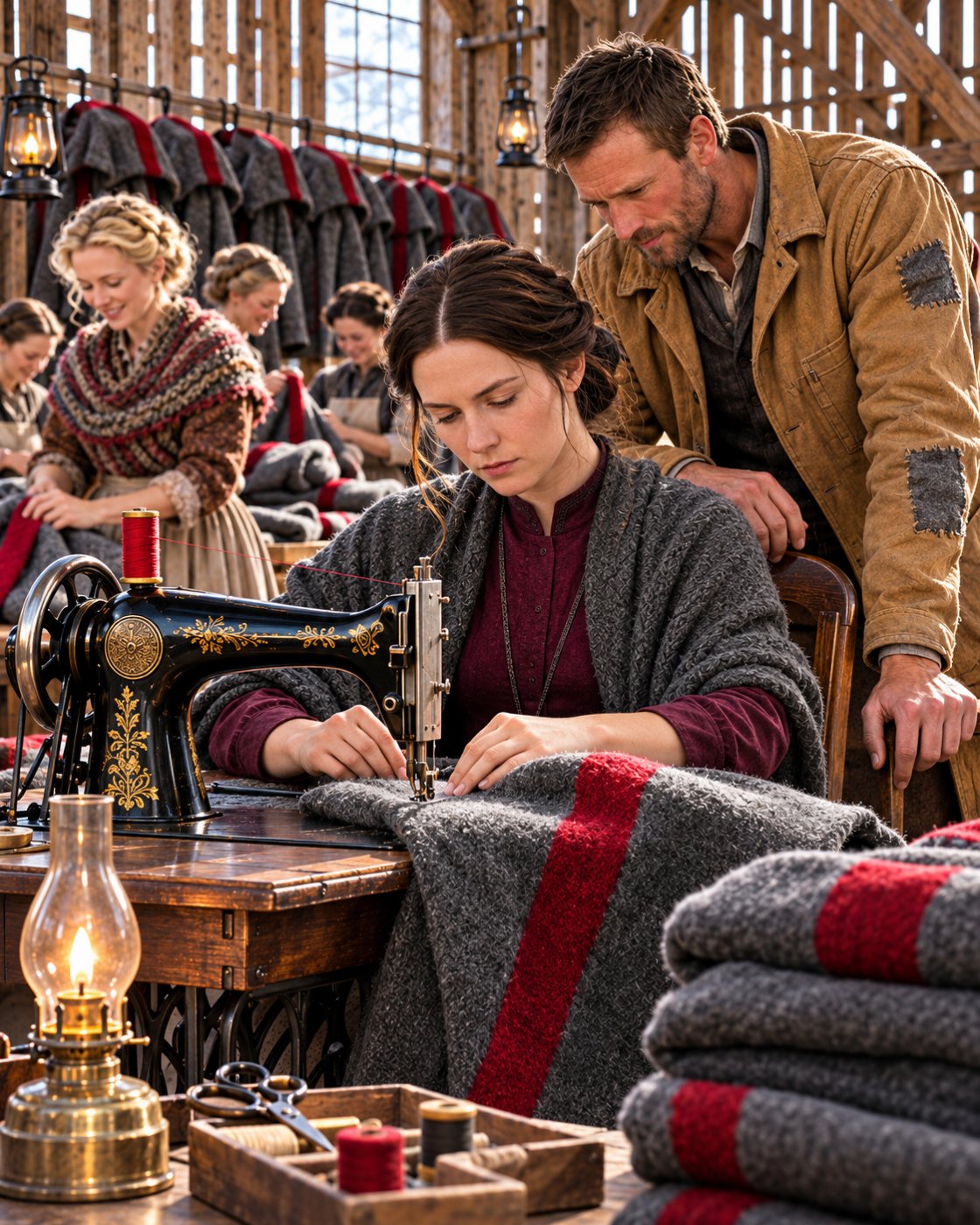
Men from neighboring ranches arrived wearing the heavy gray coats Odessa and the women had made.
Some carried ropes.
Others brought sleds, blankets, and provisions.
They organized themselves into groups, each connected by a long length of rope.
The men had crossed the Sandhills in every kind of weather.
But few had experienced a storm like this one.
At times, they could barely see the person standing directly ahead.
The red stripes became their most useful visual guide.
A flash of color through the blowing snow showed where the next man stood.
When the rope slackened, they stopped.
When someone stumbled, the others helped him rise.
And when the wind forced them to change direction, they searched for the nearest red-marked hood before moving again.
By late afternoon, the first rescue party reached the schoolhouse.
Inside, Ottoline Fenwick had gathered the children around the last warmth of the stove.
She opened the door and nearly wept when she saw the men.
“You came.”
One of them smiled beneath his frozen scarf.
“Of course we came.”
They wrapped the children in spare coats and blankets, settled them onto sleds, and began the slow journey home.
The rescue took hours.
More than once, the men stopped to regain their bearings.
But the red stripes helped them maintain their line through the whiteout.
When the final sled reached safety, every one of the twenty-three children had survived.
The storm broke on the fourth morning.
Sunlight spilled across the frozen hills, revealing drifts higher than fences and barns nearly buried beneath snow.
The people of Plum Bluff emerged from their homes and began counting what they had lost.
Cattle had died.
Roofs had collapsed.
Several families had lost nearly everything they owned.
But the news that mattered most traveled quickly.
Not one person in the district had died in the storm.
The rescue parties had brought every child home.
Colm Rooney was recovering.
And several ranchers who had become disoriented in the blizzard credited the bright red stripes on their coats with helping them find their way.
One elderly rancher, Abner Voss, told anyone who would listen that he had nearly walked into a frozen creek.
“I couldn't see my own hands,” he said. “But I saw that red stripe ahead of me and followed it until I found the road.”
The story spread from farmhouse to farmhouse.
Soon everyone knew about the woman from Milwaukee who had arrived carrying a sewing machine in a wooden crate.
The same woman some people had privately laughed at when she first came to town.
The same woman whose husband had initially insisted there was no room for her machine.
And the same woman whose unusual coats had helped save their children.
Three days after the storm, Odessa was kneading bread when she heard wagon wheels outside.
She glanced through the window.
A sled was approaching.
Then another.
And another.
Within minutes, the yard was crowded with wagons, sleds, horses, and families bundled in heavy winter clothing.
Odessa wiped flour from her hands.
“Halvor?”
He stepped onto the porch.
His expression was unreadable.
“I think you'd better come outside.”
She followed him.
Nearly every family in Plum Bluff seemed to be gathered in the yard.
Dagny Lindquist stood at the front, holding her youngest child.
Beside her was Ottoline Fenwick.
Ezra Pell, the mercantile owner, carried a leather ledger.
And behind them stood the men who had crossed the blizzard wearing Odessa's coats.
For a moment, nobody spoke.
Then Dagny stepped forward.
“Mrs. Ingram, we've come to thank you.”
Odessa shook her head.
“You don't need to do that.”
“Yes,” Dagny answered firmly. “We do.”
She placed a basket on the porch.
Inside were eggs, preserves, and a small parcel of wool.
Another woman brought a ham.
A rancher offered a load of firewood.
A widow handed Odessa a pair of knitted mittens.
Then a little girl approached with a drawing.
It showed a woman sitting at a sewing machine.
Behind her, a bright yellow sun filled the sky.
The girl held it up.
“My mother says you helped bring my brother home.”
Odessa knelt.
“What's your name, sweetheart?”
“Mary.”
“That's a beautiful drawing, Mary.”
The child smiled.
“It's you.”
Odessa's eyes filled.
She carefully accepted the paper.
Then Ezra Pell cleared his throat.
“Mrs. Ingram, there's something else.”
He opened his ledger.
“When you started making those coats, you paid for materials yourself. You gave your time, your skill, and your machine to people who couldn't afford what they needed.”
Odessa shook her head.
“The women helped. I couldn't have done it alone.”
“And they've been properly thanked,” Pell replied. “But the families wanted to settle what they owed.”
He turned the ledger toward her.
Names filled the pages.
Beside each name was an amount.
Some families had contributed cash.
Others had offered livestock, grain, wool, or labor.
The total exceeded six hundred dollars.
Odessa stared.
“I can't accept all this.”
Dagny placed a hand on her shoulder.
“Every mother standing here has a child who came home because someone was wearing one of those coats.”
Odessa looked toward the children gathered in the yard.
Their gray hoods were marked with red.
She began to cry.
Pell reached into his coat and withdrew a folded document.
“And there's one more thing.”
He handed it to Halvor.
The rancher unfolded the paper.
His face changed.
He read it once.
Then again.
Odessa looked at him.
“Halvor?”
He couldn't answer.
Pell spoke gently.
“It's a receipt from the Plum Bluff Bank.”
Halvor's hands trembled.
“The note,” he whispered.
Odessa stared.
“What note?”
He looked at her.
“The debt on the ranch.”
He swallowed.
“It's paid.”
For eleven years, Halvor had carried the weight of his father's debt.
Four hundred and twelve dollars.
A sum that had seemed impossible to repay after the previous winter destroyed a third of his herd.
Every year, he had worked harder.
Every spring, he had hoped the cattle would bring enough money.
And every autumn, the debt remained.
Now it was gone.
The townspeople had arranged for the bank to accept payment from the funds collected for Odessa's coats.
The remaining balance had been placed in an account bearing both their names.
Halvor stared at the receipt.
He had spent eleven years believing that keeping the ranch meant carrying every burden himself.
And now the ranch had been saved by the woman he had almost sent back to Milwaukee.
He looked toward Odessa.
She was surrounded by neighbors, children, and women who had helped her sew.
Her cheeks were wet.
But she was smiling.
Halvor felt something break inside him.
Not sorrow.
Not shame.
Something he had held too tightly for too long.
He quietly folded the receipt and walked toward the barn.
Odessa noticed.
She excused herself and followed him.
She found him standing beside the old worktable beneath the loft.
His shoulders were shaking.
“Halvor?”
He turned away.
She approached gently.
“What's wrong?”
He shook his head.
“I don't know how to thank you.”
Odessa reached for his hand.
“You don't have to.”
“Yes,” he whispered. “I do.”
She waited.
He looked around the barn.
“I thought I was bringing a wife here to help me survive.”
“And?”
He swallowed.
“You brought the whole town with you.”
Odessa smiled through her tears.
“Only because you made room.”
Halvor looked at her.
Then he drew her into his arms.
For the first time since their marriage, he held her without hesitation.
And Odessa understood that the man who had spent eleven years protecting himself from disappointment was finally allowing himself to hope.
That evening, after the visitors had gone, Halvor asked Odessa to sit beside the stove.
The house was warm.
The wind had quieted.
Outside, the snow reflected the moonlight.
He sat opposite her, turning his hat slowly between his hands.
“There's something I need to say.”
Odessa smiled.
“You look as nervous as you did at the railway station.”
“I feel worse.”
“Then perhaps you'd better begin.”
He looked down.
“The day you arrived, I told you I didn't have room for your machine.”
“I remember.”
“I was wrong.”
She waited.
“I had a house with two rooms, a barn with six stalls, and eleven hundred acres of land.”
He paused.
“But I didn't have room for hope.”
Odessa's smile faded into tenderness.
“I'd lost so much that I stopped believing anything good could last.”
He looked at her.
“Then you stepped off that train with a crate bigger than your trunk and asked me for one day.”
She laughed softly.
“You looked ready to send me straight back.”
“I nearly did.”
“I know.”
He reached for her hand.
“I've thought about that every day.”
“Halvor…”
“I was afraid of needing you.”
Her eyes filled.
He continued.
“I thought if I let myself love you, I'd have one more thing to lose.”
Odessa squeezed his fingers.
“And now?”
He looked directly into her eyes.
“Now I think losing you would be worse than losing the ranch.”
For a moment, she couldn't speak.
Then she moved closer.
“I didn't come here because I needed a rich husband.”
“I know.”
“I came because your letters sounded like they belonged to an honest man.”
He smiled faintly.
“And did you find one?”
She touched his cheek.
“Yes.”
Halvor closed his eyes.
“Odessa, I love you.”
The words were quiet.
But they filled the little house.
She leaned forward.
“I love you too.”
He kissed her.
It was a slow, careful kiss, filled with all the tenderness they had been too frightened to express.
When they parted, Halvor rested his forehead against hers.
“I've been sleeping on that bench for three months because I didn't want you to feel obliged to share a bed with a stranger.”
Odessa laughed.
“Halvor Ingram, I believe we've stopped being strangers.”
He looked at her.
“Have we?”
She took his hand.
“Come with me, husband.”
And for the first time since their wedding, they entered their bedroom together.
Spring came slowly to the Sandhills.
The snow melted.
The cattle returned to the pastures.
And the Ingram ranch began to recover.
Without the bank debt, Halvor could purchase breeding stock and repair the fences that had been neglected for years.
Colm Rooney remained at the ranch, stronger and happier than before.
He wore his gray coat until the weather grew warm, then hung it carefully beside his bed.
When Odessa asked why he didn't put it away, he smiled.
“It's the first thing anybody ever made just for me. I like seeing it.”
She hugged him.
But Halvor had another surprise waiting.
One morning, he led Odessa around the south side of the farmhouse.
A new wooden addition stood against the wall.
It had a broad window facing the morning sun.
Inside was a long worktable, shelves for fabric, and a space built precisely for her Singer machine.
Odessa stopped in the doorway.
“What is this?”
Halvor smiled.
“Your workroom.”
She stared.
“You built me a room?”
“You've spent your whole life making things for other people.”
He took her hand.
“I thought it was time someone made something for you.”
Odessa stepped inside.
Sunlight fell across the polished table.
There were drawers for needles, hooks for scissors, and shelves deep enough to hold bolts of wool.
In the corner stood her sewing machine.
No longer crowded into a kitchen.
No longer hidden in a cold barn.
It had a place of its own.
Odessa touched the cabinet.
Then she turned toward Halvor.
“Nobody's ever built me a room before.”
He smiled.
“I've been waiting eleven years for someone worth building it for.”
She crossed the room and kissed him.
The following year, Odessa opened a small sewing shop in Plum Bluff.
She trained young women who needed work and widows who wanted to earn their own money.
She never forgot what it felt like to sew for wealthy strangers while wearing a coat too thin for winter.
Whenever a girl came to her without proper clothing, Odessa found a way to help.
And every autumn, she prepared gray hooded coats with red stripes for children whose families couldn't afford them.
The town began setting aside funds for winter clothing.
The pattern became familiar throughout the Sandhills.
For years afterward, a child wearing a gray coat with a red stripe was recognized as someone the community had promised not to forget.
Odessa and Halvor had four children.
Their little two-room house grew into a home filled with laughter, books, muddy boots, and the steady rhythm of the sewing machine.
The ranch prospered.
Colm eventually became foreman.
And Halvor never again complained that his wife had brought too much luggage.
Sometimes, when visitors asked about the old Singer machine, he smiled.
“That machine saved my ranch.”
Odessa would laugh.
“The machine didn't do anything by itself.”
“No,” Halvor agreed.
Then he would look at her.
“But the woman who brought it did.”
Many years later, Odessa's grandchildren gathered around her worktable during a cold November afternoon.
One little girl pointed toward a small brass plate resting above the fireplace.
“What does that say, Grandmother?”
Odessa smiled.
The plate had been presented to her by the people of Plum Bluff after the terrible winter of 1888.
Its inscription was simple.
The Town Owes You Everything.
Beneath those words was a second line.
And We Know We Can Never Repay It.
Odessa looked toward the window.
Beyond it, the Sandhills stretched beneath a pale winter sky.
She remembered the railway platform.
The enormous wooden crate.
The lonely rancher who had said there was no room.
And the first night she heard her sewing machine rattling inside his quiet house.
She smiled at her granddaughter.
“It means people are stronger when they take care of one another.”
The little girl considered that.
“Did you really save the whole town?”
Odessa shook her head gently.
“No, sweetheart. The town saved itself. I only showed them something we could make together.”
“But Grandfather says you saved him.”
Odessa looked toward the doorway.
Halvor stood there, older now, his hair silver and his shoulders slightly bent.
But his eyes were as gentle as they had been on the day he carried her trunk into the farmhouse.
He smiled.
“She did.”
Odessa held out her hand.
He crossed the room and took it.
“And he saved me,” she answered.
Outside, the first snowflakes began to fall.
Inside, the old Singer machine rested beside the window, its polished cabinet glowing in the firelight.
It had traveled hundreds of miles inside a wooden crate.
It had helped clothe an entire district.
It had turned strangers into neighbors.
And it had brought two lonely people together.
But the greatest thing Odessa Brandt ever made wasn't a coat, a dress, or even the bright red stripe that helped guide people home through a blizzard.
It was a life built beside a man who had once believed there was no room for her.
And who spent every winter afterward making certain she never doubted that she belonged.