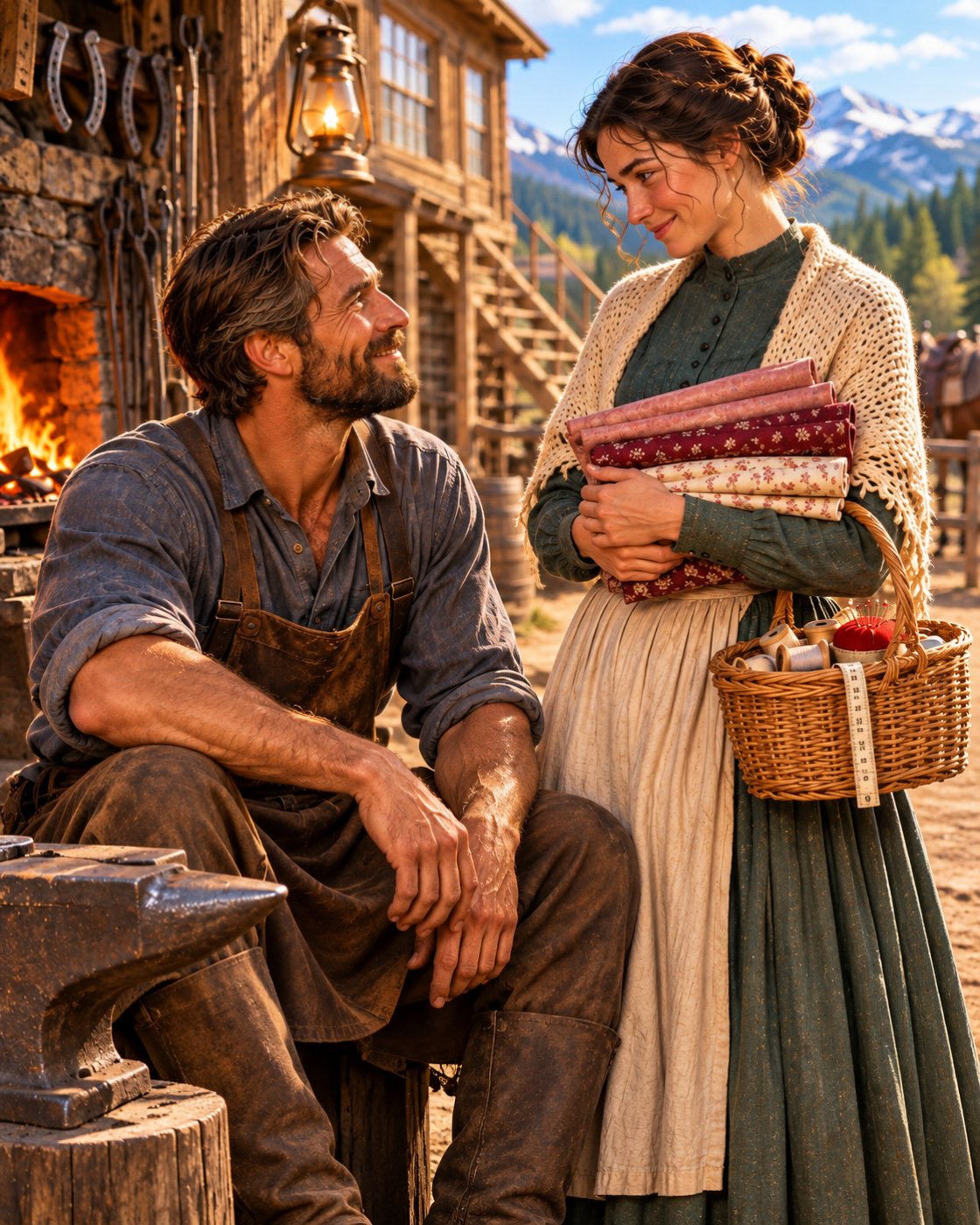
PART 3
In case you missed it: widowed blacksmith Gideon Hale rented the sewing room he had built for his late wife Ruth to Nora Whitlock, a seamstress fleeing a marriage her stepbrother had arranged to pay his gambling debts.
Over the autumn, she brought light back into his life.
She brought him supper, sat with him on the anniversary of Ruth's death, and helped him open the trunk of his wife's things he had kept locked for seven years.
Then, nine days before Christmas, Everett Thorne, the St.
Louis merchant she had run from, stepped off the stage in Juniper Falls.
Gideon found her ten minutes later.
She was sitting on the floor of the sewing room, beside her mother's treadle machine, with her arms wrapped around her knees.
The governor's ball gown lay half-pinned on the dress form above her.
Pins were scattered all over the floor where they'd fallen from her lips.
Her face was as white as the snow outside the window.
"He found me," she whispered.
"I don't know how.
But he found me".
Gideon knelt down beside her.
"Lyman must have told him," Nora went on, staring at nothing.
"Or someone at the depot.
A woman traveling alone with a sewing machine in the baggage car.
People remember things like that.
I should have known.
I should have sold it in Omaha and gone on without it".
"You'd never have sold it," said Gideon.
"No".
She closed her eyes.
"No, I wouldn't".
He looked at her for a long moment, sitting there among the scattered pins.
Then, slowly, as if he weren't sure he was allowed, he reached out and laid his big hand over both of hers, folded on her knees.
"He'll have to come through me first," Gideon said quietly.
"You understand that, Nora? He'll have to come through me".
Thorne did not come to the smithy that day.
He was a careful man, and a patient one, and he knew the value of letting fear do its work before he spoke.
Instead, he took the best room at the Juniper Falls Hotel, ate a large supper in the dining room, and the next morning went straight to the office of Harmon Ellery, justice of the peace.
He laid two documents on the old man's desk.
The first was a promissory note signed by Lyman Whitlock, acknowledging a debt of four hundred dollars and pledging as security the household goods and personal property of the late Thomas Whitlock.
Including, it stated plainly, one treadle sewing machine.
The second was a paper Thorne called a contract of betrothal.
It bore Lyman's signature, and below it, a scrawled mark that was meant to be Nora's.
She had never seen it in her life.
Then, at ten o'clock, with the snow still falling, Everett Thorne walked into the smithy as though he owned it.
He was a tall, heavy man in a black broadcloth coat and a silk hat, with a thick gold watch chain and small, pale, careful eyes.
He brushed the snow from his hat with a gloved hand and looked around the forge as if pricing it.
Gideon was at the anvil.
Nora was standing on the bottom step of the outside stairs, with one hand gripping the rail and her chin raised.
"Miss Whitlock," Thorne drawled.
He smiled.
It did not reach his eyes.
"You have led me on a very long and very expensive chase.
Eleven hundred miles.
I have come to bring you home".
"I'm not going anywhere with you, Mr. Thorne".
"Your brother has given his word.
And so, I believe, have you".
He drew the betrothal paper halfway out of his coat, so she could see it.
"I am a man who expects people to honor their word".
"I gave you nothing," said Nora.
Her voice shook, but it was clear.
"I never signed that paper.
I never saw it.
Lyman had no right to promise you my hand, and he knows it.
And so do you".
"Your stepbrother is the head of your family," said Thorne coldly.
"Whatever you may think of his authority over your person, his authority over your father's property is not in question".
He nodded toward the stairs.
"That machine upstairs belongs to me, Miss Whitlock.
It was pledged against his debt.
Along with, I should think, every stitch of goods you've made on it.
Justice Ellery will hear the matter on Saturday.
I have no doubt how he will rule".
Nora's face went gray.
"So you may choose," Thorne went on pleasantly.
"Come back to St.
Louis as my wife, with your machine and your dignity.
Or stay here with nothing.
In a stranger's attic.
Without even the means to earn your bread".
Gideon set down his hammer.
He did not raise his voice.
He didn't need to.
He simply walked around the anvil, unhurried, and came to stand between Everett Thorne and the stairs.
He was a full head taller than the merchant and twice as broad, and the red glow of the forge lit up the scars on his bare forearms.
"I think," said Gideon quietly, "you'd best leave my shop now, Mr. Thorne".
Thorne looked up at him.
For just a moment, something flickered in his pale eyes that might have been fear.
Then he smiled again.
"Mr. Hale, I believe.
The blacksmith".
He drew on his gloves, finger by finger.
"I've made some inquiries about you.
I understand you take your iron by freight wagon from the depot at Shoshone.
And it happens that the freight line between Shoshone and this valley is owned by a company in which I hold a considerable interest".
He settled his silk hat carefully back on his head.
"It would be a great pity if your shipments were delayed this winter.
A blacksmith without iron is not much of a blacksmith, is he?"
Gideon didn't move.
His face didn't change.
But Nora, behind him on the stairs, saw his hands close slowly into fists at his sides.
"Think on it," said Thorne.
"Both of you.
I'll see you on Saturday".
He walked out.
The door swung shut behind him.
Cold air swirled across the floor of the forge.
And Nora sank down onto the bottom step and began to shake.
That night, she packed her carpetbag.
She did it quietly, by the light of a single candle, so he wouldn't hear her moving around overhead.
She folded her few dresses.
Her best scissors.
The bundle of her mother's letters.
She left the governor's gown on the dress form with a note pinned to it for the superintendent's wife, explaining which seams remained.
She left the three wedding dresses folded on the worktable, finished, with the brides' names on slips of paper.
She left her mother's machine under the east window.
She couldn't carry it alone.
And she couldn't bear to ask Gideon to help her carry it away.
Then she sat at the worktable, in the dark, and tried to write him a note.
She wrote one and tore it up.
She wrote another and tore that up too.
Every word she wrote sounded either too much or not nearly enough.
She thought about Thorne's freight line.
About Gideon's forge, the forge he had built stone by stone with his own hands.
The only thing that had held him together through seven winters of grief.
If Thorne stopped his iron, Gideon would lose everything.
His work.
His name.
His reason for getting up every morning in the dark.
And it would be her fault.
If she went back to St.
Louis, Thorne would have no reason to hurt him.
If she stayed, she would only bring ruin to the one person in the world who had shown her nothing but kindness.
In the end, she wrote only two lines.
Thank you for the coffee you let me make you.
Thank you for everything else.
N.
She left it on Ruth's trunk.
At first gray light, she carried her carpetbag down the outside stairs, step by step, trying not to make the boards creak.
She crossed the yard.
She walked out into Front Street through the fresh snow, toward the stage office across the way, with her bag in both hands and her eyes burning.
Gideon was waiting for her at the stage office.
He was leaning against the hitching rail in his heavy coat, with his breath smoking in the frozen air.
His beard was rimed with frost.
He looked as though he hadn't slept at all.
Nora stopped dead in the middle of the street.
"I heard you on the stairs," Gideon said quietly.
"I've been listening to your footsteps on those boards for two months, Nora.
You think I don't know the sound of you leaving?"
"Gideon.
Please".
Her eyes filled.
"Please don't make this harder.
He'll ruin you.
He'll stop your iron.
He'll turn the town against you, and it'll be my fault.
I won't let that happen.
I won't let you lose everything you have because of me".
Gideon pushed himself off the rail and came across the snow to her.
He took the carpetbag gently out of her hand and set it down in the street.
Then he took both her cold hands in his scarred, warm ones, and held them.
"I lived alone for seven years," he said.
His voice was low and rough.
"Seven years, I worked that anvil from dark to dark and never once heard anything but my own hammer.
I thought that was all the life I had left.
I'd made my peace with it".
He swallowed.
"Then you came knocking in the rain with a card in your hand.
You brought me coffee I didn't ask for.
You sat with me on the cold floor on the worst night of my year and didn't say one foolish thing.
You helped me open a trunk I couldn't open alone.
You gave me back my life, Nora".
He shook his head slowly.
"You think I'd trade that for a wagonload of iron? There's iron in Boise.
There's iron in Salt Lake City.
I'll drive the wagon there myself, every week, all winter, if I have to.
But there's only one of you".
Nora stared up at him.
Tears were running down her cold cheeks.
"Stay," Gideon whispered.
"Stay and fight him with me.
Not for the machine.
Not for your shop.
Stay because I'm asking you to.
Because I don't want to go back to living alone.