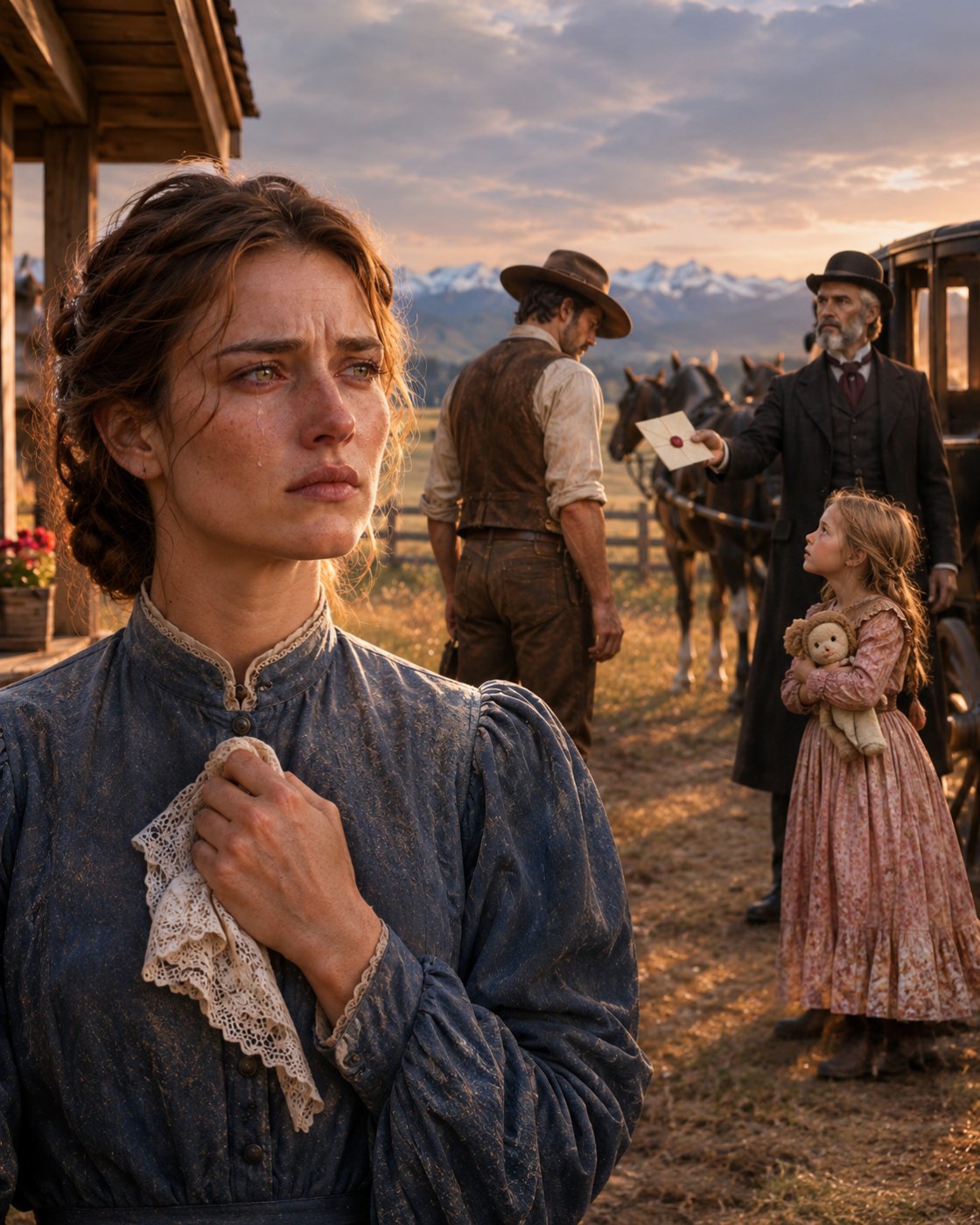
PART 3
In case you missed it: Grace Whitmore ran away from Cheyenne and the rich man her father wanted her to marry, and settled in a little cottage in Silver Creek.
There she fell in love with her neighbor, widowed rancher Ethan Miller, and his eight-year-old daughter, Sophie.
Then her father, freight baron Robert Whitmore, bought the mortgage Ethan had taken out to pay for his dying wife's care.
He offered to forgive it if Ethan broke Grace's heart.
To save the home he'd promised his late wife he would keep, Ethan told Grace he didn't love her.
She went home to Cheyenne in tears.
Ethan knelt down on the kitchen floor so he was level with his daughter.
Sophie was standing in the middle of the room in her nightgown, holding the half-braided horsehair bracelet she'd been making for Grace all week.
It was a lumpy thing, red and black, done in the pattern Grace had taught her on the porch the Sunday before.
Sophie had been planning to give it to her at the jam-making.
"Sweetheart," Ethan said.
"Miss Grace isn't coming on Sunday".
Sophie's face went still.
"Why not? Is she sick?"
"No, sweetheart.
She's gone back to Cheyenne.
To her mother and father".
"But she promised".
Sophie's lip began to tremble.
"She promised, Pa.
Strawberry jam.
On Sunday.
She said she'd show me how to tell when it's set, with a cold saucer.
She promised".
"I know she did".
Sophie looked at him with her mother's eyes.
Hannah's eyes.
Large and gray and much too sharp for eight years old.
"Did you two have a fight?"
Ethan looked down at the floorboards.
He'd never lied to his daughter.
Not once, in eight years.
Not even when Hannah was dying, and Sophie was two, and kept asking why Mama was so tired.
He'd told her the truth then, as gently as he could.
Mama is very sick, sweetheart.
The doctors are trying.
He'd told her the truth when Hannah died.
He'd made himself a promise, in the worst week of his life, that whatever else happened, his little girl would never have to wonder whether her father was telling her the truth.
He wasn't going to start lying to her now.
"I told her," he said slowly, "that we couldn't see her anymore".
Sophie stared at him.
"Why?"
"Because of the house, sweetheart".
He took a breath.
"When your mama was sick, I borrowed money from the bank.
A lot of money.
To pay for the doctor from Denver, and the medicine, and the nurse at the end.
I promised the bank I'd pay it back.
But the ranch hasn't done well since.
We lost the herd in the dry summer.
I've been behind on the payments for two years".
Sophie listened without moving.
"Miss Grace's father bought that loan from the bank," Ethan said.
"Now he's the one I owe.
And he came here yesterday and offered to forgive the whole thing.
Every dollar.
So we'd never lose the house".
He swallowed.
"He gave me money too.
Enough to buy cattle again".
"That's good," said Sophie uncertainly.
"Isn't it?"
"He wanted something for it".
Ethan looked at her.
"He wanted me to stop seeing Miss Grace.
And make her go home.
And I agreed".
Sophie's face crumpled.
"But you love her, Pa".
It wasn't a question.
Ethan closed his eyes.
"I do," he said.
"Does she know?"
"No".
His voice cracked.
"I told her I didn't love her.
I said some terrible things to her, Sophie.
Cruel things.
Things a man should never say to a woman who trusted him.
I said she was just a rich girl playing house.
I said you didn't need somebody pretending to be your mother".
Sophie's eyes filled.
"You made her cry," she whispered.
"Yes, sweetheart".
Sophie stood there in her nightgown, holding the lumpy horsehair bracelet.
Tears ran down her cheeks.
She didn't wipe them away.
"I miss Mama," she said.
"Even if I can't remember her.
I miss her every day".
"I know, sweetheart".
"And I don't want to lose our house.
It's Mama's house.
You told me.
It's where I took my first steps, by the stove, and Mama clapped".
She took a shaky breath.
"But Pa.
You always tell me that when I hurt somebody, I have to say I'm sorry.
Even if I didn't mean to.
Even if it's hard.
You said a sorry that comes late is still better than no sorry at all".
Ethan couldn't speak.
"Doesn't that count for grown-ups too?" said Sophie.
He opened his eyes and looked at his daughter.
"Yes, sweetheart," he said hoarsely.
"It does.
It counts for grown-ups most of all".
"Then I don't want you and Miss Grace to be sad forever.
Not because of a house".
She held out the bracelet.
"Can you go and tell her you're sorry? And give her this? I made it crooked, but she said crooked ones are one of a kind".
Ethan took the bracelet.
He looked at it in his big rough palm.
It was red and black, lumpy, with one end coming unbraided.
"I'm going to try," he said.
Three days earlier, in Cheyenne, Grace Whitmore had come home.
She walked up the steps of the big brick house on Ferguson Street at nine o'clock at night, carrying her own trunk because she hadn't wanted to wait for a porter.
She rang the bell.
Her mother opened the door herself, in her dressing gown, with a lamp in her hand.
"Grace.
Oh, darling".
Diane Whitmore set the lamp down on the hall table and took her daughter's face in both hands.
"What's happened? You look like you haven't slept in a week".
"I'm sorry, Mother," Grace whispered.
"I just need to be home for a while".
"You don't have to explain anything tonight".
Her mother pulled her inside and shut the door against the cold.
"Not one word.
Come upstairs.
I'll have Mrs. Kelly bring you some tea".
Grace went upstairs to her old room with the rose wallpaper and the four-poster bed and the window that looked out on the lights of Cheyenne.
She lay down on the bed in her traveling clothes.
She didn't take off her boots.
She didn't cry, at first.
She just lay there and stared at the ceiling.
Then she remembered the pie.
The first pie she'd baked them, the morning after Ethan fixed her door.
Sophie had stood on a chair beside her at the kitchen table, rolling the crust.
Not too thin, sweetheart, we don't want it to tear.
And Sophie had said, My mama used to make apple pie.
Pa says hers was the best in Wyoming.
And then, very matter-of-factly, Mama died when I was two.
And Grace had said, Then we'd better make a pie your pa will remember.
More cinnamon.
She remembered Ethan's face when he tasted it.
The way he'd gone still, and then looked at her across the table, and then looked away very fast.
She turned her face into the pillow and cried until she couldn't breathe.
Her father came home late from the freight office that night.
He found his wife waiting for him in the front parlor, still in her dressing gown, sitting very straight in the wing chair by the fire.
"Grace is home," Diane said.
"Isn't she? You knew she was coming".
Robert Whitmore set his hat on the hall table.
"I had reason to believe she'd come to her senses".
"She's upstairs crying her heart out, Robert.
She won't eat.
She won't even talk to me.
She hasn't taken her boots off".
Diane's voice was very level.
"What happened in Silver Creek?"
He sat down across from her and loosened his collar.
He looked tired.
"She got herself involved with a rancher.
A widower, with a child.
A broken-down place outside town with a mortgage on it".
"Was he cruel to her? Did he mistreat her?"
"That's not the point".
"Then what is the point, Robert?" said his wife.
"That he's poor?"
He didn't answer.
"You came from nothing yourself, Robert," Diane said quietly.
"Or have you forgotten? When I married you, you were driving a mule team for the Union Pacific for forty dollars a month.
We lived in one room over a harness shop on Sixteenth Street.
With a stove that smoked so badly I had to cook with the door open in January".
She leaned forward.
"When did you start believing that being poor was something to be ashamed of?"
"I'm not ashamed of anything".
"I didn't marry you because you were rich, Robert.
You weren't.
I married you because you were a good man.
Because you used to walk me home from the dry goods store every night in the snow, even though it was three miles out of your way, and you never once asked for anything".
Robert Whitmore looked at the fire.
"I worked my whole life," he said at last, "so that our daughter would never have to live the way we lived.
In one room.
With a smoking stove.
Counting pennies at the end of every month".
His voice was rough.
"I won't watch her go back to that, Diane.
Not for some rancher who can't even pay his bank".
"We were happy in that room, Robert," said his wife.
"Somewhere along the way, you forgot that".
He didn't answer.
She looked at him a long time across the fire.
"There's something else," she said slowly.
"Isn't there? Grace said something on the stairs.
About the rancher.
She said, 'He looked me in the eye and said it, Mother.
' What did he say?"
Robert Whitmore was quiet for a long moment.
"That rancher isn't the man you think he is," he said.
"I bought his mortgage.
From the Silver Creek bank.
The debt he took on when his wife was dying".
Diane went very still.
"You did what?"
"I offered to forgive it.
All of it.
And to give him enough money for a fresh start.
On one condition".
"What did you ask him to do, Robert?"
"Walk away from Grace".
He looked up.
"And he agreed.
Inside a day.
That's the kind of man he is, Diane.
A man who truly loved our daughter wouldn't have sold her for money".
His wife stood up out of her chair.
"No, Robert," she said.
Her voice shook.
"You made him choose between two people he loves.
You threatened to take his little girl's home.
The home her mother died in.
You walked into that man's yard and made a frightened father choose between his daughter's house and our daughter's heart".
She pressed her hand to her mouth.
"And you call that proof that he doesn't love her?"
Robert Whitmore didn't say anything.
"You brought Grace home," said Diane.
"Look what it cost her".
She walked out of the parlor and up the stairs to her daughter's room, and didn't come down again that night.
Robert Whitmore sat alone by the fire until it burned down to coals.
Ethan Miller arrived in Cheyenne on the Thursday train.
He'd left Sophie with Mrs. Lindgren down the road, with a hug and a promise.
He'd sold the two best of his three remaining horses to Olaf Lindgren that morning to pay for the ticket, because he wouldn't touch a cent of Whitmore's money for it.
He wore his only good shirt and his Sunday coat, which was too short in the sleeves.
In his coat pocket, he carried a leather wallet with every dollar Robert Whitmore had given him, untouched.
And in his shirt pocket, over his heart, he carried a lumpy horsehair bracelet, red and black.
He walked from the depot to the offices of the Whitmore Freight Company on Capitol Avenue.
It was a big brick building with gold letters on the windows.
A clerk in a celluloid collar looked at his boots and his short sleeves and told him Mr. Whitmore did not see people without appointments.
"Tell him Ethan Miller from Silver Creek," said Ethan.