PART 3
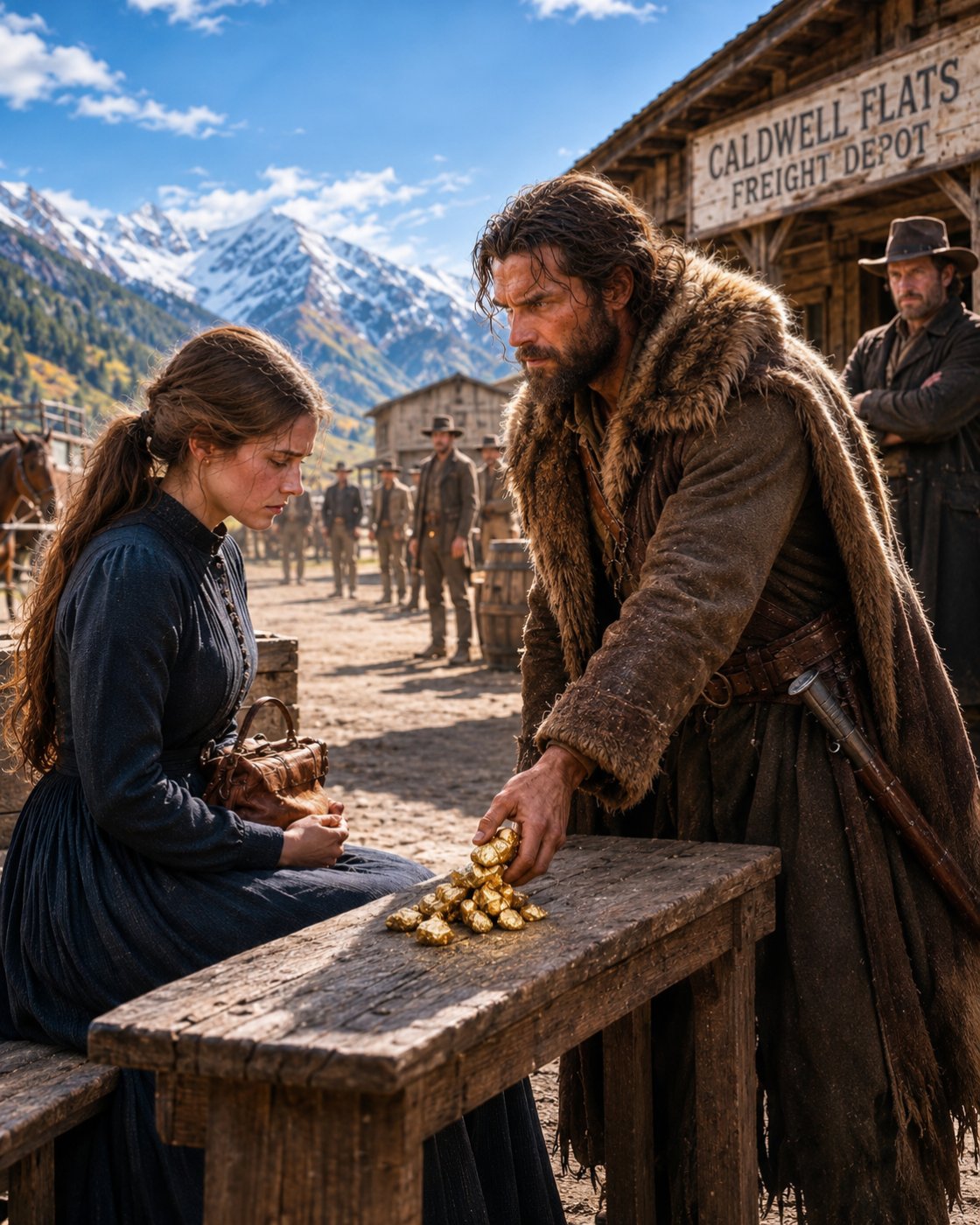
In case you missed it: Fleur came west in 1898 to marry her fiancé, Roland, and was left alone on a freight depot bench in Caldwell Flats for seven days.
A mountain man named Cabell set thirty-five dollars in gold beside her and asked who she was when nobody was left to define her.
She spent it on a rifle and boots and followed him into the high country, where he taught her to shoot.
In November, with Cabell away, a freighter named Thresh, who'd watched her every night on that bench, came out of the trees with a partner and reached for his gun.
Fleur squeezed the trigger.
The carbine bucked into her shoulder, solid and familiar, exactly where Cabell had taught her to set it.
The shot cracked off the granite cliff behind the cabin and came rolling back from three directions at once.
Thresh went over backward into the snow.
His revolver hadn't cleared the holster.
He didn't get up.
The other man stood frozen.
He was small and quick-eyed, and his name, she'd learn later, was Curry.
He looked at Thresh.
He looked at the porch.
He looked at the barrel of the Winchester, which Fleur had already worked again without lifting her cheek from the stock.
The empty brass spun once in the pale light and hissed into the snow.
Curry dropped his shotgun.
Then he turned and ran.
He crashed back through the deep powder into the spruce in a blind, lurching panic.
The sound of him faded fast into the muffled quiet of the high country, and then there was only the wind.
Fleur stood on the porch a long time.
The ringing in her ears slowly gave way to the sound of the wind in the trees.
She lowered the barrel.
She waited for something dramatic to happen inside her.
Horror, or grief, or the shakes.
What came was quieter than any of those.
It was a deep, exhausted solidity, as though a question she hadn't known she was carrying had finally been answered.
She went down off the porch.
She didn't go near Thresh.
She picked up Curry's shotgun from the snow and carried it inside and laid it on the table.
She went back out and picked up her axe from where she'd dropped it by the woodpile, and she finished splitting the round she'd been working on.
She didn't know why.
It seemed important that the round get split.
Then she sat down on the chopping block with the rifle across her knees and waited.
Cabell came back an hour later, leading the mules, with a quartered moose lashed across two packsaddles.
He stopped at the edge of the clearing.
He looked at the dark shape in the snow.
He looked at the trampled track running off into the spruce.
He looked at the porch.
Then he looked at her, sitting on the chopping block with the rifle in her lap.
He tied the mules.
He walked across the clearing without hurrying and stopped in front of her.
He looked at her face for a long time, reading it the way he read weather.
"His partner ran," Fleur said.
"Without his coat.
Or his gun".
"He won't make the valley without a coat," said Cabell.
"Or he'll make it with no toes".
"I told Thresh to turn around.
Once.
He reached for his revolver".
Cabell nodded slowly.
He walked over to Thresh and crouched beside him in the snow.
He didn't touch anything.
He looked carefully at the revolver, half-drawn and frozen in the dead man's hand.
At the tracks.
At the distance to the porch.
Then he stood up.
"Get the short-handled shovel from the shed," he said.
"Ground's frozen hard.
We'll put him under the rock shelf by the creek, where the soil's deep.
And we leave his gun in his hand till we do, and I'll write down where everything lay.
Someday somebody's going to come asking, and I want to tell them true".
"All right," she said.
When she passed him on her way to the shed, he put his hand on her shoulder.
It was one heavy, grounding touch.
It wasn't comfort, exactly.
It was the thing that passes between two people who have both been through something and know its weight without saying so.
They buried Thresh in the frozen ground under the rock shelf while the north wind moved through the spruce above them.
It took four hours.
Neither of them said much.
That was right.
That night, Cabell sat at the table and wrote it all out by lamplight in a slow, square hand on the back of a fur receipt.
The date and the hour.
The distance from the porch to the body, paced off.
The revolver half out of its holster in Thresh's right hand.
The shotgun dropped in the snow.
The tracks of a second man running north and east.
He signed it and dated it.
Then he slid it across to her.
"Read it.
Tell me what's wrong".
She read it.
Nothing was wrong.
She signed it below his name.
He folded it and put it in the tin box on the shelf where he kept his papers.
"I don't regret it," Fleur said.
"I know".
"Shouldn't I?"
Cabell was quiet a long time.
"A man came up a mountain in November to find a woman alone," he said.
"He brought a friend with a shotgun.
You gave him a door and he walked past it.
I don't know what you're supposed to feel.
But I know regret ain't owed".
Winter in the high country isn't a season.
It's a condition.
It presses on every surface, finds every gap in the chinking, tests every joint in every log.
You don't beat it.
You learn to carry it.
They lived by its rhythm.
Trap lines before breakfast.
Wood split after.
Hides scraped in the thin afternoon light.
Snowshoes mended by the stove at night.
The work was relentless, and in it, Fleur found a growing clarity.
There was no room left in the day for the low, constant grief she'd carried since Belleville, the grief of a life arranged around other people's decisions.
Here, every hour had a demand.
You met it or you didn't.
The mountain had no opinion about her feelings.
Cabell talked rarely.
When he did, it was worth listening to.
He told her where the wolverine ran and how to read the age of a track by the edge of the snow.
He showed her which plants held water and which were poison, and how to pack a wound with yarrow when there was nothing better.
One night in January, with the wind working at the roof, he told her why he'd come up there.
"My father was a respected man," he said, looking at his hands.
"In Halifax.
A grain merchant.
Deacon in the church.
Wore a silk hat on Sundays and knew everybody worth knowing".
He turned his coffee cup slowly.
"He was also bankrupt for the last eleven years of his life.
Every penny borrowed.
Every dinner he gave was on credit.
My mother sold her mother's silver one piece at a time to pay the butcher and told everybody she'd sent it out to be polished.
We'd go hungry three days a week in a house with a piano in the parlor.
Because people mustn't know".
"What happened?"
"He died.
The creditors came the day after the funeral.
Took the piano.
Took the house.
My mother went to live with her sister in Truro and never left the back bedroom again".
He drank his coffee.
"I was nineteen.
I'd spent my whole life watching people work themselves to death keeping up a story nobody believed.
So I came west.
Up here, a story's expensive.
You pay for it with your life.
The cold doesn't care what anybody thinks of you.
The snow doesn't.
A wolverine doesn't.
Whatever's true is right there in front of you every morning, and you can see it".
He said it simply.
He wasn't trying to impress her.
He was just explaining himself, the way a man does to someone he's decided is worth explaining himself to.
Fleur thought about that for a long time afterward.
She thought about Roland's letter, folded in the bottom of her bag.
The little lopsided cabin he'd drawn.
It had been a lovely picture.
He'd drawn a curl of smoke coming out of the chimney.
It had been a story.
In February, she woke in the dark to a crack like a cannon shot below the cabin.
She had the Winchester in her hands before her eyes were fully open.
She stood in the middle of the floor in her nightshirt with her heart slamming and the barrel trained on the door.
A match flared in the corner.
Cabell lit the lamp, and the cabin filled with moving amber light.
He looked at the rifle.
Then at her face.
"River ice letting go," he said.
She lowered the barrel.
She sat down on the edge of her cot, shaking, and pressed the heels of her hands against her eyes.
Cabell got up.
He put a log in the stove.
He set the coffee pot on to heat.
He kept his back turned while he did it, so she could shake in private.
"The jump doesn't leave," he said quietly.
"You carry it.
But it gets smaller.
Takes up less room, over time".
"Do you still get it?"
"Every time the ice goes".
He turned around and leaned against the warm stovepipe.
The open neck of his shirt showed the old faded scars across his chest.
She'd long since stopped noticing them as anything but the record of a long life lived high up.
"I've buried men up here," he said.
"Ones I shot.
Ones I couldn't get down off the mountain in time.
You stay long enough, you leave a trail behind you.
It's the price of the altitude".
He poured two cups of coffee and brought one to her.
Their fingers touched in the handing over.
His skin was rough as bark, and warm.
"I feel like something's been taken out of me," Fleur said.
He sat on the stool across from her, holding his cup in both hands.
"Nothing's been taken," he said.
"You're just lighter.
The fear took up a lot of room in you.
The waiting.
The helplessness.
All that's gone now.
You shot it dead on the porch".
He paused.
"What you put in its place is up to you".
It was the longest speech she'd ever heard him make.
She looked at him across the lamplight.
And she understood, with no sentimentality at all, that she trusted this man with the truest version of herself.
Not the version she'd kept polished for Roland, or smoothed for her family's comfort.
The version that had picked up a rifle and made a choice and buried a man in frozen ground, and was sitting here at four in the morning trying to figure out what to do with all the empty room the fear had left behind.
"I don't know what to put there," she said.
"You don't have to know tonight," said Cabell.
"The ice'll be going out for a month yet".
In March, the law came up the mountain.
He came on a snowshoe trail from the south on a clear, bitter morning, a lean young man in a buffalo coat with a provincial police badge pinned on the outside of it.
Behind him came Pringle from the general store, puffing, with his cautious eyes even more cautious than usual.
Cabell met them in the yard with his hands empty.
"Constable," he said.
"Mr. Cabell.
I'm Ainsley, out of Ashcroft".
The young man looked past him at Fleur, who'd come out onto the porch.
"And you'll be Miss Fleur Garneau".
"I will".
"A man named Curry came down into Caldwell Flats in November," said Constable Ainsley.
"He'd lost three toes and most of one ear to frostbite.
He's been telling anyone who'll buy him a drink that a woman up here murdered a freighter named Thresh in cold blood.
Shot him from the porch while he was asking for directions".
He took off his gloves.
"The roads weren't open till now.
I'd like to hear it from you".
So she told him.
She told it plain, the way Cabell had written it down.
The seven days on the bench.
Thresh standing at the corner of the depot every night with his coffee cup.
The two men coming out of the trees.
One warning.
The revolver.
Cabell went inside and came back with the paper from his tin box and handed it over.
The constable read it twice.
Then he walked down to the rock shelf by the creek and stood looking at the place a long time.
When he came back, he looked at Curry's shotgun, which Cabell brought out of the cabin for him, still loaded.
"Curry says he never carried a gun," Ainsley said slowly.
"He says they came up unarmed".
"That's his shotgun," said Cabell.
"Pringle'll know it".
Pringle cleared his throat.
"That's Curry's.
He bought it off me in August.
I've got it in the book".
He hesitated, then added, "And I sold Thresh that revolver myself in July.
And I'll tell you something else, Constable.
Thresh stood at the corner of that depot every evening for a week, watching her.
Half the town saw it.
Nobody did anything".
He looked at the ground.
"Me neither".
Constable Ainsley was quiet a long time.
Then he folded Cabell's paper and put it inside his coat.
"I'll take this down to the magistrate in Ashcroft," he said.
"And the shotgun.
But I'll tell you now what I'll tell him.
A man who brings a shotgun up a mountain in November to find a woman alone isn't asking for directions".
He put his gloves back on.
"Curry'll be going south on the next wagon, if I have anything to say about it.
There's a man in Barkerville who'd like to talk to him about some missing harness".
At the edge of the clearing, Pringle turned back.
"Miss Garneau," he said awkwardly.
"When you came into my store in September and asked me where the loading gate was, I thought you'd shoot yourself in the foot by Christmas".