PART 3
In case you missed it: Amos Rudd, a widowed mountain man, traded his only horse to pay the passage debt of Nell Harker, a mute mail-order bride whose groom had rejected her, because she called his mare with a secret signal only his drowned son had ever known.
Over the winter, she worked beside him in silence, saved his furs from a fire, and knitted him mittens in his late wife's stitch.
Then Amos learned that his father's old water claim made him the rightful owner of Cold Fork's water, and mill owner Cyrus Pell had Nell arrested over the supposedly unpaid debt to force Amos to sell.
Just as Amos reached for the pen, Nell spoke for the first time.
The pen stopped an inch above the paper.
Amos turned slowly.
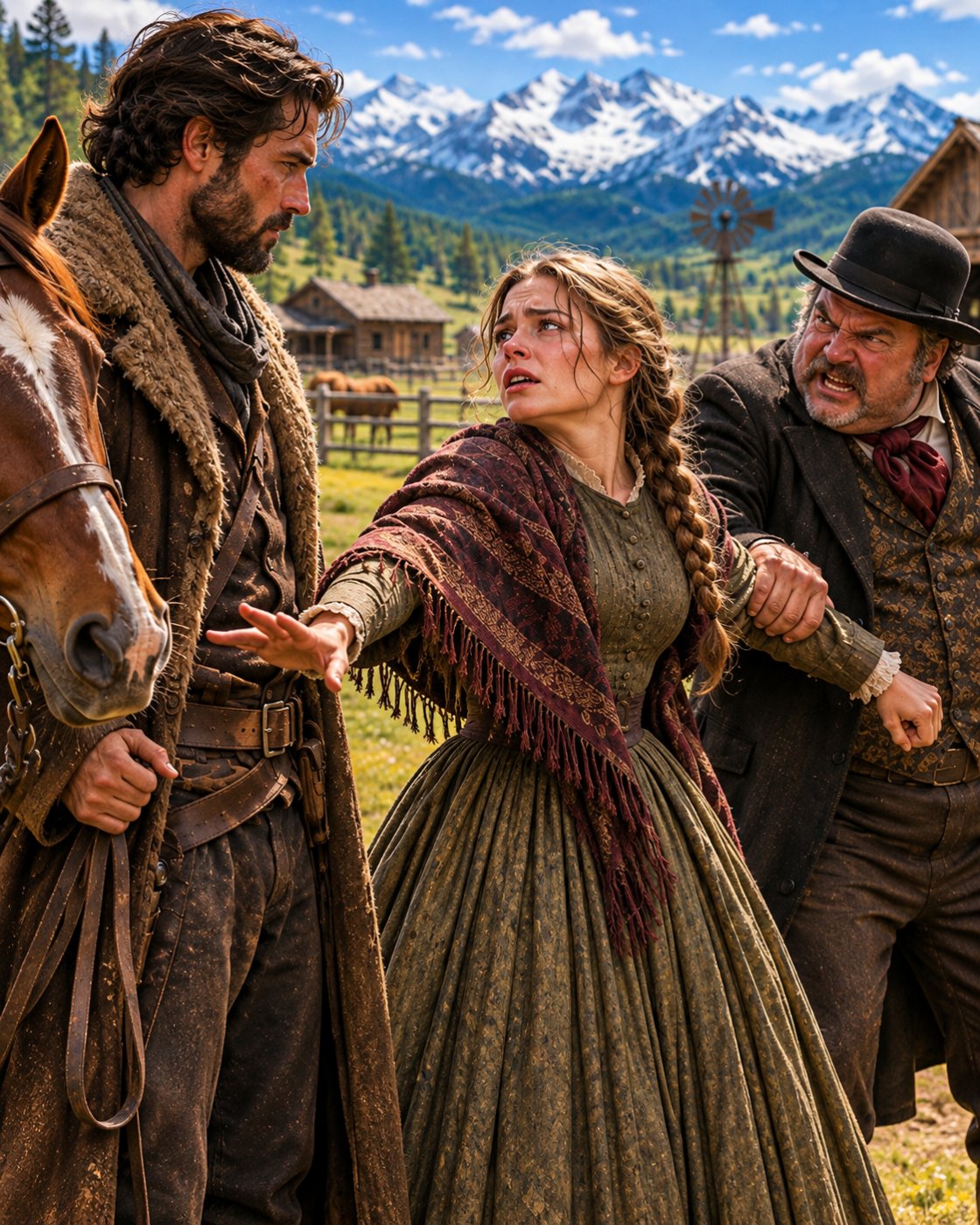
Nell was standing in the corner of Pell's office with the marshal's hand on her arm.
Her face had gone white.
She looked as if the word had cost her something, as if it had been torn up out of her by the roots.
Her lips were still parted, trembling.
"What did you say?" Amos whispered.
She swallowed.
Her throat worked.
When the word came again, it came slow and rough, like a gate that hadn't been opened in years.
"Daniel".
"I never told you that name," said Amos.
"I never told you his name.
Not once".
"I know".
Her voice was low and cracked, barely more than a breath.
But it was a voice.
Across the desk, Cyrus Pell had gone very still.
He was a big, heavy man of about fifty, with silver side-whiskers and a gold watch chain stretched across a fine vest.
He had owned the stamp mill at Silver Bend for twelve years.
A hundred and forty men worked for him.
He was a deacon at the Methodist church.
He had the face of a man who had never once in his life been told no.
Right now, his face was the color of ashes.
"Don't sign that paper," said Nell.
Each word seemed to cost her more than the last.
She pressed one hand flat against the wall as if to hold herself up.
"Why not?" said Amos.
"It was the dam".
She looked straight at Pell.
"The upper dam.
On Cold Fork.
It had a crack".
The office was so silent that Amos could hear the clock ticking on Pell's mantel.
"That's nonsense," said Pell.
But his voice had lost its smoothness.
"The girl doesn't know what she's saying".
"An engineer," said Nell.
"Came in June.
Of seventy-six.
He found the crack.
Along the eastern wall".
She drew a long, shuddering breath.
"He warned you, Mr. Pell.
In writing.
He wrote down everything he found".
"That was years ago," said Pell sharply.
"Then you remember the warning," said Amos.
Pell's mouth closed.
Amos stood up from the chair.
He laid the pen down very carefully on the paper, unsigned.
He looked at the man across the desk, and for a long moment, he couldn't speak at all.
Three years.
Three years he had told himself it was the rain.
Too much rain in the mountains, a dam built by men doing their best, an act of God that nobody could have stopped.
He had told himself that so he could go on living.
So he could get up in the morning and check his traps and not ride down the mountain with a rifle.
"You knew," he said quietly.
"You knew that dam was cracked.
And you let my wife and my boy sleep under it".
"You can't prove that," said Pell.
"Then we'll let the county judge decide".
Amos turned to the marshal.
"Marshal Keane.
You heard her.
You heard all of it".
The marshal was a lean, gray, tired man who had been sheriff of the county for nine years.
He looked from Pell to Nell to Amos, and something moved behind his eyes.
"I heard," he said slowly.
He looked at Nell.
"Miss Harker.
That engineer's warning.
Did he put it in writing?"
"Yes," whispered Nell.
"I kept his letter".
The marshal let go of her arm.
"Mr. Pell," he said, "I believe this meeting is over".
But the debt was not over.
The company agent, a sour man named Coburn, insisted on that.
He produced the company's contract, with Nell's mark on it.
Sixty dollars, payable on arrival, or the company could place her in service until it was worked off.
The liveryman had paid him cash at the depot, Coburn admitted when the marshal pressed him.
But he'd given no receipt, and without a receipt and without a signed marriage paper, the company considered the matter unsettled.
"Who told you to say that, Coburn?" Amos asked.
Coburn looked at the floor.
"She stays in the marshal's custody until it's paid," said Coburn.
"Those are the terms".
"Then I'll pay it," said Amos.
"Again.
With a receipt this time, and the marshal standing witness".
He rode back up the mountain that night on a borrowed horse.
He loaded every pelt from the winter's trap line onto a pack frame.
Marten and mink and beaver and three fine red foxes.
Every one of them caught on the line he and Nell had run together, every one of them carried out of the chimney fire in her own two arms.
At dawn, he sold the whole lot to the fur buyer at the mercantile for seventy-two dollars.
At nine o'clock, he counted sixty dollars onto Coburn's desk in the marshal's office, one dollar at a time.
Marshal Keane wrote out the receipt himself and made Coburn sign it, and signed it again as witness, and handed it to Amos.
"Paid in full," the marshal said.
"Miss Harker, you're free to go home".
Nell came out of the little back room where she had spent two nights.
Her dress was wrinkled.
Her hair was coming down.
Her burned arm was still wrapped in the bandage he'd tied for her.
She stopped in the doorway and looked at him.
"You sold the furs," she said.
Her voice was still hoarse, still careful, like someone walking on ice.
"Seemed like they were half yours anyway".
She looked at him for a long moment.
Then she came across the room and stood in front of him, and very gently, she laid her good hand flat against the front of his coat.
"Take me home, Amos," she said.
It was the first time she had ever said his name.
They walked the seven miles up the mountain together, slowly, through the melting snow.
For a long time, neither of them spoke.
Amos had a hundred questions and didn't know where to begin, and he could see that every word still cost her.
Halfway up, at the big rock where the trail turned, she stopped and sat down.
"I'll tell you now," she said.
"All of it.
I've been waiting to tell you all winter".
He sat down beside her.
She told it slowly.
Sometimes she stopped for a long time in the middle of a sentence and had to start again.
Sometimes she made a sound like a word that wouldn't come and had to try another.
But she told it.
"I stopped talking when I was twelve.
Scarlet fever.
When I got well, the words were.
.
.
gone.
Not gone.
Stuck.
Doctors said there was nothing wrong with my throat.
They said it was shock.
I could hum.
I could make sounds.
But words wouldn't come".
She looked down at her hands.
"So I learned to talk with my hands, and a slate.
People thought I was simple.
Some of them were cruel about it.
Most just looked past me".
"Fifteen years," said Amos softly.
"Seventeen".
She almost smiled.
"I'm twenty-nine".
She told him about Denver.
About going into service at sixteen, as housekeeper to an engineer named Mr. Edmund Ashby, a kind, nearsighted old widower who never once treated her like she was simple.
He taught her to copy his reports in a fair hand.
He trusted her with everything.
"In June of seventy-six," she said, "he came here.
To inspect Mr. Pell's dam on Cold Fork.
I came with him to keep his house.
We stayed three weeks".
She closed her eyes.
"He found the crack the second day.
All along the east wall, down near the footing.
He said if there was ever a big rain, it would go.
He wrote Mr. Pell a letter.
I copied it out fair.
Eleven thousand dollars, the repairs would cost.
Mr. Ashby said they had to be done before the fall rains".
"And Pell didn't do them".
"We went back to Denver in July.
In October, we read in the paper about the flood.
Four houses on the river.
Three people drowned".
Her voice shook.
"Mr. Ashby went white.
He took the train back here the very next day, and I came with him.
He wanted to see.
He wanted to find out why the repairs were never made".
She stopped.
"What did he find?" Amos asked.
Nell turned and looked at him.
Her eyes were wet.
"A little boy," she said.
"At the livery stable.
In town".
Amos didn't breathe.
"Mr. Brandt, the liveryman, had found him on a gravel bar two miles down the river, the morning after the flood.
Half drowned.
Hanging onto a cottonwood root.
He was wearing one red mitten".
Nell's voice was barely a whisper now.
"Mr. Pell came to the livery while we were there.
I heard him tell Mr. Brandt the boy was a foundling.
From an emigrant wagon that got swept off the ford.
No family left.
Mr. Pell said he would file the guardianship papers himself, as a county commissioner, and pay Mr. Brandt for the boy's keep.
If Mr. Brandt would raise him and ask no questions".
Amos put his face in his hands.
"I mended his mitten," Nell said.
"While Mr. Ashby was talking to Mr. Pell.
The little boy was sitting on a hay bale, crying for his papa, and his mitten had a hole in the thumb.
I mended it for him.
That's how I learned the cuff stitch.
I studied it for an hour so I could match it".
She swallowed.
"And while I sewed, he talked to me.
Little children talk to people who can't talk back.
He told me his name was Daniel.
He told me his papa had a horse called Juniper.
He showed me how to call her.
Two fingers crossed.
A double click.
'That's how Papa does it,' he said.
'She always comes.
'"
The wind moved in the pines over their heads.
"Mr. Ashby knew something was wrong," Nell went on.
"A family from the ford would have had a name.
Somebody would have been looking.
He meant to go to the county judge.
He wrote it all down, everything he'd seen and heard, and pinned it to his copy of the dam warning".
She took a long breath.
"But on the train back to Denver, he took sick.
Pneumonia.
He died in December.
He never got to the judge".
"And the letter?"
"Before he died, he gave it to me.
He said, 'Nell, find the boy's father.
'" Her voice broke completely.
"How could I find him? I couldn't speak.
I didn't even know his name.
Just Daniel, and a horse named Juniper.
I was a servant girl with eleven dollars and no voice.
I didn't know anyone here.
And Mr. Pell was the most powerful man in the county.
If I'd come back alone and started asking questions, with a slate, about his dam and his foundling.
.
".
She shook her head.
"He'd have had me run out of town before sundown.
And the letter with me".
"So you answered a marriage advertisement".
"It was the only way I could afford the stage".
She almost laughed.
"The company found me a groom in Silver Bend.
I didn't care who.
I only needed to get here.
I sewed Mr. Ashby's letter inside the lining of my trunk, and I came".
"And then you saw Juniper on the platform".
"A chestnut mare.
Old.
With a white star".
Nell turned and looked at him.
"I didn't know if it was her.
There must be a hundred chestnut mares in Colorado.
So I made the signal.
And she came".
"And I asked where you'd learned it".