PART 3
“I don’t want to unknow it,” Jesse said. “I want to know it. Every bit.”
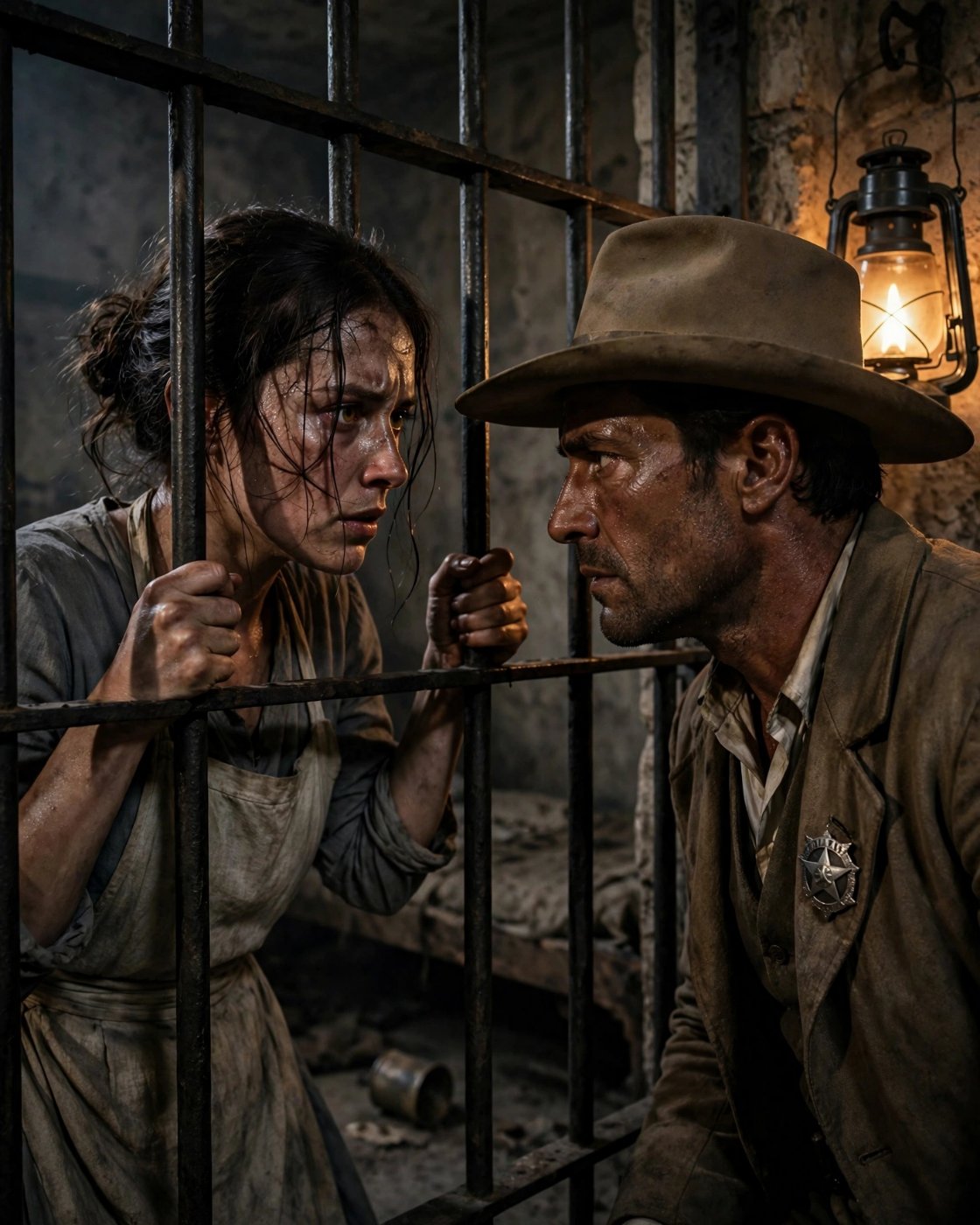
Clara studied him through the bars for a long moment. Then she looked past him, toward the front office, where Sheriff Tom Wiley sat with his boots on the desk and a newspaper over his face.
“Tom,” she called. “Would you step outside for a smoke?”
The sheriff lowered the paper. He looked at Clara, then at Jesse, then sighed like a man who had been expecting trouble for two weeks and was almost relieved it had finally come. He took his tobacco pouch and went out, and the door closed behind him.
Clara sat down on the edge of her cot. Jesse pulled the sheriff’s spare chair over to the bars and sat facing her, his hat in his hands.
“It was raining,” she began. “You’ll have heard that. It rained so hard that night the creek came up over the low road, and Garrett’s foreman had to bring me around by the ridge. Hattie came with me. She always does, on a first baby. Her hands are steadier than mine with the hot water.
“Annie wasn’t due for six weeks. When Lyle Dunn banged on my door at ten o’clock, I thought she’d had a fall. That’s what Lyle said. ‘Missus fell on the stairs.’” Clara’s mouth tightened. “When I got there, she was on the floor of the bedroom. Not the stairs. The bedroom. There was a chair turned over and a broken lamp, and somebody had tried to wipe the oil off the floorboards and done a poor job of it.”
Jesse’s hands had gone still on the brim of his hat.
“I got her on the bed. I unlaced her nightgown to check the baby. And I saw her ribs.” Clara’s voice stayed level, but Jesse saw her fingers close on the edge of the cot. “Ranger, I have seen what a kicking mule does to a man. I’ve seen a man thrown from a wagon. I know what a fall looks like. Your sister had not fallen. There were bruises across her side in the shape of a boot heel. Old ones going yellow underneath, and new ones over the top of them, still dark.”
“Old ones,” Jesse repeated.
“Some weeks old. Some months, maybe.” She paused. “She asked me not to look at them. She said, ‘Please, Clara. Just the baby. Just help me with the baby.’ So I did.”
Jesse looked down at the floor between his boots. He was seeing letters. A year and a half of Annie’s letters, folded into his saddlebag, carried from Ysleta to Alice to every camp on the Rio Grande. Garrett is busy with the new herd. Garrett has a temper when the cattle prices drop, but he’s sorry after. I’m fine, Jesse, truly. Don’t you worry about your little sister. Mind you don’t get shot.
He had read those lines a dozen times. He had never once read them right.
“Go on,” he said hoarsely.
“Garrett was in the front parlor. Drinking. Every hour or so he’d come to the door. He never came in. He’d stand there with the bottle and say, ‘Is it a boy yet?’ Like he was asking after a calf.” Clara swallowed. “Once he said, ‘It had better be a boy, Annie. You owe me that much.’
“She labored six hours. She was so tired, Jesse. She was bleeding inside, and I knew it, and there was nothing I could do. You can’t stitch what you can’t reach. Dr. Pierce might have tried, if anyone had sent for him then. Nobody did. Garrett wouldn’t have it. He said a midwife was good enough for his wife.”
She stopped. For a moment she couldn’t go on, and Jesse waited.
“The baby came at a quarter past three. A girl. Small, but she cried right away, loud and angry, and I thought, thank God, thank God, at least there’s that. I put her on Annie’s chest. And Annie looked at her, and then she looked at the door, where we could hear Garrett in the hall, and her face...” Clara shut her eyes. “I’ve never seen anyone so frightened. Not even dying.
“She grabbed my wrist. She was so weak by then, but she held on hard enough to bruise. And she said, ‘He wanted a son. Don’t let him have her. Get her to Jesse.’”
Jesse made a sound he didn’t recognize as his own.
“She said one more thing,” Clara whispered. “She said, ‘Call her Rose. For Mama.’ And then she just held the baby and looked at her, and about twenty minutes later she was gone.”
The jail was so quiet Jesse could hear the clock ticking in the sheriff’s office.
“Rose,” he said. “Our mother’s name was Rose.”
“I know. She told me, once, at a church supper. She told me about you too. Her big brother the Ranger. She was so proud of you.” Clara opened her eyes. “That’s why I didn’t trust you, when you came. Because she was so sure you’d come, and you didn’t. Not for a year and a half.”
He took that without flinching. He’d earned it.
“What did you do?”
“What she asked.” Clara lifted her chin. “Garrett came to the door again and said, ‘Well?’ And I stood up between him and the bed, and I told him his wife was dead and the child was born dead with her.”
“He believed you?”
“He was drunk, and he didn’t care. He asked if it was a boy. I said it was a girl. He said...” Clara’s jaw set. “He said, ‘Then it don’t matter.’ He didn’t even want to look. He said to wrap it up and put it in with her, and he’d have them both in the ground at first light, before the whole county came gawking.”
“Before anyone could see her ribs,” Jesse said.
“Yes.”
“And the baby?”
“Hattie was by the back window with my bag. I wrapped Rose in your mother’s quilt, tight, the way you wrap them so they feel held, and I put a sugar teat in her mouth to keep her quiet, and I handed her out the window into the rain. Hattie had her under her slicker and halfway to the ridge before Garrett finished his bottle.”
“Then what did you put in Annie’s arms?”
Clara looked at him steadily. “A flour sack from the Holloway pantry, packed with salt, wrapped in the birthing sheets and Annie’s own christening gown. It weighed about what a little baby weighs. I laid it in her arms and folded her hands over it.” Her voice finally broke. “I told her I was sorry. I told her I’d keep her girl safe. And then I sat with her until Garrett’s men came with the box.”
Jesse put his face in his hands.
He stayed like that for a long time. Clara didn’t speak. She sat on her cot and let him be, and when at last he lifted his head, his eyes were red and his face was older than it had been an hour before.
“How did you end up in here?”
“I went to Tom Wiley the next morning. Right after the burial. I told him Annie hadn’t died of childbirth alone. I told him about the boot marks.” She gave a short, humorless laugh. “By supper, Garrett had been to see the county attorney. Dr. Pierce had signed a certificate saying Annie died of hemorrhage caused by the midwife’s careless handling, and that I’d given her too much ergot and torn her trying to hurry the birth. By nightfall, I was in here.”
“Pierce never even examined her alive.”
“He came at dawn to sign the paper. He saw her before they closed the box. He saw the same bruises I did. I watched him see them.” Clara leaned forward. “And he wrote down what Garrett told him to write.”
Jesse stood up. He walked to the small high window and stood looking out at the courthouse square, at the farm wagons and the dogs asleep in the dust, at the ordinary Thursday morning carrying on as if the world had not just come apart.
“Why didn’t you tell Tom about the baby?” he asked without turning. “He’s a fair man.”
“He’s a fair man with a wife and four children who rents his house from Garrett Holloway’s bank.” Clara’s voice was tired. “And it wouldn’t matter if he were a saint. Think about it, Ranger. If I tell the court that baby is alive, what happens to her?”
He turned slowly.
“She goes to her father,” Clara said. “That’s the law in Texas. Garrett Holloway is her lawful father. He’d walk into that courtroom and pick her up and carry her home, and there’s not a judge in this state who’d stop him. A girl he didn’t want, born to a wife he beat to death. You tell me how long she’d last in that house.”
Jesse had not thought of that. He’d been so full of grief and rage he hadn’t thought past the hidden room and the star quilt and the miracle of a living child.
“So you sat in here,” he said slowly, “and let them call you a murderer. And you’d have let them hang you. Rather than say one word that might put her in his hands.”
“I promised Annie.”
“You barely knew Annie.”
Clara met his eyes. “I knew her for six hours. She was the bravest woman I ever delivered. That’s enough.”
Jesse came back to the bars. He stood very close to them, close enough that she had to tip her head back to look up at him.
“I said I came to watch you hang,” he said quietly. “I was wrong. I was wrong about everything, and I said a cruel thing to a woman who didn’t deserve it, and I’m sorry.”
“You were grieving.”
“That’s no excuse.”
“No,” Clara agreed. “But it’s a reason. I’ve sat with a lot of grieving people, Ranger. They all say cruel things. The ones worth anything come back and say sorry.” A faint, tired smile touched her mouth. “You’re the first one who ever came back in less than a day.”
“Then let me make it right.”
“How?”
“The only way it’ll ever be right.” His hand closed around one of the iron bars. “Garrett Holloway has to stand up in open court in front of the whole county and be proven a liar and a killer. Not suspected. Proven. So no judge on earth would ever hand that baby back to him. That means I need Pierce. And I need you to stay alive till Monday.”
“I don’t intend to die before Monday,” Clara said. “After Monday is the part that worries me.”
Jesse didn’t go back to the hotel. He went to work.
He’d been a Ranger eleven years. He knew how to find out what a town knew, and he knew that what a town knew was almost never said in daylight. So he spent Thursday afternoon at the livery, helping old Abe Pruett shoe a mule and listening. He spent Thursday evening at the Wagon Yard saloon, nursing one whiskey for three hours at a corner table, and listening.
He learned that Garrett Holloway had bought out two neighbors in the drought of ‘91 and hadn’t paid either of them fair. He learned that Lyle Dunn, the foreman, had been in jail twice in Lampasas for fighting. He learned that Annie Holloway hadn’t come to church in four months, and that the women of the Methodist Ladies’ Circle had remarked on it and decided she was “putting on airs.”
And near midnight, when the bartender, a big, quiet Swede named Nils Lindqvist, came by to wipe his table, Jesse learned the thing he’d come to learn.
“You’re asking about Doc Pierce,” Nils said, low. It wasn’t a question.
“I might be.”
Nils glanced at the door. “Last winter. December. There’s a game in the back room on Saturdays. Doc Pierce, he likes cards more than cards like him. He lost to Holloway. Lost and lost and kept signing markers.” He wiped the same ring off the table three times. “Near two thousand dollars, by Christmas. Holloway made a joke of it. Said he’d take the doc’s house and his practice and his fancy German instruments, and Doc could go back to Tennessee and pull teeth.”