PART 3
The rain struck the smithy roof like handfuls of gravel.
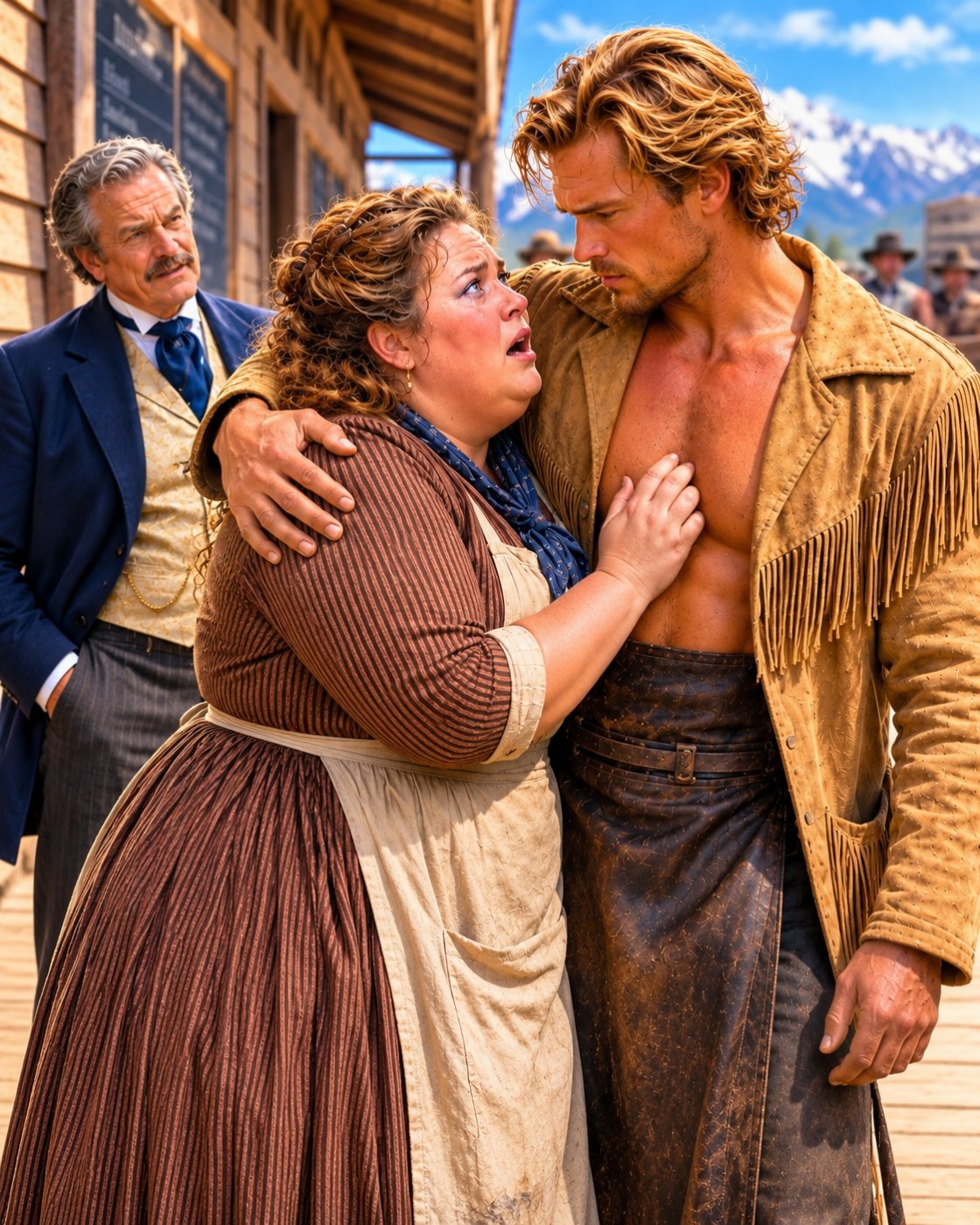
Hattie Ashby stood inside the doorway, staring at her husband lying helpless in the mud.
Caleb had always seemed indestructible to her.
He could lift wagon axles, bend hot iron, and work twelve hours beside a roaring forge without complaining.
Now he was struggling to raise himself with one arm.
His right shoulder had been injured, and the shotgun lay beyond his reach.
Outside, Wade Toiver shouted another order.
“Get the woman!”
Hattie felt something change inside her.
For years, she had believed the cruel things people said about her.
Too large.
Too clumsy.
Too much trouble.
Too much of everything.
But Caleb had spent months teaching her another truth.
Her strength was not something to apologize for.
It was something she could use.
She rushed into the rain.
“Hattie!” Caleb gasped. “Go back!”
She ignored him.
Dropping beside him, she slipped her arms beneath his shoulders and pulled him toward the smithy.
The mud caught at her boots.
The distance felt endless.
But she kept moving.
One step.
Then another.
A rider shouted behind her.
Hattie reached the doorway, dragged Caleb across the threshold, and kicked the heavy door shut.
Something struck it from outside.
The wooden bar jumped against its brackets.
Caleb groaned.
“Hattie, you have to get away.”
She knelt beside him.
“Look at me.”
His eyes found hers.
“You once told me substance survives a Montana winter.”
“Hattie—”
“Well, I'm still here.”
She pressed clean cloth against his injured shoulder and tightened the bandage.
Then she stood.
Outside, another blow rattled the door.
Hattie looked toward the enormous anvil beside the forge.
For months, she had watched Caleb work beside it.
Three hundred and ten pounds of iron.
He had once joked that it was the only thing in the shop more stubborn than she was.
Now she approached it.
She bent her knees, braced herself, and shifted the anvil from its wooden block.
The weight strained every muscle.
She moved it only a few feet, sliding and lifting it in short, determined efforts.
But those few feet were enough.
She positioned it against the door.
The next impact shook the frame.
The anvil held.
Outside, someone cursed.
Caleb stared at her.
“Good Lord, woman.”
“Save your breath,” she answered. “You'll need it when I tell you what this door is going to cost to repair.”
Despite his pain, he almost smiled.
Then smoke began seeping through the roof.
The attackers had set fire to the outer shingles.
Hattie hurried to the forge.
She knew the building.
She knew where Caleb kept his water.
She knew which shutters could be secured and which had warped during winter.
She used the quenching water to soak the threatened wall and roof supports, fighting the flames before they spread.
A man forced open the east shutter.
Hattie seized a long iron bar from the workbench and raised it between them.
“Get out!”
He hesitated.
She stepped forward.
He withdrew.
But Wade Toiver was less easily discouraged.
He appeared through the damaged opening, his coat dripping rainwater.
“Still making trouble, Hattie?”
She recognized the voice that had mocked her before the entire town.
The voice that had announced her weight as though it were a defect.
The voice that had tried to give her away.
“You should have stayed at the hotel,” he sneered.
Hattie stood between him and Caleb.
“Why? So Ivy could bury me?”
Toiver's expression changed.
Only slightly.
But enough.
“You found that receipt.”
“I did.”
“Then you should have kept quiet.”
Hattie lifted the iron bar.
“Leave.”
He glanced toward Caleb.
“Your husband won't be much use to you now.”
For the first time, Hattie felt no shame.
No fear of being laughed at.
Only a fierce determination to protect the man who had taught her that she deserved to be loved.
“You've spent years frightening women who had nowhere to go,” she said. “But this is my home.”
Toiver stepped forward.
A sudden movement sent a tool rack crashing between them.
He stumbled backward, losing his footing on the wet floor.
Hattie slammed the shutter and secured it.
Outside, the attackers shouted.
But something had changed.
The men were no longer certain that the smithy would be easy to take.
And down the mountain, faintly, came the sound of approaching horses.
The fire had been visible from Rusk Hollow.
The miners had seen it.
Help was coming.
Hattie looked through a narrow gap in the shutters.
At the top of the grade stood a buggy.
Beside it, beneath an expensive dark-blue coat, was Judson Ivy.
He was watching his hired men retreat.
Hattie recognized the strongbox beside the driver's seat.
She had seen it many times at the hotel.
Ivy kept his most valuable papers inside it.
Including, perhaps, the mysterious placement ledger Nell had mentioned.
The miners' horses were growing louder.
Ivy turned his buggy toward the road.
Hattie faced a terrible choice.
Caleb needed her.
But if Ivy escaped with that box, the evidence of what had happened to the missing women might disappear forever.
She knelt beside her husband.
“Can you hold this bandage?”
Caleb nodded weakly.
“Where are you going?”
“To finish something.”
“Hattie, don't.”
She touched his face.
“You brought me out of that town because you couldn't bear to see someone treated like property.”
His eyes filled with fear.
“I brought you out because you deserved a life.”
“And so did those other women.”
She kissed his forehead.
“I'll come back.”
Then she stepped into the rain.
The miners were already approaching the lower yard.
Their lanterns swung through the darkness.
Ivy saw them too.
He urged his team forward.
But the narrow switchback had become slick with mud, and one wheel slipped toward the ditch.
The buggy lurched.
The strongbox slid from the seat and struck the ground.
Ivy scrambled after it.
Hattie reached the box first.
For a moment, they stood facing each other.
The man who had once counted her worth in dollars.
And the woman he had intended never to see again.
“Give me that,” Ivy demanded.
Hattie held the box against her side.
“No.”
“You have no idea what you're doing.”
“I know exactly what I'm doing.”
His expression hardened.
“You think your husband can protect you forever?”
Hattie looked toward the approaching miners.
“He doesn't have to.”
Two men from Rusk Hollow dismounted nearby.
One recognized Ivy.
Another saw the burning shed.
“What happened here?” he demanded.
Hattie raised her voice.
“Send someone for the sheriff. My husband is hurt, and this man has papers that may explain why several women disappeared from Choke Cherry Bend.”
Ivy opened his mouth.
Then closed it.
For the first time in all the years Hattie had known him, he had nothing useful to say.
The miners secured the scene and kept Ivy from leaving until the authorities arrived.
Hattie returned immediately to Caleb.
He was conscious.
Barely.
His face was pale.
But when she entered, his eyes opened.
“Did you come back?”
She knelt beside him.
“Of course.”
He tried to smile.
“I knew you would.”
She pressed her forehead against his.
“Don't you dare leave me now.”
“I've got no intention of it.”
“You'd better not.”
His good hand found hers.
“You saved me.”
She shook her head.
“You saved me first.”
He looked at her for a long moment.
“No, Hattie.”
His voice was weak but certain.
“I opened a door. You walked through it.”
She began to cry.
And for once, she did not try to hide the tears.
By dawn, the sheriff had arrived with a doctor from the mining settlement.
Caleb's shoulder injury was serious, but the doctor believed he could recover if infection did not set in and he rested long enough.
Hattie remained beside him while the doctor worked.
When Caleb finally fell asleep, she allowed herself to breathe.
Then she turned toward the strongbox.
It had been placed on the table under the sheriff's supervision.
Inside were money, correspondence, freight agreements, and a thick black ledger.
Hattie recognized Judson Ivy's handwriting.
She opened the book.
Twenty-two names.
Twenty-two women.
Each listed beside a placement fee and a destination.
Some had been sent to timber camps.
Others to remote mining settlements.
Several had no recorded return.
At the back was a narrow column labeled:
“Settled.”
Four names carried small crosses.
Hattie read them slowly.
She knew two.
Young women who had worked beside her at the Bend House.
Girls who had disappeared after being promised good wages.
Her hands trembled.
The sheriff leaned closer.
“What does that mark mean?”
“I don't know yet,” Hattie answered.
But she had an awful suspicion.
She took out the undertaker's receipt bearing her own name.
Then she compared the handwriting and dates.
The sheriff's expression darkened.
“We'll need the undertaker's records.”
“Yes.”
“And statements from anyone who handled these placements.”
“Yes.”
He studied her.
“Mrs. Ashby, this may become a very serious investigation.”
Hattie closed the ledger.
“It should have been one years ago.”
Three days later, she traveled to the county seat with the sheriff.
Caleb remained at home under the doctor's care, furious that he could not accompany her.
Before she left, he caught her hand.
“You don't have to carry this alone.”
“I know.”
“Then remember that.”
She leaned down and kissed him.
“I'll be home before dark.”
He smiled.
“That's a promise I'll hold you to.”
At the county attorney's office, Hattie sat for three hours explaining everything she knew.
The hiring board.
The debt papers.
The missing women.
The undertaker's receipt.
Ivy's threats.
The attack on the smithy.
She did not exaggerate.
She did not speculate beyond the evidence.
She simply told the truth.
And when she finished, the attorney asked her to return the following morning.
The investigation moved quickly.
The undertaker's records confirmed that burial arrangements had been paid for in the names of four women before their recorded departures from Choke Cherry Bend.
Investigators began tracing the women and the camps to which they had supposedly been sent.
Wade Toiver, facing serious charges arising from the attack, agreed to cooperate.
He identified camp bosses, explained the placement payments, and described how Ivy had used debts and false employment promises to control vulnerable workers.
His testimony did not answer every question.
But it gave investigators names and places to examine.
And it destroyed Ivy's carefully maintained appearance of respectability.
At the public inquest, the four women's names were read aloud.
Hattie stood in a borrowed black dress.
She had spent years being stared at because of her body.
Now the room watched her for another reason.
She was the woman who had survived.
The woman who had brought the evidence.
The woman who had refused to remain silent.
When asked what the undertaker's receipts proved, she answered carefully.
“They prove that someone arranged and paid for these burials before those women were recorded as leaving town.”
She paused.
“And I believe those women deserve to have their stories investigated, not forgotten.”
No one laughed.
No one made a joke about her size.
No one called her a burden.
The county attorney thanked her.
And Hattie sat down with her head held high.
The months that followed brought arrests, testimony, and legal proceedings.
The mining company terminated Ivy's ore-road agreement after the extent of his misconduct became known.
His business interests were seized or sold to satisfy judgments and financial obligations.
The hotel changed hands.
The freight barn passed to new owners.
And the scale on which he had weighed half the county was no longer his.
Lucinda Prior, who had spent years counting Hattie's biscuits and encouraging the guests to laugh at her, departed on an eastbound stage.
Few people noticed.
Judson Ivy was eventually convicted on charges connected to the fraudulent labor scheme and related offenses.
He was sent to the territorial prison at Deer Lodge.
For the first time, the man who had controlled so many lives through paper and debt had lost control of his own.
But Hattie did not celebrate his imprisonment.
She thought of the women whose names had appeared in the ledger.
She thought of their families.
She thought of how easily a person could disappear when powerful men believed nobody would ask questions.
And she made herself a promise.
No woman who came to her seeking honest work would ever be treated as property.
Back on Cinder Ridge, Caleb recovered slowly.
His shoulder remained stiff through summer.
He could not lift the heaviest iron for months.
So Hattie took his place at the forge.
At first, the miners stared.
A woman working the bellows.
A woman handling heavy stock.
A woman keeping the accounts and negotiating prices.
Then they saw the quality of her work.
They stopped staring.
And started bringing more business.
One afternoon, Caleb stood in the doorway watching her finish a wagon fitting.
She lowered the hammer and looked up.
“What?”
He shook his head.
“Nothing.”
“You've been standing there for ten minutes.”
“I know.”
“Then say whatever you're thinking.”
He smiled.
“I was thinking I married the finest blacksmith in Montana.”
Hattie laughed.
“You married a hotel girl nobody wanted.”
His expression changed.
He crossed the room and gently took her hands.
“No.”
She looked into his eyes.
“I married a woman the town was too foolish to recognize.”
Her throat tightened.
“Caleb…”
“You were never unwanted, Hattie.”
He kissed her forehead.
“You were simply surrounded by people who didn't know your worth.”
She leaned against him.
For a long time, neither spoke.
Then Caleb added, “Though I would appreciate it if you'd stop lifting things that frighten me.”
She laughed against his chest.
“No promises.”
The mine eventually negotiated a lawful agreement to use the road across Cinder Ridge.
The Ashbies retained ownership.
Every wagon carrying ore over the grade paid a toll.
For eleven years, those payments helped support the smithy and the growing settlement around it.
Caleb expanded the forge.
Hattie kept the accounts.
They hired apprentices.
And whenever a young woman came looking for work, Hattie asked only what she wanted to learn.
Not what she weighed.
Not whether she was pretty.
Not whether a man would marry her.
What she wanted to learn.
She paid wages directly to the workers who earned them.
She kept transparent records.
And she refused to use debt contracts to bind anyone to the mountain.
Word spread.
Women arrived from Helena, Butte, and smaller settlements scattered across the territory.
Some had been dismissed as too weak.
Others as too plain.
A few had been told they were too old to begin again.
Hattie listened to their stories.
Then she showed them the work.
Nell Sackett eventually moved up the mountain and opened a boarding house near the foot of the grade.
She became one of Hattie's closest friends.
Together, they built a place where women could earn a living without being humiliated for needing one.
The ridge prospered.
And so did the Ashby family.
Their first child was a boy.
Caleb held him with the solemn expression of a man examining something more precious than gold.
“He's got your hands,” he whispered.
Hattie laughed.
“He's a baby. He hasn't got anybody's hands yet.”
“Strong ones.”
“Stubborn ones, probably.”
Caleb looked at her.
“Then he'll do fine.”
Their daughter arrived two years later.
She inherited Hattie's gray eyes and Caleb's determined jaw.
By the age of four, she followed her mother around the smithy asking endless questions.
“Why does iron turn red?”
“Because it's hot.”
“Why does it get soft?”
“Because heat changes it.”
“Does everything change when it gets hot?”
Hattie smiled.
“Not everything, sweetheart.”
The little girl thought about this.
“Did you change?”
Hattie stopped working.
She looked toward Caleb, who was fitting a horseshoe beside the second forge.
“Yes,” she answered softly.
“I did.”
“Because of Papa?”
Hattie considered the question.
“Your papa helped me see something that was already there.”
“What?”
She knelt beside her daughter.
“That I was strong. And that being strong was nothing to be ashamed of.”
The little girl nodded solemnly.
“I'm strong, too.”
Hattie smiled.
“I know you are.”
Years passed.
The name Ashby became known throughout the region.
Teamsters told stories about the night a woman had defended a mountain smithy against armed men.
Some exaggerated.
Some claimed she had lifted an anvil over her head.
Others insisted she had stopped a runaway team with one hand.
Hattie laughed whenever she heard the stories.
She knew what had really happened.
She had been frightened.
She had been exhausted.
She had nearly lost the man she loved.
But she had refused to surrender.
That was enough.
By her fortieth year, the smithy had become one of the busiest workshops in the mountain district.
A large iron sign hung above the door.
Caleb had forged it himself.
ASHBY & ASHBY
BLACKSMITHS
Hattie's name appeared first in the business records.
Caleb had insisted.
“You keep the accounts,” he told her. “You negotiate the contracts. And half the work that comes through this shop is yours.”
She smiled.
“People will talk.”
“Let them.”
“Some might laugh.”
He took her hand.
“Then they'll have to laugh while paying our bill.”
One autumn evening, Hattie sat on the porch watching ore wagons descend the switchback road.
The sky glowed amber.
The mountains stood dark against the fading light.
Inside the house, their children were arguing over whose turn it was to feed the chickens.
Caleb came out of the smithy with soot on his hands.
He sat beside her.
For a while, they watched the wagons in silence.
Then he said, “Do you ever think about that day in Choke Cherry Bend?”
Hattie looked toward him.
“Sometimes.”
“Do you wish I'd done anything differently?”
She smiled.
“You could have spoken to me before marrying me.”
He laughed.
“Fair criticism.”
“And you could have told me why you were paying so much money.”
“I didn't think you'd believe me.”
“I wouldn't have.”
He nodded.
They sat quietly.
Then Hattie said, “Do you know what I remember most?”
“The crowd?”
“No.”
“The preacher?”
“No.”
He looked puzzled.
“The wagon?”
She nodded.
“You stopped two miles outside town.”
Caleb smiled faintly.
“The iron was making the seat uncomfortable.”
“You moved it.”
“Yes.”
“And you folded a blanket for me.”
He shrugged.
“It was a rough road.”
Hattie took his hand.
“That was the first time in years anyone had noticed I was uncomfortable and tried to make it better without asking for something in return.”
Caleb's expression softened.
“I wish someone had done it sooner.”
“So do I.”
She leaned against his shoulder.
“But I'm glad it was you.”
He turned toward her.
“You know what I remember?”
“What?”
“You standing on that boardwalk.”
Hattie looked away.
“I was trying not to cry.”
“I know.”
“Everyone was laughing.”
“I know.”
She swallowed.
“And you looked at me.”
Caleb gently turned her face toward his.
“I saw a woman who had been treated cruelly and still stood on her own feet.”
He brushed a loose strand of hair from her cheek.
“I thought that was something worth respecting.”
Hattie smiled through tears.
“And now?”
“Now?”
He leaned closer.
“Now I think I was the luckiest fool in Montana.”
She laughed.
He kissed her.
It was the same gentle kiss he had given her beside the forge years earlier.
Only now, there was no uncertainty.
No fear that kindness might come with a price.
No need to make herself smaller.
Below them, the road they had refused to sell wound through the mountains.
Wagon after wagon carried ore toward the valley.
And the man who had once stood before an entire town and chosen the woman nobody wanted sat beside her, holding her hand as though he had never considered choosing anyone else.
Hattie looked at the sunset.
She remembered the hiring board.
The laughter.
The shame.
The moment she had believed she was worth less than a pair of mules.
Then she looked at her husband, her home, and the life they had built together.
She finally understood something.
The town had never decided her worth.
It had only revealed its own cruelty.
And Caleb had not made her valuable by choosing her.
He had simply been the first man brave enough to recognize the value that was already there.
What matters more in love: finding someone who sees your worth when nobody else does, or learning to see that worth in yourself?