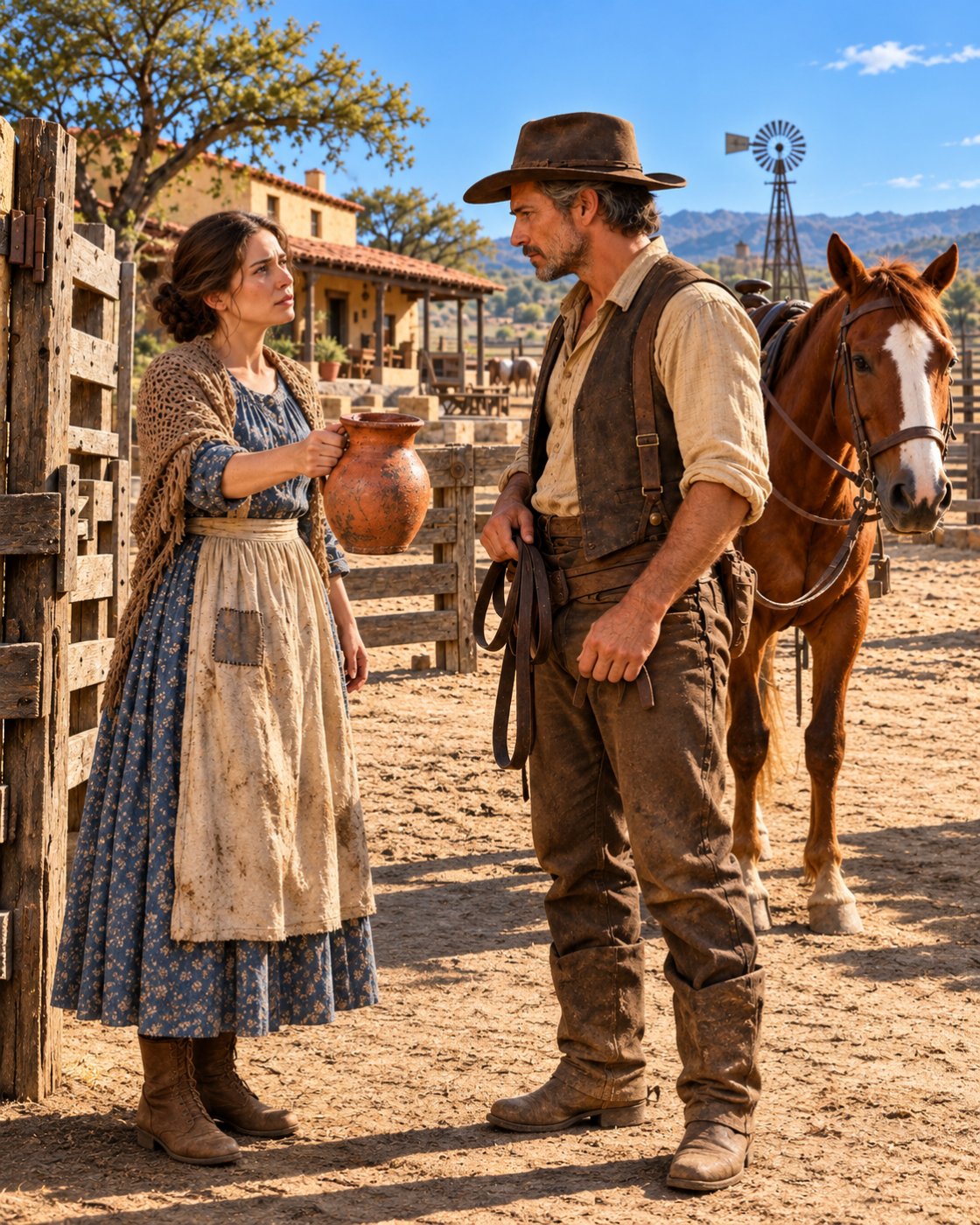
“I Live Alone, and They Rob Me Every Night”—The Widow Begged a Stranger for Protection, Never Knowing Who Was Behind the Thefts
PART 1
“Please don't leave, mister. I live alone, and someone robs me almost every night.”
The stranger stopped beside the well, his little daughter clinging to his hand. Lydia Thorne stood on her porch with an unloaded shotgun trembling against her shoulder. For two years, she'd buried her husband, defended their small Kansas homestead, and begged the people of Willow Bend to believe someone was stealing her livestock and tools. Nobody listened. They called her a lonely widow imagining shadows.
Now she was asking a man she'd known for less than ten minutes to protect her.
His name was Jesse Calder, a widowed blacksmith traveling west with his six-year-old daughter, Effie. Their wagon had broken down, their water was gone, and the little girl could barely stand beneath the summer heat.
“Papa,” Effie whispered, “I'm so thirsty.”
Lydia lowered the shotgun immediately.
“Come to the well, sweetheart.”
The child drank until water spilled down her chin. Jesse watched with exhausted gratitude.
“You've saved us a hard journey, ma'am.”
Lydia hesitated before asking, “Could you stay a few nights? I can offer hot meals and a roof. That's all.”
Jesse studied her frightened face.
“You'd trust a stranger?”
“You asked for water instead of taking it.”
That evening, Lydia served bean soup and cornbread while Effie sat at the kitchen table holding an old blue drinking dipper. For the first time since Walter Thorne died in a well-digging accident, the house contained something besides silence.
Jesse slept in the barn, insisting Lydia lock her bedroom door.
“Even against you?” she asked.
“Especially against a stranger you barely know.”
Shortly after midnight, hoofbeats sounded beyond the fence. Jesse hurried outside with his lantern, but the rider escaped into the darkness.
At sunrise, he discovered a fresh horseshoe print beside Lydia's missing chicken coop.
The shoe had a distinctive crack through its heel.
Lydia stared at it.
“That's the same mark I found near the well last month.”
Jesse knelt beside the print.
“Whoever's been stealing from you rides the same horse every time.”
For the first time, someone believed her.
Over the following days, Jesse repaired her broken windlass, Effie helped bake cornbread, and Lydia found herself laughing at a dinner table she'd once dreaded approaching alone.
Then a wealthy cattleman named Lucius Bramwell arrived in a polished black buggy.
“I've come to make another offer for your well, Mrs. Thorne.”
Lydia stiffened.
“My answer hasn't changed.”
Bramwell smiled coldly.
“Widows living alone should be careful about refusing generous men.”
After he departed, Jesse noticed something Lydia hadn't.
The horse pulling Bramwell's buggy wore an expensive set of shoes.
But the animal tied behind the carriage had a cracked shoe on its left hind hoof.
Jesse slowly turned toward Lydia.
And suddenly, the nightly robberies looked less like random thefts—and more like a carefully planned attempt to frighten a widow off her land.
Was Bramwell stealing from Lydia to force her into selling the well her husband died digging? And if Jesse confronted the wealthiest man in Willow Bend, would Lydia lose the only person who had finally made her feel safe?
What would you do if the man offering to buy your home might also be the one terrorizing you?
The next clue comes from a missing hammer Lydia thought she'd never see again. Read PART 2 in the first comment. 👇
PART 2
And suddenly, the nightly robberies looked less like random thefts—and more like a carefully planned attempt to frighten a widow off her land.
Jesse didn't accuse Bramwell immediately. Instead, he began watching the roads after dark. One morning, he found another print beside Lydia's fence, the same cracked horseshoe unmistakable in the damp earth. That afternoon, while buying nails in Willow Bend, he spotted Bramwell's hired man, Dewey Rook, leading the horse he'd seen behind the buggy. Jesse recognized the damaged shoe instantly. But before he could question Dewey, the man hurried away, leaving Jesse with a terrible suspicion and no witness willing to support it.
Meanwhile, Lydia's neighbors had begun talking. Beatrice Lusk, the town's most outspoken gossip, claimed Lydia had invented the robberies to justify keeping a strange man on her property. At the Sunday market, Bramwell publicly accused Jesse of stealing tools from nearby farms. Lydia stepped forward to defend him, but the crowd turned against her. “You've been lying about thieves for months,” Beatrice declared. “Now you've brought one into your own home.” Lydia stood trembling as people she'd known for twelve years looked at her with disgust. Jesse quietly took her hand and led her away.
That night, Lydia cried at the kitchen table. “They'll never believe me.” Jesse knelt beside her. “Then we'll give them something they can't deny.” He strung small bells along the fence and repaired the gate. For seven nights, nothing disappeared. Effie began laughing again, Lydia found herself smiling whenever Jesse entered the room, and one evening beneath the porch lantern, he gently kissed her hand. “I haven't felt at home anywhere since Anna died,” he whispered. Lydia's eyes filled. “And I haven't felt safe since Walter.”
But their peace shattered when someone cut the bell ropes and destroyed the well's wooden windlass. That same morning, Effie developed a dangerous fever. Jesse rode through the night to bring Odessa Pike, the elderly midwife who knew every family in Willow Bend. While Odessa cared for the child, Bramwell sent Lydia a written warning: surrender the well or he would petition the county to investigate whether a homeless drifter was fit to raise a motherless girl.
Lydia stared at the letter. Jesse had risked everything to protect her, and now his daughter might suffer because of it. Before sunrise, she quietly packed a bag and left the blue dipper on the kitchen table. She intended to sign over the well and disappear from Jesse's life before Bramwell could carry out his threat.
But halfway down the road, Jesse caught up with her.
“Lydia, stop!”
She turned, crying. “I'm doing this to save Effie.”
He dismounted and took her trembling hands. “You don't save us by leaving us. We face him together.”
“Why would you risk losing your daughter for me?”
Jesse's voice broke.
“Because I love you, Lydia. And Effie loves you too.”
Before Lydia could answer, a rider appeared behind them. It was Odessa, carrying a bloodstained leather tool pouch she'd found hidden beneath Bramwell's barn floor.
Inside was Walter Thorne's missing hammer.
And wrapped around its handle was a folded document bearing Lydia's forged signature, transferring ownership of her well to Lucius Bramwell.
The robberies were no longer the only crime.
Someone had been preparing to steal Lydia's land even if she refused to sell.
But could a widow accused of lying convince a judge that the richest man in town had forged her name?
If the whole town called you dishonest, would you still stand up and tell the truth?
Comment “JUSTICE” for PART 3, where Lydia must face Bramwell in public—and Jesse must prove that the home he's found is worth fighting for.
PART 3
The robberies were no longer the only crime.
Someone had been preparing to steal Lydia's land even if she refused to sell.
Lydia Thorne stood beside the dusty road, staring at the folded document in Odessa Pike's trembling hand. The paper bore her name in dark ink, followed by a signature that looked almost like hers. Almost. Whoever had written it had copied the long curve of the L and the sharp downward stroke of the T, but Lydia knew immediately that she had never signed it.
Beside the forged document lay Walter's old hammer.
She recognized the worn hickory handle, the small chip in the iron head, and the initials her husband had carved near the base during their first summer on the homestead.
For two years, Lydia had believed that hammer was gone forever.
Now it had been found hidden in the barn of the man who wanted her well.
“Where did you get this?” Jesse asked Odessa.
The older woman wiped her forehead with her sleeve. “Dewey Rook's wife came to me before dawn. Said she'd found the pouch beneath loose boards in Bramwell's barn while fetching feed. Dewey told her to keep quiet, but she was frightened. She brought it to me because she didn't know who else to trust.”
Jesse examined the document carefully.
“Bramwell's been preparing to claim the well without Lydia's permission.”
Odessa nodded grimly.
“And he has enough friends in town to make a forged paper look respectable.”
Lydia's knees felt weak.
She had endured months of theft, threats, and humiliation. She had watched neighbors turn away when she approached them. She had stood alone in her kitchen, listening to footsteps outside, wondering whether the next night would bring something worse than missing chickens.
And all along, someone had been trying to take the last thing Walter left her.
The well.
The land.
The home they'd built together.
Jesse reached for her hand.
“We're going to the judge.”
Lydia looked toward Willow Bend.
“They won't believe me.”
“Then we'll bring the evidence.”
She shook her head.
“Lucius Bramwell owns half the town.”
Jesse's expression hardened.
“He doesn't own the truth.”
Judge Nathaniel Ames arrived in Willow Bend the following morning.
He was a circuit judge who traveled between frontier settlements, settling property disputes and hearing criminal complaints when the county court convened.
Odessa knew him from years earlier, when she'd helped deliver his youngest grandson during a terrible winter storm.
She had sent a rider to request an urgent hearing.
By noon, nearly every resident of Willow Bend had crowded into the meeting hall.
The room smelled of dust, sweat, and old pine boards. Men stood shoulder to shoulder along the walls while women filled the wooden benches, whispering behind handkerchiefs.
At the front sat Lucius Bramwell, dressed in an immaculate black coat, his silver watch chain gleaming beneath his vest.
Beside him stood Dewey Rook.
The hired man's face was pale.
Lydia entered with Jesse on one side and Odessa on the other.
Effie remained at Odessa's house with a trusted neighbor, recovering from her fever.
As Lydia walked down the aisle, the whispering began.
“There's the widow.”
“Brought her drifter with her.”
“Probably another story about imaginary thieves.”
Lydia lowered her eyes.
Jesse leaned close.
“Look straight ahead.”
She swallowed.
“They're staring.”
“Let them.”
He gently squeezed her hand.
“You've done nothing wrong.”
Lydia lifted her chin.
And kept walking.
Judge Ames called the hearing to order.
Bramwell rose immediately.
“Your Honor, I regret that we've been forced to gather over the accusations of a distressed widow.”
Lydia felt her stomach tighten.
Bramwell continued.
“Mrs. Thorne has lived alone since her husband's unfortunate death. In recent months, she has made repeated claims of theft without producing a single reliable witness.”
He glanced toward Jesse.
“And now she shelters an unemployed wanderer and his child. I fear she has become vulnerable to manipulation.”
A murmur passed through the room.
Jesse's jaw tightened.
But he remained silent.
Judge Ames raised a hand.
“Mr. Bramwell, you'll have your opportunity to speak. First, I intend to hear from Mrs. Thorne.”
Lydia stood.
Her hands trembled.
For a moment, she couldn't find her voice.
Then she remembered Walter standing beside her at the well, laughing as they hauled their first bucket of clear water from the earth.
She remembered the day they'd planted the cottonwood tree near the porch.
And the afternoon she'd buried him beneath the hill, promising herself she would keep their home standing.
She took a breath.
“My name is Lydia Thorne,” she began.
The room grew quiet.
“For twelve years, I've lived on the same homestead. My husband and I built our house, planted our fields, and dug our well with our own hands.”
Her voice strengthened.
“After Walter died, I stayed because it was our home. But someone began stealing from me. First chickens. Then corn. Then tools. I told my neighbors. I told the sheriff. Nobody believed me.”
She looked around the room.
“People said I imagined things because I was lonely.”
Several women lowered their eyes.
Lydia continued.
“I wasn't imagining anything. I was frightened. And every time I asked for help, I was made to feel ashamed.”
Her eyes filled.
“Then a stranger came to my well asking for water.”
She glanced at Jesse.
“He didn't laugh at me. He didn't call me foolish. He stayed awake at night so I could sleep.”
Jesse looked down.
Lydia turned back toward the judge.
“I don't ask this town to pity me. I ask you to listen.”
For the first time since Walter's death, she felt her voice belonged entirely to her.
Jesse stepped forward with the evidence.
He placed a drawing of the distinctive horseshoe print on the judge's desk, along with the damaged shoe Dewey Rook's horse had worn before the blacksmith removed it.
“I've worked as a blacksmith for fourteen years,” Jesse explained. “A horseshoe cracked through the heel leaves a mark that's difficult to mistake.”
He showed the judge the shape of the fracture.
“This same print appeared repeatedly beside Mrs. Thorne's fence after her property was stolen.”
Judge Ames examined the shoe.
“Can you prove it belonged to Mr. Rook's horse?”
Jesse nodded.
“Mr. Henderson, the mercantile owner, watched me examine the horse. And Mrs. Pike saw the animal near Lydia's road after midnight on two occasions.”
Odessa stood.
“I did.”
Bramwell laughed sharply.
“An old woman's nighttime observations and a wandering blacksmith's opinion. Hardly proof of a conspiracy.”
Judge Ames ignored him.
“Mr. Rook, step forward.”
Dewey moved reluctantly into the center of the room.
His hands shook.
The judge studied him.
“Did you ride onto Mrs. Thorne's property after dark?”
Dewey swallowed.
“No, sir.”
Jesse looked at him.
“Dewey, your horse left tracks beside her fence.”
“Lots of horses wear shoes.”
“Not with that crack.”
Dewey looked toward Bramwell.
The wealthy cattleman stared back coldly.
Judge Ames leaned forward.
“Mr. Rook, I remind you that you're under oath.”
Dewey's face crumpled.
He lowered his head.
“Yes, sir.”
The room erupted.
Judge Ames struck his gavel.
“Quiet!”
Dewey wiped his forehead.
“I went there.”
Lydia gripped the back of a chair.
“How many times?” the judge asked.
Dewey's voice trembled.
“More than I can count.”
“Why?”
He looked toward Bramwell again.
Then he whispered, “Because Mr. Bramwell paid me.”
The room fell silent.
Dewey told the entire story.
Bramwell's spring had begun drying up the previous summer. Without a dependable water supply, his expanding cattle operation faced serious losses.
He had offered to purchase Lydia's well.
She refused.
So he decided to make her life unbearable.
He ordered Dewey to steal chickens, corn, and tools. He told him to damage fences, frighten livestock, and leave signs that strangers were entering the property at night.
The plan was simple.
Eventually, Lydia would become frightened enough to sell.
But she hadn't.
Instead, she had asked Jesse Calder for help.
And Bramwell's carefully constructed scheme had begun falling apart.
“He told me to make the widow think she wasn't safe,” Dewey confessed.
Lydia felt tears spill down her cheeks.
For months, she'd wondered whether she was losing her mind.
Now the truth stood before the entire town.
She hadn't imagined anything.
She hadn't been foolish.
She'd been deliberately terrorized.
Judge Ames turned toward Bramwell.
“Is this true?”
Bramwell rose.
“Absolutely not. This man is a liar.”
Dewey shook his head.
“You told me to take her hammer. Said it would frighten her because it belonged to her husband.”
Lydia covered her mouth.
The cruelty of that detail struck deeper than any stolen chicken or broken fence.
Walter's hammer hadn't merely been a tool.
It had been one of the last things he'd touched before he died.
Bramwell had known that.
And he'd taken it anyway.
Then Odessa produced the forged deed.
Judge Ames examined the document carefully.
“Mrs. Thorne, is this your signature?”
“No, Your Honor.”
“Have you ever agreed to transfer ownership of your well to Mr. Bramwell?”
“Never.”
The judge turned toward Bramwell.
“Can you explain why this document was hidden with stolen property in your barn?”
Bramwell's face reddened.
“I have no knowledge of that paper.”
Dewey suddenly spoke.
“He told me to keep it there until the county clerk could record it.”
Bramwell slammed his hand against the table.
“Shut your mouth!”
The entire room froze.
Judge Ames rose slowly.
“Mr. Bramwell, sit down.”
Bramwell stared at him.
“Your Honor—”
“Sit. Down.”
The wealthy cattleman sank into his chair.
For the first time in years, Lucius Bramwell looked powerless.
The judge ordered Bramwell and Dewey held for further criminal proceedings.
He directed the county authorities to investigate the thefts, threats, and attempted fraudulent transfer of Lydia's property.
The forged deed would not be recorded.
The stolen tools and livestock, or their value, would be returned.
And Lydia's ownership of her homestead and well remained secure.
When Judge Ames finished speaking, Lydia stood motionless.
She had imagined this moment so many times.
She'd dreamed of someone finally believing her.
Yet now that it had happened, she felt almost unable to breathe.
Jesse stepped beside her.
“It's over,” he whispered.
Lydia shook her head.
“No.”
He looked concerned.
She smiled through her tears.
“It's beginning.”
As the crowd began leaving the meeting hall, Beatrice Lusk approached.
The woman who had accused Lydia of inventing the robberies stood with her hands clasped tightly before her.
“Lydia,” she whispered.
Lydia turned.
Beatrice's eyes were wet.
“I said terrible things about you.”
Lydia remained silent.
“I told people you were dishonest. I repeated gossip I had no reason to believe.”
Her voice broke.
“I even said it in church.”
Lydia looked at her for a long moment.
Then she answered quietly.
“You made me feel ashamed of asking for help.”
Beatrice lowered her head.
“I know.”
“You made other people afraid to believe me.”
“I know.”
Lydia took a slow breath.
“I forgive you, Beatrice.”
The older woman began crying.
But Lydia wasn't finished.
“Next time a widow tells you she's frightened, believe her enough to listen before you decide she's lying.”
Beatrice nodded.
“I will.”
Lydia turned away.
For the first time in two years, she felt lighter.
Not because everyone suddenly loved her.
But because she no longer needed their approval to know she was telling the truth.
That evening, Lydia returned to the homestead with Jesse.
The sun was setting over the Kansas prairie, painting the sky in soft orange and gold.
Effie ran from the porch as soon as she saw them.
“Papa!”
Jesse lifted her into his arms.
“Hello, Sweet Pea.”
The little girl looked past him.
“Miss Lydia?”
Lydia smiled.
“Yes, sweetheart?”
“Did you save the well?”
Lydia knelt.
“We did.”
Effie threw her arms around her neck.
“I knew you would.”
Lydia held her tightly.
Then the child pulled back.
“Does that mean we can stay?”
The question caught Lydia off guard.
She looked toward Jesse.
He stood quietly beside the porch, watching her.
For months, he'd been traveling without a permanent home.
He had lost his wife to fever.
He had carried his daughter across dusty roads, searching for work and a place where she could grow up safely.
Now he stood on Lydia's land, uncertain whether he was still welcome.
Lydia rose.
“Effie, would you like to stay?”
The little girl's face lit up.
“Forever?”
Lydia looked at Jesse again.
Her heart pounded.
“If your papa wants to.”
Jesse's expression changed.
He stepped closer.
“Lydia…”
She smiled nervously.
“You've repaired my well, fixed my fences, and kept watch when nobody else would.”
He shook his head.
“You don't owe me a home for that.”
“I know.”
She took his hand.
“That's why I'm offering.”
For a moment, Jesse couldn't speak.
Then he smiled.
“I'd like that very much.”
The following weeks brought a kind of happiness Lydia had nearly forgotten.
Jesse opened a small blacksmith shop beside the barn.
Farmers began bringing horses to be shod and wagons to be repaired.
Effie recovered completely from her fever and spent her days helping Lydia gather eggs, bake cornbread, and tend the garden.
The house that had once echoed with silence now filled with laughter.
And every evening, Jesse returned from the forge with soot on his face and warmth in his eyes.
He'd wash his hands at the well, step onto the porch, and ask the same question.
“Coffee ready?”
Lydia would smile.
“Always.”
Sometimes they sat together until the stars appeared.
They spoke about Walter.
About Anna.
About the people they'd loved and lost.
Neither tried to erase the past.
Instead, they learned that grief and happiness could exist in the same heart.
One evening, Jesse reached for Lydia's hand.
“Do you think Walter would have liked me?”
Lydia smiled.
“He would have complained that you never put your tools away properly.”
Jesse laughed.
“Sounds fair.”
“But he would have liked you.”
She squeezed his fingers.
“Because you care for the people you love.”
Jesse looked toward the house, where Effie was singing softly to herself.
“Anna would have liked you too.”
Lydia's eyes filled.
“Do you think so?”
“I know so.”
He kissed her hand.
“She always said our daughter needed a woman who would teach her to be brave.”
Lydia looked down.
“I don't feel brave.”
Jesse smiled.
“You stood in front of an entire town and told the truth when everyone wanted you to stay silent.”
He leaned closer.
“That's brave enough for me.”
The proposal came on a quiet Sunday afternoon.
Lydia was sitting beneath the cottonwood tree near the well, mending one of Effie's dresses.
Jesse approached carrying a small wooden box.
He looked unusually nervous.
Lydia noticed immediately.
“Jesse Calder, what have you broken?”
He laughed.
“Nothing.”
“Then why do you look like you're about to confess to something?”
He sat beside her.
“Because I am.”
Lydia set down her sewing.
Jesse opened the box.
Inside lay a simple gold ring.
He had made it himself, shaping the metal carefully at his forge during the evenings after Lydia and Effie had gone to bed.
Lydia covered her mouth.
“Jesse…”
He took her hand.
“When I came to your well, I was looking for water.”
His voice trembled.
“I'd lost my wife. My daughter had forgotten how to laugh. And I didn't know where we belonged.”
Lydia's eyes filled.
“You gave us water. Then supper. Then shelter.”
He swallowed.
“But what you really gave us was a home.”
He lowered himself onto one knee.
“Lydia Thorne, I can't promise you a life without trouble. I can't promise every season will be easy.”
He smiled.
“But I can promise that you'll never have to face another hard night alone.”
Lydia was crying now.
Jesse continued.
“I love you. And I want to spend the rest of my life choosing you.”
He held out the ring.
“Will you marry me?”
For a moment, Lydia couldn't speak.
She thought of Walter.
Of the years she'd spent grieving.
Of the nights she'd stood alone on the porch with an unloaded shotgun, praying someone would believe her.
And then she thought of Jesse.
The tired father who had asked for water instead of taking it.
The man who had slept in her barn so she could feel safe.
The man who had defended her when the whole town turned away.
She smiled through her tears.
“Yes,” she whispered.
Jesse closed his eyes.
Then she laughed.
“Yes, Jesse. I'll marry you.”
He rose and gathered her into his arms.
And when he kissed her beneath the cottonwood tree, Lydia felt something she hadn't felt in years.
Not relief.
Not gratitude.
Hope.
They married one month later.
The ceremony was held in the yard beside the well.
Odessa Pike decorated the porch with wildflowers.
Neighbors brought pies, bread, and roasted chicken.
The town fiddler played beneath the cottonwood tree while children chased one another through the grass.
Lydia wore a simple cream-colored dress.
Jesse wore his best dark suit.
Effie stood between them holding a small bouquet of sunflowers.
When the minister asked whether Jesse took Lydia to be his wife, he answered without hesitation.
“I do. Today and every day after.”
Lydia smiled.
“And I do. With my whole heart.”
The minister pronounced them husband and wife.
The guests applauded.
Then Effie tugged at Lydia's sleeve.
“Miss Lydia?”
Lydia knelt.
“Yes, sweetheart?”
The little girl's eyes shone.
“Can I call you Mama now? For real?”
Lydia felt tears spill down her cheeks.
She gathered Effie into her arms.
“Yes, my little sunflower.”
She kissed the child's forehead.
“For real. Forever.”
Jesse knelt beside them.
And beneath the warm Kansas sunshine, the three of them held one another.
A family.
Not because their lives had begun together.
But because they'd chosen to build something new.
Years later, travelers passing through Willow Bend often stopped at the Calder homestead for water.
The well remained the finest in the county.
Jesse's blacksmith shop prospered.
Effie grew into a bright young woman who loved music, horses, and the stories her parents told beside the fireplace.
And Lydia never again stood alone on her porch with an unloaded shotgun.
Sometimes, on quiet evenings, she would sit beside Jesse beneath the cottonwood tree and listen to the wind moving through the grass.
One night, she looked toward the well and smiled.
“Do you remember the first thing I said to you?”
Jesse laughed.
“Stop right there, mister. Not one step closer.”
Lydia smiled.
“I was terrified.”
“I know.”
“I thought you might be another thief.”
He took her hand.
“And I thought you were the bravest woman I'd ever met.”
She leaned against his shoulder.
“I wasn't brave.”
Jesse kissed her forehead.
“You were brave enough to ask for help.”
Lydia looked toward the house, where Effie's laughter drifted through the open window.
“And you were kind enough to stay.”
Jesse smiled.
“Best decision I ever made.”
She squeezed his hand.
“Mine too.”
And as the last light faded over the prairie, Lydia Calder finally understood something she'd spent years trying to learn.
A home wasn't merely a place where you lived.
It was a place where you were believed.
Where you were protected.
Where you could speak without fear.
And where love didn't ask you to surrender your strength.
It simply gave you someone willing to stand beside you.
Would you have trusted Jesse when he first arrived asking for water, or would you have been too frightened after months of robberies? And do you believe Lydia was right to forgive the neighbors who had humiliated her?