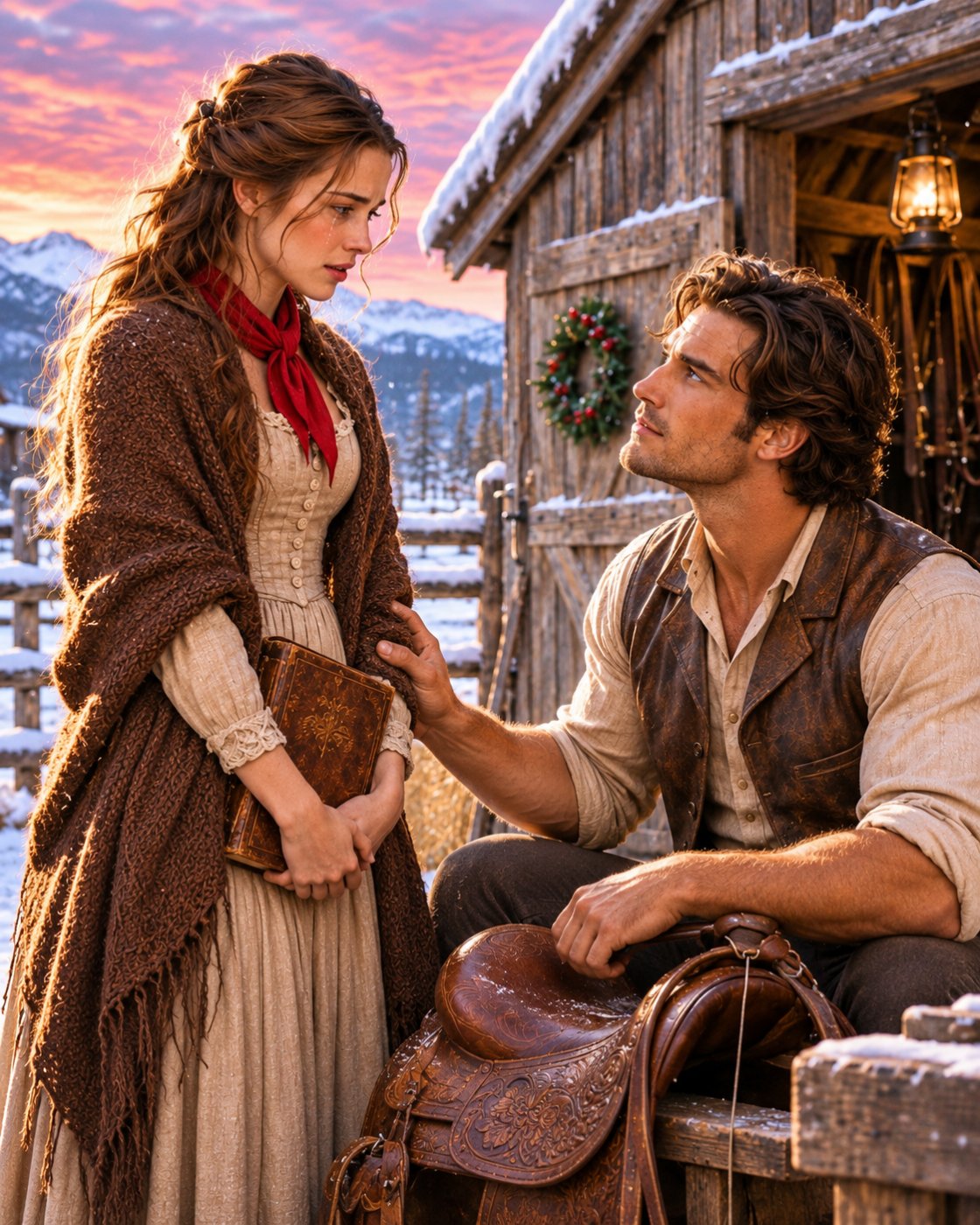
PART 3
In case you missed it: Young widow Ada Bramwell had until noon on Christmas Eve, 1884, to remarry, or her late father-in-law's will would hand her Oregon ranch and its precious spring to Ambrose Kettering, the man who owned most of the valley.
Every local man was too afraid to help, so she asked a newly arrived saddle maker named Will Tanner.
He rode all night to recover her stolen horses and let Kettering's foreman humiliate him in the street without a fight.
He admitted "Will Tanner" was only half his name.
Then, the night before the wedding, a note came from the preacher: "I cannot do it".
They rode back to town under the stars.
Neither of them said anything.
Ada sat on the wagon seat with the reverend's note crushed in her glove and stared straight ahead at the dark road.
The cottonwoods along Bramwell Creek were black against the snow.
Somewhere up in the timber, an owl called and was answered.
The parsonage stood at the end of Main Street, behind the little white church.
A lamp was burning in its window.
Through the frosted glass, Ada could see Reverend Elam Porter on his knees on the floor beside a trunk.
It was half packed.
He was folding a shirt into it with great care, the way a man folds a flag.
He opened the door before she could knock.
His white hair stood up in tufts, as if he had been running his hands through it all evening.
He looked at Ada.
He looked past her at Will, standing at the bottom of the steps with his hat in his hands.
"Ada," the old man said.
"I wrote to you because I couldn't bear to say it to your face".
"Then say it to my face now, Reverend".
He stood aside and let them in.
The little room was cold.
The stove had burned low and nobody had fed it.
A Bible lay open on the lid of the trunk.
On the table stood a cup of coffee with a skin on it.
"He came at sundown," the reverend said.
He sat down heavily in his chair.
"Ambrose Kettering.
He stood right there on the church step while I was hanging the cedar garland.
He told me he'd donated the lot that church stands on.
That he paid for the bell.
That he pays the note on this parsonage every quarter".
The old man's hands twisted in his lap.
"He said if I marry you tomorrow, by New Year's I'll be preaching to the wind in an empty field".
"He'd shut a house of God over one wedding?"
"That's what I asked him.
He said, 'I built this church, Reverend.
I can unbuild it.
'" The reverend looked up.
His eyes were wet.
"I'm seventy-one years old, child.
I have a bad heart and no family left in this world.
Where would I go?"
Ada took off her gloves and laid them on the table.
One of them was Ruth's, old and soft.
She looked at it for a moment.
Then she pulled out the other chair and sat down facing him, knee to knee.
"Reverend," she said, "you married Samuel and me in that church on a June morning, with lilacs on the altar.
Do you remember? You told Samuel he looked like a man about to be hanged, and he said he'd never been so happy to stand on a gallows".
The old man made a sound that was half a laugh.
"Last Christmas Eve," Ada went on, "after Samuel pulled that calf out of the creek and the fever came on him, you sat by his bed for six nights running.
You read him the second chapter of Luke while I held his hand.
And when he died, you buried him from that church in the snow.
You walked all the way up Bramwell Creek behind the wagon, in the cold, at your age, because you said a man shouldn't make his last trip home alone".
The reverend bowed his head.
"If you get in a wagon tonight," Ada said quietly, "Mr. Kettering doesn't just take my ranch.
He takes your pulpit.
And every soul in Pine Fork learns that the word of God in this valley can be bought for the price of a bell".
The old man didn't answer.
The stove ticked.
Outside, the wind moved along the eaves.
"Fences can be mended," Ada said.
"Pews can be set out under a tree in summer.
But once a valley learns to keep its head down, Reverend, its children grow up keeping theirs down too.
And their children after them".
For a long while, there was no sound in that cold little room but the stove.
Will stood by the door with his hat in his hands.
He didn't say a word.
Ada would remember that afterward.
He didn't try to help her.
He didn't add anything.
He just stood there and let her say it, as if he knew it was hers to say.
At last, Reverend Porter lifted his head.
"Ruth used to say," he said slowly, "that you were the only Bramwell who wasn't born one.
And the stubbornest of the whole lot".
He reached over and closed the Bible on the trunk lid.
He laid his hand flat on it.
"Unpack my trunk for me, would you, child? My back won't do it twice in one night".
He looked at Will over his spectacles.
"Half past eleven tomorrow.
The doors will be open".
On the ride home, Ada didn't say anything at all.
She was shaking, now that it was over.
She couldn't seem to stop.
But somewhere past the burned cottonwood, the wagon jolted hard over a frozen rut.
Her shoulder came to rest against Will's arm.
She didn't move it away.
It was nearly midnight when they got back to the ranch.
Will had gone straight to the spring house with a lantern to mend the broken hinge, though she told him it could wait.
When he came in at last, stamping snow off his boots, Ada was sitting at the long fir table with a small box of blue tin in her hands.
She'd taken off Opal's shawl.
Her hair had come half down.
She looked very young in the lamplight, and very tired.
"Sit down, Will," she said.
"Before tomorrow, we should be plain with each other".
He sat across from her.
"This is a marriage to save a spring and a grave," Ada said.
"I know that.
You know it.
Once the will is satisfied, once the land is safe, you're free.
I won't hold you to one hour more than you want to give.
I want you to know that before we stand up in that church".
He was quiet for a moment.
"Then hear my side of it plain, too," he said.
"Any day you want me gone, you put a paper on this table, and I'll sign it without a word.
No argument.
No questions.
I'll saddle my horse and ride".
She nodded.
Then she opened the tin box.
Inside, on a scrap of faded velvet, lay a plain gold band.
It was worn thin on one side, where a man's hand had closed around a rope or a hammer or a saddle horn every day for years.
"This was Samuel's," she said.
"It's the only ring in this house.
I'd like you to wear it tomorrow".
She held it out to him across the table.
Will didn't take it at once.
He looked at it for a long while.
Then he looked up at her.
"I'll keep it as carefully as he would have," he said quietly.
"And I'll keep the promise that goes with it, for as long as you want it kept".
He took the ring.
He didn't put it on.
He put it in the breast pocket of his shirt and buttoned the pocket.
Ada stood up quickly, to put the box away on the shelf.
Her sleeve caught on a nail at the edge of it.
The old leather glove in her other hand tore clean across the palm.
"Oh," she said.
Her voice wobbled.
"Oh, that's done it.
Those were Ruth's".
"Give it here".
He took the two needles and the spool of waxed thread out of his pocket.
They were the same ones Boyd Lassiter had knocked into the slush that afternoon.
He drew the thread across a lump of beeswax.
He threaded a needle on each end.
And he began to stitch, there at her table, in the lamplight.
He worked one needle through the leather from the front and the other from the back, both through the same hole, and drew them tight together.
Then the next hole.
Then the next.
Every stitch locked twice.
Ada sat down again and watched his hands.
"Samuel always said that was the only stitch worth anything," she said softly.
"If one side wears through, the other still holds".
"A saddle stitch," said Will, without looking up.
"A machine can't do it.
That's why a hand-sewn saddle outlasts the man who rides it".
She watched him a while longer.
Then her eyes wandered past him, to the wall beside the door.
An old bridle hung there on a peg.
It was cracked with age and dark with oil and decades of handling.
She'd looked at it every day for four years without seeing it.
But now, in the lamplight, she saw the brow band.
Across it ran a line of small, slanted, double-locked stitches.
Exactly the same as the ones Will was making in Ruth's glove.
"That's strange," Ada said.
"What is?"
"That bridle was Ephraim's.
He'd never let anyone throw it away, not even when the cheek pieces cracked.
Ruth told me once that a boy mended it for him, years and years ago.
A boy who could sew leather better than Ephraim ever could".
She tilted her head.
"Your stitches look just like those".
Will's needles stopped.
Only for half a breath.
"A saddle stitch is a saddle stitch, Ada," he said, and pulled the thread tight.
"Any decent leather man would sew it the same".
He bit off the thread and handed her the glove.
She turned it over.
The seam was so neat she could barely find it.
She slipped it on and closed her fingers.
And before she quite knew how it had happened, his hand was still holding hers across the table.
It was warm and rough and steady.
Neither of them moved.
"Ruth died in February," Ada said, very low.
"There's a page pinned at the back of her book.
She wrote it her last week.
She was too weak to sit up, so I held the book and she wrote lying down".
She swallowed.
"She folded it twice and pinned it shut and made me promise not to open it until it was time.
She wrote on the outside, For the Christmas when Ada no longer sets this table alone".
"She must have loved you very much".
"She said I'd know when".
Ada looked down at their hands.
"I didn't think that Christmas was ever coming".
Then, slowly, she drew her hand back.
"Good night, Will".
"Good night, Ada".
She lay awake a long time in the dark, listening to the wind and to her own heart.
The last thing she heard, before she finally slept, was the soft creak of the front door.
Then a horse moving off down the creek road in the dark, at a trot, toward town.
When she woke on the morning of Christmas Eve, the house was silent.
She knew before she got up.
She knew from the quality of the silence.
She went out to the front room in her nightdress, with her shawl clutched around her, and looked.
Will's bedroll lay folded neatly by the stove.
The coffeepot had been washed and turned upside down to dry.
His saddle was gone from its peg in the barn.
His horse was gone from the corral.
In the snow, a single line of hoofprints led down the creek road toward town.
They didn't come back.
Ada stood in the open doorway in the freezing air and looked at those tracks until she couldn't see them clearly anymore.
She told herself she'd known.
She told herself that a stranger who'd ridden in ten days ago owed her nothing.
That he'd rescued her horses and mended her glove, and that was more than any man in Pine Fork had done for her in a year.
She told herself she ought to be grateful.
She went back inside, sat down at the long fir table, put her face in her hands, and wept.
At nine o'clock, a buggy came rattling up the road.
It was Opal Grummond.
She was sixty-eight years old and round as a cider barrel, and she ran the mercantile in Pine Fork.
She'd known Ada since Ada was a skinny girl of six who stole cinnamon sticks out of the barrel.
She was the only soul in the valley who still called her Addie.
There was a big pasteboard box on the seat beside her.
"I heard in town," Opal said, climbing down with a grunt.
"I came straight out".
"Heard what?"
"Lassiter's men are telling everybody on Main Street the saddle man rode north out of Pine Fork at one o'clock this morning.
Hard.
They say Mr. Kettering's already had the bill of sale written up and is waiting at the bank with it".
She looked at Ada's face.
"Oh, child".
"Then it's true".
"I didn't come out here to tell you it's true".
Opal set the box on the table and lifted the lid.
"I came to bring you this".
Inside, folded in tissue paper, lay a dress of ivory silk.
It had yellowed a little at the seams with age.
A row of tiny pearl buttons ran down the back.
"I wore this to marry my Henry forty-one years ago," Opal said.
"In Ohio.
I've let out every seam I own since, but never this one.
Try it on".
"Opal.
There isn't going to be a wedding".
"Then you'll wear it to church for the Christmas service," said Opal.
"And Ambrose Kettering can rob you looking at pearl buttons, instead of a widow in a shawl".
She took Ada's face in her two mittened hands.
"And Addie.
Listen to me.
Folks saw that man kneel in the slush for his needles yesterday, with Lassiter's boys laughing.