PART 3
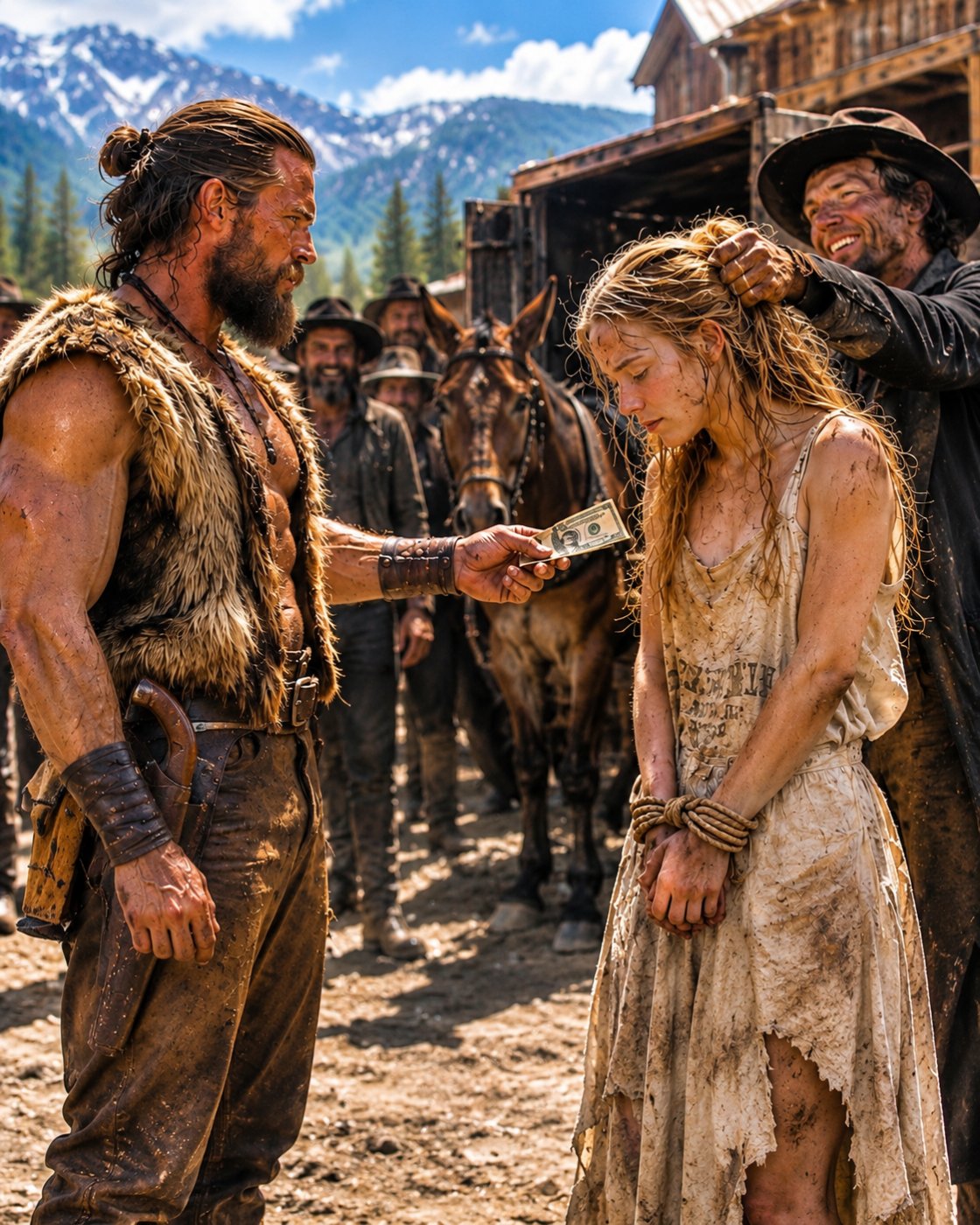
In case you missed it: In 1887, a lonely mountain trapper named Hayes paid forty dollars to stop a man named Pike from auctioning off a young woman named Josie, whose own father had sold her to pay a debt.
He took her to his cabin, gave her the loft, and asked nothing of her.
Snow closed the trail until April.
When Hayes broke his leg in December, Josie took over every chore on the mountain.
Then, in January, she went out to check the far trap line, a blizzard came down, and she didn't come home.
Hayes lay on his bunk and listened to the storm.
He'd been listening to it for two hours.
Since before dark.
Since the light outside the small window had gone from gray to blue to black, and the wind had come up off the ridge with a sound like a train with no end to it.
The snow was hitting the north wall so hard the logs creaked.
The fire in the stove kept leaning sideways in the draft.
She'd left at first light.
Three miles up the ridge to the far line, three miles back.
It was a long day on snowshoes, but she'd done it four times since his leg broke.
She always came back by the middle of the afternoon.
She always came in stamping snow off her boots and hung the furs on the drying pole and said something short and practical about the weather or the horses.
It was past seven o'clock now.
Hayes had told himself at four that she'd been held up.
A marten in a set that needed skinning.
A drift across the trail.
At five, he'd told himself she'd been smart and stayed put somewhere out of the wind.
At six, he'd stopped telling himself anything.
He sat up.
His leg screamed at him.
It had been six weeks.
The bone was knitting, he could feel it, but it hadn't knit.
Not yet.
He could stand on it for a minute at a time, holding the table.
He could hop to the stove.
He had not walked a hundred feet on it since the day he fell.
He swung both legs off the bunk anyway.
The pain went white behind his eyes.
He sat with his head down and his hands gripping the edge of the bunk and breathed through his teeth until it settled into something he could think around.
Then he reached for his boots.
The right one wouldn't go on over the splint.
He took his knife and cut the side of it open from the top to the ankle, and laced it shut again over the chair rungs with rawhide.
He pulled on his heavy coat.
It was the spare, the old buffalo coat, because Josie was wearing the elk hide.
She'd worn it every day since Cold Water Crossing.
He'd never asked for it back.
He took the lantern off the hook and lit it.
He took the coil of rope from the peg by the door and slung it over his shoulder.
He took his rifle.
Then he looked at the snowshoes leaning against the wall.
There was only one pair.
She had the other.
He'd have to go without.
He stood up, holding the table.
He stood there for a long moment, swaying, sweat breaking out on his face in the cold cabin.
Then he opened the door and went out into the storm.
He never did know afterward how long it took him.
The wind hit him so hard on the porch that he nearly went down right there.
The snow was coming sideways, thick as wool, so dense that the lantern light just stopped three feet from his face against a white wall.
He couldn't see the barn.
He couldn't see the trees.
He could barely see his own hand on the porch rail.
But he knew the way.
He'd walked it a thousand times.
Up past the barn, through the gap in the spruce, along the creek to the big split boulder, then up the ridge on the old game trail to the first of the far sets.
He went step by step.
Every time his right foot came down, the pain shot up through his knee into his hip, and he had to stop and breathe.
The snow was over his knees.
Without snowshoes, he sank to his thighs in the drifts.
He fell four times.
The fourth time, by the creek, he lay face down in the snow for what might have been a minute or might have been ten, and the voice in his head said very reasonably that he could just rest here a while.
He thought of her face across the fire under the rock ledge.
And now you've bought me.
So tell me, Mr. Hayes.
What did you buy me for?
He got up.
He shouted her name into the wind every fifty steps.
The storm tore it out of his mouth and threw it away.
He shouted it anyway.
At the split boulder, he stopped.
The trail turned uphill there.
Above it, the ridge rose up steep and dark into the storm.
Three more miles.
He looked up at it, and for the first time, he understood that he wasn't going to make it.
Not on this leg.
Not tonight.
"JOSIE!"
Nothing.
Only the wind.
He leaned against the boulder, gasping.
He held up the lantern and swung it in a slow arc.
Back and forth.
Back and forth.
The way you'd signal a boat.
"JOSIE!"
And from somewhere off to the left, faint and thin and impossibly close, a voice answered.
"Hayes?"
He turned so fast his leg went out from under him.
He caught himself on the rock.
"HAYES? Is that you?"
It came from the cliff.
From the big overhang of rock fifty yards west of the trail, where the creek bank rose up into a shelf of gray granite.
There was a hollow under it, a dry space ten feet deep where the wind didn't reach.
He'd sheltered there himself once, years ago, in a hailstorm.
And now, through the blowing snow, he could see a light in it.
Small, flickering, orange.
A fire.
He went toward it.
He didn't remember the fifty yards.
He remembered the light getting bigger, and the shape of her coming out of the hollow toward him with her arms held out.
Then he remembered falling into the snow at the edge of the overhang, and her hands on his coat, hauling him in under the rock out of the wind.
"You fool," Josie was saying.
Her voice was shaking.
"You fool, you absolute stupid fool, Hayes, what are you doing out here? Your leg.
Your leg".
She got him in under the overhang and propped him against the back wall by her little fire.
She knelt beside him and pulled the lantern out of his frozen fingers and set it down.
She put her hands on his face, on his cold cheeks.
Then she ran them down his right leg, over the cut boot and the rawhide and the splint, and he flinched, and she said a word he'd never heard her say.
"It's fine," he said.
"It's fine".
"It is not fine.
You walked a mile and a half on a broken leg in a blizzard in the dark".
She sat back on her heels and stared at him.
Her face was red with cold and her eyes were wet.
"Why? Why on earth would you do that?"
"You didn't come home," he said.
She stopped.
The fire crackled.
She'd built it well, he saw.
Small and hot, against the back of the overhang where the rock would throw the heat back.
Dry spruce from somewhere.
She'd cut a pile of boughs for a bed.
Two martens from the trap line lay skinned and frozen at the edge of the shelter, and her snowshoes were propped against the rock.
"I saw the sky at noon," she said quietly.
"I knew I wouldn't make it back before it hit.
I remembered you said once there was a dry place under this cliff.
So I came here and made a fire and waited it out".
She looked at him.
"I was going to come home in the morning.
I was fine, Hayes.
I knew what to do.
You taught me".
He leaned his head back against the cold rock and closed his eyes.
"I didn't know that," he said.
"Back at the cabin.
All I knew was the clock said seven and you weren't there".
She didn't say anything for a long time.
He heard her moving.
He opened his eyes.
She was taking off the elk-hide coat, his coat.
She spread it over both of them like a blanket, and then she sat down beside him against the rock, close, her shoulder against his.
"Nobody's ever come looking for me before," she said.
Very low.
Almost to herself.
"Not once.
Not in twenty-four years".
He didn't know what to say to that.
So he didn't say anything.
He just stayed where he was, with her shoulder against his and the coat over them both, and let the fire warm them.
The storm went on outside the overhang all night.
It howled past the mouth of the shelter like a living thing.
But under the rock, there was only the small hot fire, and the smell of spruce smoke, and the two of them.
Sometime after midnight, she asked him.
"Why do you live up here, Hayes? All alone.
You never said".
He was quiet so long she thought he'd gone to sleep.
"I was a surveyor," he said finally.
"For the railroad.
Out of Denver.
Laying out lines through the mountains.
That's where the books come from.
The surveying guides".
He looked at the fire.
"I had a wife.
Ellen.
She was a schoolteacher.
She was going to have a baby, the spring of '80".
Josie went very still beside him.
"I was out with a crew in the San Juans when her time came," Hayes said.
"Six weeks out.
I'd promised to be home.
I'd promised her.
And the line was behind schedule, and the railroad said one more week, and I said all right".
He was quiet for a moment.
"She had a fever after.
Childbed fever.
And the baby, too.
A little girl.
They were both gone two days before I got back".
The fire popped.
"I had the cabin built by that fall," he said.
"I figured if you don't let anybody near you, you can't fail them.
You can't be six weeks away when they need you".
He looked down at his ruined boot.
"That was seven years ago.
I hadn't spoken more than ten words to anybody but Donna at the trading post in all that time.
Until Cold Water Crossing".
Josie didn't say anything.
She reached over in the dark and found his hand on top of the coat and held it.
Hard.
They sat that way until the storm wore itself out, near dawn.
In the gray morning light, she got him up.
She put his arm over her shoulders.
She took most of his weight.
And step by slow step, with him leaning on her and her leaning on the snowshoe poles, they made their way home together down the ridge.
It took them three hours.
Neither of them complained once.
His leg had to be set again.
She did it at the kitchen table, with his teeth clamped on a leather strap and his hands gripping the edge of the table, the way he'd once told her his grandfather set a bone.
She didn't apologize.
When it was done, she rebound it with new splints she'd split from a length of ash.