PART 3
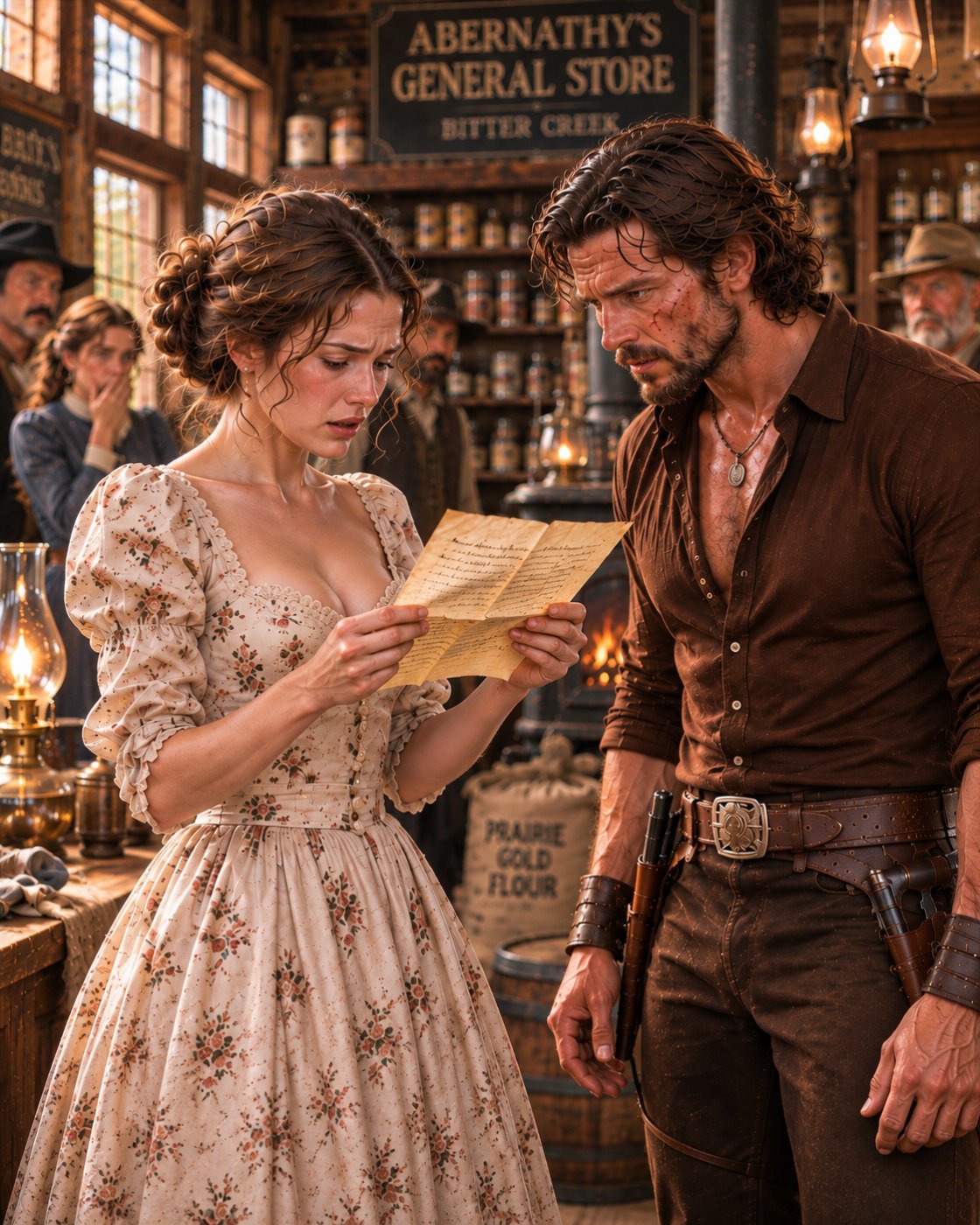
In case you missed it: quiet Hannah Mercer, whom everyone in Bitter Creek believed was simple, read a dying woman's letter aloud for horse breaker Jesse Rollins, who couldn't read.
His sister Delilah begged him to come for her six-year-old son, Tommy, before the state took him.
Jesse arrived too late.
Delilah had died and the boy was gone.
Over the winter, Hannah read to Jesse every Tuesday, and in spring she found the clue that might lead them to Tommy, hidden in faded ink on Delilah's old envelope.
Then Jesse asked her to come with him to Laramie, and her employer told her that if she left, she was finished.
The whole store had gone quiet again.
It was a Thursday morning, the busiest hour of the week.
Mrs. Pickett was at the dry goods counter with a bolt of blue calico.
The banker, Mr. Lowell, was buying cigars.
Two ranch wives were choosing thread.
A farmer was waiting for his flour to be weighed.
Every one of them had stopped what they were doing to look at the cowboy with the travel bag and the girl in the cream-colored dress.
Mr. Abernathy stood behind his counter with both hands flat on the wood.
He was a stout man with a red face and a gold watch chain, and he had owned the biggest store in Bitter Creek for twenty years.
He had hired Hannah when she was sixteen, as a favor to her late mother.
He had told the whole town, many times, how charitable that was.
"I mean it, Hannah," he said.
"You walk out with him, and you needn't come back.
I took you in when nobody else would.
I've been patient.
But I won't have folks saying my store employs a girl who goes running off across the territory with a mountain man".
Hannah stood very still.
For eight years she had stood behind that counter.
She had arranged the shelves so neatly that customers could find anything with their eyes closed.
She had kept the stock books in her own careful hand, every night after closing, without anyone asking her to, because Mr. Abernathy's arithmetic was poor and she couldn't bear to watch the columns go wrong.
He had never once thanked her.
He had never once noticed.
He thought the books simply kept themselves.
She had eleven dollars saved in a coffee tin under her bed.
She had a room at Mrs. Daugherty's boarding house, rented by the month.
She had nowhere else in the world to go.
She looked at Jesse.
He was standing in the doorway with his hat in his hand.
He didn't say anything.
He didn't try to convince her, or argue with Abernathy, or tell her what to do.
He just waited, the way a man waits who has decided that whatever she chooses, it's hers to choose.
Hannah thought about the letter.
About the last line.
Don't let him grow up believing nobody came for him.
She thought about a little boy somewhere in Laramie, sitting by a window in a strange place, six years old, wondering if anybody in the whole world remembered his name.
She untied her apron.
She folded it once, neatly, the way she folded everything, and laid it on the counter in front of Mr. Abernathy.
"I've kept your books for eight years, Mr. Abernathy," she said quietly.
"The ledger's in the second drawer under the register.
Everything's balanced through last night.
You'll want to watch the account for the Halsey ranch.
They're three months behind".
Abernathy stared at her.
His mouth opened and closed.
"You.
.
.
you kept the books?"
"Every night since I was seventeen," said Hannah.
Then she took her coat off the peg by the door and put it on, and walked past Mrs. Pickett and the banker and the ranch wives with their thread, and stood beside Jesse in the doorway.
"Let's go find Tommy," she said.
Behind them, as the bell rang over the door, she heard Mrs. Pickett say, in a voice that didn't carry at all for once, "Well.
I never".
The road to Laramie took two days.
Jesse had borrowed a light wagon from the livery and a pair of good bays, because he didn't want a six-year-old boy riding a hundred miles behind a saddle on the way home.
He drove.
Hannah sat beside him with a leather satchel in her lap, and inside it every paper they had.
Delilah's letters, all four of them.
The envelope with the faded return address.
Jesse's own papers from the land office, with his name and his father's.
And a long list in Hannah's neat hand of every date and name she had pieced together over the winter.
Neither of them talked much the first morning.
The prairie rolled away on both sides, brown and gold with the first green coming through, and the Laramie range rose blue and white in the west.
Meadowlarks sang from every fence post.
Jesse kept his eyes on the road and his jaw tight, and Hannah could see he was afraid.
"You think it'll be another dead end," she said, around noon.
"I've had five of them already".
He didn't look at her.
"Five homes.
Five desks.
Five people looking at me like I was some saddle tramp come to steal a child.
One of them laughed at me, when I couldn't read the form she put in front of me".
His hands tightened on the reins.
"If this one's wrong too, Miss Mercer, I don't know that I've got another one in me".
Hannah didn't answer right away.
"When I was eight," she said finally, "I had scarlet fever.
Very bad.
I was in bed for two months.
When I got up, I couldn't hear properly out of my left ear.
I still can't.
And I couldn't talk the way I used to.
The words got stuck.
I'd know exactly what I wanted to say, and it would come out slow, or not at all".
Jesse turned his head.
"The other children called me Dummy," Hannah said.
"The teacher put me at the back of the class and told my mother I couldn't learn.
So I stopped trying to talk.
It seemed easier.
If you don't say anything, nobody can laugh at how you say it".
She looked down at the satchel in her lap.
"But my mother taught me to read at home.
At the kitchen table, every night.
She said, 'Hannah, they can stop you talking.
They can't stop you reading.
' And she was right.
By the time I was twelve, I'd read every book in the Bitter Creek library.
Twice".
"And nobody ever knew".
"Nobody ever asked".
She almost smiled.
"Mr. Abernathy hired me when I was sixteen because my mother begged him to, after my father died.
He told everybody he was doing a kindness for the poor simple girl.
After a while, I suppose I started to believe it myself".
Jesse was quiet for a long time.
"My pa took me out of school when I was seven," he said at last.
"We had a homestead outside Ogallala.
He broke his leg, and somebody had to run the place.
I was the oldest.
Delilah was just a baby".
He shrugged.
"I never went back.
By the time I was grown, I was too ashamed to let anybody know I couldn't read.
I'd take the newspaper and pretend.
I'd sign my name with an X and say my hand was hurt.
I'd memorize things people said so I never had to look at a paper".
His voice roughened.
"Delilah used to write me every month.
I'd carry those letters around in my coat for weeks.
I'd take them out at night by the fire and look at her handwriting, and not know what she'd said".
Hannah stared at him.
"You couldn't read her letters at all?"
"Sometimes I'd find somebody to read them to me.
A cook at a cow camp.
A preacher, once.
Mostly I just kept them".
He shook his head.
"That last one, I carried for three weeks before I came into your store.
Three weeks, Miss Mercer.
If I'd found somebody to read it to me the first day.
.
".
"Don't," said Hannah quietly.
"She was dying, and she was begging me to come, and I was carrying her letter around in my pocket like a fool because I was too proud to ask somebody to read it".
"Jesse".
It was the first time she'd ever called him by his first name.
"You did ask.
You walked into a store full of people who were laughing at you, and you asked the one person in that room nobody else would've asked.
That took more courage than anybody in Bitter Creek has ever shown in their life".
He didn't answer.
But after a while, his hands loosened on the reins.
They camped that night by a creek under a big cottonwood.
Jesse built the fire and cooked bacon and beans, and Hannah sat wrapped in a blanket and read aloud from a book of poems she had borrowed from the library and forgotten to return.
Jesse lay on his back with his hat over his eyes and listened.
When she came to a line she especially liked, she read it twice.
He never asked her to stop.
The children's home in Laramie was a tall, narrow brick building on Grand Avenue, with a white picket fence and a bare little yard where a few children were playing tag.
Jesse stopped the wagon in front of the gate and sat there without moving.
Hannah put her hand on his arm.
"I'll be right beside you," she said.
A middle-aged woman with steel-gray hair and kind, tired eyes met them in the front hall.
Mrs. Whitmore, the director.
She listened to Jesse explain, and took the papers Hannah handed her, and looked through them one by one.
Then she went into her office and closed the door.
They waited in the hallway for a long time.
Jesse couldn't sit.
He paced the length of the narrow hall and back again, with his hat crushed in his hands.
Somewhere upstairs, a child was crying.
Somewhere else, a piano was being practiced, badly.
Hannah sat very still on the bench with the satchel in her lap and her hands folded on top of it and prayed, which she had not done in a long while.
At last the office door opened.
"We have a boy here who might match your description," said Mrs. Whitmore.
Jesse stopped pacing.
"His name is Tommy," he said hoarsely.
"He's six.
Dark hair.
Brown eyes.
My sister wrote he's got a little birthmark by his left ear, shaped like a bean".