PART 3
"I know," Jacob said.
He came down the ladder slowly, rung by rung, and stood in the yard in front of her with his hat in his hands.
Tommy stayed up on the roof, holding onto the ridge board, staring down at them both.
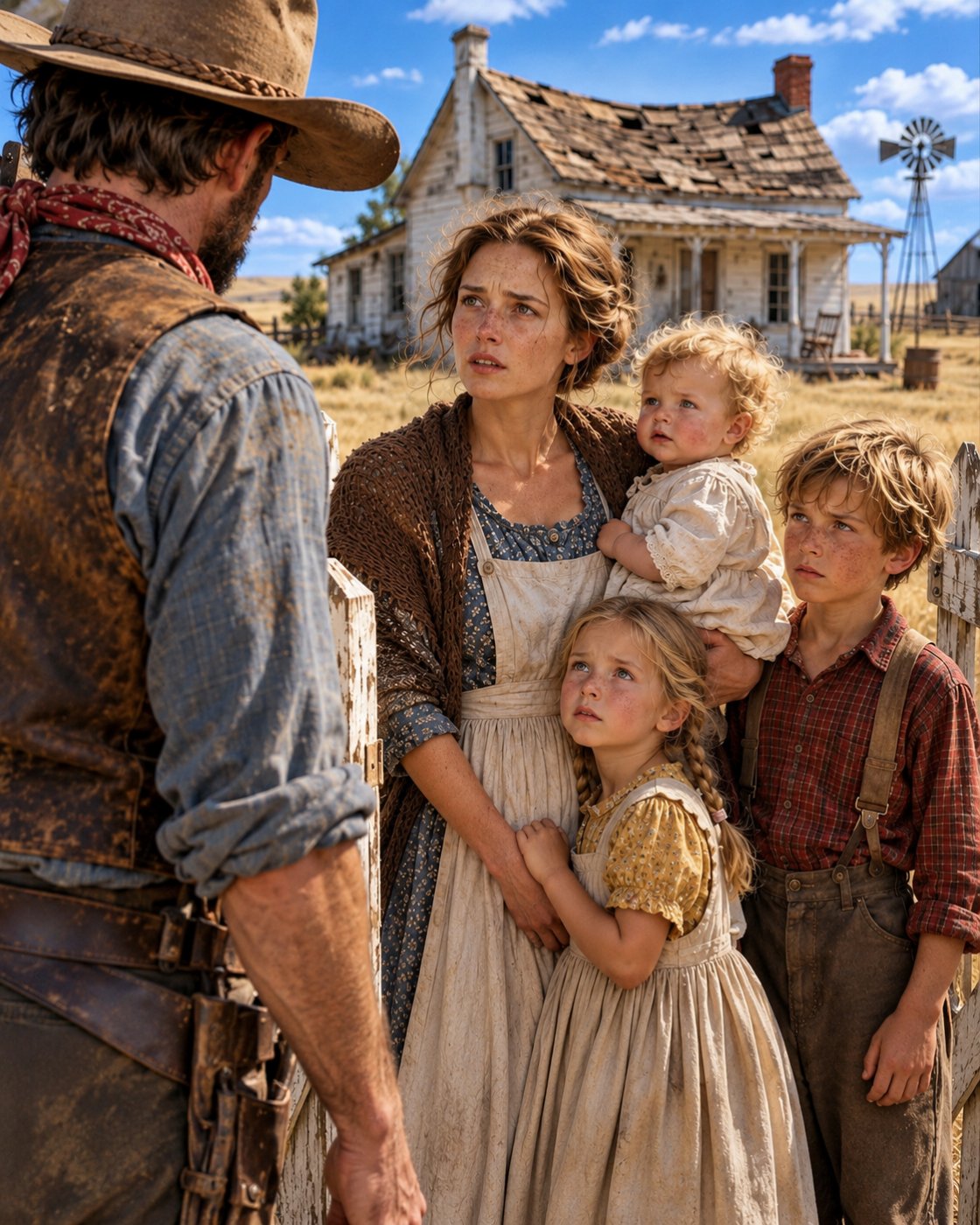
From the porch, Rosie peeked around the doorframe with the baby on her hip, too heavy for her, his fat legs dangling.
Anna did not move.
Her face was white.
"Rosie," she said without turning her head.
"Take Ben inside".
"But Mama.
.
".
"Inside".
The screen door banged.
Anna waited until she heard the latch.
"Why didn't you tell me?" she said.
Her voice was low and very steady, and Jacob thought that was worse than if she had shouted.
"You sat at my well.
I told you about Daniel.
I told you things I haven't told the pastor.
And you sat there and let me".
"I know".
"Stop saying that".
Jacob looked down at the hat in his hands.
"I didn't tell you," he said, "because you'd have sent me away.
And the roof would have come down on them".
Anna stared at him.
"That's the truth," Jacob said.
"I'm not saying it to make it better.
It doesn't make it better.
But it's the truth.
I looked at that roof from the road, and I looked at those rafters, and I knew what the first heavy snow would do.
And I knew if I told you who I was, you'd put me back on the road before supper.
You'd have been right to".
"So you lied".
"I didn't say anything.
That's a kind of lying.
I know it is".
Up on the roof, Tommy made a small sound.
Anna looked up at him.
Her son's lip was swollen and split where the Ransom boy had hit him at school.
His eyes were wet.
He was holding onto that ridge board so hard his knuckles had gone white.
She looked back at Jacob.
"Finish the north side," she said.
"Then go".
She turned and walked into the house and shut the door.
Jacob stood alone in the yard.
After a while, he looked up at Tommy.
The boy climbed down the ladder without a word, walked past him without looking at him, and went into the barn.
Jacob heard him in there, in the dry corner, throwing something.
Then crying.
Then nothing.
He finished the north side by dark.
He worked by lantern for the last hour, alone, his hammer loud in the cold air.
Nobody brought a biscuit.
When the last shingle was down, he climbed off the roof and stood in the yard for a long time looking at the dark kitchen window.
Then he went into the barn, past Tommy asleep in the straw with the toolbox clutched against his chest, and rolled up his blanket.
He was halfway down the lane when he saw the lantern coming toward him.
It was the pastor.
Pastor Elias Hale was past seventy, a thin, bent man with white hair that stood straight up in the wind and a coat older than Jacob.
He had walked out from town in the dark, two miles, carrying a lantern and a cane.
He stopped in the middle of the lane and lifted the lantern and looked Jacob up and down.
"Leaving again?" he said.
"Yes, sir".
"Thought you might be.
Anna came to see me tonight".
Jacob looked down the lane toward the town lights.
"She has every right to hate me".
"She doesn't hate you, son.
She's afraid".
The old man set the end of his cane in the frozen dirt and leaned on it.
"Fear and hate look a good deal alike in the dark.
Most folks can't tell them apart even in daylight".
"If I stay," Jacob said, "they'll take her land.
Nobody'll sell her flour.
Her boy gets beaten at school.
If I go, they'll forget all about it by Christmas".
"They might," said Pastor Hale.
"But you won't".
Jacob didn't answer.
The pastor looked at him for a while in the lantern light.
Then he lowered himself slowly onto a big rock at the side of the lane with a little grunt and patted the rock beside him.
"Sit down, son.
My knees aren't made for standing in the cold arguing with a man half my age.
What happened in Topeka?"
Jacob stood there a moment longer.
Then he sat.
He reached into his coat pocket and took out the little carved horse head.
He held it out on his palm in the lantern light.
It was a child's carving, rough and lopsided, with two notches cut for eyes and a mane scratched in with the point of a knife.
The neck was broken off clean.
"My son made me this," he said.
"Samuel.
He was seven.
He made the whole horse.
He worked on it for a month with my old pocketknife.
He hid it under his bed so it'd be a surprise".
Pastor Hale said nothing.
"I worked in a furniture shop in Topeka," Jacob said.
"I was good at it.
Best man in the shop.
Made good money.
And every payday I'd go to McGinty's saloon on the way home, and I'd drink most of it before I got there".
He turned the horse head over in his fingers.
"Some weeks I'd drink all of it".
The wind moved through the dry grass along the lane.
"One night it was past midnight.
Mary came to the saloon to bring me home.
She had Samuel with her.
She'd waited up and waited up, and finally she put his coat on him and walked him six blocks in the cold, because she thought if I saw the boy, I'd come".
His voice went flat.
"Samuel had the horse.
He'd brought it to give me.
He came right up to the bar and held it up.
He said, 'Papa, I made you a horse.
'"
Jacob stopped.
"And everybody at the bar laughed," he said.
"Not mean.
They thought it was sweet.
But I was drunk, and I was ashamed in front of them, and I said, 'I said go home.
' And when he didn't go, when he just stood there holding it up, I knocked it out of his hand".
The pastor closed his eyes.
"It hit the floor and broke.
The head came right off.
Samuel didn't cry.
That's what I remember.
He didn't cry.
He just looked at me.
Then he got down on the floor and picked up the body and put it in his coat, and Mary took his hand and they went out".
"And you?"
"I busted up the saloon".
Jacob laughed, a short, dead sound.
"I don't even remember why.
I threw a chair through McGinty's mirror.
They locked me up for two weeks.
When they let me out, I went home".
He looked at the horse head.
"The landlady met me at the door.
She said, 'They left two weeks ago, Mr. Reed.
Took the train.
Didn't say where.
' I asked if Mary left me a letter.
The landlady said, 'Only this.
' And she handed me the horse's head.
She said, 'Your wife said you'd know what it was.
'"
He closed his hand around it.
"The landlady's husband was standing in the hall behind her.
He'd heard about McGinty's.
Everybody had.
He looked at me and said, 'You don't get a second chance at that, Reed.
'"
They sat in silence.
Far off, a dog barked at a farmhouse and stopped.
"That was six years ago," Jacob said.
"I've been looking for them ever since.
Every town I go through, I find the church first.
I ask the pastor if anybody's seen a woman named Mary Reed with a boy named Samuel.
He'd be thirteen now.
Dark hair.
Got a little scar over his left eyebrow where he fell off the porch".
He shook his head.
"Nobody ever has.
Not once.
Not in six years".
"And the whiskey?"
"I haven't touched it since that night".
Jacob looked down at his boots.
"But I stood in front of the saloon in town last week.
On my way back from buying nails.
I stood there a whole minute with my hand on the door".
"And then?"
"And then I walked away".
He shrugged.
"That doesn't make me a good man, Pastor".
Pastor Hale reached over and laid his thin old hand on Jacob's knee.
"No," he said.
"It doesn't make you a good man.
But it makes you a man who walks away from the right door.
That's more than most of us manage, son.
Most of us spend our whole lives walking through the wrong one".
Jacob didn't say anything.
"Kemper wants the whole county to know who you were," the pastor said.
"Fine.
Maybe it's time they did.
But maybe it's time they heard it from you.
Not from Hattie Pruitt over a sack of flour.
From you.
Standing up in front of them".
He squeezed Jacob's knee.
"And then maybe they'll hear who you are now".
"In church".
"It's where people go to hear the truth.
Or so I keep telling them".
"Church isn't for men like me, Pastor.
You saw me last Sunday.
I stood outside the whole time".
"I saw you," said the old man.
"I told you there was always room on the back bench.
I meant it then, and I mean it now".
He got slowly to his feet, leaning on the cane.
"Sunday.
Ten o'clock.
I'll leave the door open".
He picked up his lantern and walked back toward town without waiting for an answer.
Jacob sat on the rock alone in the dark for a long time.
Then he got up, picked up his blanket roll, and walked back up the lane to the Collins barn.
Tommy was still asleep in the straw with the toolbox in his arms.
Jacob lay down in the far corner, as far from the boy as the barn allowed, and did not sleep at all.
Anna saw him in the morning from the kitchen window, splitting kindling by the woodpile.
She stood there a long moment with the coffeepot in her hand.
She did not come out.
But she did not send him away either.
At noon, a plate appeared on the barn step.
No biscuit.
Just beans and cornbread.
But there was a plate.
The church was full that Sunday.
Word had gone around, the way it always did in a town that size.
People who had not been to church since harvest came in their good coats and sat with their hands folded and their eyes moving.
Hattie Pruitt was there in the third pew in her best hat with the cherries on it.
Mr. Kemper sat at the front, near the aisle, in a gray suit, with his wife beside him.
Anna sat in the fifth pew with Rosie and the baby.
Tommy sat beside her, staring straight ahead.
He had not spoken to Jacob in three days.
When Pastor Hale climbed into the pulpit, he did not open his Bible.
"Before we begin," he said, "a man has asked to speak".
The church went quiet.
Every head turned.
Jacob Reed stood up from the back bench.
He walked down the aisle slowly in his patched coat with the hole in the elbow.
He did not look at anyone.
He stopped at the front of the church, below the pulpit, and turned around and faced them all.
He held his hat in both hands.
For a moment he could not seem to find his voice.
"My name is Jacob Reed," he said finally.
"I'm a carpenter.
Most of you have heard about me this week".
Somebody in the back coughed.
Nobody else made a sound.
"Most of what you heard is true," Jacob said.
He told them.
He told them about the furniture shop in Topeka, and the paydays, and McGinty's.
He told them about the night past midnight, and Mary and the boy coming to bring him home.
He told them about the little carved horse, and what he had said to his son, and what he had done with his hand.
He did not make it sound any better than it was.
He did not make it sound any worse.
He just told it, plain, the way a man reads off a list of measurements.
"The next morning they were gone," he said.
"Well, two weeks later.
I was in jail.
But they were gone.
I don't know where they are.
I've been looking ever since.
Six years".
He looked down at his hat.
"I haven't had a drink since that night.
But that doesn't change what I did.
Nothing changes that".
Then he looked up, straight at the front pew where Kemper sat.
"Mrs. Collins didn't know any of this," Jacob said.
"She didn't know a thing.
She gave a stranger a meal and a dry corner of her barn because her children's bed was getting rained on.
That's all she did.
That's the whole of it.
If you want to punish somebody for what I am, punish me.
Not her.
Not her children.
Not her boy at school".
He turned the hat around once in his hands.
"I'll be gone by tonight," he said.
He started back up the aisle.
Mr. Kemper stood up.
"There.
You see?" Kemper's voice was smooth and carrying, a man used to speaking in rooms.
"A drunk and a deserter.
He admits it himself.
Living out at a widow's place.
I warned you all.
I said so plainly.
A woman who can't pay her debts, who opens her home to a man like that, what does that say about.
.
".
"Mr. Reed.
Wait".
Anna was on her feet.
Every head in the church swung around.
Kemper stopped with his mouth open.
Anna stood in the fifth pew with Rosie clutching her skirt and the baby on her hip.
Her face was white, but her voice was clear, and it carried to every corner of that little church.
"For a year," she said, "I prayed alone at my window.
Every night.
Every single night since Daniel died.
I didn't ask God for money.