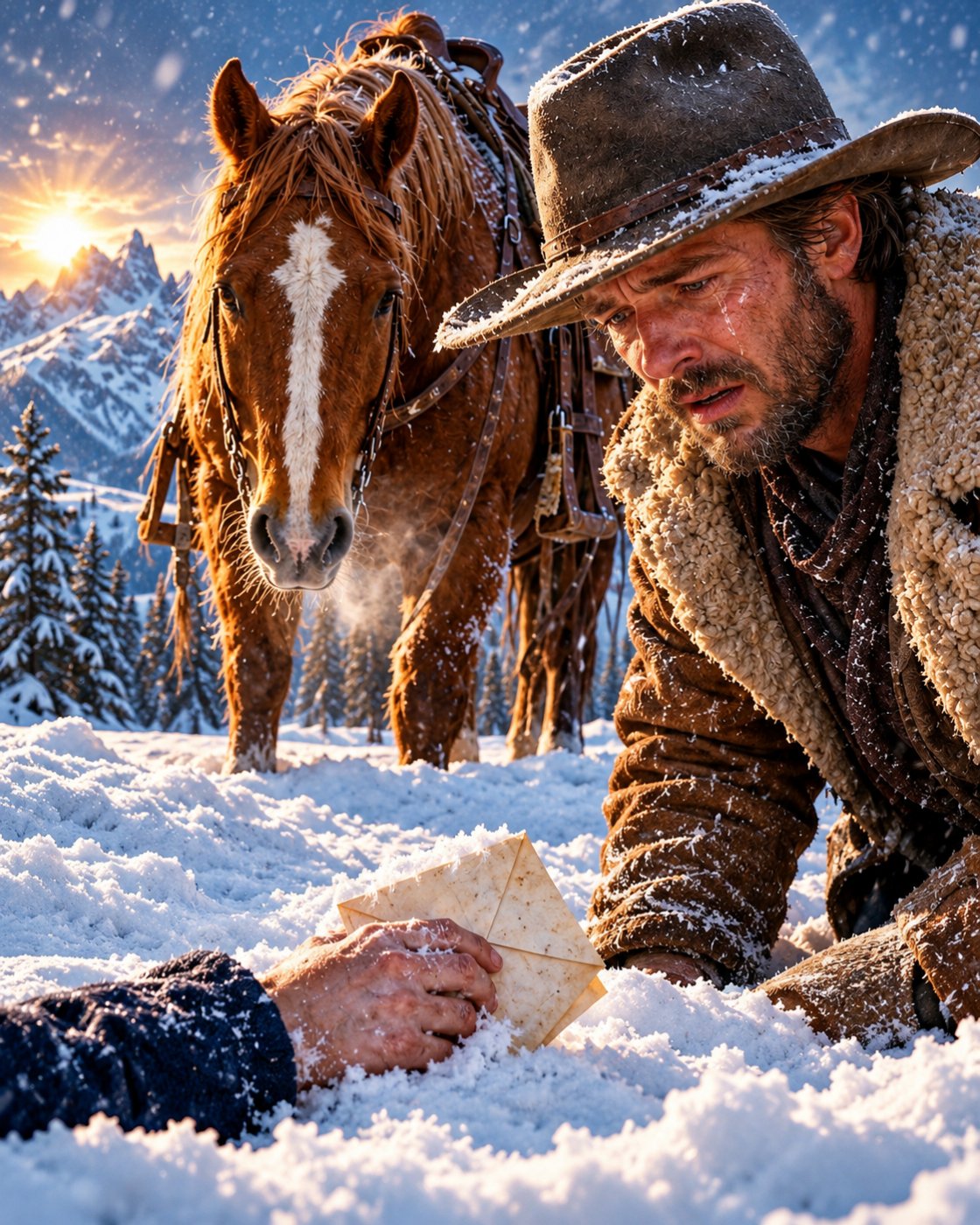
PART 3
In case you missed it: in a Christmas blizzard in 1884, rancher Caleb Hart found the chestnut mare he had sold standing guard over a snowdrift, and under it lay Eleanor Whitlock, the mail-order bride who had never arrived.
She told him the truth at last: a Cheyenne moneylender named Silas Varner claimed her father had signed her over to seven years of service to pay his gambling debts, had dragged her off the train before she ever reached Rock Creek, and had kept her locked away until she escaped on Juniper.
Now the sheriff had come with a telegram.
Varner was arriving on the Christmas Eve train with a judge's paper, to take back both the horse and the woman.
When the sheriff's horse had disappeared down the lane, the house was very quiet.
Eleanor sat in the chair by the front window, the one Caleb had built for her with a sheepskin footstool so her healing feet could rest.
She did not move.
She stared out at the snow-covered valley, at the frozen creek and the long white slope of the foothills, and her hands lay folded in her lap so tightly that her knuckles had gone white.
Caleb stood by the door with his hat still in his hands.
"Eleanor".
"I should go tonight," she said.
She didn't turn her head.
"Before he comes.
If I'm gone, he can't hurt you".
"Where would you go?"
"I don't know.
Anywhere.
Denver.
Back east".
Her voice was very calm, the way a person's voice goes calm when they have already decided to do something terrible.
"He'll take the horse back.
That's all he'll get.
He won't be able to say you hid me".
Caleb crossed the room and knelt down in front of her chair, so that she had to look at him.
"On those feet? In this cold? You couldn't make it to the creek".
He shook his head slowly.
"No.
We're not running, Eleanor.
Running's what he wants.
A man like that, he counts on folks being too scared to stand still".
"You don't know him".
"No.
But I know what he did to you".
Caleb's voice stayed quiet, but something moved behind it.
"He bought your father's debts.
He took you off a train in front of a carful of people.
He locked you in a room for three weeks.
And now he's coming up my lane on Christmas Eve to collect you like a parcel left at the station".
He took a breath.
"I'm not going to stand on my porch and hand you over to him, Eleanor.
Paper or no paper".
She looked at him.
For a moment, he thought she would argue.
Instead, she started to cry.
Silently, the way she must have cried in that locked room, so no one would hear.
Caleb did not tell her to stop.
He just took her cold hand in both of his and held it.
When she was done, he said, "Tell me about your father.
Everything you can remember about the day he died.
Every single thing".
They sat up most of that night at the kitchen table.
Caleb turned the lamp up high and built the fire until the stove ticked.
In the corner, the little spruce tree he'd cut on the ridge glowed softly with its scraps of red ribbon.
Martha Ames had stayed for supper and gone home at dark, promising to come back at first light.
Outside, the snow had stopped, and the night was so clear and so cold that the stars looked close enough to touch.
Eleanor told him everything.
She told him about her father's little shop on Third Street in Dayton, with its hundred clocks on the walls.
How they all chimed together at noon, a hundred tiny bells at once, and how she'd stood in the middle of the room as a girl and felt like she was standing inside a song.
She told him how kind her father was, and how foolish.
How he'd played cards in the back room of the Phoenix Hotel every Saturday night for twenty years, and lost more than he won, and always swore it was the last time.
"He wasn't a bad man, Caleb," she said.
"He was just weak in that one place.
And men like Silas Varner can smell a weak place from across a whole city".
She told him about the winter Papa fell ill.
Lung fever.
How she'd sat up with him every night for six weeks, and sewed in the shop by day to pay the doctor.
How Varner had come to the house twice that winter, in his black coat, and shut himself in Papa's room, and how she had heard her father shouting through the door.
Papa never shouted.
"What was he shouting?"
"I couldn't hear the words.
Only his voice".
She looked down at her hands.
"After Mr. Varner left the second time, Papa called me in.
He held my hand and said, 'Nell, whatever happens, you be brave.
' I thought he meant about dying.
I didn't understand".
She told him about the funeral at St.
Mark's.
The rain.
The handful of mourners.
The pastor who had known her since she was a baby.
And she told him how, three weeks after the funeral, Silas Varner had come to the shop with his paper.
"He sat at Papa's workbench," Eleanor said, "with all those clocks ticking around him, and he took the paper out of his coat and laid it on the bench.
He wouldn't let me touch it.
He held it flat with his cane, so I could only read it upside down.
It said my father had pledged my service to Silas Varner for seven years, in payment of four thousand two hundred dollars.
And it had Papa's signature at the bottom.
And a judge's seal".
"Did it look like his signature?"
"It looked like it," she said slowly.
"Almost.
But Papa always made his J with a little loop at the top, like a clock hand.
That one didn't have the loop.
I told Mr. Varner so.
He laughed.
He said a dying man's hand shakes".
Caleb was quiet for a long time.
Then he asked her a question she had never thought to ask herself.
"This paper of his.
Did you ever see the date on it?"
Eleanor frowned.
"The date? He only showed it to me that once, across the workbench".
She closed her eyes, trying to picture it.
"It said the fourteenth of March.
I remember, because that was my mother's birthday.
She's been gone since I was nine.
I thought it was cruel of him.
To use that day".
"And when did your father pass?"
Eleanor opened her mouth to answer.
Then she stopped.
Caleb watched something come alive in her eyes that he had not seen there before.
Not fear.
Not grief.
Something sharp and bright and furious.
"The second of March," she whispered.
"He died on the second of March, in the early morning.
The pastor buried him on the fifth".
Her hands had started to shake.
"Caleb.
He'd been in the ground nine days when that paper was dated.
Twelve days dead".
"A dead man can't sign a contract".
"No".
"Every judge in the territory knows that".
"But it's my word against his".
Her voice cracked.
"I'm a seamstress with nothing.
He's a rich man with a judge's seal.
They'll say I'm lying about the date.
They'll say I'm a runaway who stole a horse and will say anything to stay free".
"Then we need something better than your word".
Caleb leaned forward.
"Did your father leave anything? Any paper at all? Anything with a date on it from before he died?"
Eleanor sat very still.
Then she stood up so fast she nearly fell, and caught herself on the table edge, and her face went white with the pain in her feet.
"My coat," she said.
"Caleb, where's my coat? The blue one".
It was hanging on the peg by the fire, where Martha had left it to dry.
Caleb brought it to her.
Eleanor took it in her lap and turned it inside out, and ran her fingers along the hem of the lining until she found the place.
Then, with hands that would hardly obey her, she tore the stitches open.
Folded inside, flat and dry and wrapped in a square of oilcloth, were three letters.
"I sewed them in the night before I left Dayton," she said.
"I didn't want to leave them in my trunk, in case the trunk got lost.
They're the last things Papa ever wrote me.
I couldn't bear to leave them behind".
She unwrapped the oilcloth with great care.
"He wrote them while he was sick, when he couldn't talk much.
He'd leave them on his nightstand for me to find in the morning.
Silly things, mostly.
About the clocks.
About my mother".
She lifted the last one and stopped.
"I could never make myself read the last one again.
After".
"Read it now," said Caleb.
She unfolded it.
The handwriting was shaky and slanted, the hand of a man with a fever.
At the top, in that same shaking hand, was a date.
The first of March, 1884.
Eleanor read it aloud.
Her voice wavered on every line.
"My dearest Nell.
Mr. Varner has been to see me again about the debts.
He wants me to sign you over to his service, and I have told him I would sooner burn.
Whatever he tells you after I am gone, know that I never put my name to it.
Forgive your foolish father.
Be brave.
Be free.
Your loving Papa".
And at the bottom, his signature.
Josiah Whitlock.
With a small, careful loop at the top of the J, like a clock hand.
Eleanor pressed the letter to her chest and wept.
Caleb sat across from her and let her.
He had to look away himself, toward the little spruce tree glowing in the corner, until he could trust his own face again.
When she had quieted, he stood up from the table without a word.
He walked across the room to the old desk in the corner, the one that had been his father's, and opened the bottom drawer.
He rummaged through a stack of feed bills and bank notices and pulled out a single folded paper he had not looked at since April.
He laid it on the table beside her father's letter.
"Eleanor," he said.
"Do you know who bought Juniper from me last spring?"
She looked up at him, her face wet.
"A man in Cheyenne," Caleb said.
"He came through Rock Creek on the train in April, looking for horses.
He paid me half in cash and promised the rest by October.
The rest never came.
I wrote him twice.
He never answered".
He turned the paper so she could see it.
"I never knew what kind of man he was.
I just needed the money for the bank".
At the bottom of the bill of sale, beside Caleb's own name, was a signature in black ink.