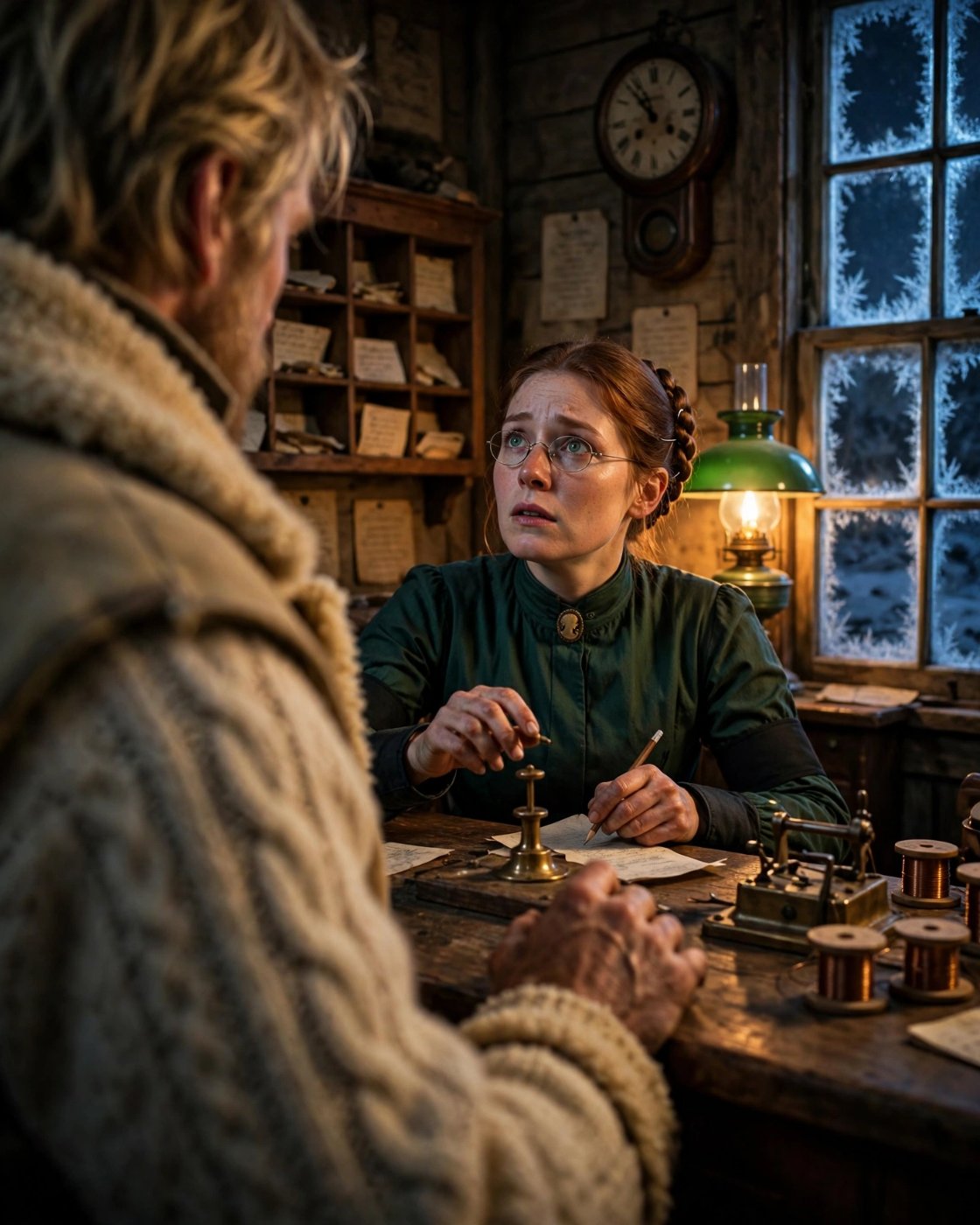
PART 3
In case you missed it: Hattie Monroe had decoded an order to drive Eli Strand’s sheep off the rimrock and kill him if he got in the way. The order carried her father’s name, but the secret check word at the end belonged to the ranch foreman, Bart Kessler. And now Kessler was standing at her counter, asking why her horse had been ridden hard in the middle of the night.
Hattie did not let her face move.
She had grown up at her father’s supper table, among cattlemen who could read a lie in a man’s eyes faster than a brand on a steer’s hip. She had learned early that the trick was not to look away. Looking away was what guilty people did.
So she looked straight at Bart Kessler over the top of her spectacles and said, “Is the Colonel paying you to count the sweat on my horse now, Mr. Kessler? Or is that a hobby of your own?”
Something flickered behind his eyes. Then he laughed, easy and warm, the laugh that had charmed every rancher’s wife between here and Cheyenne.
“Just looking out for you, Miss Hattie. Dangerous country at night. Wolves. Rustlers.” He tapped two fingers on the counter, idly. “Sheepherders.”
“I couldn’t sleep after my shift. I rode along the creek. I do it often.”
“Course you do.” He straightened and settled his hat. He was a big, handsome man of about forty, with a neat brown mustache and a good gray coat, and he had been her father’s foreman for six years. Long enough that Papa called him “son” after a second whiskey. Long enough that Hattie had once, at nineteen, thought she might be a little in love with him, before she watched him take a quirt to a lame horse that wasn’t moving fast enough.
“You know, Miss Hattie,” he said pleasantly, “I’ve always admired how you keep the rules in this place. The Colonel’s mighty proud of it. Says his girl would sooner cut off her hand than tell a soul what goes over that wire.” He smiled. “I hear they send an operator to the penitentiary at Laramie for breaking that oath. Can you imagine? A Monroe in Laramie. The Colonel’s name in every paper in the territory.”
“I can’t imagine it at all,” Hattie said.
“Good.” He touched his hat brim again. “You give my best to your daddy.”
The door shut behind him. Hattie stood perfectly still until his horse had gone clattering off down Main Street. Then she sat down hard on her stool, put her face in her hands, and breathed.
He didn’t know. Not for certain. If he had known, he wouldn’t have come in smiling. He suspected, and he had come to warn her, and from now on he would be watching.
At eight o’clock, Mr. Dawes, the day manager, came in with his lunch pail and his newspaper, and Hattie was free to go home.
She didn’t go home.
She went into the back room, where the copybooks were kept.
Every message that left the Buffalo office was pressed into a thick bound ledger before it went over the wire. The copybooks went back four years, stacked to the ceiling, and nobody but the operators was allowed to touch them. Hattie had no business there now. She told Mr. Dawes she was checking a billing error from last winter. He grunted and turned to the cattle prices.
She took down January 1887.
She didn’t entirely know what she was looking for. Only that something from Sunday supper had been sitting in her mind like a stone in a boot.
Her father had raised his glass, as he did every year on the anniversary of the great thaw. “To Bart,” he’d said. “The man who saved this ranch in the Hard Winter. When every outfit on the Powder River was skinning dead cattle and selling the hides, Bart Kessler found hay when there wasn’t a forkful to be had in Wyoming. Never would tell me where. Wouldn’t take a penny extra for it. You don’t find men like that twice.”
And Kessler had smiled modestly and said, “Just doing my job, Colonel.”
Hattie had heard that toast three years running. This year, for the first time, she had noticed that Kessler never once looked her father in the eye when he said it.
And there was something else. One Thursday in July, while she waited on the Cheyenne line, she and Eli had been teasing each other about the weather. She had tapped that she hated the cold. He had tapped back, slow and serious:
BAD WINTER 87. I FED COWS THAT WERE NOT MINE.
She’d thought he was joking. She’d tapped back HOW CHARITABLE, and he’d smiled that slow smile of his and let it go.
She turned the brittle pages one after another. Wires for coal, for doctors, for coffins. So many coffins that winter. Cattle prices falling so fast the numbers looked like a fever chart.
January 21, 1887.
TO MRS INGRID STRAND, FERGUS FALLS, MINN. MOR. PLEASE SEND THREE HUNDRED DOLLARS AT ONCE FOR HAY. MONROE CATTLE DYING ON NORTH FORK BY HUNDREDS. CANNOT STAND BY. WILL REPAY ALL. ELI.
Hattie read it four times.
Then she looked at the operator’s mark in the corner, the little initials every operator wrote beside a message to show who had sent it.
H.M.
She had sent it herself.
She had been twenty-two that winter, newly hired and terrified of making a mistake. She remembered a big man in a buffalo coat stiff with ice, his face so wrapped in scarves she never saw it. She remembered that he smelled of sheep. And she remembered thinking, with the easy contempt she’d learned at her father’s table, that a sheepman was probably wiring his mother for whiskey money.
She had sent the words that saved her father’s ranch, and she had never even read them.
Below it, three days later, was another wire from Eli, to a hay merchant in Miles City, Montana, ordering six tons delivered to the railhead at Sheridan, cash on arrival. Four days after that, another. And another.
In the whole month of January there was not a single wire from Bart Kessler about hay. Not one.
Hattie closed the book very quietly and put it back on the shelf.
Eli came in at two o’clock that afternoon.
It wasn’t Thursday. Mr. Dawes looked up, surprised. Eli took off his hat and said in his slow, deep voice that he needed to wire his mother again, he’d forgotten something, and he began filling out a blank at the counter with great care.
His left hand rested on the wood. His fingers began to move.
A-R-E Y-O-U S-A-F-E.
Hattie kept her eyes on the sounder as if she were listening for Cheyenne. Her pencil tapped against the inkwell.
Y-E-S. K-E-S-S-L-E-R C-A-M-E. H-E S-U-S-P-E-C-T-S.
His fingers went still. Then: I W-I-L-L K-I-L-L H-I-M.
N-O. Y-O-U W-I-L-L N-O-T. She pressed the pencil so hard the lead snapped. She picked up another. K-E-S-S-L-E-R S-E-N-T I-T. N-O-T P-A-P-A. M-E-E-T M-E P-O-L-E 4-7 T-E-N T-O-N-I-G-H-T.
A long pause. Then: Y-E-S.
Mr. Dawes rattled his newspaper. “You two have the same nervous habit, I see. Drumming. My late wife did that. Drove me out of my mind.”
“I’m sorry, Mr. Dawes,” Hattie said.
“Sorry, sir,” said Eli, and handed her a blank that read, in a careful hand, MOR. ALL WELL HERE. ELI. It cost him twenty-five cents to send it. Hattie sent it anyway, because it was the only honest thing anyone had said all day.
Pole 47 stood by itself on the Sheridan road, three miles north of town, where the telegraph line crossed Rock Creek. Hattie had chosen it because every operator in Buffalo knew the number and nobody else in the world would think twice about it.
She went on foot, the long way through the cottonwoods, so no livery hand could report a sweating horse. Eli was already there, sitting on a rock in the dark with his back against the pole. He stood when he heard her, and for a moment neither of them said anything at all.
“Your father didn’t send it,” he said finally.
“No. Kessler did. With Papa’s name on it.”
“Why?”
“Your spring. There’s an English syndicate in Cheyenne buying up every piece of range with year-round water. Kessler’s been meeting their agent.” She hugged her shawl tighter. “If your flock goes over the rimrock and you go with it, your claim goes up for sale, and I’d wager Kessler’s already arranged who buys it. And if anyone ever asks, the order came from Colonel Monroe, who’s hated sheepmen out loud for ten years. Who’d doubt it?”
Eli let out a long breath. “So he kills me, he takes my water, and your father hangs for it.”
“Yes.”
“He is a careful man, this Kessler.”
“He’s a snake.” Hattie stepped closer. “Eli. I need to ask you something, and I need you not to lie to me.”
He waited.
“The Hard Winter. The hay. It was you, wasn’t it?”
He looked away, toward the dark shape of the hills. In the starlight she could see his jaw working.
“Who told you?”
“Nobody told me. I sent the wire. January twenty-first. ‘Monroe cattle dying on North Fork by hundreds. Cannot stand by.’ I sent it with my own hands, and I didn’t even read it.” Her voice cracked. “Why didn’t you ever say?”
For a long moment he was quiet. When he spoke, his voice was low and slow, the Norwegian lilt under every word.
“That winter I had hay. I had cut it all summer, every slough and creek bottom, because my father taught me in Norway: the winter you don’t prepare for is the one that comes. My sheep were in the coulee, out of the wind. They were all right. But in January I rode to the North Fork to look for strays, and your father’s cattle had drifted against his fence.” He stopped. “Hundreds of them, Hattie. Standing in the snow, eating the bark off the fence posts. Eating each other’s tails. The sound they made...” He shook his head. “I could not listen to that.”
“So you fed them.”
“I fed them my hay. Eleven loads by sledge. Then my hay was gone and I wired my mother, and I bought more in Miles City and brought it down from Sheridan. Twenty more loads. It took all of February.”
“And Kessler?”
“I met him at the north gate the first night. He said the Colonel would shoot any sheepman on his land, and he’d sooner see his cattle die than take charity from one. Kessler said, ‘Leave the hay at the gate. I’ll tell him I found it. It’s the only way he’ll let them eat.’” Eli shrugged his big shoulders. “He was probably right.”
“And you let him take the credit. For three years.”
“I didn’t need your father’s thanks.” He looked down at her. “I needed the cows to stop screaming. Cattle don’t choose their owners.”
Hattie found she was crying. She hadn’t meant to. She took off her spectacles and wiped her eyes with the heel of her hand, and when she put them back on, he was much closer than before.
“Last night,” he said quietly, “you told me, ‘Please be worth it.’”
“I remember.”
He reached out and took her hand, turned it palm up, and with one finger, very slowly, he tapped against the inside of her wrist.
I W-I-L-L T-R-Y.
Hattie closed her fingers around his.
“Eli,” she whispered. “Hiding isn’t going to be enough.”
“It will be enough. We move the sheep. Ole and Pete sit up with me. When Kessler’s men come, they find nothing. They go home.”
“And then what? Kessler tries again in a month. Or next spring. Some other night, some other way. And someday the wire with Papa’s name on it turns up, and my father hangs for something he never did.” She shook her head. “The only thing that ends this is the truth. All of it. The order, the check word, the hay. In front of everyone.”