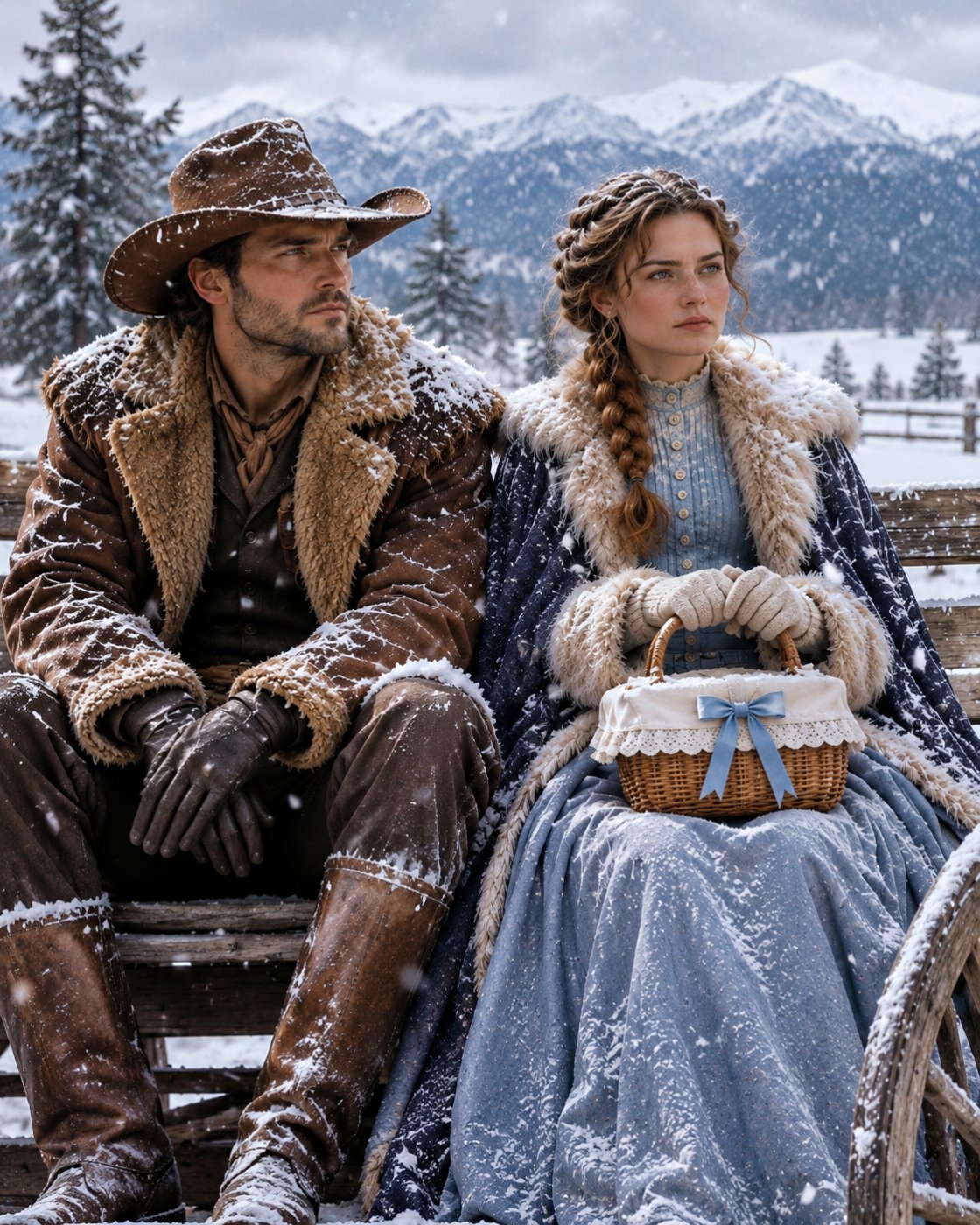
She Expected a Tiny Cabin After Marrying a Poor Cowboy—But He Led Her Somewhere Incredible....
The church bells of Millbrook were still ringing when Clara Whitmore realized that every person in town was laughing at her. She stood on the steps of the little white chapel in a borrowed dress, holding a bunch of wildflowers that were already beginning to wilt in the heat. Beside her stood the man she had married only minutes before. His name was Eli Turner. His boots were cracked. His coat had been patched at both elbows, and there was still dust on his sleeves from the long ride into town. Across the street, a group of women whispered behind their gloves. Clara heard one of them say, the Whitmore girl married a cow hand. Her poor father would turn in his grave. Her cheeks burned, but she lifted her chin. She had already lost too much to lose her pride as well. Only three months earlier, Clara's life had been comfortable. Her father, Thomas Whitmore, had owned the largest general store in Millbrook. Then everything fell apart. Debts appeared that Clara had never heard of. Her father's health failed under the weight of it all, and one cold morning he did not wake up. When the lawyers finished their work, the store was gone, the house was gone, and Clara was left with one trunk of clothes and a stack of her father's old account books. And then there was Harlan Price. Price was the richest banker in the county. He was 50 years old with a gold watch chain and eyes that never seemed to blink. He had held most of her father's debts. Two weeks after the funeral, he came to the boarding house where Clara was staying and made her an offer. Marry me, he said, and you will never want for anything again. He did not say it kindly. He said it the way a man makes a bid on a horse. Clara refused. Price only smiled. You have nothing, Miss Whitmore. No money, no family, no future. You will change your mind before winter. He began to make sure of it. Clara applied for work as a seamstress, and the shop owner had no openings. She asked to teach at the schoolhouse, and the town council, which Price sat upon, voted against her. Every door in Millbrook was closing one by one, and Clara knew exactly whose hand was closing them. That was when she met Eli. It happened at the feed store. Price had cornered her there, speaking loudly enough for everyone to hear. He told her that a woman in her position should be grateful for any offer at all. Clara felt tears pressing against her eyes, but before she could answer, a calm voice spoke from behind a stack of grain sacks. Seems to me the lady already gave you her answer. Price turned and looked the stranger up and down. He saw the worn boots and the patched coat, and he laughed. And who might you be? Just a man buying oats, Eli said. But I know what no sounds like. Price left in a fury. They talked for an hour on the bench outside. He was quiet and gentle, and he listened more than he spoke. He told her he worked cattle out west, past the river country. When she asked about his home, he only smiled and said, it's a long way from here. He came back the next day and the day after that. On the fifth day, he took off his hat, turned it nervously in his hands, and asked her to marry him. I can't offer you fancy things, he said. But I can offer you a home where nobody will ever push you around again. Clara thought about Price's cold eyes. She thought about the winter coming. Most of all, she thought about how safe she felt when Eli was near. She said yes. Now, standing on the chapel steps, she watched Harlan Price step out of the bank across the street. He tipped his hat with a cruel little smile. Congratulations, Mrs. Turner, he called. I hope you enjoy your mud hut. Laughter rippled down the street. Eli did not answer. He simply took Clara's hand, helped her onto the seat of his old wagon, and picked up the reins. As the wagon rolled out of Millbrook, Clara did not look back. But she could not stop wondering what kind of life waited for her at the end of that long and dusty road. For three days, the wagon rolled west across the open prairie. The town disappeared behind them. Then the farms disappeared. Soon there was nothing but endless grass moving like waves under the wide blue sky. Clara had never seen so much empty land in her life. Out here, there was no one to call for help. There was only the wind, the wagon, and the quiet man beside her. Eli spoke little, but he noticed everything. When the sun grew too hot, he handed her his canteen before drinking himself. When the nights turned cold, he wrapped his only blanket around her shoulders and slept close to the fire with nothing but his coat. On the second morning, Clara woke to find that he had gathered wild berries and set them beside her on a clean handkerchief. You didn't have to do that, she said softly. I know, he replied. I wanted to. She did not understand him yet, but she was beginning to want to. On the third afternoon, the sky turned dark. The clouds rolled in like black smoke. The wind began to scream across the grass. Thunder cracked so loudly that the horses reared in their harness. Hold on, Eli shouted. Rain came down in heavy sheets. The wagon slid sideways in the mud. Clara gripped the seat with both hands as lightning struck a lone tree not far from the trail and split it in two. The horses panicked and bolted. For a terrifying moment, Clara was sure the wagon would tip over and crush them both. Then Eli was on his feet, standing in the shaking wagon, pulling the reins with all his strength and speaking to the horses in a low, steady voice. Slowly, impossibly, they calmed. He guided them into a shallow gully and held their heads until the storm passed. When he climbed back up, he was soaked to the bone. His hands were bleeding where the leather had torn them. Are you hurt? he asked her first. Clara shook her head. Without thinking, she took his hands in hers, tore a strip from the hem of her dress, and wrapped his wounds. Eli looked at her in silence, and something passed between them that neither of them could name. That night, by a small fire under a clearing sky, Clara made a decision. Whatever his home was, she would make the best of it. She had married this man with her eyes open. He was kind, brave, and honest. If he lived in a single room with a dirt floor, then she would sweep that dirt floor every day and be grateful. She began to picture it, preparing her heart. A tiny cabin, perhaps a leaking roof, a narrow bed, a window covered with oiled paper instead of glass. She told herself she could plant a little garden. She could sew curtains. She could make it feel like home. The next morning, they passed through a stretch of rocky hills, and late in the afternoon Eli pulled the wagon to a stop. In front of them stood a small wooden shack. It leaned to one side. Its roof was patched with tin. The door hung crooked on leather hinges, and a rusty water bucket sat beside a broken fence. A single thin tree threw a little shade across the yard. Clara's heart sank just for a moment. Then she took a deep breath, climbed down from the wagon and smoothed her wrinkled dress. It's lovely, she said, forcing a bright smile. I'll have it fixed up in no time. A few curtains, some flowers by the door, and it will be the warmest little home in the territory. Eli stared at her. Then, for the first time since she had known him, he laughed. It was a deep, warm laugh that seemed to surprise even him. Clara felt her face turn red. What's so funny? Clara, he said gently, this isn't our home. This is an old line shack where my men sleep when they're checking fences. Your men, she repeated. But Eli only climbed back onto the wagon and offered her his hand. Come on, he said. We're almost there. I want you to see it while the sun is setting. Confused and uneasy, Clara took his hand. The wagon climbed the long slope of the final ridge, and as they reached the very top, the land opened up beneath them. Clara gasped, and her hand flew to her mouth. Below them lay a valley so beautiful that Clara could hardly believe it was real. A silver river curved through the middle of it, shining like a ribbon in the golden evening light. Green meadows stretched for miles in every direction. And across those meadows, as far as she could see, were cattle. Not dozens, not hundreds, thousands of them, moving slowly across the grass like a living sea. In the center of the valley, on a gentle rise above the river, stood a house. It was not a cabin. It was not even a farmhouse. It was a grand home built of river stone and heavy timber, two stories high, with a wide porch that wrapped all the way around. Behind it stood enormous barns, long horse stables, and corrals. Clara could not speak. She could not even breathe. Welcome to the Silver Creek Ranch, Eli said quietly. As they drew closer, men came out of the barns and stables. They took off their hats. A broad-shouldered foreman with a gray mustache stepped forward and grinned. Welcome home, Mr. Turner, he said. Then he bowed slightly toward Clara. And welcome, Mrs. Turner. We've been waiting to meet you. An older woman with kind eyes hurried down the porch steps, wiping her hands on her apron. Oh, look at you, child, she said warmly. I'm Martha. I keep this house in order. Your room is ready, and there's hot water waiting. Clara looked from Martha to the foreman to the great house and finally to Eli. Her shock slowly began to change into something else. Something sharp and painful. That night, after supper, Clara found Eli standing alone on the porch, looking out at the dark river. You lied to me, she said. He turned. I never told you I was poor. You let me believe it. Her voice shook. You let the whole town laugh at me. You let Harlan Price call me a fool to my face. You watched me stand in front of that shack and pretend to be happy. Was that a game to you? Did you enjoy watching me? No, he said firmly. Never. Then why? Eli was silent for a long time. When he finally spoke, his voice was low and heavy. My father built this ranch with his bare hands, he said. He came west with nothing, and he worked until it killed him. When he died, I was 22, and su
She Married a Cowboy Everyone Called Poor—Then He Took Her Beyond the Hills to a Ranch Worth a Fortune
PART 1
The entire town laughed when Clara Whitmore married a cowboy whose boots were falling apart.
Her wedding dress was borrowed. Her flowers were gathered from a roadside meadow. And the man standing beside her owned, as far as anyone knew, nothing but an old wagon, two horses, and a patched brown coat.
Across the street, Harlan Price, the wealthiest banker in Millbrook, tipped his hat.
“Congratulations, Mrs. Turner. I hope you enjoy living in a mud hut.”
Clara lifted her chin, refusing to give him the satisfaction of seeing her cry.
Three months earlier, she had been the daughter of a prosperous storekeeper. Then her father died, mysterious debts swallowed his business, and Clara found herself penniless.
Price had offered to rescue her.
All she had to do was marry him.
When she refused, every employer in town suddenly turned her away.
Then Eli Turner appeared.
He was quiet, gentle, and worked with his hands. When Price publicly humiliated Clara at the feed store, Eli stepped between them.
“The lady already told you no.”
Clara fell in love with him because he never treated her poverty as something shameful.
Five days later, he asked her to marry him.
“I can't promise you luxury,” Eli said. “But I'll give you a home where nobody gets to make you feel small.”
She accepted.
Now, three days after their wedding, Clara sat beside him in a wagon crossing endless prairie.
She imagined their future: a little cabin, a vegetable garden, perhaps a leaking roof she could repair with her own hands.
Then Eli stopped beside a crooked wooden shack.
Its door hung loose. The roof was patched with rusted tin.
Clara swallowed her disappointment.
“It's lovely,” she whispered. “I'll plant flowers. We can make it beautiful.”
Eli stared at her.
Then he laughed.
“Sweetheart, this isn't our home.”
Clara blinked.
“It isn't?”
“No. It's where my ranch hands sleep when they're checking the fences.”
“Your ranch hands?”
He offered his hand.
“Come with me.”
Their wagon climbed the final ridge.
And when Clara saw what waited on the other side, she nearly fell from her seat.
A silver river wound through a valley filled with thousands of cattle. Enormous barns surrounded a magnificent two-story house.
Men removed their hats as Eli approached.
“Welcome home, Mr. Turner!”
Clara turned toward her husband.
“Eli… what have you done?”
But before he could answer, she noticed something that made her blood run cold.
Standing beside the grand house was a man she recognized from her father's funeral.
And he was holding a leather case marked with Harlan Price's initials.
Read PART 2 in the first comment below.
PART 2
Clara stared at the leather case while the stranger hurried toward the stables. She recognized him as the thin man who had stood beside Harlan Price when the banker took possession of her father's store. Why was he here, hundreds of miles from Millbrook?
“Eli, who is that man?” she asked. Eli followed her gaze, but the stranger had disappeared. “I don't know. I'll have my foreman find out.” Then Clara turned toward the magnificent house. “And this? You let me believe we were going to live in a shack.”
Eli's smile vanished. He explained that his father had built Silver Creek Ranch from nothing. After inheriting it, Eli discovered that people valued his fortune more than his character. He began traveling in worn clothing, hoping someone might finally love him without knowing what he owned. “I never said I was poor,” he whispered. “But you let me think it,” Clara answered.
That evening, Clara refused to share his bedroom. “I married an honest cowboy, Eli. I don't know whether I married an honest husband.” He accepted her decision without argument. Over the following weeks, he worked beside her, taught her to ride, and trusted her with the ranch accounts. Slowly, Clara began to see the same kind man beneath the wealth.
Then Harlan Price arrived with two armed riders and a lawyer. He presented a deed claiming Eli's late father had sold him the river rights nine years earlier. Without that river, thousands of cattle would perish. Price offered to surrender his claim in exchange for half the ranch.
Clara recognized the lawyer's leather case immediately. The stranger she had seen on their arrival was working for Price. Eli refused the demand, but Price warned that a territorial hearing would settle everything in fourteen days.
Five nights later, the largest barn erupted in flames. Eli rushed inside to free the trapped horses. He escaped only moments before the roof collapsed, suffering a terrible shoulder injury. As Clara held his hand through the night, she realized how deeply she loved him.
At dawn, she examined the disputed deed beside her father's old account books. Her breath stopped. The signature attributed to Samuel Turner contained an unusual curling letter T. The same strange stroke appeared on the loan papers that had destroyed her father.
Both signatures appeared to have been written by the same forger.
Clara hurried to Eli's bedside. “I think Price stole your river the same way he stole my father's store.”
Eli struggled to rise. “Then we're going to court.”
“No,” Clara whispered, pressing him gently against his pillow. “You're going to heal. This time, I'm fighting for us.”
But when she opened the final account book, she discovered something even more frightening: a payment recorded to someone inside Silver Creek Ranch.
Comment exactly one word, “JUSTICE”, to read PART 3 and discover who betrayed Eli—and whether Clara can save the ranch before the river is stolen.
PART 3
The signature in the account book was small, almost insignificant.
But Clara Whitmore Turner had spent enough years helping her father balance ledgers to recognize the importance of a single misplaced mark.
She sat alone in the study at Silver Creek Ranch, surrounded by open books, loose papers, and the fading light of an early autumn afternoon.
On the desk before her lay three documents.
The first was the deed Harlan Price claimed gave him ownership of the river.
The second was a loan agreement that had helped destroy her father's business.
The third was a payment record dated nine years earlier.
All three contained the same peculiar curling stroke in the letter T.
Clara traced it with her fingertip.
Her father had never written his name that way.
She remembered watching Thomas Whitmore sign hundreds of receipts behind the counter of his general store. His handwriting had been plain and deliberate, the kind of handwriting that belonged to a man who believed every account should be understood by the person reading it.
But the signatures on Price's loan papers were elaborate.
False.
And now she had found the same elaborate stroke on a document supposedly signed by Eli's father.
The third paper was even more troubling.
It recorded a payment of eight hundred dollars to a man named Walter Briggs.
Clara had seen that name before.
Briggs was Silver Creek's longtime bookkeeper.
He had welcomed her politely when she first arrived. He was a thin, gray-haired man who rarely smiled and seemed uncomfortable whenever she entered the office.
Eli trusted him.
Briggs had worked for Samuel Turner before Eli inherited the ranch.
Clara stared at the payment.
Eight hundred dollars was an enormous sum.
Why would Harlan Price have paid a ranch bookkeeper that much money nine years earlier?
And why had the payment been recorded among her father's old business papers?
She closed her eyes and tried to remember the last months of her father's life.
Thomas Whitmore had become increasingly worried about his finances. He had spoken of missing payments, strange charges, and documents he did not remember signing.
Clara had begged him to challenge the bank.
But her father had been proud.
He believed that if he worked harder and sold more goods, he could repay whatever he owed.
Then his health failed.
And Harlan Price took everything.
Clara opened her eyes.
For the first time, she wondered whether her father's death had been hastened by something more deliberate than ordinary business failure.
She did not know whether Briggs was guilty.
She did not know whether the payment was connected to the forged deed.
But she knew she could no longer ignore it.
She gathered the papers and hurried upstairs.
Eli was awake.
His injured shoulder was wrapped in clean bandages, and the doctor had ordered him to remain in bed for at least another week.
He looked pale, but when Clara entered, his face softened.
“Clara.”
She sat beside him.
“I found something.”
Eli studied the papers.
As she explained the matching signatures and the payment to Walter Briggs, his expression grew darker.
“Briggs?” he repeated.
“Yes.”
“He worked for my father for almost twenty years.”
Clara nodded.
“I know.”
“He helped me keep this ranch together after Pa died.”
“I know that, too.”
Eli looked toward the window.
For a long moment, he said nothing.
Then he asked, “Are you certain?”
“No.”
He turned back.
“Then we need proof.”
Clara felt a small surge of relief.
He had not dismissed her.
He had not accused her of imagining things.
He had listened.
“I thought you'd be angry,” she admitted.
“I am.”
She lowered her eyes.
“But not with you.”
Eli reached for her hand.
“Clara, I kept something important from you when we married. I won't make the mistake of asking you to ignore something important now.”
Her throat tightened.
He continued.
“If Briggs betrayed my father, I need to know. And if Price ruined your family with forged papers, then your father deserves the truth.”
Clara squeezed his hand.
“Thank you.”
Eli smiled faintly.
“You don't have to thank me for believing my wife.”
She looked at him.
The words were simple.
But they meant more than he knew.
For weeks, Clara had struggled with the knowledge that Eli had concealed his wealth.
She had wondered whether their marriage began with a test she never agreed to take.
Now, lying injured in bed, he was showing her something more valuable than any ranch.
He was willing to trust her judgment.
“There's something else,” she said.
Eli waited.
“The man I saw carrying Price's leather case when we arrived. I think he was meeting someone here.”
Eli's expression hardened.
“Then we'll find out who.”
He reached toward the bedside table.
Clara stopped him.
“What are you doing?”
“Getting my boots.”
She almost laughed.
“Eli Turner, you can barely lift your arm.”
“I can still walk.”
“You can barely walk without complaining.”
He looked offended.
“I don't complain.”
Clara raised an eyebrow.
“You told Martha her pillows were conspiring against you.”
Eli smiled despite himself.
“They are.”
She leaned closer.
“For once, let me handle this.”
He studied her face.
Then nodded.
“All right.”
Clara stood.
As she reached the door, Eli called her name.
She turned.
“Be careful.”
She smiled.
“I will.”
Then she added, “And don't you dare get out of that bed.”
He raised his good hand.
“Yes, ma'am.”
For the first time since the fire, they both laughed.
But when Clara closed the door behind her, her smile disappeared.
Someone inside Silver Creek Ranch might have helped Harlan Price steal the river.
And that person might still be watching her.
The following morning, Clara went to the ranch office.
Walter Briggs sat behind a high wooden desk, writing figures into a ledger.
He looked up when she entered.
“Mrs. Turner.”
“Good morning, Mr. Briggs.”
“Can I help you?”
Clara smiled politely.
“I've been reviewing the older accounts. Eli says you've kept the books since his father's time.”
Briggs nodded.
“That's right.”
“Then you must know more about the ranch's history than almost anyone.”
He looked pleased.
“I suppose I do.”
Clara placed a ledger on the desk.
“I found several entries I don't understand.”
Briggs glanced at the book.
His expression changed almost imperceptibly.
“Which entries?”
Clara opened to a page dated nine years earlier.
“There are payments here that don't match the receipts.”
Briggs leaned forward.
“Old records are often difficult to reconcile.”
“Of course.”
She pointed to a line.
“And this payment?”
He glanced down.
Then quickly looked away.
“Routine legal expenses.”
“Eight hundred dollars?”
“Yes.”
“Who received it?”
Briggs hesitated.
“A representative of the land office.”
Clara nodded slowly.
“Do you remember his name?”
“No.”
“That's unfortunate.”
Briggs closed the ledger.
“Mrs. Turner, perhaps you should leave these matters to people who understand ranch business.”
Clara felt the familiar sting of condescension.
It reminded her of Harlan Price.
Of the lawyers who had dismissed her questions after her father's death.
Of the shopkeepers who had refused to employ her because a wealthy man disapproved.
She smiled calmly.
“My father taught me bookkeeping when I was twelve.”
Briggs blinked.
“Did he?”
“Yes.”
She placed her hand on the ledger.
“And he taught me that when an account doesn't balance, the answer is rarely to stop asking questions.”
Briggs stared at her.
Then he forced a smile.
“I'm sure your father was a capable businessman.”
“He was.”
Clara closed the book.
“I'll continue reviewing these.”
Briggs stood.
“Mrs. Turner, those records belong to the ranch.”
Clara met his eyes.
“So do I.”
She carried the ledger out before he could answer.
That afternoon, she found Martha in the kitchen preparing supper.
The older woman had worked at Silver Creek for more than fifteen years.
She knew every servant, every ranch hand, and every corner of the great house.
Clara trusted her.
“Martha, may I ask you something?”
The woman looked up.
“Of course, child.”
“Do you remember Walter Briggs from the years before Samuel Turner died?”
Martha's hands slowed.
“Why?”
Clara hesitated.
“I'm trying to understand some old accounts.”
Martha studied her.
Then she set down the knife.
“Walter Briggs was always careful with money.”
“Careful?”
“Too careful, sometimes.”
Clara sat.
“What do you mean?”
Martha wiped her hands on her apron.
“Your husband's father trusted him. But there were disagreements near the end.”
“About what?”
“Land.”
Clara leaned forward.
Martha continued.
“Mr. Samuel refused to sell the river rights. A banker came from Millbrook offering a great deal of money.”
Clara felt her heart begin to race.
“Harlan Price?”
Martha nodded.
“I believe that was his name.”
“What happened?”
“Mr. Samuel sent him away.”
“And Briggs?”
Martha looked toward the door.
“He argued that the offer was too good to refuse.”
Clara swallowed.
“Did Samuel Turner ever change his mind?”
“Never.”
Martha shook her head firmly.
“He said the river belonged with the land. Without water, the cattle couldn't survive.”
Clara looked down.
“Then the deed is false.”
Martha's expression grew serious.
“Is that what this is about?”
Clara nodded.
Martha sat beside her.
“Child, if you're going after Harlan Price, be careful.”
“I will.”
“That man has friends in places where honest people have none.”
Clara thought of her father.
Of the store.
Of the way Price had smiled while telling her she had no future.
Then she looked at Martha.
“He counted on me being afraid.”
Martha reached across the table and squeezed her hand.
“Then don't let him count on it again.”
Over the next two days, Clara quietly gathered evidence.
She compared signatures.
She examined property records.
She asked the foreman, Daniel Hayes, about the ranch's history.
Daniel had worked for Samuel Turner and remembered the attempted sale.
“Mr. Samuel said no banker was going to turn his cattle thirsty,” Daniel recalled.
“Did Briggs know?”
“Everybody knew.”
Daniel frowned.
“Why?”
Clara showed him the deed.
He studied it.
Then shook his head.
“That isn't Mr. Samuel's signature.”
“You're certain?”
“I watched him sign payroll papers every month for fifteen years.”
Clara felt hope rise.
“Would you testify?”
Daniel looked at her.
Then toward the distant barns.
“Mrs. Turner, your husband pulled my youngest boy out of a flooded creek when he was seven.”
His voice grew firm.
“I'd testify against the devil himself if it meant protecting this ranch.”
Clara smiled.
“Thank you.”
But she still needed more.
A handwriting resemblance alone might not convince the territorial judge.
And even if the deed was false, she needed evidence connecting Price to the fraud.
That evidence came unexpectedly.
On the third evening, Tommy, one of the youngest stable hands, approached her near the porch.
“Mrs. Turner?”
Clara turned.
“Yes?”
The boy looked nervous.
“I heard you asking about Mr. Briggs.”
Clara studied him.
“What did you hear?”
Tommy glanced toward the stables.
“Two nights before the fire, I saw him talking to a man by the south gate.”
“What man?”
“I didn't know him.”
“Can you describe him?”
Tommy nodded.
“Tall. Black coat. Carried a leather case.”
Clara's stomach tightened.
“Did you hear what they said?”
“Only a little.”
She waited.
Tommy swallowed.
“The man said Mr. Price was getting impatient.”
Clara felt cold.
“And Briggs?”
“He said the papers would be ready.”
“Anything else?”
Tommy looked frightened.
“He said the ranch wouldn't be worth much after the water was gone.”
Clara took a slow breath.
“Tommy, you did the right thing telling me.”
The boy nodded.
“Am I in trouble?”
“No.”
She knelt slightly so they were eye to eye.
“But I need you to promise something.”
“What?”
“Don't tell anyone else what you saw. Not yet.”
Tommy nodded.
“I promise.”
Clara thanked him.
Then she went directly to Daniel.
Within an hour, the foreman had assigned two trusted men to watch the ranch office.
Clara returned to Eli's room.
He was sitting upright, looking irritated.
“What's wrong?” she asked.
“Martha won't let me downstairs.”
Clara smiled.
“Good.”
He frowned.
“Clara.”
She sat beside him.
“I found a witness.”
His expression changed.
She told him about Tommy.
Eli listened without interrupting.
When she finished, he looked toward the window.
“Briggs.”
Clara nodded.
“I think he's involved.”
Eli closed his eyes.
For a moment, grief crossed his face.
“Pa trusted him.”
“I know.”
“He sat at our table.”
Clara took his hand.
“I know.”
Eli opened his eyes.
“If he betrayed my father…”
His voice broke.
Clara squeezed his hand.
“Then we'll make sure the truth comes out.”
He looked at her.
“You've done more in three days than I managed in three weeks.”
She smiled faintly.
“Perhaps you should have married a bookkeeper sooner.”
Eli laughed.
“Perhaps.”
Then his expression softened.
“Clara, I owe you an apology.”
She blinked.
“For what?”
“For making you think I had to test your love.”
She looked down.
Eli continued.
“I told myself I was protecting my heart. But I never considered what it would feel like for you to discover I'd hidden something so important.”
Clara swallowed.
He reached for her hand.
“I was wrong.”
She looked at him.
“I know you were afraid.”
“That doesn't excuse it.”
“No.”
He nodded.
“I want us to begin again.”
Clara's eyes filled.
“How?”
“By telling each other the truth.”
She smiled through tears.
“Even when it's difficult?”
“Especially then.”
She leaned forward and kissed his forehead.
“Then we begin tonight.”
The next morning, Walter Briggs disappeared.
His desk was empty.
His personal belongings were gone.
And the old ledger Clara had been reviewing had vanished from the office.
Daniel sent riders to search the nearby roads.
Clara felt a terrible sinking in her stomach.
“He knows,” she whispered.
Eli stood beside the window, his injured arm in a sling.
“He knows we're onto him.”
Clara turned.
“You're supposed to be in bed.”
He smiled grimly.
“I'm improving.”
“You're stubborn.”
“That too.”
Daniel entered.
“We found tracks heading east.”
“Toward Millbrook?” Eli asked.
Daniel nodded.
“Looks that way.”
Clara thought quickly.
“If Briggs reaches Price, they may destroy the evidence.”
Eli looked at her.
“Then we go to the territorial capital before they do.”
Clara shook her head.
“You're not riding.”
“I can travel in the wagon.”
“The doctor said—”
“The doctor said I shouldn't work cattle.”
Clara folded her arms.
“Eli.”
He stepped closer.
“Clara, this is our ranch.”
She looked at him.
He continued.
“And your father's name.”
For a moment, she said nothing.
Then she nodded.
“All right.”
But she raised one finger.
“You ride in the wagon. You rest. And you do exactly what the doctor said.”
Eli smiled.
“Yes, ma'am.”
They left at dawn.
Daniel accompanied them with two trusted ranch hands.
Clara carried the forged deed, her father's account books, Samuel Turner's authentic letters, and written statements from Martha and Daniel.
The journey took four days.
Eli's shoulder ached badly, but he refused to complain.
Clara watched him carefully.
At every stop, she checked his bandages.
She made sure he ate.
She insisted he sleep.
And each evening, when the campfire burned low, they talked.
Not about money.
Not about the ranch.
About themselves.
Eli told her about his childhood.
About the long winters when his father struggled to keep the cattle alive.
About his mother's laughter.
About the first time he realized people treated him differently because of his wealth.
Clara told him about her father.
About the smell of coffee in the general store.
About the little bell above the door.
About the way Thomas Whitmore used to let poor families buy flour on credit when winter was hard.
Eli listened.
Then he said, “Your father sounds like a good man.”
Clara smiled sadly.
“He was.”
She looked into the fire.
“I wish he'd met you.”
Eli reached for her hand.
“I wish I could have thanked him.”
“For what?”
“For raising the woman I love.”
Clara looked at him.
Then she leaned against his shoulder.
For a long moment, neither spoke.
The stars stretched above them.
And Clara realized that the man beside her was no longer a mystery she was trying to solve.
He was her husband.
Imperfect.
Stubborn.
Sometimes foolish.
But willing to learn.
And she loved him.
On the morning of the hearing, Clara stood outside the courthouse with her papers clutched against her chest.
Eli stood beside her.
His arm was still in a sling.
Daniel and the ranch hands waited nearby.
Clara looked toward the building.
Her stomach twisted.
“What if they don't believe us?”
Eli took her hand.
“Then we'll keep fighting.”
She looked at him.
“What if we lose?”
He smiled gently.
“Then we'll build something else.”
Clara blinked.
“You'd give up the ranch?”
“I'd fight for it with everything I have.”
He looked into her eyes.
“But Clara, I didn't marry you because I needed a ranch.”
Her throat tightened.
“I married you because I needed you.”
She smiled through tears.
Then she squeezed his hand.
“Let's go.”
Inside, the courtroom was crowded.
Harlan Price sat near the front in an expensive gray suit.
His lawyer stood beside him.
Walter Briggs sat several rows behind them, avoiding Clara's eyes.
When Price saw her, he smiled.
“Well, Mrs. Turner.”
Clara said nothing.
He looked at Eli's sling.
“Your husband seems to have had an unfortunate accident.”
Eli's expression hardened.
Clara stepped forward.
“He survived.”
Price's smile faded slightly.
“How fortunate.”
She looked directly at him.
“And so will the truth.”
Price laughed.
“We shall see.”
The judge entered.
Everyone rose.
The hearing began.
Price's lawyer presented the disputed deed.
He argued that Samuel Turner had sold the river rights nine years earlier.
He claimed the transaction was legitimate.
He insisted that Eli Turner had no legal right to prevent Price from using the water.
Then Clara was called.
She walked to the front of the courtroom.
Her hands trembled.
But she remembered her father's voice.
When an account doesn't balance, Clara, don't be afraid to ask why.
She placed the documents on the judge's bench.
“Your Honor, I believe the deed is forged.”
A murmur moved through the room.
Price's lawyer objected.
The judge raised a hand.
“Mrs. Turner, explain.”
Clara opened Samuel Turner's authentic letter.
“This was written by my husband's father.”
The judge examined it.
Then she placed the disputed deed beside it.
“Please look at the letter T.”
The judge leaned closer.
Clara continued.
“In the authentic letter, Samuel Turner writes the letter plainly.”
She pointed to the deed.
“Here, it has an unusual curling stroke.”
The judge studied the difference.
Clara opened her father's account books.
“These are loan papers Harlan Price used to claim my father's store.”
She placed them beside the deed.
“The same unusual stroke appears in the forged signature of Thomas Whitmore.”
The judge frowned.
“Two different men?”
“Yes, Your Honor.”
“Who lived in different counties?”
“Yes.”
“And you believe the same person forged both signatures?”
“I do.”
Price's lawyer stood.
“Objection. This is speculation.”
The judge nodded.
“Mrs. Turner, handwriting similarities alone do not establish forgery.”
Clara took a breath.
“I understand.”
She turned toward Daniel.
“Then I would like to call witnesses.”
Daniel testified that Samuel Turner had refused to sell the river rights.
Martha confirmed that Harlan Price had visited the ranch years earlier and been turned away.
Then Tommy, the young stable hand, described seeing Walter Briggs meet a man carrying Price's leather case.
The courtroom grew quiet.
Price shifted in his chair.
His lawyer objected repeatedly.
But the judge allowed the testimony.
Then Clara presented the payment record.
“Eight hundred dollars,” she said.
The judge examined it.
“Paid to Walter Briggs?”
“Yes.”
“For what purpose?”
“That is what I would like to know.”
The judge turned toward Briggs.
“Mr. Briggs, please stand.”
The bookkeeper rose slowly.
His face was pale.
“Did you receive this payment?”
Briggs swallowed.
“I don't remember.”
The judge studied him.
“Eight hundred dollars was a substantial amount nine years ago.”
Briggs looked toward Price.
Clara noticed.
So did the judge.
“Mr. Briggs,” the judge said, “I suggest you answer carefully.”
Briggs's hands trembled.
Then he whispered, “Yes.”
A murmur swept through the courtroom.
Price stood.
“This is ridiculous.”
The judge ordered him to sit.
Clara stepped closer.
“What was the payment for?”
Briggs looked down.
For a long moment, he said nothing.
Then he began to cry.
“I didn't know what he was going to do.”
Price's face drained.
The judge leaned forward.
“Explain yourself.”
Briggs wiped his eyes.
“Mr. Price wanted copies of Samuel Turner's signatures. He said he was preparing a legitimate offer for the river rights.”
Clara felt her heart pounding.
“And you gave them to him?”
Briggs nodded.
“Yes.”
“Did you know the deed was false?”
Briggs hesitated.
Then whispered, “Not at first.”
The judge's expression hardened.
“And later?”
Briggs began shaking.
“Later, he told me the deed had been recorded. He said if I spoke, he'd ruin me.”
Price leaped to his feet.
“Liar!”
The judge struck the bench.
“Mr. Price, sit down!”
Briggs continued.
“He paid me to keep quiet.”
Clara closed her eyes.
The truth was finally coming out.
The judge ordered the territorial land records brought forward.
The clerk confirmed that no legitimate transfer of the river rights had been recorded under Samuel Turner's name.
The disputed deed had appeared only recently.
Its supporting documents were incomplete.
And the signature did not match the authentic records.
The judge ruled that Price had failed to establish ownership.
The river rights remained with Silver Creek Ranch.
Clara felt her knees weaken.
Eli caught her with his good arm.
“We did it,” he whispered.
She looked at him.
Tears filled her eyes.
“We did.”
But the hearing was not over.
The judge ordered the disputed documents preserved and referred the evidence of forgery and fraud to the territorial prosecutor.
He also directed the marshal to investigate the fire at Silver Creek.
Price's face twisted with anger.
As he was escorted from the courtroom for questioning, he turned toward Clara.
“You think you've won?”
She looked directly at him.
“No, Mr. Price.”
He sneered.
“Then what do you think?”
Clara lifted her chin.
“I think my father finally gets his name back.”
Price said nothing.
For the first time since Clara had known him, he had no answer.
Outside the courthouse, the afternoon sunlight felt almost unreal.
Clara stood on the steps, breathing deeply.
Eli approached.
“How do you feel?”
She looked toward the street.
“Like I've been carrying something heavy for years.”
He waited.
“And someone finally helped me set it down.”
Eli smiled.
He took her hand.
“Your father would be proud.”
Clara's eyes filled.
“I hope so.”
They returned to Silver Creek six days later.
The ranch hands gathered near the main house when the wagon appeared on the ridge.
Daniel rode ahead.
Someone shouted that the Turners were home.
Men came out of the barns.
Martha hurried down the porch steps.
And when Clara climbed from the wagon, the entire gathering broke into applause.
She stopped in surprise.
Eli smiled.
“They're cheering for you.”
Clara looked at him.
“For us.”
He shook his head.
“No, sweetheart.”
He took her hand.
“You saved this ranch.”
Clara looked toward the river.
The water glittered beneath the late afternoon sun.
Cattle grazed peacefully along the banks.
The barns were being rebuilt.
The great house stood warm and welcoming against the hills.
She remembered the day she first saw it.
The shock.
The anger.
The fear that she had married a man she did not truly know.
Now she looked at Eli.
His coat was still patched.
His boots were still worn.
His shoulder was still healing.
But his eyes were the same.
Gentle.
Steady.
Honest in a way he had learned to become.
And Clara knew she would choose him again.
That evening, they sat together on the porch.
The sun sank behind the western ridge.
The river turned gold.
Eli looked toward the valley.
“Do you remember the old line shack?”
Clara laughed.
“How could I forget?”
“You told me you'd plant flowers around it.”
“I meant it.”
He smiled.
“I know.”
She leaned against him.
“When I married you, I thought we'd live in a tiny cabin.”
“And now?”
Clara looked at the enormous house.
The barns.
The cattle.
The river.
Then she turned toward her husband.
“Now I know something I didn't understand then.”
Eli waited.
“The most incredible place you led me to wasn't this valley.”
He smiled softly.
“What was it?”
Clara placed her hand over his heart.
“It was here.”
Eli's eyes filled.
She continued.
“I would have lived in that crooked little shack forever if it meant waking up beside the man who defended me when nobody else would.”
He drew her closer.
“And I would give up every acre of this ranch before I'd let you believe your worth depended on what you owned.”
Clara smiled through tears.
“Then I suppose we're both rich.”
Eli laughed.
“Richer than Harlan Price ever understood.”
She rested her head against his shoulder.
Outside, the last sunlight disappeared behind the mountains.
The river continued flowing.
The cattle settled into the grass.
And inside the great house, Martha was preparing supper.
Clara listened to the familiar sounds of home.
She had arrived in Silver Creek expecting poverty.
Instead, she found wealth beyond anything she had imagined.
But the greatest treasure was not the land.
It was not the cattle.
It was not the house.
It was the man who had learned that love required more than being chosen for the right reasons.
It required honesty.
Trust.
And the courage to stand beside someone when everything was at risk.
Clara Whitmore Turner had once believed her future ended when her father died and his store was taken.
Now she knew that sometimes the road that seemed to lead toward loss was the very road that carried a person toward a new beginning.
And Eli Turner, the wealthy rancher who had disguised himself as a poor cowboy, finally understood something his mother had tried to teach him years earlier.
A woman who would love him without a fortune was precious.
But a woman who would stand beside him, challenge him, forgive him, and fight for their shared future was worth more than all the land in the territory.
He kissed Clara's forehead.
“Welcome home, Mrs. Turner.”
She smiled.
“I've been home since the day I chose you.”
And beneath the wide western sky, the two of them watched the last light fade over Silver Creek Ranch, knowing that whatever storms came next, they would face them together.