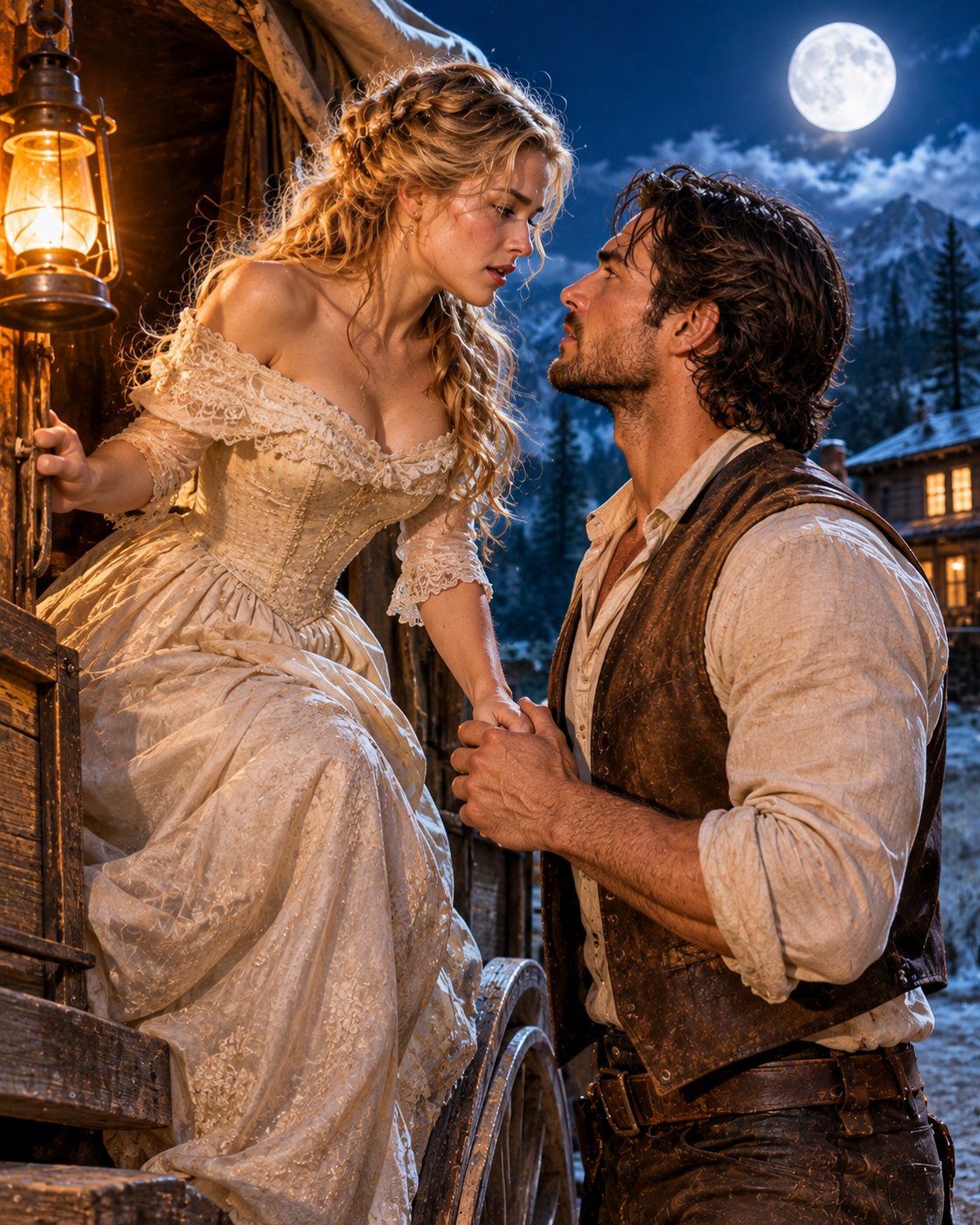
1 đoạn đã chọn
CHUẨN
She Found a Stranger in Her Barn… Then Her Daughter Ran Into His Arms and Cried, “I Knew You’d Come Back!”
PART 1
“GET AWAY FROM MY DAUGHTER!”
Ivy Caldwell raised her garden spade, her heart pounding as her seven-year-old daughter threw herself into the arms of a filthy stranger hiding behind the hay bales.
But the little girl wasn't frightened.
She was crying with happiness.
“I knew you'd come back!” Nell whispered, wrapping both arms around the man's neck. “I told Mama you would!”
The stranger dropped to his knees, holding her as though she were someone precious he had feared never seeing again.
“Nell?” he breathed.
Ivy froze.
How did this man know her daughter's name?
Wyoming Territory, 1887.
At thirty-one, Ivy Caldwell had learned that promises were often nothing more than pretty lies.
Her husband had disappeared five years earlier, leaving her with a baby, a struggling farm, and a heart she had eventually taught herself to protect. Their marriage had since been legally dissolved, but the humiliation of waiting for someone who never returned had remained.
Now she raised Nell alone outside Larkspur Flats, running her late father's small printing press and publishing a weekly newspaper that made powerful men uncomfortable.
And lately, one man had been making her especially uncomfortable.
Edmund Voss.
A wealthy land agent representing interests connected to the Wyoming and Platte Central Railway, Voss had been pressuring Ivy to sell her farm.
The railroad's proposed route crossed her north pasture, directly over the spring that supplied water to several neighboring families.
Ivy suspected something was wrong.
She just couldn't prove it.
Until the stranger appeared in her barn.
“Explain yourself,” she demanded, lowering the spade only slightly.
The man gently released Nell.
“My name is Elias Hartwell. I'm a surveyor.”
“Then explain why my daughter recognizes you.”
Nell turned, astonished.
“Mama! He's the man who drew my map at the county fair!”
Ivy remembered.
Months earlier, Nell had returned from the fair carrying a hand-drawn map showing their little farmhouse, a winding river, distant mountains, and even Deacon, their notoriously ill-tempered goose.
The stranger had promised to return someday and show Nell the ocean.
Ivy had dismissed it as another careless promise.
But now he was standing in her barn.
“I didn't come because of the promise,” Elias admitted painfully. “I came because two men are hunting me.”
He opened his battered leather case.
Inside were rolled maps, notebooks, and survey instruments.
He spread two drawings across an overturned crate.
Both showed Ivy's property.
But the railroad tracks followed entirely different routes.
“The first is the original survey,” Elias whispered. “The second is what the company published.”
Ivy stared at the altered line.
“Someone moved the railroad?”
“Two miles south. Straight across your spring.”
“Who?”
Elias looked toward the barn door.
“Edmund Voss.”
Then he said something that made Ivy's blood run cold.
“He doesn't want your farm for the railroad, Mrs. Caldwell. He wants you to believe you'll lose it so you'll sell it to him.”
Outside, a horse stopped near the gate.
Elias went pale.
“They've found me.”
Had Ivy unknowingly sheltered the one man who could save her home? And what would happen when the powerful land agent discovered his missing surveyor was hiding beneath her roof?
The stranger's most dangerous secret—and the reason Nell might be the only person who could save him—was still waiting to be uncovered in the first comment.
PART 2
The horse outside belonged to the mail carrier, but Elias didn't relax until it disappeared down the road. Ivy watched him carefully. “You worked for the railroad,” she said. “Why should I believe you?” Elias lowered his eyes. “Because I helped create the maps they're using to frighten you. I drew the honest route, then looked away when powerful men changed it. That's a mistake I intend to correct.”
For the next five days, Elias remained hidden at the Caldwell farm while Ivy compared his drawings with county records. They argued constantly. He organized her newspaper proofs into neat piles. She scattered them again. He insisted on precise measurements. She insisted that ordinary people deserved explanations they could understand. Yet every evening, after Nell went to bed, their disagreements softened into conversations beneath the kitchen lamp.
One night, Ivy told him about the husband who had abandoned her. “I spent years waiting for a letter,” she admitted. “Eventually I understood that some men are better at leaving than loving.” Elias looked at her across the table. “I've spent twenty years traveling because I never found anywhere worth staying.” Something passed between them, quiet and frightening. Neither dared name it.
Their breakthrough came from Nell. She brought Elias the old map he had drawn at the fair. “I kept it,” she announced proudly. When Elias turned it over, his expression changed. On the back were forgotten survey measurements identifying an iron marker forty paces from Ivy's spring. If the marker remained undisturbed, its position could help establish which railroad route matched the original survey.
Two mornings later, Ivy and Elias rode into the north pasture. Beneath moss-covered stones, they discovered a rusted iron pin stamped with the number 42. Elias knelt beside it, almost laughing. “This could save four farms.” Ivy reached for his hand. For one breathless moment, he looked at her as though he wanted to kiss her.
But their happiness ended when Edmund Voss arrived at the farmhouse.
He offered Ivy twice the farm's value in exchange for the property and any railroad documents she possessed. When she refused, his smile hardened. “A fugitive surveyor has been seen nearby. Harboring him would be unfortunate for a mother raising a child alone.”
That evening, Elias made a decision. Rather than endanger Ivy and Nell further, he surrendered himself to Sheriff Ned Pruitt, carrying copies of the disputed surveys. “I'm not running again,” he told Ivy. “And this time, when Nell asks whether I'm coming back, I want the answer to be true.”
The following morning, the sheriff took Elias into custody while he examined the evidence. Ivy watched him ride away, then uncovered her father's printing press. By dawn, four hundred newspapers lay drying across her floor, each exposing the conflicting railroad routes.
Within days, frightened farmers began bringing her letters, receipts, and suspicious purchase offers. A territorial hearing was scheduled. Elias would testify, but the complaint accusing him of stealing company documents remained unresolved.
On the morning of the hearing, Ivy entered the courthouse holding Nell's hand. Across the crowded room, Elias stood beside the sheriff.
Then Voss's attorney rose with a document Ivy had never seen.
“Before this witness speaks,” he announced, “we intend to establish that Mr. Hartwell deliberately removed company property and concealed evidence from his employers.”
Elias went still.
Ivy realized that the maps might save her farm while condemning the man she was beginning to love.
Could Elias prove his honesty without losing his freedom? And if he survived the hearing, would he finally choose a home with Ivy and Nell—or disappear down another road?
The courtroom was about to hear the truth, but the hardest choice of Elias's life would come after the verdict. That choice—and the promise a little girl refused to forget—would change everything in Part 3.
PART 3
The courthouse in Larkspur Flats had never held so many people.
Farmers crowded the benches. Merchants stood along the walls. Two women shared a chair near the back, while several men remained in the doorway because there was nowhere else to sit.
At the front of the room, Elias Hartwell stood beneath the stern gaze of the territorial examiner.
Across the aisle, Edmund Voss watched with the satisfied expression of a man who believed he had already won.
Ivy Caldwell sat beside her daughter, her father's notebook pressed against her knees.
Nell's small hand slipped into hers.
“Is Mr. Elias in trouble, Mama?”
Ivy looked toward the man who had arrived in her barn with nothing but a battered leather case and a desperate need for shelter.
“I don't know, sweetheart.”
Nell frowned.
“But he told the truth.”
“I know.”
“Then why would anybody punish him?”
Ivy had spent years printing questions that powerful men disliked.
She had never struggled so much to answer one.
The examiner called Elias forward.
He wore a freshly washed shirt borrowed from Sheriff Pruitt and a dark coat that still showed signs of hard traveling. His beard had been trimmed, revealing a strong jaw and a face more handsome than Ivy had first realized.
But it was his eyes that held her attention.
Those steady gray-blue eyes were searching for hers.
When their gazes met, he gave the smallest nod.
Ivy returned it.
Then the questioning began.
“Mr. Hartwell, were you employed by the Wyoming and Platte Central Railway?”
“Yes, sir.”
“Did you remove survey drawings and notebooks from company custody without authorization?”
Elias hesitated.
The room became very still.
“Yes.”
A murmur passed through the crowd.
Voss leaned back.
His attorney, Mr. Bellamy, stepped forward.
“So you admit taking documents that did not belong to you?”
“I admit removing the original drawings I prepared while employed by the company.”
“Without permission?”
“Yes.”
“And you subsequently concealed yourself on Mrs. Caldwell's property?”
“I sought shelter there.”
“Because you feared arrest?”
“Because two men had followed me across three towns, and I believed they intended to take the drawings before anyone could examine them.”
Bellamy smiled.
“Believed, Mr. Hartwell? Or knew?”
“Believed.”
“Then you have no proof those men intended to harm you?”
“No direct proof.”
Voss's smile widened.
Ivy felt her stomach tighten.
Elias was answering honestly, but each answer seemed to strengthen the accusation against him.
Bellamy lifted one of the survey sheets.
“Isn't it possible that you altered these maps yourself after being dismissed?”
“No.”
“Can you prove that?”
“Yes.”
For the first time, Elias's voice grew firm.
“My field notebooks contain measurements made during the original survey. Those measurements correspond to physical markers placed in the ground before the route was changed.”
Bellamy waved dismissively.
“Measurements written by the accused himself.”
“Measurements that can be independently verified.”
The examiner leaned forward.
“Explain.”
Elias described the original railroad route along the ridge, the altered route crossing the farms, and the numbered iron marker beside Ivy's spring.
Then Sheriff Pruitt was called.
The sheriff removed his hat and spoke slowly.
“I rode to the spring with a county engineer. We found marker number forty-two where Mr. Hartwell's notes said it would be.”
“And the measurements?” asked the examiner.
“They matched the original field records.”
The county engineer confirmed the sheriff's account.
More importantly, he explained that the published railroad route did not correspond to the established markers and distances.
The maps were not simply different artistic interpretations.
They represented conflicting surveys.
And one had been altered.
Voss shifted in his chair.
Bellamy objected that no evidence established who had ordered the change.
The examiner agreed that the question remained open.
But the evidence was enough to justify further investigation.
Then Ivy was called.
She walked to the front carrying her father's notebook.
Bellamy examined her with thinly disguised contempt.
“Mrs. Caldwell, you publish a newspaper?”
“I do.”
“And you've printed articles criticizing the railroad?”
“I've printed questions about its proposed route.”
“Questions designed to stir public anger?”
“Questions designed to receive answers.”
A few people chuckled.
Bellamy's expression tightened.
“Isn't it true that you offered shelter to Mr. Hartwell after learning he was wanted for removing company documents?”
“I sheltered a man who told me he had evidence that my neighbors and I were being deceived.”
“Despite knowing he might be a criminal?”
“I knew there was a complaint against him. I did not know whether it was justified.”
“Yet you believed him?”
“I examined his evidence.”
Bellamy stepped closer.
“Or perhaps you believed him because you had become personally attached to him?”
The room fell silent.
Ivy felt heat rise into her cheeks.
Across the aisle, Elias stiffened.
Bellamy continued.
“A widow living alone, a mysterious stranger appearing at her farm, several nights spent together examining documents. Would you describe your relationship as entirely professional?”
Ivy straightened.
“I'm not a widow, Mr. Bellamy. My former husband abandoned our family, and our marriage was legally dissolved. I have raised my daughter and supported my farm without his assistance.”
Bellamy looked briefly uncomfortable.
“That does not answer my question.”
“No,” Ivy said. “It answers the suggestion beneath it.”
A ripple of approval moved through the room.
The examiner struck his desk lightly.
“Order.”
Ivy turned toward him.
“Sir, whether I care for Mr. Hartwell has no bearing on where the railroad's survey markers stand. You may question my judgment, but you cannot move an iron pin by questioning my character.”
This time, the laughter was impossible to suppress.
Even Sheriff Pruitt lowered his head to hide a smile.
Elias looked at Ivy as though he had never seen anyone quite like her.
And perhaps he hadn't.
The hearing continued for hours.
Mr. Fenn, the feed-store owner, produced a purchase offer from Voss's office dated weeks before the railroad route became public.
A neighboring widow presented another.
A farmer from the southern valley testified that he had been warned his property would become worthless unless he sold immediately.
Each account added another piece to the troubling pattern.
Then Ivy produced the special edition of the Larkspur Weekly.
Four hundred copies had already circulated throughout the county.
The newspaper did not accuse Voss of crimes that had not been proven.
Instead, it displayed the two railroad routes, the recorded measurements, the land offers, and the questions that remained unanswered.
The examiner studied the pages for a long time.
Finally, he adjourned the hearing.
His decision would come the following week.
Outside the courthouse, the crowd broke into anxious conversations.
Some people shook Ivy's hand.
Others congratulated Elias.
But when Sheriff Pruitt approached, the relief faded.
“The complaint against Mr. Hartwell hasn't been dismissed,” he explained. “Until the examiner decides how the documents are to be handled, Elias remains in my custody.”
Nell's face crumpled.
“But he told the truth!”
The sheriff crouched beside her.
“That he did, little lady.”
“Then why can't he come home?”
Pruitt looked toward Elias.
“Sometimes the law takes longer to catch up with the truth than we'd like.”
Elias knelt before Nell.
“Remember the map I drew you?”
She nodded.
“Remember what I said about finding the ocean?”
“You said you'd show me someday.”
“I still want to.”
Her eyes filled.
“People always say someday.”
The words struck him harder than anything Bellamy had said inside the courthouse.
Elias glanced at Ivy.
She stood very still.
Then he took Nell's hands.
“I won't promise you a day I cannot guarantee,” he said gently. “But I can promise I won't disappear without telling you where I'm going.”
Nell studied his face.
“That's better,” she whispered.
Ivy turned away before either of them saw her tears.
That night, she returned to the farm alone with her daughter.
The kitchen felt strangely empty.
Elias's pencils were gone from the table.
His coat no longer hung beside the back door.
Even the neat stack of maps he had arranged seemed to leave a space in the room.
Nell sat on a crate beside the printing press.
“Are you going to make another newspaper?”
“Yes.”
“About Mr. Elias?”
“About what happened today.”
Nell considered this.
“Will you put in the part where he told the truth even though it made him look bad?”
Ivy stopped setting type.
“Yes,” she said softly. “I think that's the most important part.”
For the next six days, Ivy worked harder than she ever had.
She interviewed witnesses, checked dates, and printed every confirmed detail she could establish.
She refused to exaggerate.
She refused to turn suspicion into certainty.
And she refused to let the town forget the four families whose farms remained threatened.
By the time the examiner returned, nearly everyone in the valley knew what was at stake.
The ruling came on a cold Tuesday morning.
The territorial authorities would open a formal investigation into the disputed survey and the land transactions surrounding it.
All proposed seizures affecting the four farms were suspended pending review.
The railroad was ordered to preserve its original records.
And the complaint against Elias would not be pursued while investigators examined the circumstances under which he had removed the maps.
It was not a complete victory.
The investigation could take months.
But Ivy's farm was safe for the moment.
The spring would remain untouched.
And Elias could return home.
When Nell heard the news, she ran straight through the courthouse crowd and collided with his legs.
“You're coming back!”
Elias caught her.
“Yes, little one.”
“For supper?”
He laughed.
“For supper.”
“And breakfast?”
“If your mother will have me.”
Nell turned toward Ivy.
“Mama?”
Ivy folded her arms.
“He still hasn't fixed the barn door.”
Elias smiled.
“I suppose I'd better stay until it's done.”
But something had changed between them.
That evening, after Nell was asleep, Ivy found Elias standing on the porch.
The stars hung bright above the Wyoming hills.
For a long time, neither spoke.
Then Elias said, “You defended me today.”
“I defended the truth.”
“You defended more than that.”
Ivy leaned against the porch railing.
“You would have done the same for me.”
“Yes.”
The certainty in his voice made her turn.
He stepped closer.
“Ivy, when I first arrived here, I thought I was looking for somewhere to hide.”
“And now?”
“Now I'm afraid I've found something I don't know how to leave.”
Her breath caught.
“Then don't.”
The words escaped before she could stop them.
Elias stared at her.
Ivy looked away.
“I mean, there's still work to be done. The railroad investigation, the farm, the spring—”
“Ivy.”
She fell silent.
“I don't want to stay because you need someone to repair your fences.”
“Good,” she whispered. “Because you're rather slow at it.”
He laughed softly.
Then he took her hand.
“I want to stay because I love the way you argue with people who frighten everyone else. I love that your kitchen is covered in ink and newspapers. I love that you never let me pretend my mistakes weren't mistakes.”
His thumb brushed her knuckles.
“And I love the way you look at Nell as though the whole world begins and ends with her.”
Ivy's eyes burned.
“Elias…”
“I think I'm falling in love with you.”
She had imagined hearing those words again.
Sometimes, in the loneliest hours, she had wondered whether anyone would ever say them and mean them.
Now they frightened her more than she expected.
“My husband said he loved me,” she whispered. “Then one morning he rode away.”
Elias's expression softened.
“I know.”
“I spent years wondering what I had done wrong.”
“You did nothing wrong.”
“You can't know that.”
“I know that a man who leaves a child waiting without explanation has failed to keep a responsibility that belongs to him.”
Ivy looked at him.
“And what if you leave?”
“Then I'll tell you where I'm going, why I'm going, and when I expect to return. And if I can't keep that date, I'll find a way to send word.”
She swallowed.
“That sounds very practical.”
“I'm a surveyor.”
A reluctant smile touched her lips.
He lifted her hand and kissed her fingers.
“I can't promise a life without disappointment, Ivy. But I can promise not to use your love as an excuse to be careless with your trust.”
For a moment, she wanted to step into his arms.
Instead, she whispered, “Give me time.”
He nodded.
“As much as you need.”
And he meant it.
Over the following weeks, Elias repaired fences, helped Nell with her drawings, and assisted Ivy in organizing evidence for the continuing investigation.
He learned that Deacon the goose could not be bribed with corn when he had already decided to dislike someone.
He learned that Nell believed every important question deserved at least three follow-up questions.
And he learned that Ivy hummed softly when she worked at the printing press, though she always denied doing so.
One rainy evening, Elias discovered her asleep at the kitchen table.
Her head rested on a stack of proofs.
A smear of ink marked her cheek.
He stood watching her for a moment before gently draping a blanket around her shoulders.
Ivy stirred.
“Elias?”
“Go back to sleep.”
“Did you finish checking the county notices?”
“Yes.”
“And the broken hinge?”
“Yes.”
“And Nell's arithmetic?”
He smiled.
“She informed me my method was unnecessarily complicated.”
“That sounds like her.”
Her eyes opened fully.
He was still standing beside her.
“Why are you looking at me like that?”
“Because I've never been happier in a room full of unfinished work.”
Ivy reached for his hand.
This time, she didn't let go.
Their first kiss happened beneath the kitchen lamp.
It was gentle, hesitant, and so unexpectedly tender that Ivy felt the years of loneliness rise in her throat.
When Elias drew back, she rested her forehead against his.
“I've forgotten how to do this,” she admitted.
“Then we'll learn.”
Together, they did.
But their happiness soon faced another test.
Three weeks after the hearing, a letter arrived from a surveying firm in Dakota Territory.
Elias read it twice.
The firm had heard about his testimony and wanted to employ him to conduct independent surveys for settlers and territorial authorities.
The position offered excellent wages.
It also required extensive travel.
For a man who had spent twenty years drifting from one assignment to another, it was the opportunity he had always wanted.
Ivy knew it immediately.
She also knew what accepting it might mean.
“You should take it,” she said.
Elias looked up.
“You haven't even asked where it is.”
“I saw the letterhead.”
“Ivy—”
“You've earned this.”
He set the paper down.
“What about us?”
Her heart twisted.
“Us?”
“You know what I mean.”
She turned toward the stove.
“I won't ask you to sacrifice your future because my daughter and I have grown fond of you.”
“Fond?”
She closed her eyes.
“Don't make this harder.”
Elias stood.
“Ivy, I love you.”
“And I love you!”
The words burst from her before she could stop them.
They stared at each other.
It was the first time she had said it.
For one beautiful instant, everything seemed possible.
Then Ivy shook her head.
“But love isn't supposed to become a chain. I won't keep you here because I'm afraid of being alone again.”
Elias approached her.
“What if staying is what I want?”
“Then choose it freely.”
She looked into his eyes.
“Not because Nell needs a father. Not because I need help with the farm. And not because you feel guilty about a promise you made at a county fair.”
Her voice trembled.
“Choose us because this is the life you want.”
Elias had no answer.
Not because he doubted his love.
Because for the first time in his life, someone was asking him to decide where he belonged.
And he had never learned how.
Two days later, Nell found his leather case open on the bed.
His shirts were folded inside.
His instruments lay wrapped in cloth.
She stood in the doorway.
“You're leaving.”
Elias turned.
“Nell…”
“You promised.”
He knelt.
“I promised I wouldn't disappear without telling you.”
“That's not the same as staying.”
“No,” he admitted. “It isn't.”
Her lower lip trembled.
“I thought you liked our house.”
“I love your house.”
“And Mama?”
He swallowed.
“I love your mama very much.”
“Then why are your shirts in the case?”
It was such a simple question.
And he had no simple answer.
Nell stepped backward.
“I don't want another map.”
Then she ran down the hallway.
Elias remained kneeling beside the open case.
For the first time, the familiar sight of his packed belongings made him feel ashamed.
Not because traveling was wrong.
But because he had spent so many years leaving places before they could become home.
That night, Ivy found him sitting in the barn.
The same barn where she had first discovered him hiding behind the hay.
A lantern glowed beside his boots.
Deacon watched suspiciously from the rafters.
“I thought you might be here,” Ivy said.
Elias looked up.
“I've been thinking.”
“About Dakota?”
“About every place I've ever lived.”
She sat beside him.
He rubbed his hands together.
“When I was twenty, I told myself I'd settle down after one more job. At twenty-five, I said the same thing. At thirty, I stopped pretending I was serious.”
Ivy listened.
“I've drawn roads across half the West,” he continued. “I've measured mountains, rivers, and land people would spend their whole lives trying to make their own.”
He turned toward her.
“But I never once asked where I wanted my own road to end.”
“And now?”
He reached into his coat and removed the letter.
“I wrote back.”
Ivy's heart sank.
“I see.”
“I told them I'd accept the work on one condition.”
She looked up.
“That I establish my home and office in Larkspur Flats. I'll travel when a survey requires it, but I won't relocate permanently.”
“Elias…”
“They may refuse. If they do, I'll find other work.”
“You can't throw away your opportunity.”
“I'm not throwing it away.”
He took her hands.
“I'm finally choosing what I want.”
Tears filled her eyes.
“And what is that?”
“You.”
His voice broke slightly.
“You and Nell. The printing press. That impossible goose. The crooked barn. The sound of your voice when you're angry about something that matters.”
He smiled through his emotion.
“I want to come home to you, Ivy. Not because I'm needed. Because I can't imagine a better place to belong.”
She covered her mouth.
For years, she had believed that love meant waiting for someone to return.
Now she understood something different.
Love could also mean being chosen.
Again and again.
Even when leaving would be easier.
She stepped into his arms.
“Yes,” she whispered.
Elias held her close.
“Yes to what?”
“To building a life together.”
He kissed her.
And this time, neither hesitated.
Above them, Deacon made a disapproving noise.
Ivy laughed against Elias's shoulder.
“He'll get used to you.”
“I wouldn't count on it.”
A month later, the surveying firm accepted Elias's conditions.
He would establish a small office in Larkspur Flats, conducting local work and traveling for larger assignments.
For the first time, his journeys would have a destination waiting at the end.
Home.
The territorial investigation continued through winter.
Additional records supported the conclusion that the railroad route had been improperly altered. Edmund Voss was removed from the company's negotiations, and authorities pursued further examination of the land transactions.
Elias was formally cleared of the outstanding complaint.
By spring, the railroad company announced that it would proceed with the original ridge route, subject to the remaining engineering approvals.
The four farms were no longer threatened by the altered line.
And Ivy's spring remained untouched.
On a bright morning in May, Elias asked Ivy to walk with him to the north pasture.
The grass was green.
The creek ran clear.
Wildflowers had begun to appear beside the fence.
They stopped near the spring, where water emerged from the rocks and flowed toward the valley.
Ivy smiled.
“This is where we found marker forty-two.”
“I remember.”
“You were so happy you nearly kissed me.”
“I was trying to be respectful.”
“You were being foolish.”
He laughed.
Then he reached into his coat.
“I drew you something.”
He unfolded a small sheet of paper.
It was a map.
Not a complicated survey filled with bearings and measurements.
A simple drawing showing three places.
The Caldwell farmhouse.
Nell's school.
And the spring.
Thin lines connected them.
At the center, in Elias's careful handwriting, were the words:
“Every road I want to travel begins and ends with you.”
Ivy read the sentence twice.
Then she began to cry.
Elias took her hand.
“Ivy Caldwell, will you marry me?”
She looked up.
“I have a daughter who asks too many questions.”
“I know.”
“A newspaper that keeps me awake half the night.”
“I know.”
“A farm that needs constant repairs.”
“I've noticed.”
“And a goose who may never accept you.”
Elias sighed.
“That is the one obstacle I cannot promise to overcome.”
Ivy laughed through her tears.
Then she threw her arms around him.
“Yes.”
He held her tightly.
“Yes?”
“Yes, Elias Hartwell. I'll marry you.”
They were married in June.
The ceremony took place in the Caldwell farmhouse because Nell insisted the house had been waiting for a wedding longer than anyone else.
The neighbors crowded into the kitchen.
Mr. Fenn brought flowers.
Sheriff Pruitt wore his best coat.
Aunt Winifred cried before the minister had even begun speaking.
Nell wore a blue dress and carried a bunch of wild larkspur.
When the minister asked who would give the bride away, Nell raised her hand.
“I will.”
Everyone laughed.
She stepped beside Ivy.
“But I want everyone to know Mama isn't being given away because nobody wants her.”
The room grew quiet.
Nell looked at Elias.
“She's being married because somebody finally knew how to stay.”
Ivy's eyes filled.
Elias knelt and kissed Nell's forehead.
“That's exactly right.”
Then he stood and took Ivy's hand.
Their vows were simple.
There were no grand promises of a life without sorrow.
Only promises to tell the truth, face difficult days together, and keep choosing one another.
When the minister pronounced them husband and wife, Elias kissed Ivy beneath the same roof where she had once sworn she would never trust another man.
Outside, Deacon honked loudly.
Nell declared that he approved.
Nobody believed her.
Five years passed.
The Caldwell-Hartwell farm grew louder, warmer, and more crowded.
The barn was finally straightened.
A new room was added to the farmhouse.
The Larkspur Weekly expanded to five hundred subscribers and moved into a proper shop near the town square.
Ivy continued publishing uncomfortable questions.
Elias continued drawing honest maps.
And Nell, now twelve, had become an accomplished young artist who could sketch the surrounding mountains with astonishing precision.
There was also Toby.
Nearly three years old, he had his father's gray-blue eyes, his mother's red hair, and a determination to climb anything taller than himself.
He had been born during a snowstorm, with Elias pacing the hallway and Nell announcing that she would personally supervise the arrival of her younger brother.
When she finally saw the baby, she studied him seriously.
“He'll do,” she declared.
And he had.
On a golden afternoon in late summer, Ivy sat on the porch mending a small shirt.
Toby played beside her.
Nell sat on the steps drawing the mountains.
Elias was repairing the gate.
Suddenly, Nell looked up.
“Papa?”
Elias stopped working.
“Yes, sweetheart?”
“Would you have come back if I hadn't kept your map?”
He set down his screwdriver.
For a moment, he said nothing.
Then he sat beside her.
“I don't know.”
Nell frowned.
“You don't?”
“I'd like to tell you I would have. But the truth is, I was frightened, tired, and unsure where to go.”
He looked toward the distant hills.
“I might have kept walking.”
Nell considered this.
“But you remembered me?”
Elias smiled.
“Every time I saw a map, I remembered the little girl who wanted to know how to reach the ocean.”
“And the goose?”
“Especially the goose.”
She laughed.
Then Elias grew serious.
“When I had nowhere else to go, I remembered someone had once believed I would return.”
Nell leaned against him.
“I knew you would.”
He kissed the top of her head.
“Yes,” he whispered. “You did.”
Inside the farmhouse, above the stove, hung a small wooden frame.
Behind its glass was a faded sheet of paper.
A little house.
A winding blue river.
Mountains.
The distant ocean.
And one very badly drawn goose.
It was the first map Elias had ever given Nell.
The paper had grown soft at the folds, but the drawing remained.
Ivy looked at it every morning.
Not because it had helped expose a dishonest railroad scheme.
Not because the survey measurements on its reverse had helped protect their land.
But because it reminded her that the smallest promises sometimes carried the greatest weight.
Elias came up the porch steps and sat beside her.
Toby immediately climbed into his lap.
Ivy reached for her husband's hand.
“You know,” she said, “I almost hit you with a spade the morning we met.”
“I remember.”
“You were hiding in my barn.”
“I remember that, too.”
“And you looked terrible.”
“I was hoping you'd forgotten that part.”
She smiled.
“Not a chance.”
Elias leaned over and kissed her.
Across the yard, Nell suddenly shouted.
“Papa! Deacon's in the kitchen again!”
Elias closed his eyes.
“That bird has been trying to ruin my life for five years.”
Ivy laughed.
“Go rescue supper.”
He stood with Toby in his arms.
Then he paused and looked back at her.
The same crooked smile.
The same steady eyes.
Only now, there was no fear of leaving in them.
“I'll be right back,” he said.
Ivy watched him disappear into the house.
Once, those words would have frightened her.
Once, she would have wondered whether they were another promise waiting to be broken.
Now she simply smiled.
Because she knew he meant them.
And somewhere inside, a little boy laughed, a goose protested, and the man who had once wandered across the West called for his daughter to help him save the kitchen.
Ivy put down her mending and went inside.
She had finally found something more precious than a perfect promise.
A life in which love was proven every ordinary day.
And the map that mattered most had never been drawn on paper.
It had been drawn through kindness, courage, forgiveness, and the choice to stay.
Perhaps the greatest love stories don't begin with a kiss or a wedding, but with one frightened stranger discovering that someone has been waiting for him all along.
Would you have trusted Elias after finding him in your barn, or would you have sent him away before learning the truth?
This is a fictional Western romance, creatively adapted and developed with AI assistance for storytelling and entertainment.
'I'll Take the One Nobody Wants,' the Blacksmith Said—And Chose Her Without Looking Back
They wrote her name at the bottom of the hiring board in Choke Cherry Bend, beneath a span of oxen and two mules, and not one soul in that town thought it strange enough to mention. Hadty Dunar read it through the steamed kitchen glass while her bread scorched behind her. A woman could be listed with livestock. Worse than that, she had learned a woman could be priced under it. She was 23 years old and she had scrubbed the Bend House Hotel kitchen for two of them from black morning to black night until her hands went hard as saddle leather and her back learned to carry anything the stairs demanded. She was a large woman, broad through the shoulder, heavy through the hip, built like something the mountains had made on purpose and set down whole. The town called it grotesque. Her father had called it Goodstock. And then her father had died. He died owing Judson Ivy $418, and Ivy collected it out of her instead. Three years of her labor signed in a dying man's shaking hand on the kitchen table. Two years served, one year left to run. Lucinda Prior, the housekeeper, counted the biscuits every morning and announced the count allowed in the dining room. She liked to say the Bend House fed one hired girl and four of her besides. The guests laughed every single time. Ivy owned the hotel, the freight barn, the scale, and every hiring paper in the county. That spring, he wanted more. The new mine at Rusk Hollow needed an ore road down the mountain, and he meant to build it and take the toll on every ton forever. Through the window, she watched a wagon come off the north road loaded with bar iron and charcoal sacks. One man handling all of it alone, Caleb Ashby, the smith from Cinder Ridge. He never drank in the hotel and never weighed his iron on Judson Ivy's scale. Nell Sackett dried plates beside her that evening and spoke low under the clatter. Ivy had sold three girls hiring papers to the winter timber camps in as many years, she said, and not one of the three had ever come back to town to collect her wages. That night, Hattie sat up with her father's old tally book and ran his sums by candle light the way she had since she was 10. Numbers had always been kind to her. Numbers were the only thing in Montana territory that had never once mentioned her size. In the morning, the board was chocked fresh for hiring day. Nine names on it. Hers sat at the bottom under the oxen, under the mules, with no wage written beside it at all. Hiring day filled the boardwalk by 8:00. Ranchwives, camp bosses, mine cooks, and a crowd that had come for nothing but the show of it. The nine girls stood against the hotel wall in a line, straight as fence posts, hands folded. The buyers went down that line the way men go down a corral rail. They lifted chins with two fingers. They asked after teeth and temper, and whether a girl could handle a range stove. One by one, the girls were spoken for and led away. Then the buyers reached the end of the line. A rancher's wife looked Hattie over from hem to hairline and laughed out loud into the cold air. "She would eat the whole profit before the first snow flew," the woman said, and walked on past. "Wade Toiver did the calling for Ivy." He read her terms out in a voice pitched to carry the length of the street. One year remaining, kitchen trained, sound of wind and limb, and then he called out her weight as though it were a term written into the contract. The crowd howled at that. To dropped the price to $60, then 40, then 20. He offered her paper free and clear to any man who would haul one load of stove coal up to the hotel in exchange for it. Nobody spoke. The wind came down off the slope and pushed at the awning canvas above them. Hadtie kept her eyes on a knot in the boardwalk plank and made herself into nothing at all, which was a thing she was very good at. Judson Ivy stepped out of his own door with his thumbs hooked in his vest. He said the town had seen the plain truth of it. "A thing nobody wants is not property," he said. It is a debt and he supposed he would go on carrying it. Boots came up the boardwalk then unhurried. Caleb Ashby crossed through the crowd with coal dust still in the creases of his hands, stopped square in front of Judson Ivy and said it loud enough for the whole street to hear. I'll take the one nobody wants. Iivey's smile went thin as wire. He said, "No unmarried man carried a girl's paper out of his town, and he said it slowly so the crowd could enjoy watching the trap close on a fool." "Ashb did not blink." "Then fetch the preacher," he said. They were married in 11 minutes on the hotel steps in front of every mouth that had laughed. He counted out the full $418 in gold, took her carpet bag out of Toiver's hand, and walked straight to his wagon. He did not look back once. Ivy called after him about the road across Cinder Ridge, and a fair price paid for a fair grade. Ashby handed her up onto the seat, climbed on, and clucked to the team. The calling went on behind them the length of two streets, and he never turned his head. The town fell away into pine. Hadtie sat with her carpet bag on her knees and her heart going like a bird in a grain sack. She had been bought for the price of her father's debt by a man she had never once spoken to in her life. She waited for it to begin. Every kindness she had ever been shown came with a bill attached somewhere at the bottom. She counted the mileposts and braced herself for the moment he would tell her exactly what she now owed him. Two miles on, he pulled the team up, climbed down without a word, and shifted 100 lb of bar iron from under the seat to the back of the wagon bed. Then he folded a wool blanket over four times and laid it on the seatboard beside him. "Bards bruise," he said. That was the whole of it. She sat down on the folded blanket and could not for the life of her understand what had just happened to her. The road climbed all afternoon. Pine gave way to raw rock, and the wind came down off the snow fields with teeth in it. He pulled a buffalo robe from beneath the seat and laid it over her lap without comment and without looking at her. They camped at the head of the pass. He built the fire fried salt pork and cornmeal in a black skillet and filled her plate first and fuller than his own. She sat with it on her knees and waited for the joke about her appetite. It did not come. He looked at her hands instead at the split knuckles and the old burn scars from the hotel range. He asked how long she had been carrying water yolks. two years," she said. He nodded slowly, the way a man nods over a well-kept ledger. She asked him finally, "Why? Why her, when the whole town had stood there and watched and laughed and kept its money buttoned in its pocket?" "They put your name under the mules," he said. He turned a stick over in the coals. "A town that does that is telling you what it is. It is not telling you one thing about what you are. Snow started at first light and quit by 9. They came over the top at noon, and Cinder Ridge opened below them, a long black shoulder of rock and green timber with a creek running white at the base of it. A stone smithy stood at the center of it all with a chimney breathing steady smoke and past that a cabin, a pole corral, three charcoal kils, and a switchback grade cut into the ridge face by hand. One summer at a time, he set the break. She sat looking down at the only road that could carry or wagons off the rusk hollow side of that mountain. She did not yet know she was looking at the reason a man had already decided she should be dead by spring. She had braced herself for a filthy hvel full of hides and flies. She found a swept floor, a scrubbed table, a bed with a clean tick, and a wall of books running from the doorframe clear around to the stove pipe. ropebound volumes on iron and a saying, a Bible with a cracked spine, Shakespeare and a mining almanac gone soft at the corners from handling. She stood in front of that shelf with her wet shawl dripping on his clean boards and could not think of a word to say. He carried her carpet bag in, set it at the foot of the bed, and told her the bed was hers. He slept in the smithy loft, he said, where the banked fire wanted watching through the night. Anyway, she said carefully that they were married. He said they were married on paper because a paper was the only thing that would get her out of that town alive, and that nothing else under his roof would ever be decided by Judson Ivy. Then he went out to the forge and left her standing in it. She sat down on the edge of that clean bed in a house belonging to a stranger and cried for a long time without making a single sound out of pure habit. The first days went by in a silence she kept waiting to hear break. She rose before he did, worked until dark, and moved through the small rooms trying to take up considerably less room than she actually did. He never raised his voice, not once. He set fresh meat in the cold house, split her kindling small so it would catch on the first match, and hung a lantern out on the path so she would never have to walk to the smithy in the dark. On the fourth morning, she baked. The cabin filled with the smell of it, and she stood square in front of the stove with her jaw set, waiting to be told exactly how much flour she had wasted on herself. He came in, ate three pieces, standing up with his hat still on, looked down into the empty pan, and said one word, "More." She turned to the stove so he would not see what her face was doing. She started hauling his charcoal up from the kils. The sacks ran 90 lb a piece, and the boy he had hired the summer before had managed exactly one at a time with rests. She took two, one on each shoulder, and never set them down on the slope. He watched her come up the grade that way, and said nothing for a good while. Then he told her the boy had quit over that hill in particular. She laughed out loud, a real one, and the sound of it surprised them both. In April, she asked to see his accounts, because his tally on the Rusk Hollow shoeing was $2 out, and it had been quietly
…
“I’ll Take the One Nobody Wants,” the Blacksmith Said — And Married Her Before the Whole Town Could Laugh Again
PART 1
“NOBODY WANTS HER! NOT EVEN FOR FREE!”
The laughter rolled down the boardwalk of Choke Cherry Bend as twenty-three-year-old Hattie Dunar stood beneath the hiring board, her face burning with humiliation.
Her name had been written below two mules and a team of oxen.
No wages. No offers. No dignity.
“She's too big to feed!” a rancher's wife shouted.
“Give her away with the coal!” another voice called.
Hattie stared at the wooden planks beneath her boots.
For two years, she had scrubbed floors and carried water at Judson Ivy's hotel, working to repay the $418 debt her dying father had supposedly left behind.
One year remained on her contract.
But today, Ivy intended to transfer that contract to whoever would take her.
Wade Toiver, the hotel's hiring agent, lowered his asking price.
“Sixty dollars!”
Silence.
“Forty!”
More laughter.
“Twenty!”
Not a single hand rose.
Finally, Judson Ivy stepped forward, smiling beneath his expensive hat.
“Gentlemen, you've seen the truth. Some burdens aren't worth carrying.”
Hattie's eyes filled, but she refused to cry.
Then heavy footsteps sounded behind the crowd.
A tall blacksmith stood at the edge of the boardwalk, his broad shoulders dusted with coal and his hands blackened from the forge.
Caleb Ashby.
The quiet smith from Cinder Ridge.
He looked at Hattie, not at the laughing spectators.
“I'll take the one nobody wants.”
The crowd went silent.
Ivy's smile tightened.
“An unmarried man can't take responsibility for her contract outside this county.”
Caleb didn't hesitate.
“Then fetch the preacher.”
Eleven minutes later, Hattie was married to a man she had never spoken to.
Caleb counted out $418 in gold, collected her papers, lifted her worn carpetbag into his wagon, and offered her his hand.
He never looked back at the town.
Hattie spent the first miles waiting for him to explain what she owed him.
Instead, he stopped the wagon, moved a heavy bundle of iron away from her seat, and folded a blanket beneath her.
“Those boards bruise,” he said.
That night, beside a mountain campfire, she finally whispered, “Why did you choose me?”
Caleb studied the flames.
“They wrote your name beneath the mules. That told me everything about the town.”
He looked directly into her eyes.
“And nothing about you.”
For the first time in years, Hattie felt something dangerously close to hope.
But she didn't know that Judson Ivy had already paid for something else.
A coffin.
A grave.
And a burial bearing her name.
Three days before Caleb ever stepped onto that boardwalk.
Why had Ivy arranged Hattie's death before trying to give her away? And had the blacksmith unknowingly rescued a woman whose survival threatened a fortune?
The first clue was hidden among the papers Caleb had brought home from Choke Cherry Bend—and what Hattie discovered there would change their marriage forever.
PART 2
Hattie expected Caleb Ashby's cabin to be a miserable place, but she found polished floorboards, clean bedding, and shelves filled with books. When he told her the bed was hers and he would sleep in the smithy loft, she stared at him. “But we're married.” Caleb gently answered, “We married because that paper was the only way to get you out of Ivy's hands. What happens under this roof will be your choice.”
For days, Hattie worked quietly, expecting kindness to become another debt. Caleb never demanded payment. He brought firewood, left lanterns along the dark path, and never mocked her appetite. One morning, she baked bread. He ate three thick slices, looked at the empty pan, and said, “More.” Hattie turned toward the stove before he could see her tears.
Their companionship grew through ordinary work. Hattie carried heavy charcoal sacks up the mountain and discovered that Caleb admired her strength. When she found a mistake in his accounts, he handed her the entire ledger box. “You're better with numbers than I am,” he admitted. Nobody had ever spoken of her abilities with such uncomplicated respect.
Then she found the receipt.
Folded beneath her former labor contract was an undertaker's bill from Choke Cherry Bend. One pine coffin. One grave. Paid in full for Hattie Dunar. The date was three days before hiring day. In the margin, someone had written, “As with the others,” followed by the initials of two young women who had disappeared after being sent to distant timber camps.
Caleb found Hattie sitting outside the smithy, trembling. He read the document, then carefully preserved it. With her agreement, he destroyed the paper claiming ownership of her labor. “You're free to leave whenever you choose,” he told her. “And if you stay, you'll be my wife because you want to be.” Hattie looked at him through tears. “What if I want to stay?” His voice softened. “Then I'll spend every day being grateful.”
Spring transformed their lives. Caleb taught her blacksmithing, praised her steady hands, and never asked her to make herself smaller. One evening, she kissed him beside the forge. He held her face tenderly and whispered, “You're the finest woman I've ever known.” For once, Hattie believed someone could love her exactly as she was.
But Judson Ivy soon arrived demanding Caleb's mountain road. It was the only practical route for hauling ore from Rusk Hollow, and Ivy had secretly promised the mining company he would control it. Caleb refused to sell. Nine nights later, their charcoal kilns burned. Then someone cut their fences and drove away their horses.
In town, Hattie learned that Ivy had signed his ore-road contract before her supposed hiring day. Her old friend Nell Sackett also revealed that Ivy kept a locked ledger recording payments for women sent to remote camps. Hattie realized the burial receipt might connect her own intended fate to a much larger crime.
That night, riders appeared along the ridge. Torches flashed through the rain. The hay shed caught fire, and Caleb rushed outside to protect their property. A sharp report echoed across the yard. He collapsed beside the smithy steps.
From the doorway, Hattie saw him struggling to rise.
Then Wade Toiver stepped into the firelight.
“Bring the big woman out,” he ordered. “Ivy wants this finished tonight.”
Hattie looked at her wounded husband, the burning shed, and the men advancing through the rain.
They had mistaken her kindness for weakness.
And now they were about to discover just how badly they had misjudged her.
What happened on that mountain would expose the secret behind four missing women—but first, Hattie would have to save Caleb's life. The moment she opened the smithy door would become the beginning of Part 3's most extraordinary reckoning.
PART 3
The rain struck the smithy roof like handfuls of gravel.
Hattie Ashby stood inside the doorway, staring at her husband lying helpless in the mud.
Caleb had always seemed indestructible to her.
He could lift wagon axles, bend hot iron, and work twelve hours beside a roaring forge without complaining.
Now he was struggling to raise himself with one arm.
His right shoulder had been injured, and the shotgun lay beyond his reach.
Outside, Wade Toiver shouted another order.
“Get the woman!”
Hattie felt something change inside her.
For years, she had believed the cruel things people said about her.
Too large.
Too clumsy.
Too much trouble.
Too much of everything.
But Caleb had spent months teaching her another truth.
Her strength was not something to apologize for.
It was something she could use.
She rushed into the rain.
“Hattie!” Caleb gasped. “Go back!”
She ignored him.
Dropping beside him, she slipped her arms beneath his shoulders and pulled him toward the smithy.
The mud caught at her boots.
The distance felt endless.
But she kept moving.
One step.
Then another.
A rider shouted behind her.
Hattie reached the doorway, dragged Caleb across the threshold, and kicked the heavy door shut.
Something struck it from outside.
The wooden bar jumped against its brackets.
Caleb groaned.
“Hattie, you have to get away.”
She knelt beside him.
“Look at me.”
His eyes found hers.
“You once told me substance survives a Montana winter.”
“Hattie—”
“Well, I'm still here.”
She pressed clean cloth against his injured shoulder and tightened the bandage.
Then she stood.
Outside, another blow rattled the door.
Hattie looked toward the enormous anvil beside the forge.
For months, she had watched Caleb work beside it.
Three hundred and ten pounds of iron.
He had once joked that it was the only thing in the shop more stubborn than she was.
Now she approached it.
She bent her knees, braced herself, and shifted the anvil from its wooden block.
The weight strained every muscle.
She moved it only a few feet, sliding and lifting it in short, determined efforts.
But those few feet were enough.
She positioned it against the door.
The next impact shook the frame.
The anvil held.
Outside, someone cursed.
Caleb stared at her.
“Good Lord, woman.”
“Save your breath,” she answered. “You'll need it when I tell you what this door is going to cost to repair.”
Despite his pain, he almost smiled.
Then smoke began seeping through the roof.
The attackers had set fire to the outer shingles.
Hattie hurried to the forge.
She knew the building.
She knew where Caleb kept his water.
She knew which shutters could be secured and which had warped during winter.
She used the quenching water to soak the threatened wall and roof supports, fighting the flames before they spread.
A man forced open the east shutter.
Hattie seized a long iron bar from the workbench and raised it between them.
“Get out!”
He hesitated.
She stepped forward.
He withdrew.
But Wade Toiver was less easily discouraged.
He appeared through the damaged opening, his coat dripping rainwater.
“Still making trouble, Hattie?”
She recognized the voice that had mocked her before the entire town.
The voice that had announced her weight as though it were a defect.
The voice that had tried to give her away.
“You should have stayed at the hotel,” he sneered.
Hattie stood between him and Caleb.
“Why? So Ivy could bury me?”
Toiver's expression changed.
Only slightly.
But enough.
“You found that receipt.”
“I did.”
“Then you should have kept quiet.”
Hattie lifted the iron bar.
“Leave.”
He glanced toward Caleb.
“Your husband won't be much use to you now.”
For the first time, Hattie felt no shame.
No fear of being laughed at.
Only a fierce determination to protect the man who had taught her that she deserved to be loved.
“You've spent years frightening women who had nowhere to go,” she said. “But this is my home.”
Toiver stepped forward.
A sudden movement sent a tool rack crashing between them.
He stumbled backward, losing his footing on the wet floor.
Hattie slammed the shutter and secured it.
Outside, the attackers shouted.
But something had changed.
The men were no longer certain that the smithy would be easy to take.
And down the mountain, faintly, came the sound of approaching horses.
The fire had been visible from Rusk Hollow.
The miners had seen it.
Help was coming.
Hattie looked through a narrow gap in the shutters.
At the top of the grade stood a buggy.
Beside it, beneath an expensive dark-blue coat, was Judson Ivy.
He was watching his hired men retreat.
Hattie recognized the strongbox beside the driver's seat.
She had seen it many times at the hotel.
Ivy kept his most valuable papers inside it.
Including, perhaps, the mysterious placement ledger Nell had mentioned.
The miners' horses were growing louder.
Ivy turned his buggy toward the road.
Hattie faced a terrible choice.
Caleb needed her.
But if Ivy escaped with that box, the evidence of what had happened to the missing women might disappear forever.
She knelt beside her husband.
“Can you hold this bandage?”
Caleb nodded weakly.
“Where are you going?”
“To finish something.”
“Hattie, don't.”
She touched his face.
“You brought me out of that town because you couldn't bear to see someone treated like property.”
His eyes filled with fear.
“I brought you out because you deserved a life.”
“And so did those other women.”
She kissed his forehead.
“I'll come back.”
Then she stepped into the rain.
The miners were already approaching the lower yard.
Their lanterns swung through the darkness.
Ivy saw them too.
He urged his team forward.
But the narrow switchback had become slick with mud, and one wheel slipped toward the ditch.
The buggy lurched.
The strongbox slid from the seat and struck the ground.
Ivy scrambled after it.
Hattie reached the box first.
For a moment, they stood facing each other.
The man who had once counted her worth in dollars.
And the woman he had intended never to see again.
“Give me that,” Ivy demanded.
Hattie held the box against her side.
“No.”
“You have no idea what you're doing.”
“I know exactly what I'm doing.”
His expression hardened.
“You think your husband can protect you forever?”
Hattie looked toward the approaching miners.
“He doesn't have to.”
Two men from Rusk Hollow dismounted nearby.
One recognized Ivy.
Another saw the burning shed.
“What happened here?” he demanded.
Hattie raised her voice.
“Send someone for the sheriff. My husband is hurt, and this man has papers that may explain why several women disappeared from Choke Cherry Bend.”
Ivy opened his mouth.
Then closed it.
For the first time in all the years Hattie had known him, he had nothing useful to say.
The miners secured the scene and kept Ivy from leaving until the authorities arrived.
Hattie returned immediately to Caleb.
He was conscious.
Barely.
His face was pale.
But when she entered, his eyes opened.
“Did you come back?”
She knelt beside him.
“Of course.”
He tried to smile.
“I knew you would.”
She pressed her forehead against his.
“Don't you dare leave me now.”
“I've got no intention of it.”
“You'd better not.”
His good hand found hers.
“You saved me.”
She shook her head.
“You saved me first.”
He looked at her for a long moment.
“No, Hattie.”
His voice was weak but certain.
“I opened a door. You walked through it.”
She began to cry.
And for once, she did not try to hide the tears.
By dawn, the sheriff had arrived with a doctor from the mining settlement.
Caleb's shoulder injury was serious, but the doctor believed he could recover if infection did not set in and he rested long enough.
Hattie remained beside him while the doctor worked.
When Caleb finally fell asleep, she allowed herself to breathe.
Then she turned toward the strongbox.
It had been placed on the table under the sheriff's supervision.
Inside were money, correspondence, freight agreements, and a thick black ledger.
Hattie recognized Judson Ivy's handwriting.
She opened the book.
Twenty-two names.
Twenty-two women.
Each listed beside a placement fee and a destination.
Some had been sent to timber camps.
Others to remote mining settlements.
Several had no recorded return.
At the back was a narrow column labeled:
“Settled.”
Four names carried small crosses.
Hattie read them slowly.
She knew two.
Young women who had worked beside her at the Bend House.
Girls who had disappeared after being promised good wages.
Her hands trembled.
The sheriff leaned closer.
“What does that mark mean?”
“I don't know yet,” Hattie answered.
But she had an awful suspicion.
She took out the undertaker's receipt bearing her own name.
Then she compared the handwriting and dates.
The sheriff's expression darkened.
“We'll need the undertaker's records.”
“Yes.”
“And statements from anyone who handled these placements.”
“Yes.”
He studied her.
“Mrs. Ashby, this may become a very serious investigation.”
Hattie closed the ledger.
“It should have been one years ago.”
Three days later, she traveled to the county seat with the sheriff.
Caleb remained at home under the doctor's care, furious that he could not accompany her.
Before she left, he caught her hand.
“You don't have to carry this alone.”
“I know.”
“Then remember that.”
She leaned down and kissed him.
“I'll be home before dark.”
He smiled.
“That's a promise I'll hold you to.”
At the county attorney's office, Hattie sat for three hours explaining everything she knew.
The hiring board.
The debt papers.
The missing women.
The undertaker's receipt.
Ivy's threats.
The attack on the smithy.
She did not exaggerate.
She did not speculate beyond the evidence.
She simply told the truth.
And when she finished, the attorney asked her to return the following morning.
The investigation moved quickly.
The undertaker's records confirmed that burial arrangements had been paid for in the names of four women before their recorded departures from Choke Cherry Bend.
Investigators began tracing the women and the camps to which they had supposedly been sent.
Wade Toiver, facing serious charges arising from the attack, agreed to cooperate.
He identified camp bosses, explained the placement payments, and described how Ivy had used debts and false employment promises to control vulnerable workers.
His testimony did not answer every question.
But it gave investigators names and places to examine.
And it destroyed Ivy's carefully maintained appearance of respectability.
At the public inquest, the four women's names were read aloud.
Hattie stood in a borrowed black dress.
She had spent years being stared at because of her body.
Now the room watched her for another reason.
She was the woman who had survived.
The woman who had brought the evidence.
The woman who had refused to remain silent.
When asked what the undertaker's receipts proved, she answered carefully.
“They prove that someone arranged and paid for these burials before those women were recorded as leaving town.”
She paused.
“And I believe those women deserve to have their stories investigated, not forgotten.”
No one laughed.
No one made a joke about her size.
No one called her a burden.
The county attorney thanked her.
And Hattie sat down with her head held high.
The months that followed brought arrests, testimony, and legal proceedings.
The mining company terminated Ivy's ore-road agreement after the extent of his misconduct became known.
His business interests were seized or sold to satisfy judgments and financial obligations.
The hotel changed hands.
The freight barn passed to new owners.
And the scale on which he had weighed half the county was no longer his.
Lucinda Prior, who had spent years counting Hattie's biscuits and encouraging the guests to laugh at her, departed on an eastbound stage.
Few people noticed.
Judson Ivy was eventually convicted on charges connected to the fraudulent labor scheme and related offenses.
He was sent to the territorial prison at Deer Lodge.
For the first time, the man who had controlled so many lives through paper and debt had lost control of his own.
But Hattie did not celebrate his imprisonment.
She thought of the women whose names had appeared in the ledger.
She thought of their families.
She thought of how easily a person could disappear when powerful men believed nobody would ask questions.
And she made herself a promise.
No woman who came to her seeking honest work would ever be treated as property.
Back on Cinder Ridge, Caleb recovered slowly.
His shoulder remained stiff through summer.
He could not lift the heaviest iron for months.
So Hattie took his place at the forge.
At first, the miners stared.
A woman working the bellows.
A woman handling heavy stock.
A woman keeping the accounts and negotiating prices.
Then they saw the quality of her work.
They stopped staring.
And started bringing more business.
One afternoon, Caleb stood in the doorway watching her finish a wagon fitting.
She lowered the hammer and looked up.
“What?”
He shook his head.
“Nothing.”
“You've been standing there for ten minutes.”
“I know.”
“Then say whatever you're thinking.”
He smiled.
“I was thinking I married the finest blacksmith in Montana.”
Hattie laughed.
“You married a hotel girl nobody wanted.”
His expression changed.
He crossed the room and gently took her hands.
“No.”
She looked into his eyes.
“I married a woman the town was too foolish to recognize.”
Her throat tightened.
“Caleb…”
“You were never unwanted, Hattie.”
He kissed her forehead.
“You were simply surrounded by people who didn't know your worth.”
She leaned against him.
For a long time, neither spoke.
Then Caleb added, “Though I would appreciate it if you'd stop lifting things that frighten me.”
She laughed against his chest.
“No promises.”
The mine eventually negotiated a lawful agreement to use the road across Cinder Ridge.
The Ashbies retained ownership.
Every wagon carrying ore over the grade paid a toll.
For eleven years, those payments helped support the smithy and the growing settlement around it.
Caleb expanded the forge.
Hattie kept the accounts.
They hired apprentices.
And whenever a young woman came looking for work, Hattie asked only what she wanted to learn.
Not what she weighed.
Not whether she was pretty.
Not whether a man would marry her.
What she wanted to learn.
She paid wages directly to the workers who earned them.
She kept transparent records.
And she refused to use debt contracts to bind anyone to the mountain.
Word spread.
Women arrived from Helena, Butte, and smaller settlements scattered across the territory.
Some had been dismissed as too weak.
Others as too plain.
A few had been told they were too old to begin again.
Hattie listened to their stories.
Then she showed them the work.
Nell Sackett eventually moved up the mountain and opened a boarding house near the foot of the grade.
She became one of Hattie's closest friends.
Together, they built a place where women could earn a living without being humiliated for needing one.
The ridge prospered.
And so did the Ashby family.
Their first child was a boy.
Caleb held him with the solemn expression of a man examining something more precious than gold.
“He's got your hands,” he whispered.
Hattie laughed.
“He's a baby. He hasn't got anybody's hands yet.”
“Strong ones.”
“Stubborn ones, probably.”
Caleb looked at her.
“Then he'll do fine.”
Their daughter arrived two years later.
She inherited Hattie's gray eyes and Caleb's determined jaw.
By the age of four, she followed her mother around the smithy asking endless questions.
“Why does iron turn red?”
“Because it's hot.”
“Why does it get soft?”
“Because heat changes it.”
“Does everything change when it gets hot?”
Hattie smiled.
“Not everything, sweetheart.”
The little girl thought about this.
“Did you change?”
Hattie stopped working.
She looked toward Caleb, who was fitting a horseshoe beside the second forge.
“Yes,” she answered softly.
“I did.”
“Because of Papa?”
Hattie considered the question.
“Your papa helped me see something that was already there.”
“What?”
She knelt beside her daughter.
“That I was strong. And that being strong was nothing to be ashamed of.”
The little girl nodded solemnly.
“I'm strong, too.”
Hattie smiled.
“I know you are.”
Years passed.
The name Ashby became known throughout the region.
Teamsters told stories about the night a woman had defended a mountain smithy against armed men.
Some exaggerated.
Some claimed she had lifted an anvil over her head.
Others insisted she had stopped a runaway team with one hand.
Hattie laughed whenever she heard the stories.
She knew what had really happened.
She had been frightened.
She had been exhausted.
She had nearly lost the man she loved.
But she had refused to surrender.
That was enough.
By her fortieth year, the smithy had become one of the busiest workshops in the mountain district.
A large iron sign hung above the door.
Caleb had forged it himself.
ASHBY & ASHBY
BLACKSMITHS
Hattie's name appeared first in the business records.
Caleb had insisted.
“You keep the accounts,” he told her. “You negotiate the contracts. And half the work that comes through this shop is yours.”
She smiled.
“People will talk.”
“Let them.”
“Some might laugh.”
He took her hand.
“Then they'll have to laugh while paying our bill.”
One autumn evening, Hattie sat on the porch watching ore wagons descend the switchback road.
The sky glowed amber.
The mountains stood dark against the fading light.
Inside the house, their children were arguing over whose turn it was to feed the chickens.
Caleb came out of the smithy with soot on his hands.
He sat beside her.
For a while, they watched the wagons in silence.
Then he said, “Do you ever think about that day in Choke Cherry Bend?”
Hattie looked toward him.
“Sometimes.”
“Do you wish I'd done anything differently?”
She smiled.
“You could have spoken to me before marrying me.”
He laughed.
“Fair criticism.”
“And you could have told me why you were paying so much money.”
“I didn't think you'd believe me.”
“I wouldn't have.”
He nodded.
They sat quietly.
Then Hattie said, “Do you know what I remember most?”
“The crowd?”
“No.”
“The preacher?”
“No.”
He looked puzzled.
“The wagon?”
She nodded.
“You stopped two miles outside town.”
Caleb smiled faintly.
“The iron was making the seat uncomfortable.”
“You moved it.”
“Yes.”
“And you folded a blanket for me.”
He shrugged.
“It was a rough road.”
Hattie took his hand.
“That was the first time in years anyone had noticed I was uncomfortable and tried to make it better without asking for something in return.”
Caleb's expression softened.
“I wish someone had done it sooner.”
“So do I.”
She leaned against his shoulder.
“But I'm glad it was you.”
He turned toward her.
“You know what I remember?”
“What?”
“You standing on that boardwalk.”
Hattie looked away.
“I was trying not to cry.”
“I know.”
“Everyone was laughing.”
“I know.”
She swallowed.
“And you looked at me.”
Caleb gently turned her face toward his.
“I saw a woman who had been treated cruelly and still stood on her own feet.”
He brushed a loose strand of hair from her cheek.
“I thought that was something worth respecting.”
Hattie smiled through tears.
“And now?”
“Now?”
He leaned closer.
“Now I think I was the luckiest fool in Montana.”
She laughed.
He kissed her.
It was the same gentle kiss he had given her beside the forge years earlier.
Only now, there was no uncertainty.
No fear that kindness might come with a price.
No need to make herself smaller.
Below them, the road they had refused to sell wound through the mountains.
Wagon after wagon carried ore toward the valley.
And the man who had once stood before an entire town and chosen the woman nobody wanted sat beside her, holding her hand as though he had never considered choosing anyone else.
Hattie looked at the sunset.
She remembered the hiring board.
The laughter.
The shame.
The moment she had believed she was worth less than a pair of mules.
Then she looked at her husband, her home, and the life they had built together.
She finally understood something.
The town had never decided her worth.
It had only revealed its own cruelty.
And Caleb had not made her valuable by choosing her.
He had simply been the first man brave enough to recognize the value that was already there.
What matters more in love: finding someone who sees your worth when nobody else does, or learning to see that worth in yourself?
This is a fictional Western romance, creatively adapted and developed with AI assistance for storytelling and entertainment.
16. "If You Kiss Me Again, Cowboy, I'll Never Forgive You!" She Cried — But When He Turned to Leave, She Begged Him to Stay
Montana, 1893 · Enemies to Lovers · Second-Chance Romance · Secret Sacrifice
Closer To Perfect — Jimmy Fat Fingers
jimmyfatfingers.com
WHAT IF
What if the cowboy who broke your heart five years ago returned as the only man capable of saving your home—and the only man you still wanted to kiss?
Cốt truyện và xung đột
Evelyn Harper, 25 tuổi, là một cô gái xinh đẹp, kiêu hãnh sống tại trang trại gia đình ở Montana. Năm năm trước, cô từng yêu say đắm Nathaniel Brooks, 33 tuổi, một cao bồi nghèo làm thuê cho cha mình.
Họ từng hẹn sẽ bỏ trốn cùng nhau. Nhưng đúng đêm Evelyn chờ anh dưới gốc sồi, Nathaniel biến mất không lời từ biệt.
Giờ đây, anh trở về, giàu có hơn, trưởng thành hơn và được thuê để cứu trang trại của gia đình cô khỏi phá sản.
Evelyn căm ghét anh. Nathaniel cũng không giải thích lý do năm xưa.
Một tối mưa lớn, họ tranh cãi dữ dội trong chuồng ngựa. Evelyn đẩy anh ra, buộc tội anh đã hủy hoại tuổi trẻ của mình.
Nathaniel nhìn cô, giọng khàn đi:
"I left because I thought you'd be happier without me."
Evelyn bật khóc. Khi anh định quay đi, cô nắm lấy cổ áo anh và hôn anh trước.
Nụ hôn khiến cả hai nhận ra tình cảm chưa từng biến mất.
Nhưng Evelyn lập tức lùi lại:
"If you kiss me again, cowboy, I'll never forgive you!"
Nathaniel đau đớn quay lưng. Và chính lúc đó, cô thì thầm:
"Please... don't leave me twice."
Những ngày sau, họ bắt đầu hàn gắn bằng những điều giản dị: Nathaniel dạy cô cưỡi con ngựa mới, Evelyn chăm sóc bàn tay chai sạn của anh, cả hai khiêu vũ một mình trong nhà kho dưới ánh đèn dầu.
PLOT TWIST
Evelyn phát hiện năm năm trước, Nathaniel không hề tự nguyện bỏ đi.
Cha cô đã ép anh rời khỏi Montana bằng cách đe dọa tố cáo sai sự thật người em trai của Nathaniel. Để bảo vệ gia đình, anh chấp nhận mất Evelyn.
Nhưng bí mật còn đau lòng hơn: Nathaniel đã âm thầm gửi tiền về cứu trang trại suốt năm năm, dù biết Evelyn có thể sẽ không bao giờ tha thứ.
Đúng khi Evelyn quyết định nói lời yêu, cô phát hiện Nathaniel đã ký hợp đồng bán trang trại riêng của mình để trả nợ cho cha cô.
Và chuyến tàu đưa anh rời Montana sẽ khởi hành vào sáng hôm sau.
DRAMATIC QUESTION
Would Evelyn let the cowboy who had loved her in silence for five years disappear again, or would she chase the morning train and finally fight for the love they had both sacrificed?
…
“If You Kiss Me Again, Cowboy, I’ll Never Forgive You!” She Cried — But When He Turned to Leave, She Begged Him to Stay
PART 1
“DON'T YOU DARE KISS ME AGAIN, NATHANIEL BROOKS!”
Evelyn Harper shoved the cowboy away, tears streaming down her cheeks as thunder shook the barn.
Five years.
Five years since he had abandoned her beneath the old oak tree, where she had waited in her wedding dress with a packed suitcase and two train tickets.
Now he stood before her again, taller, broader, and dressed like a man who had made something of himself.
And she hated him for still being able to make her heart race.
“You have no right to touch me,” she whispered.
Nathaniel lowered his hands.
“I know.”
“Then why did you come back?”
“To save your father's ranch.”
Montana, 1893.
At twenty-five, Evelyn Harper had learned to live with two kinds of heartbreak: the man who disappeared without explanation and the slow destruction of the home she had inherited responsibility for.
Her father, Thomas Harper, had suffered a stroke the previous winter. Medical expenses, unpaid loans, and three disastrous cattle seasons had pushed the family toward foreclosure.
The bank wanted payment within thirty days.
And the man her father had hired to negotiate with creditors was Nathaniel Brooks.
Thirty-three years old.
Former ranch hand.
The only man Evelyn had ever loved.
The man she had sworn never to forgive.
“You expect me to believe you've come here out of kindness?” she demanded when he arrived.
“No.”
“Then what do you want?”
Nathaniel looked toward the familiar house.
“To keep this place standing.”
Evelyn laughed bitterly.
“You couldn't even keep a promise.”
He accepted the insult without defending himself.
That made her angrier.
For the next week, Nathaniel repaired fences, negotiated extensions, and worked beside the ranch hands from dawn until dark.
He never asked Evelyn to trust him.
But he watched her with an expression she remembered too well.
One rainy evening, she confronted him in the barn.
“Tell me why you left!”
Nathaniel stood motionless.
“Evelyn…”
“I waited until sunrise! I thought you'd been hurt. I searched every road!”
His voice broke.
“I thought you'd be happier without me.”
She slapped his chest with both hands.
“You don't get to decide that!”
He caught her wrists gently, then released them.
For one trembling moment, their faces were inches apart.
Evelyn kissed him.
It was desperate, angry, and full of five years of unfinished love.
Then she pulled away.
“If you kiss me again, cowboy, I'll never forgive you!”
Nathaniel stepped back.
“Then I won't.”
He turned toward the door.
And suddenly, the thought of losing him again hurt more than the memory of his betrayal.
“Please,” she whispered.
He stopped.
“Don't leave me twice.”
Nathaniel turned around, his eyes shining.
“I never stopped loving you, Evelyn.”
But neither of them knew that Thomas Harper was listening from the barn doorway.
And hidden inside his locked desk was a letter that could destroy everything Nathaniel had come back to save.
Why had Evelyn's father forced the cowboy out of her life? And what terrible price had Nathaniel paid to protect a family that never knew he was protecting them?
The answer began with a secret Thomas Harper had buried five years earlier—and the truth was waiting just beyond this first chapter.
PART 2
Nathaniel stood in the rain-darkened barn, unable to move. Evelyn's whispered plea still hung between them. “Don't leave me twice.” He stepped closer, but this time he didn't kiss her. Instead, he took her trembling hands. “I won't disappear without telling you the truth again,” he promised. From the doorway, Thomas Harper silently turned his wheelchair toward the house, carrying a secret that had already stolen five years from them.
The days that followed brought an uneasy tenderness. Nathaniel taught Evelyn to handle a spirited new mare, guiding her patiently while she pretended not to enjoy his attention. When his hands became cracked from repairing winter-damaged fences, she brought warm water and salve. One evening, they danced alone in the barn beneath an oil lamp. For a few precious minutes, Evelyn almost believed their past could be forgiven.
But the ranch's troubles worsened. The bank rejected another extension, and Thomas's medical debts threatened to consume the remaining cattle profits. Nathaniel quietly met with creditors while Evelyn worked desperately to save what remained of the spring herd. She noticed that he never complained about money, even when his own expenses seemed to grow.
Then she discovered an old letter hidden in her father's desk.
It was dated five years earlier, the morning after Nathaniel vanished. Thomas had written to Nathaniel threatening to accuse his younger brother, Samuel Brooks, of stealing livestock unless Nathaniel left Montana and abandoned Evelyn forever. Samuel had been only seventeen, and the accusation was false. Thomas knew a criminal charge could destroy the boy's future.
Evelyn confronted her father that evening. “You made him leave?” Thomas lowered his eyes. “I thought I was protecting you from poverty.” Her voice broke. “You protected your pride. You destroyed the only man I ever wanted to marry.” Thomas began to weep, but Evelyn could not comfort him.
She found Nathaniel beside the corral. “Why didn't you tell me?” He looked exhausted. “Your father was ill when I returned. I didn't want you forced to choose between us.” Evelyn touched his cheek. “You should have trusted me with that choice.” Nathaniel nodded. “I know. And I'm sorry.”
The following morning, Evelyn discovered another secret. Bank records showed anonymous payments had kept the Harper ranch solvent during the previous five years. Every payment traced back to Nathaniel. He had been protecting her home even while she believed he had forgotten her.
Before she could confront him, a legal notice arrived. Nathaniel had agreed to sell his own prosperous ranch to settle the remaining Harper debts. The sale would close in Helena, and his train departed at sunrise. His signature was already on the contract.
Evelyn ran to the bunkhouse. Nathaniel's belongings were packed. On his pillow lay a note: “I wanted to leave you something better than another broken promise.”
She stared at the empty room, remembering the old oak tree and the night she had waited until dawn.
Five years earlier, she had let him disappear because she believed he no longer loved her. Now she knew the truth—but could she reach him before he sacrificed his future a second time?
By sunrise, Evelyn would have to choose between the safety Nathaniel had purchased for her and the love neither had ever truly surrendered. The next chapter begins at the railway station, where one decision could change both their lives forever.
PART 3
Evelyn Harper had never hated the sound of a train whistle until that morning.
It came faintly through the cold Montana darkness, carrying across the sleeping fields like a warning.
She stood in Nathaniel's empty bunkhouse, his farewell note trembling between her fingers.
“I wanted to leave you something better than another broken promise.”
She read the words again.
Then she looked at the neatly made bed, the empty hooks where his coats had hung, and the little wooden box he had left on the table.
Inside lay a silver hair ribbon.
Her ribbon.
The one she had worn beneath the old oak tree five years earlier.
She had believed it lost.
Nathaniel had kept it all this time.
Evelyn pressed the ribbon against her chest.
For five years, she had told herself he was a coward.
A selfish man who had run away because loving her had become inconvenient.
But now she knew the truth.
He had been threatened.
He had protected his younger brother.
He had silently paid her father's debts.
And now he was preparing to sell the ranch he had spent years building, simply to save the home of the woman who had spent those same years hating him.
“No,” she whispered.
Then louder:
“No. Not again.”
She hurried toward the stable.
The sky was still black, and frost glittered across the fence rails.
Her mare, Willow, lifted her head as Evelyn approached.
“Come on, girl.”
She saddled the horse with shaking hands.
The railway station was nearly twelve miles away.
The train was scheduled to depart shortly after sunrise.
She had little time.
But she was no longer the frightened twenty-year-old who had waited beneath an oak tree for someone else to decide her future.
She was twenty-five.
She had survived disappointment, hardship, and years of responsibility.
And this time, she intended to fight for the man she loved.
As she led Willow toward the yard, a voice called from the porch.
“Evelyn.”
She turned.
Her father sat in his wheelchair beneath a wool blanket.
Thomas Harper looked older than he had the previous evening.
His shoulders sagged.
His eyes were red.
For a moment, Evelyn wanted to ride past him.
She still could not forgive what he had done.
But he raised one trembling hand.
“Wait.”
“I don't have time, Father.”
“I know.”
He held out a folded document.
“I should have given you this years ago.”
Evelyn approached reluctantly.
“What is it?”
“A statement.”
She unfolded the paper.
It was written in her father's familiar handwriting.
Thomas had described the threat he had made against Samuel Brooks five years earlier.
He admitted the accusation of livestock theft had been false.
He explained that Nathaniel had left because he believed his younger brother would otherwise face prosecution.
And at the bottom, Thomas had signed his name.
Evelyn looked up.
“Why are you giving me this now?”
Her father's eyes filled.
“Because I have spent five years pretending my pride was wisdom.”
He swallowed.
“I thought Nathaniel was beneath you. He had no money, no family name, no land worth mentioning.”
Evelyn's jaw tightened.
“And now?”
“Now he has done more for this family than I ever deserved.”
Thomas lowered his head.
“I was wrong.”
The admission was painfully small compared with the damage he had caused.
But it was the first honest thing Evelyn had heard from him about Nathaniel.
She folded the statement.
“Will you tell him yourself?”
“If he'll listen.”
“He may not.”
“I know.”
Evelyn placed the paper inside her coat.
“Then you'll have to live with that.”
Thomas nodded.
She turned toward Willow.
“Evelyn?”
She stopped.
“I don't expect you to forgive me today.”
She looked back.
“Good.”
His expression crumpled.
Then she added quietly, “But I hope someday you become a man I can forgive.”
She mounted Willow.
And rode into the darkness.
The road toward town was hard with frost.
The wind cut through her coat.
Willow's hooves struck the frozen earth in a steady rhythm as the first gray light appeared above the eastern hills.
Evelyn leaned forward.
“Faster, girl.”
She remembered another night.
Five years earlier.
A warm June evening beneath the old oak tree.
She had worn a simple white dress.
Nathaniel had promised to meet her after midnight.
They had planned to travel west, marry quietly, and begin a life together.
She remembered how excited she had been.
How frightened.
How certain that love would make everything possible.
Then midnight had passed.
One o'clock.
Two.
By dawn, she had been alone beneath the tree, her dress wet with dew and her heart broken.
She had never known that Nathaniel was already riding away under the weight of a threat against his brother.
She had never known he had stopped twice along the road, nearly turning back.
Or that he had carried her silver ribbon in his pocket for five years.
Now she knew.
And she refused to let the past repeat itself.
By the time Evelyn reached Larkspur Junction, the station platform was crowded.
Men loaded trunks.
Women hurried toward the passenger cars.
A conductor checked his watch.
Steam rose from the locomotive.
Evelyn searched desperately.
“Nathaniel!”
No answer.
She pushed through the crowd.
“Nathaniel Brooks!”
A porter pointed toward the far end of the platform.
“Tall fellow with a brown coat? Just boarded the rear passenger car.”
Evelyn ran.
The conductor called, “All aboard!”
She reached the carriage steps just as the whistle sounded.
“NATHANIEL!”
A man appeared in the doorway.
Tall.
Broad-shouldered.
Dark-haired.
Nathaniel Brooks.
For a moment, he simply stared.
“Evelyn?”
She stopped beneath him, breathless.
“You weren't going to tell me?”
He descended one step.
“What are you doing here?”
“Answer me.”
Nathaniel glanced toward the conductor.
“Evelyn, the train is leaving.”
“Then let it leave without you.”
He stepped onto the platform.
Her eyes filled.
“I found the papers.”
His face changed.
“The bank records. The payments. Your ranch sale.”
“Evelyn…”
“Five years, Nathaniel.”
He lowered his eyes.
“You've been paying our debts for five years?”
“I could afford to help.”
“That isn't an answer.”
He looked toward the locomotive.
“I didn't want your father to lose the ranch.”
“And what about you?”
He remained silent.
“What about your home? Your land? Your future?”
Nathaniel's voice grew quiet.
“I built that ranch because I needed somewhere to put my hands and my grief. I thought if I worked hard enough, eventually I'd stop thinking about you.”
Evelyn felt tears slip down her cheeks.
“Did it work?”
He looked at her.
“No.”
The conductor called again.
“Sir, are you boarding?”
Nathaniel hesitated.
Evelyn reached for his hand.
“Don't go.”
He swallowed.
“I have to meet the buyer in Helena.”
“Then we'll meet him together.”
His eyes widened.
“What?”
“We'll explain the situation. We'll find another way.”
“The bank wants payment.”
“Then we'll negotiate.”
“Evelyn, the debt is too large.”
“Then we'll sell cattle, lease pasture, reduce expenses, or ask for more time.”
She stepped closer.
“But you are not selling everything you've built without giving me a say.”
Nathaniel stared at her.
“Your father owns the Harper ranch.”
“Then he can answer for his own debts.”
The words surprised even her.
For years, she had believed protecting her father meant carrying every burden he placed before her.
Now she understood that love did not require surrendering every boundary.
She reached inside her coat and handed Nathaniel the statement.
He read it slowly.
His expression hardened.
Then softened.
Finally, he folded the paper.
“Thomas wrote this?”
“Yes.”
“He admitted what he did?”
“Yes.”
Nathaniel looked away.
For a long moment, neither spoke.
Then he said, “I spent five years wishing he'd tell you.”
Evelyn touched his arm.
“You should have told me yourself.”
He nodded.
“I know.”
“You didn't trust me to make my own choice.”
“I thought I was protecting you.”
“You were protecting me from a truth I deserved to know.”
He closed his eyes.
“I'm sorry.”
Evelyn took a breath.
“I believe you.”
The train whistle sounded again.
The conductor approached.
“Last call, sir.”
Nathaniel looked toward the open carriage door.
Then at Evelyn.
And finally, he picked up his suitcase.
For one terrible second, her heart stopped.
But he did not board.
He stepped away from the train.
“Tell the buyer I'll be delayed,” he said.
The conductor frowned.
“Sir?”
Nathaniel smiled faintly.
“I've decided there's somewhere else I need to be.”
The train pulled away without him.
Evelyn watched it disappear into the morning.
Then she turned toward Nathaniel.
He stood beside her, holding his suitcase.
“Now what?” he asked.
She laughed through her tears.
“Now we go home.”
He looked at her carefully.
“Home?”
She took his hand.
“Whichever one we decide to build together.”
Nathaniel set down his suitcase.
Then he pulled her into his arms.
This time, Evelyn did not push him away.
She kissed him beneath the morning sky while the last carriage vanished around the bend.
And for the first time in five years, neither of them was leaving.
But love alone could not solve the financial crisis.
They still had creditors to face.
A ranch to save.
And a father whose betrayal had nearly destroyed their future.
The following week tested them more than either expected.
Nathaniel contacted the buyer and negotiated a delay in the sale.
Evelyn examined the Harper ranch accounts, something her father had always handled privately.
What she discovered was painful.
The debts were real.
But they were not impossible to manage.
Several loans had unfavorable terms.
Some expenses had been poorly recorded.
And Thomas had continued making decisions as though the ranch would recover through luck alone.
Evelyn sat at the kitchen table surrounded by papers.
Nathaniel stood beside her.
“This is worse than I thought,” she admitted.
He nodded.
“But not hopeless.”
She looked up.
“You really believe that?”
“I wouldn't be here if I didn't.”
Together, they developed a plan.
They would sell part of the remaining cattle herd, lease unused pasture to neighboring ranchers, and renegotiate the outstanding loans.
Nathaniel offered to use some of his savings.
Evelyn refused.
“Not unless we put everything in writing.”
He raised an eyebrow.
“You don't trust me?”
“I trust you enough to insist we do this properly.”
He smiled.
“Fair enough.”
They worked late into the night.
Sometimes they argued.
Sometimes they laughed.
Sometimes Evelyn grew frustrated and Nathaniel reminded her to rest.
But every decision was made together.
That was new.
And it was beautiful.
One afternoon, Thomas asked to speak with Nathaniel.
They met in the sitting room.
Evelyn remained nearby, uncertain whether she should intervene.
Her father looked uncomfortable.
“Nathaniel.”
“Mr. Harper.”
Thomas folded his hands.
“I owe you an apology.”
Nathaniel said nothing.
“Five years ago, I threatened your brother because I believed you weren't good enough for my daughter.”
Nathaniel's jaw tightened.
“I remember.”
“I was wrong.”
“Yes,” Nathaniel answered quietly. “You were.”
Thomas lowered his eyes.
“I've spent years watching Evelyn become unhappy, and I told myself it was because she had lost her youthful illusions.”
He paused.
“But she lost something because of me.”
Nathaniel remained still.
Thomas looked up.
“I cannot undo what I did.”
“No.”
“But I can stop pretending it was justified.”
For a long moment, the two men faced each other.
Then Nathaniel spoke.
“Samuel spent years afraid that someone would accuse him again.”
Thomas closed his eyes.
“I know.”
“He deserved better.”
“Yes.”
“And so did Evelyn.”
Thomas nodded.
Nathaniel took a breath.
“I don't know whether I can forgive you yet.”
Thomas looked at him.
“But I won't let what happened five years ago decide the rest of my life.”
He stood.
“I love your daughter.”
Thomas's eyes filled.
“I know.”
“And if she'll have me, I intend to marry her.”
For the first time, Thomas smiled through his tears.
“I hope she does.”
Nathaniel turned toward the doorway.
Evelyn stood there, crying silently.
He approached her.
“Were you listening?”
“Yes.”
“Did you hear everything?”
“Yes.”
He smiled.
“Then I suppose I should ask properly.”
He took her hands.
“Evelyn Harper, would you consider marrying a stubborn cowboy who once made the worst mistake of his life?”
She laughed through her tears.
“Only if he promises never to disappear without telling me where he's going.”
“I promise.”
“And only if he lets me help make the important decisions.”
“Always.”
“And only if he understands that I intend to argue with him.”
Nathaniel grinned.
“I've been counting on it.”
She threw her arms around him.
“Yes.”
He kissed her.
And somewhere behind them, Thomas Harper began to weep.
The months that followed were not easy.
There were long days.
Difficult negotiations.
Unexpected expenses.
And moments when Evelyn wondered whether they had taken on more than they could manage.
But Nathaniel never disappeared.
When he traveled to meet creditors, he told her where he was going.
When he was delayed, he sent word.
When he made a mistake, he admitted it.
And when Evelyn became overwhelmed, he reminded her that she no longer had to carry everything alone.
Slowly, the ranch began to recover.
The leased pasture brought steady income.
The cattle sale reduced their immediate debt.
The bank agreed to a revised repayment schedule after reviewing their financial plan.
And Nathaniel was able to cancel the sale of his own ranch before the transaction closed.
One evening, Evelyn stood beside him overlooking the Harper pastures.
“We did it,” she whispered.
Nathaniel shook his head.
“We've started.”
She smiled.
“Always the practical cowboy.”
“Someone has to be.”
She leaned against him.
“And someone has to remind you that life isn't only about work.”
He looked down.
“Is that so?”
“Yes.”
She kissed him.
He smiled against her lips.
“I suppose I could learn.”
They married the following spring.
Not in a grand church.
Not before hundreds of guests.
But beneath the old oak tree where Evelyn had once waited alone.
The same tree.
The same branches.
The same Montana sky.
Only this time, Nathaniel arrived early.
He stood beneath the tree wearing his best dark suit, holding a small bouquet of wildflowers.
When Evelyn approached in a simple ivory dress, he looked at her as though the entire world had narrowed to one beautiful moment.
“You came,” she whispered.
Nathaniel smiled.
“I told you I would.”
She laughed softly.
“And this time?”
“This time, I'm not going anywhere.”
Their vows were simple.
They promised honesty.
Patience.
Courage.
And the willingness to face difficult truths together.
When the minister pronounced them husband and wife, Nathaniel kissed Evelyn beneath the branches that had once witnessed her heartbreak.
This time, the tears on her cheeks were happy ones.
Afterward, they danced in the barn.
Just the two of them.
An oil lamp glowed above the doorway.
The evening wind moved softly through the hay.
Nathaniel held her close.
“Do you remember what you said the night we kissed in the rain?”
Evelyn smiled.
“That I'd never forgive you if you kissed me again?”
“Yes.”
She looked up at him.
“I was very angry.”
“I noticed.”
“And frightened.”
“I know.”
She rested her hand against his chest.
“I thought loving you again would destroy me.”
Nathaniel gently brushed her hair from her face.
“And now?”
She smiled.
“Now I think loving you has taught me how to be brave.”
He kissed her forehead.
“Then perhaps I should kiss you again.”
She laughed.
“You'd better.”
Years passed.
The Harper ranch survived.
Thomas gradually surrendered management to Evelyn and Nathaniel, who transformed the struggling property into a profitable cattle operation.
Nathaniel continued operating his own ranch, and together they built a partnership that strengthened both properties.
They had children.
They planted new trees.
They repaired old fences.
They argued over horses, weather, and the proper way to manage a stubborn bull.
And every evening, no matter how difficult the day had been, Nathaniel came home.
Sometimes late.
Sometimes exhausted.
Sometimes covered in dust.
But always with a smile reserved for Evelyn.
One autumn afternoon, years after their wedding, Evelyn stood beneath the old oak tree with their young daughter beside her.
The little girl looked up.
“Mama?”
“Yes, sweetheart?”
“Why do you always smile when you look at this tree?”
Evelyn considered the question.
“Because something very sad happened here once.”
The child frowned.
“Then why smile?”
Evelyn looked toward the ranch house.
Nathaniel was walking across the yard, carrying their youngest son on his shoulders.
He saw her and waved.
She waved back.
“Because sometimes,” she said softly, “the places where our hearts break become the places where they finally heal.”
Her daughter thought about that.
“Did Papa fix your heart?”
Evelyn smiled.
“No, darling.”
She knelt beside her.
“Papa helped me believe in love again. But we both had to learn how to be brave enough to choose it.”
The little girl nodded solemnly.
Then she ran toward Nathaniel.
Evelyn watched him lift their daughter into his arms.
He looked toward her.
And smiled.
The same smile he had given her beneath the oak tree when they were young.
The same smile she had carried in her heart through five lonely years.
Only now, there was no fear behind it.
No secrets.
No unfinished goodbye.
Just love.
Steady.
Imperfect.
And chosen every day.
Evelyn walked toward her family.
Nathaniel reached for her hand.
And together, they went home.
Because the greatest love stories are not always about two people who never hurt each other.
Sometimes they are about two people who learn that love cannot survive on sacrifice alone.
It needs honesty.
Trust.
And the courage to stay when leaving would be easier.
Would you have forgiven Nathaniel after learning why he disappeared, or would five years of heartbreak have been too much to overcome?
This is a fictional Western romance, creatively adapted and developed with AI assistance for storytelling and entertainment.
17. "Don't Touch Me, Cowboy. I'm Marrying Another Man Tomorrow!" — But at Midnight, She Climbed Into His Wagon and Whispered, "Take Me Away"
Colorado, 1886 · Forbidden Love · Runaway Bride · Mountain Man Protector · Emotional Plot Twist
A moonlit, rustic romance scene features a man in | archangeltara on BudgetPixel
budgetpixel.com
WHAT IF
What if the man you were forbidden to love was waiting outside your wedding house with a wagon—and one final chance to choose your own happiness?
Cốt truyện và xung đột
Charlotte Whitmore, 23 tuổi, là con gái của một chủ ngân hàng quyền lực ở Colorado. Cô bị ép kết hôn với một thương nhân giàu có hơn mình hai mươi tuổi để cứu gia đình khỏi phá sản.
Nhưng trái tim Charlotte đã thuộc về Gabriel Hayes, 36 tuổi, một cao bồi sống cô độc trên vùng núi.
Gabriel từng cứu cô khỏi một trận lũ khi cô mới đến thị trấn. Từ đó, anh thường xuất hiện bên hàng rào trang trại, mang cho cô hoa dại và kể những câu chuyện về cuộc sống tự do trên núi.
Họ yêu nhau trong bí mật.
Một buổi chiều, cha Charlotte phát hiện hai người đang ôm nhau bên bờ suối. Ông đuổi Gabriel khỏi thị trấn và đe dọa sẽ khiến anh mất toàn bộ đất đai nếu còn gặp con gái mình.
Charlotte đau lòng nhưng buộc phải chấp nhận cuộc hôn nhân sắp đặt.
Ngày trước lễ cưới, Gabriel đến trả lại chiếc khăn tay cô từng tặng anh.
Charlotte cố tỏ ra lạnh lùng:
"Don't touch me, cowboy. I'm marrying another man tomorrow."
Gabriel không tranh cãi. Anh chỉ đặt chiếc khăn vào tay cô rồi đáp:
"Then I hope he loves you enough to let you be yourself."
Đêm đó, Charlotte ngồi một mình trong phòng cưới, nhìn chiếc váy trắng treo bên cửa sổ.
Đúng nửa đêm, cô nghe tiếng vó ngựa.
Gabriel đang đợi ngoài hàng rào với chiếc xe ngựa cũ.
Charlotte chạy ra trong chiếc váy cưới, trèo lên xe và nắm lấy tay anh.
"Take me away."
Gabriel nhìn cô, không tin vào mắt mình.
"Are you sure?"
Charlotte hôn anh rồi đáp:
"I've never been more certain of anything."
PLOT TWIST
Khi cả hai đến căn nhà gỗ trên núi, Charlotte phát hiện Gabriel đã chuẩn bị một căn phòng nhỏ dành riêng cho cô từ nhiều tháng trước.
Trên bàn là chiếc váy cưới giản dị, một bó hoa dại và hai chiếc nhẫn bạc.
Gabriel thú nhận anh từng định cầu hôn Charlotte nhưng không muốn khiến cô phải từ bỏ gia đình.
Tuy nhiên, sáng hôm sau, một người đưa thư mang đến giấy tờ chứng minh cuộc hôn nhân sắp đặt của Charlotte thực chất không cần thiết.
Cha cô đã che giấu sự thật rằng gia đình không hề phá sản. Ông muốn dùng cuộc hôn nhân để củng cố quyền lực kinh doanh.
Nhưng còn một bí mật khác: Gabriel chính là người thừa kế hợp pháp mảnh đất giàu tài nguyên mà cha Charlotte đang cố chiếm đoạt.
Charlotte nhận ra người đàn ông cô chọn vì tình yêu có thể trở thành kẻ thù nguy hiểm nhất của cha mình.
DRAMATIC QUESTION
Would Charlotte stand beside the cowboy she loved when her own father tried to destroy him, or would Gabriel sacrifice his inheritance to give her the peaceful life she had always dreamed of?
…
"Don't Touch Me, Cowboy. I'm Marrying Another Man Tomorrow!" — But at Midnight, She Climbed Into His Wagon and Whispered, "Take Me Away"
PART 1
“DON'T TOUCH ME, COWBOY! I'M MARRYING ANOTHER MAN TOMORROW!”
Charlotte Whitmore's voice broke as she pushed Gabriel Hayes away from the garden gate.
The handsome, broad-shouldered mountain cowboy stood motionless beneath the Colorado sunset, holding the embroidered handkerchief she had given him the summer before.
Tomorrow, Charlotte would marry a wealthy merchant twenty years older than herself.
Tonight, she was telling the only man she had ever loved to leave.
Gabriel looked at her with wounded gray eyes.
“Is that what you want, Charlotte?”
She forced herself to nod.
“It's what must happen.”
He placed the handkerchief in her trembling hand.
“Then I hope he loves you enough to let you be yourself.”
He turned and walked away.
Charlotte watched until his tall figure disappeared beyond the cottonwood trees.
Only then did she collapse against the fence and begin to cry.
Colorado, 1886.
At twenty-three, Charlotte Whitmore was considered the most fortunate young woman in Silver Creek.
Her father owned the town's largest bank. She lived in a beautiful house, wore expensive dresses, and was engaged to Arthur Bellamy, a prosperous forty-three-year-old merchant.
Everyone congratulated her.
Nobody asked whether she was happy.
Six months earlier, Gabriel Hayes had rescued Charlotte when a sudden mountain flood swept her horse into a swollen creek.
He had carried her to safety, wrapped her in his coat, and stayed beside her until the shaking stopped.
Afterward, he began appearing near her family's pasture with wildflowers and stories about the mountains.
She fell in love with his quiet strength.
He fell in love with the girl who listened to him as though his ordinary life were something extraordinary.
But when her father discovered them embracing beside the creek, everything changed.
“You'll never see that man again,” Richard Whitmore declared.
He threatened Gabriel's mountain property and insisted Charlotte marry Bellamy to save the family bank from financial ruin.
Charlotte agreed because she believed refusing would destroy her father's livelihood.
Now her wedding dress hung beside the bedroom window.
At eleven fifty-five that night, she stood staring at it.
Then she heard hoofbeats.
Outside the fence, beneath the moonlight, stood Gabriel's old wagon.
He hadn't come to demand anything.
He was passing the Whitmore property on his way toward the mountain road.
But Charlotte suddenly understood that tomorrow's wedding would be a prison of her own making.
She grabbed her coat, lifted the hem of her white dress, and ran downstairs.
Gabriel looked up in astonishment as she climbed into the wagon.
“Charlotte?”
She took his hand.
“Take me away.”
“Are you certain?”
She kissed him.
“I've never been more certain.”
Gabriel gathered the reins.
The wagon rolled into the darkness.
But from an upstairs window, Richard Whitmore watched them disappear.
And instead of calling for his servants, he opened a locked drawer containing a document bearing Gabriel Hayes's name.
Why had Charlotte's father hidden that document for years? And what would happen when the runaway bride discovered that the man she loved owned something her father desperately wanted?
Their journey into the mountains was only the beginning of a secret that could destroy both families.
PART 2
Gabriel drove through the mountain darkness while Charlotte sat beside him, her wedding dress gathered beneath a wool blanket. Neither spoke for several miles. Finally, he stopped beneath a stand of pines and turned toward her. “I won't take you anywhere you don't want to go,” he said. Charlotte touched his face. “Then take me somewhere I can finally choose my own life.” He kissed her forehead and guided the horses toward his cabin above Silver Creek.
At dawn, Charlotte discovered that Gabriel's rough little home held a secret. Behind the main room was a newly finished bedroom with fresh curtains, a handmade cedar chest, and a small table holding dried wildflowers. Inside the chest lay a simple ivory dress and two silver rings. Gabriel stood awkwardly in the doorway. “I meant to ask you to marry me last autumn,” he confessed. “But I couldn't bear the thought of asking you to lose your family for my sake.”
Charlotte lifted one of the rings. “You made these?” He nodded. “From silver I found in the creek.” Tears filled her eyes. “You built a room for a future you thought you'd never have?” Gabriel smiled sadly. “I suppose I was hoping the future might change its mind.” She stepped into his arms, and for the first time, their love no longer felt like something stolen.
Their peace lasted until the following morning, when a courier arrived carrying a sealed letter from Charlotte's father's former accountant. The enclosed records showed that Whitmore Bank was not bankrupt. Its reserves were substantial, and the supposed financial emergency had been deliberately exaggerated. Richard Whitmore had arranged Charlotte's marriage to Arthur Bellamy to secure a powerful commercial partnership.
Charlotte read the figures twice. “He lied to me.” Gabriel took her hand. “You don't have to decide what to do this minute.” But Charlotte was already thinking of the months she had spent believing her father's survival depended on sacrificing her happiness.
Then she noticed another document in the envelope: a land survey naming Gabriel Hayes as the lawful heir to a mineral-rich mountain tract. The property included the very ridge Richard Whitmore had been trying to purchase through intermediaries. Gabriel stared at the survey. “My father owned that land. I was told the title had been lost after his death.”
Charlotte's heart sank. “My father knew.” Gabriel said nothing, but she saw the hurt in his eyes. The man who had threatened to ruin him had apparently been concealing his inheritance.
Before they could decide their next step, riders appeared below the cabin. Arthur Bellamy had arrived with Richard Whitmore and two hired men. Richard demanded that Charlotte return home immediately. She stepped onto the porch beside Gabriel. “I'm not your property, Father.”
Richard's expression hardened. “Then you should know what your cowboy has done. That land he's claiming was pledged against a debt years ago. If he contests the title, I'll see him ruined in court.”
Gabriel reached for Charlotte's hand, but Richard produced another paper.
It bore the signature of Gabriel's dead father.
And beneath it was a statement that appeared to surrender the mountain property to Whitmore Bank.
Charlotte stared at the document. Something about the signature was wrong, but she couldn't yet explain why.
Would she expose her father's deception even if it shattered their family? Or would Gabriel surrender his inheritance rather than force the woman he loved into another painful choice?
The answer lay in a detail hidden within the old bank records—a detail Charlotte was about to recognize, and one her father had spent years trying to conceal.
PART 3
Charlotte Whitmore had spent her entire life believing that her father was an honest man.
He had taught her to read financial statements before she was old enough to understand why money mattered.
He had explained interest rates, property deeds, and the importance of keeping one's word.
And whenever she asked why people trusted his bank, Richard Whitmore always gave the same answer.
“Because a Whitmore signature means something.”
Now she stood on Gabriel Hayes's cabin porch, staring at a document that carried a dead man's signature.
And for the first time, she wondered whether everything her father had taught her was a lie.
Richard held the paper between two gloved fingers.
“Your young mountain friend has no legal claim to that ridge,” he announced. “His father surrendered the property years ago.”
Gabriel's face had gone pale.
“My father never mentioned any such agreement.”
“Your father was a poor businessman,” Richard replied coldly.
Charlotte looked at the document.
“May I see it?”
Her father hesitated.
“Charlotte, this is a matter between men.”
She held out her hand.
“Then perhaps it's time a woman read it.”
Arthur Bellamy shifted uncomfortably beside the horses.
Richard finally handed her the paper.
Charlotte examined the signature.
Elias Hayes.
Gabriel's father.
The letters were carefully formed, but something troubled her.
She had seen that name before.
Not on this document.
Somewhere else.
She turned the paper toward the morning light.
The signature appeared unusually neat.
Too neat.
“Where did you obtain this?” she asked.
Richard frowned.
“From the bank archives.”
“Who witnessed it?”
“The document speaks for itself.”
“No,” Charlotte said quietly. “Documents don't speak. People explain them.”
Her father stiffened.
Gabriel stepped beside her.
“Charlotte, you don't have to fight this battle.”
She looked at him.
“Yes, I do.”
Richard's voice rose.
“You're embarrassing yourself.”
Charlotte folded the paper carefully.
“Then perhaps you should stop giving me reasons.”
For a moment, father and daughter stared at each other.
Then Richard extended his hand.
“Give it back.”
She returned the document, but not before noticing the date.
October 14, 1878.
She repeated it silently.
Eight years earlier.
A memory stirred.
Her mother had still been alive then.
And her mother had kept meticulous household journals.
Including records of visitors to the Whitmore house.
Charlotte looked up.
“I want to speak with you privately, Father.”
Richard glanced toward Gabriel.
“Come home, and we can discuss whatever you like.”
“No.”
Her voice was steady.
“We'll discuss it here.”
Richard's expression darkened.
“You've changed.”
Charlotte looked toward Gabriel.
“Yes,” she answered. “I have.”
Arthur Bellamy finally stepped forward.
“Richard, perhaps we should reconsider this entire arrangement.”
Richard turned sharply.
“Stay out of it.”
Arthur looked uncomfortable.
“I was promised a willing bride.”
Charlotte stared at him.
“You knew I didn't love you.”
“I knew you were reluctant.”
“You knew I was being pressured.”
Arthur lowered his eyes.
“I believed your father when he said you would eventually accept the marriage.”
Charlotte felt a surprising flicker of pity.
Arthur was older, wealthy, and accustomed to getting what he wanted.
But he did not appear pleased by the situation.
“Mr. Bellamy,” she said, “I won't marry you.”
He looked at her for a long moment.
Then he removed his hat.
“I understand.”
Richard exploded.
“You understand nothing! Our agreement—”
“Our agreement,” Arthur interrupted, “was contingent upon a marriage that has not taken place.”
He looked toward Charlotte.
“I will not force a woman to stand beside me at an altar.”
Richard's face reddened.
Arthur turned toward his horse.
“I suggest we let the lawyers examine the property matter.”
Then he mounted and rode away.
Charlotte watched him go.
For the first time, the wedding she had feared was truly over.
But the conflict with her father had only begun.
Richard stepped toward her.
“You have no idea what you've done.”
Charlotte lifted her chin.
“I've refused to marry a man I don't love.”
“You've destroyed a partnership worth thousands.”
“Then perhaps you should have negotiated it without using your daughter.”
Richard's mouth tightened.
Gabriel moved closer.
“Mr. Whitmore, I don't want a quarrel with you.”
Richard laughed bitterly.
“Of course you don't. You want my daughter and my mountain land.”
Gabriel's expression hardened.
“I wanted your daughter long before I knew that land belonged to my family.”
“Then prove it. Walk away from the claim.”
Charlotte turned toward Gabriel.
For a terrible moment, she feared he might agree.
He had already sacrificed so much to avoid conflict.
But this time, Gabriel shook his head.
“No.”
Richard blinked.
“No?”
“I won't surrender something my father may have lawfully left me simply because you demand it.”
Richard stared at him.
Gabriel continued calmly.
“But I won't use that claim to hurt Charlotte either. We'll settle it through the records.”
Charlotte felt her heart swell.
He wasn't choosing land over her.
He was refusing to let her father make them enemies.
Richard returned to his horse.
“You'll regret this.”
Charlotte watched him ride away.
Then she turned toward Gabriel.
“I'm sorry.”
He frowned.
“For what?”
“For my father.”
“You aren't responsible for his decisions.”
She looked toward the distant mountains.
“I used to think I was.”
Gabriel gently took her hand.
“You don't have to anymore.”
That evening, they sat beside the cabin fire.
The little silver rings lay on the table between them.
Charlotte turned one slowly beneath her fingers.
“Do you regret preparing this room?”
Gabriel looked toward the doorway.
“No.”
“Even now?”
“Especially now.”
She smiled faintly.
“Why?”
“Because it reminds me I once believed we might have a future together, even when everything around us said otherwise.”
Charlotte looked at him.
“And do you still believe that?”
He reached across the table.
“Yes.”
She placed her hand in his.
“Then so do I.”
He kissed her.
It was slow and tender, without the desperation that had marked their escape.
For a moment, the world outside the cabin disappeared.
There was only the fire.
The mountains.
And the quiet knowledge that they had chosen each other freely.
The next morning, Charlotte asked Gabriel to take her to Silver Creek.
He hesitated.
“Your father may still be angry.”
“He certainly will be.”
“Then why go?”
“Because I know where to look for the truth.”
They rode into town beneath a clear blue sky.
Charlotte went directly to the Whitmore house.
Her father was absent.
The housekeeper, Mrs. Alden, opened the door and stared in astonishment.
“Miss Charlotte!”
“Good morning.”
“Your father said you'd gone away.”
“I did.”
Mrs. Alden looked toward Gabriel waiting beside the gate.
Then she smiled.
“I see.”
Charlotte took her hand.
“Is my mother's old writing desk still in the upstairs room?”
“Of course.”
“I need to look through her journals.”
Mrs. Alden hesitated.
“Your father keeps the room locked.”
Charlotte looked at her steadily.
“Mrs. Alden, my mother left those journals to me.”
The older woman considered this.
Then she reached into her apron pocket.
“I suppose a daughter ought to have what belongs to her.”
She handed Charlotte the key.
Upstairs, the room smelled faintly of lavender and old paper.
Charlotte stood for a moment beside her mother's desk.
Memories flooded back.
Her mother reading beside the window.
Her mother's gentle laughter.
Her mother's hands guiding Charlotte through her first attempts at writing.
Then she opened the drawers.
The journals were exactly where she remembered.
Year after year.
Carefully labeled.
She found the volume for 1878.
October.
Her fingers trembled as she turned the pages.
October 14.
There it was.
A short entry.
“Mr. Elias Hayes visited today concerning the northern ridge. Richard was displeased. Mr. Hayes refused the proposed sale and departed before supper.”
Charlotte stared at the words.
The date matched the supposed surrender document.
But her mother's entry stated that Gabriel's father had refused to sell.
It did not conclusively prove that he had never signed another agreement.
Still, it raised a serious question.
She continued reading.
Two days later, another entry appeared.
“Richard says the matter is settled, though I do not understand how. Mr. Hayes has not returned. I fear my husband is keeping something from me.”
Charlotte closed her eyes.
Her mother had suspected something.
Even then.
She turned another page.
Near the end of October, she found a note about a bank clerk.
“Mr. Fletcher was dismissed suddenly. Richard said he had become unreliable, but the poor man seemed distressed when he called.”
Charlotte opened her eyes.
Fletcher.
She remembered the name.
Daniel Fletcher had worked at Whitmore Bank for years before leaving town.
Her father had always said he was incompetent.
But Charlotte remembered a kind man who brought peppermint candies to the house.
She wondered where he had gone.
Downstairs, Gabriel was waiting.
When she showed him the journal, he read the entries slowly.
“This doesn't prove the document is false,” he said.
“No.”
“But it gives us a reason to investigate.”
Charlotte nodded.
“And someone who may know what happened.”
“Fletcher?”
“Yes.”
Gabriel looked toward the street.
“Then we'll find him.”
For the next several days, they searched.
They spoke with former bank employees.
They examined public property records.
They asked questions at the county office.
Some people refused to help.
Others were frightened.
Richard Whitmore remained one of the most powerful men in Silver Creek.
But eventually, a retired clerk remembered that Daniel Fletcher had moved to Pueblo.
Gabriel and Charlotte traveled there together.
The journey took several days.
They stayed at respectable boarding houses, careful to avoid giving Charlotte's father another excuse to attack their character.
And each evening, they talked.
About their childhoods.
Their hopes.
Their fears.
Charlotte learned that Gabriel had grown up in a small mountain cabin with his father.
His mother had died when he was young.
His father had taught him to hunt, build, and survive harsh winters.
When Elias Hayes died, Gabriel had inherited little beyond a modest homestead and a handful of personal belongings.
Or so he had believed.
“I never knew about the mineral ridge,” Gabriel admitted.
Charlotte looked at him.
“Would you have wanted it?”
He considered the question.
“Not for the money.”
“Then why?”
“Because it belonged to my father.”
She understood.
The land represented something no bank account could replace.
A connection to the man who had raised him.
And a piece of his family's history.
When they reached Pueblo, Daniel Fletcher was living in a modest house near the edge of town.
He was older than Charlotte remembered.
His hair had gone gray.
But his eyes widened when she introduced herself.
“Miss Whitmore?”
“Yes.”
He looked toward Gabriel.
“And you must be Elias Hayes's son.”
Gabriel stepped forward.
“You knew my father?”
Fletcher nodded slowly.
“I did.”
Charlotte felt her pulse quicken.
“We need to ask you about a document.”
They sat in his small parlor.
Charlotte explained the supposed property surrender.
Fletcher listened without interruption.
When she finished, he lowered his head.
“I wondered when someone would come asking.”
Gabriel leaned forward.
“What happened?”
Fletcher took a long breath.
“Your father, Mr. Hayes, refused to sell the ridge to Richard Whitmore.”
Charlotte's fingers tightened around her gloves.
“Then how did the bank obtain a document claiming he surrendered it?”
Fletcher looked ashamed.
“I prepared the paperwork.”
Silence filled the room.
Gabriel's expression changed.
“You forged my father's signature?”
Fletcher shook his head.
“I didn't sign it. But I copied the deed information into a new instrument after Mr. Whitmore instructed me to prepare it. He told me a properly executed agreement would follow.”
“Did it?”
“Not that I ever saw.”
Charlotte felt sick.
“Then why did you remain silent?”
Fletcher looked toward the window.
“Because I had a wife and two children. And because I was afraid.”
He swallowed.
“When I began asking questions, your father dismissed me. I left town before he could accuse me of wrongdoing.”
Gabriel sat back.
For a moment, he seemed unable to speak.
Then he asked, “Do you have anything to support this?”
Fletcher nodded.
“I kept copies of the original correspondence.”
He stood and went to a locked cabinet.
From it, he removed a packet of papers.
Letters.
Draft agreements.
Notes.
And a copy of the proposed sale that Elias Hayes had refused to sign.
Charlotte recognized her father's handwriting on several pages.
One letter was particularly troubling.
It instructed Fletcher to proceed with preparations for transferring the ridge despite the owner's refusal.
The wording was cautious.
But the meaning was difficult to ignore.
Gabriel read it twice.
Then he looked at Charlotte.
“We have enough to challenge the title.”
She nodded.
“And enough to ask why my father concealed it.”
Fletcher looked between them.
“Will you take these to court?”
Gabriel considered the question.
“Yes.”
Charlotte reached for his hand.
“Together.”
They returned to Silver Creek with the documents.
Richard Whitmore was furious when he learned what they had found.
He summoned Charlotte to the bank.
She arrived with Gabriel and an attorney.
Her father stood behind his desk.
“You've gone too far.”
Charlotte placed her mother's journal on the table.
“No, Father. I think we've finally gone far enough to understand what happened.”
Richard stared at the papers.
For a moment, his confidence faltered.
Then he looked toward Gabriel.
“You think you can take everything I've built?”
Gabriel shook his head.
“I don't want your bank.”
“Then what do you want?”
“The truth about my father's land.”
Richard looked toward Charlotte.
“And you?”
She met his eyes.
“I want you to stop using love as an excuse for controlling people.”
Her father sank slowly into his chair.
For the first time, he looked old.
Not powerful.
Not frightening.
Just tired.
“I thought I was securing your future,” he whispered.
Charlotte felt tears rise.
“You were securing your own.”
Richard closed his eyes.
The attorney explained that the documents raised substantial questions about the claimed transfer and that a court would need to determine the property's lawful ownership.
Richard could contest the matter.
Or he could cooperate.
For a long time, he said nothing.
Then he reached for the disputed agreement.
His hands trembled.
“I never thought it would come to this.”
Gabriel's voice was quiet.
“My father died believing that ridge would remain in our family.”
Richard looked at him.
Something in his expression changed.
Perhaps shame.
Perhaps regret.
Perhaps the simple exhaustion of carrying a lie for too many years.
Finally, he said, “I will not oppose an independent examination of the records.”
It was not a full confession.
But it was the first concession he had made.
The legal proceedings lasted several months.
The original correspondence, witness testimony, and property records were examined.
The court ultimately found that the purported surrender had not been validly executed and that Gabriel's inherited claim was superior.
The disputed ridge was restored to the Hayes family title.
Richard Whitmore's business reputation suffered.
Several associates withdrew from his ventures.
He was forced to abandon plans involving the mineral tract.
Charlotte did not celebrate his humiliation.
She had wanted justice.
Not revenge.
And when the ruling came, she found Gabriel standing alone outside the courthouse.
He held the certified title papers in his hands.
For a long moment, he said nothing.
Then he looked at her.
“My father would have been grateful.”
Charlotte smiled through tears.
“I think he'd have been proud of you.”
Gabriel folded the papers carefully.
“And what about you?”
She stepped closer.
“I'm proud of the man who refused to become cruel simply because someone had been cruel to him.”
He kissed her forehead.
“I love you, Charlotte.”
She smiled.
“I know.”
He laughed softly.
“That's all?”
She took his face between her hands.
“I love you more than I ever thought possible.”
Then she kissed him.
The following spring, they were married.
Not in the grand church where Charlotte had once been expected to marry Arthur Bellamy.
Not before the wealthy families of Silver Creek.
But in a small meadow above Gabriel's cabin.
Wildflowers covered the grass.
The mountains rose blue and magnificent in the distance.
Charlotte wore the simple ivory dress Gabriel had made ready for her months earlier.
The two silver rings rested in his palm.
When the minister asked whether they came freely to marry, Charlotte answered before anyone else.
“Yes.”
The guests laughed.
Gabriel smiled.
“And I do, too.”
They exchanged vows beneath the open sky.
No business contracts.
No threats.
No bargains made by other people.
Only two hearts choosing each other.
Afterward, Charlotte's father approached them.
Richard Whitmore had changed.
His hair seemed grayer.
His manner quieter.
He had spent months trying to repair the damage his decisions had caused.
He looked at Gabriel.
“I owe you an apology.”
Gabriel waited.
“I wronged your father.”
“Yes.”
“And I wronged you.”
Gabriel nodded.
Richard turned toward Charlotte.
“I wronged you most of all.”
Her eyes filled.
“I know.”
He swallowed.
“I don't expect forgiveness today.”
Charlotte looked at him for a long moment.
Then she took his hand.
“Perhaps forgiveness begins when people stop pretending they did nothing wrong.”
Richard nodded.
It was not complete reconciliation.
But it was a beginning.
Years later, Charlotte would remember that moment more clearly than the wedding feast.
Because it was the first time her father had spoken to her as a woman capable of making her own choices.
Gabriel and Charlotte built their life on the mountain.
They expanded the cabin.
They planted a garden.
They kept horses, cattle, and a small orchard in the sheltered valley.
Gabriel continued working as a mountain guide and rancher.
The mineral-rich ridge remained in the family, but they chose to develop only limited portions of it through carefully negotiated agreements that protected the surrounding land.
Charlotte managed the accounts.
Gabriel handled the livestock and mountain work.
They argued sometimes.
About money.
About weather.
About whether a particular horse was too stubborn to train.
But they never used silence as punishment.
And they never allowed another person to decide their future.
One autumn evening, years after their wedding, Charlotte stood beside the cabin window watching their children play in the yard.
Their son was chasing a dog.
Their daughter was collecting wildflowers.
Gabriel came in carrying firewood.
He stopped behind Charlotte and wrapped his arms around her waist.
“What are you thinking about?”
She smiled.
“The night I climbed into your wagon.”
He laughed.
“You nearly frightened ten years off my life.”
“I was wearing a wedding dress.”
“You were.”
“And I told you to take me away.”
He kissed her cheek.
“You did.”
She turned toward him.
“Were you afraid?”
“Terrified.”
“Of my father?”
“No.”
“Of losing your land?”
“No.”
“Then what?”
Gabriel looked into her eyes.
“That you might wake up the next morning and regret choosing me.”
Charlotte felt her heart ache.
“Oh, Gabriel.”
He smiled faintly.
“I'd loved you so long that I could hardly believe you were sitting beside me.”
She touched his face.
“And now?”
He looked toward their children.
“Now I thank heaven every morning that you climbed into that wagon.”
Charlotte leaned into him.
“I would do it again.”
He kissed her.
“Even knowing everything we'd face?”
“Especially knowing.”
Outside, the children laughed.
The mountains stood quiet beneath the setting sun.
And the little cabin Gabriel had once prepared for a future he feared would never come was filled with warmth, love, and the ordinary happiness they had fought so hard to protect.
Charlotte rested her head against his chest.
“Do you remember what you said when you returned my handkerchief?”
Gabriel smiled.
“That I hoped your husband would love you enough to let you be yourself?”
“Yes.”
He brushed her hair from her face.
“Well?”
She looked up at him.
“He does.”
And Gabriel kissed her as the last sunlight disappeared beyond the mountains.
Because the greatest love is not the kind that demands you surrender yourself.
It is the kind that gives you the courage to become who you were always meant to be.
Would you have climbed into Gabriel's wagon and left everything behind for love, or would you have stayed and fought your father before running away?