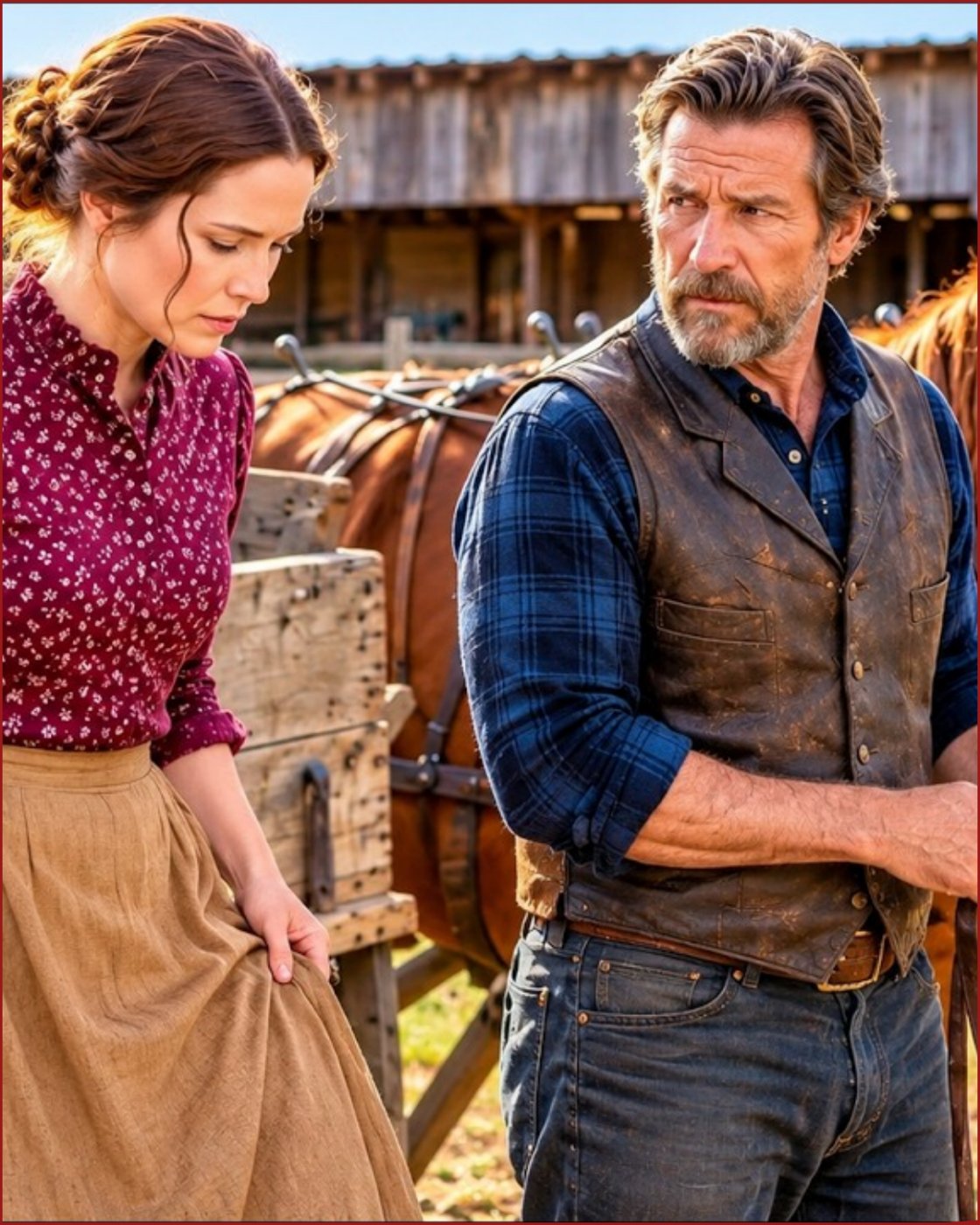
PART 3
In case you missed it: Nora Bell, the quiet postmistress of Dry Fork, Montana, helped lonely rancher Eli Mercer go through two years of bank statements and discovered that someone had been slowly stealing from him.
All three of the fake companies draining his account used the same address: Box 77 in her own post office, rented by Dale Hutchins, the respected lawyer who had handled Eli's father's estate.
Bound by federal law, Nora couldn't name the boxholder, so she pointed the sheriff to the address and he went to find a judge.
Then Hutchins himself came to her counter, smiling, and warned her to be careful.
Nora did not let her face move.
She had stood behind that counter for nine years.
She had watched men lie about late rent checks and women pretend they weren't waiting for letters that never came.
She had learned a long time ago that the safest place to put your feelings was somewhere far down inside, where nobody could see them through the glass.
So she looked Dale Hutchins in the eye and said, "I've never talked about anyone's box in my life, Mr. Hutchins.
I don't intend to start".
That was perfectly true.
Hutchins studied her for a long moment.
He had very pale blue eyes, the kind that looked kind from across a church and cold from three feet away.
Then he smiled again and tapped the counter twice with one finger.
"Good," he said.
"That's good, Miss Bell.
You have a nice evening".
The bell over the door jingled behind him.
Nora stood perfectly still until his car pulled away from the curb.
Then she walked into the back room, sat down on the sorting stool, and found that her hands were shaking so badly she had to press them flat against her knees.
Nobody had ever threatened her before.
Nobody had ever thought she was worth threatening.
She called the sheriff's office from the phone on the back wall.
Deputy Ruiz answered.
Sheriff Larkin was still in Billings, Ruiz said, waiting on Judge Hale, who was in the middle of a trial and wouldn't sign anything until it was over.
Maybe Monday.
Maybe Tuesday.
"Is something wrong, Miss Bell?"
Nora looked at the brass boxes on the east wall.
At number 77, closed and gleaming.
"No," she said.
"Tell the sheriff I called.
Tell him Mr. Hutchins came by for his mail".
She hung up.
She locked the post office that evening at five o'clock exactly, as she had every evening for nine years.
She walked home along Main Street the way she always did, past the feed store and the Methodist church and the café with the pie case in the window.
She did not look over her shoulder.
She did not walk faster.
But when she got home, she locked her door.
And then, for the first time in her life, she checked it twice.
She slept badly that night.
She lay in her narrow bed in the little frame house at the end of Cottonwood Lane and listened to the wind, and thought about Eli Mercer.
She thought about how he'd looked at her over the counter that afternoon.
"Did you find anything, Miss Bell?" She'd seen the hope in his face, and the effort it cost him to hide it, and she'd had to tell him to wait.
And he had simply nodded.
He hadn't argued.
He hadn't asked why.
He'd just looked at her, the way a man looks at someone whose word he has decided to take, and walked out the door.
Nobody had ever done that before either.
Taken her word as if it were enough.
She thought about the first time he'd come in.
Two years ago, in September.
A week after old Walt Mercer's funeral.
Eli had stood at her counter in a black suit that didn't fit him across the shoulders, with his hat against his chest, and said in a voice like gravel, "My daddy's mail.
I guess it comes to me now".
She had given him a stack of sympathy cards, and a feed bill, and a letter from the VA.
He had looked down at the sympathy cards for a long time.
Then he'd said, very quietly, almost to himself, "Mama used to write me every week.
When I was overseas".
And then he'd walked out.
The next Thursday, at ten past four, he had come back and asked if there was anything for him.
And the Thursday after that.
And every Thursday since, for two years.
Nora had never once had anything to give him.
Not the kind of thing he was asking for.
She lay in the dark and wondered, for the first time, what it would be like to be the person who could.
On Monday morning, Dale Hutchins came to the post office at nine o'clock and emptied Box 77.
Nora watched him do it from behind the counter.
He took out four envelopes, glanced at each one, and tucked them inside his coat.
Then he walked up to the counter and laid a small white card on it.
"I'll be closing this box at the end of the month, Miss Bell," he said pleasantly.
"Moving my business to Billings.
You can forward anything that comes in to this address".
Nora picked up the card.
A post office box in Billings.
A city of a hundred thousand people, where nobody knew anybody.
"Of course, Mr. Hutchins".
"You've been very helpful over the years," Hutchins said.
He smiled.
"I'll be sure to remember it".
The moment he was gone, Nora picked up the phone and called the sheriff's office again.
This time Tom Larkin answered.
"He's moving his box," Nora said.
"To Billings.
He's closing it at the end of the month".
The sheriff was quiet for a moment.
"Judge Hale signed the warrant twenty minutes ago," he said.
"I'm driving back now.
Nora.
Don't let on.
Don't change anything.
Just keep sorting the mail".
"I'm good at that," said Nora.
On Tuesday, the sheriff and two deputies walked into the First Bank of Dry Fork at ten in the morning with a signed warrant for every account connected to Dale Hutchins and the three companies with the same mailing address.
On Wednesday, they took the warrant to the post office.
Nora unlocked the records cabinet in the back room with her own key and handed Sheriff Larkin the rental card for Box 77, with Dale Hutchins's signature on it, dated four years earlier.
She did it with her hands perfectly steady, because now the law said she could.
On Thursday, at eight in the morning, just as the first flakes of the season's first real storm began to fall, Sheriff Tom Larkin knocked on the door of Dale Hutchins's big brick house on Second Street and arrested him in his bathrobe.
Nora heard about it at nine, from Mrs. Abernathy, who had heard it from her sister, who lived across the street and had watched the whole thing through her front window with her coffee going cold.
By noon, the sky had turned the color of a dirty nickel.
By two, the road out of town had vanished under white.
The wind came howling down off the Crazy Mountains and threw snow against the post office windows in long hissing sheets.
The streetlights came on at three in the afternoon.
Nobody came in for their mail.
Nora sat behind her counter alone, listening to the wind, and watching the clock.
Ten past four came and went.
The door did not open.
Of course it didn't, Nora told herself.
Nobody in their right mind would drive into town in this.
Eli Mercer had twelve hundred acres and four hundred head of cattle to look after in a storm.
He would be out in it right now, breaking ice on the stock tanks and pushing hay to the calves.
He had better things to do than drive nine miles through a blizzard to ask for a letter that wasn't there.
At half past four, she began to lock up early.
She had just turned the key in the front door when headlights swung across the window.
A pickup truck rolled to the curb, its hood caked with snow like frosting on a cake.
The engine died.
The door opened, and Eli Mercer climbed out into the storm with his hat pulled low and his collar up.
He came up the steps and stood in front of her in the blowing snow.
"Sheriff's got Hutchins in custody," he said.
His voice cracked on the last word.
"They found the accounts.
Forty-one thousand dollars, Miss Bell.
Over two years".
He shook his head slowly, as though he still couldn't make the number fit inside it.
"Another year of it, and I'd have lost the north pasture by spring.
My granddaddy cleared that pasture with a team of mules.
I'd have lost it and never even known why".
"I'm glad it's over," Nora said.
"It ain't over".
He took a step closer.
The wind tore at his coat.
"Tom Larkin told me what you did.
All of it.
How you sat up every night going through my papers.
How you walked to his office in the dark.
How Hutchins came in here and threatened you".
His jaw was tight.
"He threatened you, Miss Bell, and you never said one word to me about it".
"The sheriff asked me not to".
"I know".
He looked at her through the snow for a long moment.
"That's the other thing he told me.
That you kept your word, even when it would've been easier not to".
Neither of them spoke.
The snow whirled between them.
"You've got a mile and a half of drifted road between you and that little house of yours," Eli said at last.
"I won't have you walking it.
Let me drive you".
She should have said no.
She had walked home from this post office in every kind of weather for nine years.
Instead, she heard herself say, "All right".
The drive took forty minutes.
The plow hadn't come.
The wipers fought a losing war with the snow, and the headlights showed nothing but white, swirling and endless.
Twice the truck slid sideways toward the ditch, and twice Eli caught it with one quiet, steady hand on the wheel, without saying a word, as though it were the most natural thing in the world.
Neither of them talked much.
But the silence in the cab of that truck didn't feel the way silence usually felt to Nora.
It didn't feel like emptiness.
It felt like two people breathing the same warm air, both of them knowing the other one was there.
When they finally reached her house, the porch light was out and the front walk had disappeared under three feet of drift.
Eli killed the engine and sat staring through the windshield at the storm.
"It's worse," he said.
"I can't make it back to the ranch tonight.
Not in this".
He glanced at her, uncertain.
"I can sleep in the truck.
I've got a blanket".
"You will do no such thing," said Nora.
"I have a couch.
And I have soup".
He sat at her small kitchen table that night with his hat on his knee and his boots dripping on her linoleum, while the wind shook the windows and the snow piled up against the glass.
She made potato soup, because that was what she had, and cornbread, because she always made cornbread when she was nervous.
She set the table with her mother's old blue bowls.
And while the soup heated, she watched him look slowly around her kitchen.
At the faded yellow curtains she'd sewn herself fifteen years ago.
At the shelf of paperbacks by the window, mostly mysteries.
At the drying rack by the sink, where a single coffee mug sat upside down, all by itself.
He didn't say anything.
But his eyes stayed on that one mug for a long time.
And Nora knew exactly what he was seeing.
His own kitchen.
One plate.
One fork.
One chair pulled out from the table.
She ladled out the soup and sat down across from him.
They ate for a while without talking.
Then Eli set down his spoon.
"Why'd you do it?" he asked.
"All that work.
Sitting up every night.
Walking to the sheriff in the dark.
Getting yourself threatened.
For a man you barely know".
Nora stirred her soup.
"Because you came in every Thursday for two years," she said quietly, "asking for a letter that wasn't coming.
And every Thursday, I checked your box, hoping I'd find one for you.
I never did".
She looked down at her bowl.
"So when you finally asked me for something I could actually do, I wanted to do it right".
He was quiet for so long that she thought she had said too much.
Then he spoke.
"My mother wrote me every single week when I was in the army," he said.
"Four years.
Long, rambling letters about nothing.
The weather.
The price of hay.
What the dog did.
We had an old blue heeler named Rowdy, and she wrote about him like he was a person.
Rowdy got into the henhouse again.
Rowdy is sulking because your father yelled at him".
He smiled a little, looking down at the table.
"I carried those letters in my duffel bag all over the world.
I read them so many times the paper went soft as cloth".
"She sounds wonderful".
"She was".
He turned his spoon over in his fingers.
"She passed the year after I came home.
And my daddy.
.
".
He stopped.
"My daddy never wrote a letter in his life.
Never learned how, not really.
He could sign his name and read a feed bill, and that was about it.
He was ashamed of it.
That's why he had Hutchins handle everything, after Mama died.
And that's why he never once wrote to me, all those years.
Not one word".
Eli shook his head.
"Then he passed too.
And after that, the mailbox just went quiet".
The wind howled outside.
The clock on the wall ticked.
"I kept going to the post office every Thursday," Eli said, "because it was the day Mama's letters used to come.
I knew there'd be nothing.
I knew it every single time.
But I kept going, because it was the only place in this whole county where somebody said my name like they were glad to see me".