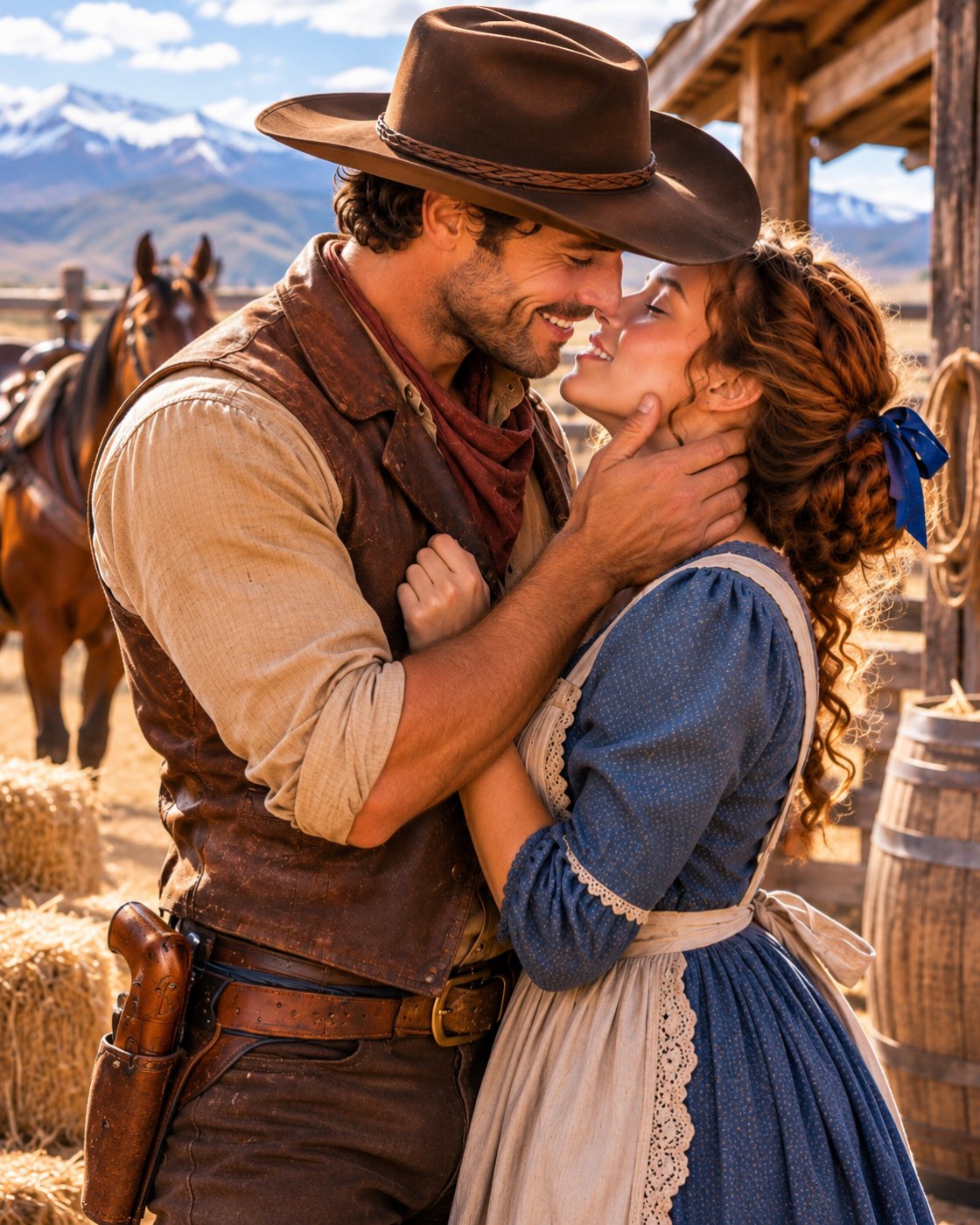
PART 3
In case you missed it: Lonely Wyoming rancher Caleb Hart sent for a mail-order bride named Margaret Ellis.
But the woman who stepped off the train was her twenty-one-year-old sister, Clara.
Margaret had died after their cruel stepfather tried to hand Clara over to Victor Hale, a rich Cincinnati man, to pay a gambling debt.
Caleb gave Clara a safe home with no strings attached, and he quietly fell in love with her.
Then word came that Hale's man was in town offering a hundred dollars for her.
Clara packed her bag and started walking down the road, alone.
Caleb watched her go for exactly five steps.
She walked fast, with her back very straight and the carpet bag clutched in both arms against her chest.
Her copper hair had come loose from its pins again, and the wind off the prairie was pulling it out behind her like a flag.
She didn't look back.
He could tell from the set of her shoulders that she knew if she looked back even once, she wouldn't be able to keep walking.
On the sixth step, he went after her.
He didn't run.
He didn't grab her.
He just walked up beside her on the road and matched her pace, and they went along together like that for twenty yards, past the corral, past the old cottonwood, toward the ranch gate.
Neither of them said a word.
At the gate, she stopped.
"You're following me," she said, without looking at him.
"I'm walking you to the road," said Caleb.
"It's a long way to California.
Somebody ought to see you start properly".
She made a small sound that might have been a laugh or a sob.
Then she turned around and faced him, and he saw she was crying after all.
"Please don't make this harder, Caleb".
It was the first time she'd used his given name.
It went through him like a nail.
"Where will you go?" he asked quietly.
"Somewhere.
Anywhere.
California, maybe".
"With what money? On what horse?"
She didn't answer.
They both knew.
She had three dollars and eleven cents in the bottom of that carpet bag.
He'd seen her count it one night at the kitchen table when she thought he was asleep in the bunkhouse.
"Alone?" he said.
"Better alone than bringing him here".
Her voice shook.
"You don't know Victor Hale.
I do.
I've watched him for two years, at our kitchen table in Cincinnati, drinking Silas's whiskey and looking at me the way a man looks at a horse he's about to buy.
He doesn't lose, Caleb.
He doesn't know how.
When a dock foreman crossed him two winters ago, the man's warehouse burned to the ground with his whole season's grain in it.
When a newspaper printed something he didn't like, the editor fell down his own cellar stairs".
She pressed her hand to her mouth.
"He'll burn this place to the ground if he has to.
Your house.
Your barn.
Your mother's apple tree.
And he'll smile while he does it".
Caleb was quiet for a long moment.
The wind moved in the grass.
Down at the corral, Smoke lifted his head and whickered, as if asking what the trouble was.
Then Caleb reached out, very gently, and took the carpet bag out of her arms.
She let him.
She was too surprised to stop him.
He set it down in the dust beside the gatepost.
"Listen to me," he said quietly.
"My father had a saying.
He said a man is measured by what he protects.
He built this ranch with his own hands, and he protected it through drought and blizzards and a cattle war.
He protected my mother, and me.
And when the fever came for her, there was nothing he could do.
He sat by her bed for nine days, and he couldn't protect her from that".
Caleb looked toward the apple tree.
"A winter storm took him two years after.
He went out to bring in the stock and didn't come back.
I found him at the north fence line in March".
Clara's face crumpled.
"I couldn't protect either of them," Caleb said.
"I've spent six years alone out here believing there was nothing left in this world worth fighting for.
Nothing left to protect.
Just cattle and a gray horse and the wind".
He looked down at her.
"I was wrong".
She was crying openly now.
"You're not running anymore, Clara," he said.
"Not from this place.
And not from me".
For a long moment, she just stood there in the road with the wind in her hair, looking up at him.
Something passed between them that neither of them could name.
Neither of them tried.
Then she bent down and picked up her own carpet bag.
And she carried it back up the road, past the cottonwood and the corral, to the house.
She put it back in his mother's old room and unpacked every single thing in it.
She stayed.
From that day on, Caleb didn't let her out of his sight.
He moved his bedroll from the bunkhouse to the barn loft, where he could see the house from the open hay door.
He nailed new bolts on the house doors, top and bottom, and new shutters on the windows.
He rode the fence line every morning and evening, looking for tracks.
And he taught her to shoot.
He took down his father's old Winchester from the pegs over the fireplace, cleaned it, and oiled it.
Then he set up a row of tin cans along the top rail of the corral fence.
He showed her how to stand, how to set the stock against her shoulder, how to breathe out slowly before she squeezed.
She was terrible at it.
Her first shot went into the dirt six feet in front of the fence.
Her second went somewhere over the barn roof.
Smoke, grazing in the near pasture, threw up his head and gave her a look of deep, personal offense.
Her third shot hit the fence post, two feet below the nearest can, and the recoil sat her right down in the dirt.
She sat there in the dust with the rifle across her lap and started to laugh.
She laughed until tears ran down her cheeks.
"I'm sorry," she gasped.
"I'm sorry, Caleb, I'm hopeless.
Margaret always said I couldn't hit the side of a barn".
"You hit the post," said Caleb gravely, helping her up.
"That's a start.
Posts are a lot smaller than barns".
She laughed even harder.
But she kept trying.
Every morning after the chores, she went out to the corral fence with the Winchester, and every morning she got a little better.
By the end of the first week, she could hit two cans out of five.
By the end of the second week, four out of five.
On the last morning, she lowered the rifle after knocking down four cans in a row.
She stood looking at the empty fence rail for a long moment.
"Margaret would have been proud," she said softly.
"I'm proud," said Caleb, before he could stop himself.
Clara turned pink to the roots of her copper hair.
She looked away quickly, at the mountains.
But she was smiling.
And Caleb went back to the barn feeling as if he'd swallowed a lit lantern.
In the evenings, they sat at the kitchen table after supper.
She read to him from the shelf of worn books his mother had brought out from Missouri in 1859.
Caleb had read them all himself, years ago, but he'd forgotten how different words sounded in somebody else's voice.
And sometimes Clara brought out Margaret's letters.
Not Caleb's letters to Margaret.
Margaret's own letters, the drafts she'd written before copying them out fair.
Clara had found them in her sister's sewing basket after the funeral.
"She wrote everything twice," Clara said, smiling a little as she smoothed one out on the table.
"She said a letter to a stranger ought to be done properly.
Look.
Here she crossed out 'I am a plain woman' and wrote 'I am not a beauty, Mr. Hart, but I have been told I have a good laugh.
'" Clara's voice wavered.
"She did.
She had the best laugh in Ohio".
Caleb looked at the careful, sloping handwriting.
Then he went to the shelf and took down the bundle of letters Margaret had sent him.
He untied the ribbon.
He laid the last one, the one that had said Thursday's train, beside the others.
The handwriting was different.
Rounder.
A little younger.
A little less steady.
"I noticed," he said quietly.
"When it came.
I thought maybe she'd hurt her hand".
Clara looked at the two letters side by side.
"I copied her style as well as I could," she whispered.
"I sat up all night practicing.
I couldn't get the loops right".
"You did fine," said Caleb.
He folded both letters together and tied them up again with the ribbon, Margaret's and Clara's in the same bundle.
"I reckon she'd have wanted them kept together".
Two weeks later, a storm rolled down from the mountains.
It came at dusk, the way the bad ones do in that country.
The sky went black over the peaks.
The wind came first, flattening the grass and slamming the shutters.
Then thunder, cracking like rifle fire, and then the rain.
It came down in silver sheets so heavy you couldn't see the barn from the porch.
Caleb was in the barn loft when he heard it.
It was a terrible, long bellowing from the stalls below, over the storm.
It wasn't a sound of fear.
It was a sound of pain.
He knew it at once.
His best heifer, a red-and-white two-year-old named Daisy, had been due any day.
Something was wrong.
He was halfway across the flooded yard toward the barn when he realized Clara was right behind him.
She was soaked to the skin in her nightdress and shawl, holding a lantern high over her head.
"Go back inside!" he shouted over the wind.
"Not a chance!"
He didn't argue.
There wasn't time.
Daisy was down in her stall, in the straw, straining and bellowing.
Her eyes were rolling white.
Caleb knelt beside her and ran his hands over her belly.
His face went grim.
"Calf's turned wrong," he said.
"Coming backward, with a leg folded under.
She can't push it out like that.
She'll die trying, and the calf with her".
"Can you turn it?"
He tried.
He tried for an hour, on his knees in the straw, with his arm in up to the shoulder.
But his hands were too big.
A rancher's hands, scarred and broad as shovels.
He couldn't get them in far enough to find the folded leg.
He sat back on his heels, gasping, his arm bloody to the elbow.
"I can't," he said.
"I can't reach it".
Clara set down the lantern on a nail.
She pushed up the sleeve of her nightdress to her shoulder.
"Then tell me how," she said.
He looked at her.
At her small, quick hands.
"Clara, it's—"
"I've been reading your mother's veterinary book every night for a month," she said.