PART 3
People on the street had begun to stop.
A farmer with a flour sack over his shoulder paused at the hitching rail.
Two women with market baskets stood still on the boardwalk.
The storekeeper came out onto his step, wiping his hands on his apron, because something was happening and Genoa did not have many things happen the day before Thanksgiving.
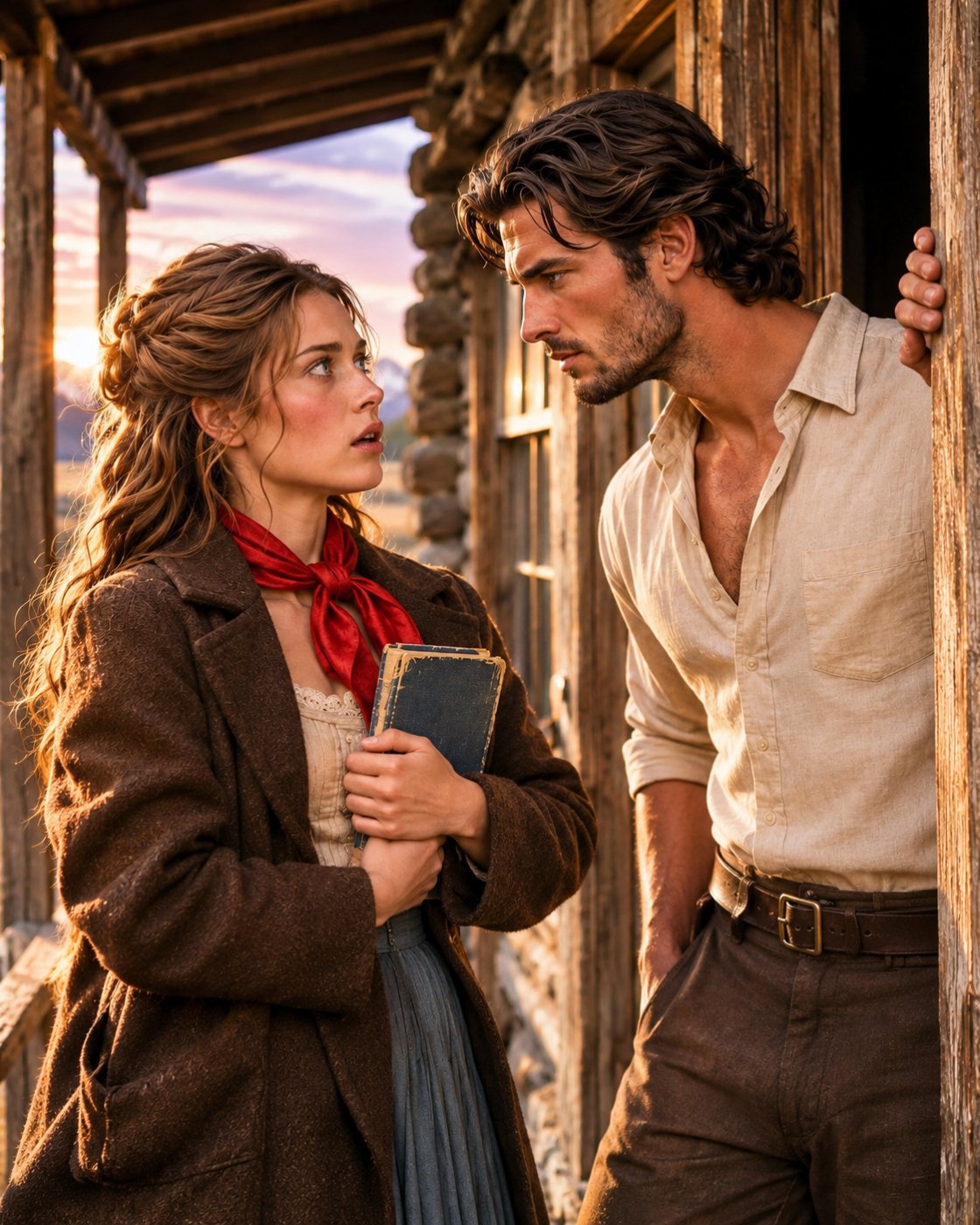
Royce Ellery saw them gathering, and Kate watched him straighten inside his black broadcloth coat like a man stepping onto a stage.
His hair was oiled flat.
A gold watch chain crossed his vest.
He was smiling, and the smile did not reach his eyes.
It never had, not once in two years.
"This woman," Royce said, raising his voice so it carried down the street, "lived under my roof for two years on my charity.
I fed her.
I clothed her.
I gave my dead brother's widow a home when no one else in Virginia City would.
And on the twentieth of this month she crept out of my house before dawn with forty dollars of my gold and my late mother's receipt book".
Kate's hands were shaking, so she folded them in front of her.
"That book was my mother's," she said.
"And that money is mine.
I earned it".
"Earned it how?" Royce asked gently, as though he pitied her.
"I baked a hundred and sixty pies after midnight, on my own time, with flour I bought myself".
Royce laughed.
He turned to the people on the boardwalk and spread his hands.
"Pies," he said.
"You hear that? The widow baked pies".
Somebody chuckled.
One of the women with the market baskets leaned toward the other and whispered behind her glove.
Kate felt every eye on that street settle on her back like a hand.
She had felt that before.
She had felt it on C Street when Royce corrected her in front of his customers, and in the kitchen when he counted the sugar, and on the night he told her a wife came cheaper than a cook.
She had told herself she would never feel it again.
Now here it was, under the open sky, three days after she had run thirty miles to get away from it.
The lean man with the star cleared his throat.
He looked like someone who would rather be anywhere else on earth.
"Mrs. Ellery," said Sheriff Ned Gilchrist, "there's a warrant sworn before Justice Strand.
I'm obliged to take you in.
And I'm obliged to take the book and the money as evidence".
"They're in my bag at the ranch," Kate said.
"Then we'll ride out for them now.
Justice Strand will hear it tomorrow morning at ten o'clock".
"Tomorrow is Thanksgiving," Gabriel said.
It was the first time he had spoken.
His voice was quiet, but the farmer at the hitching rail turned his head at it.
"Mr. Ellery has insisted," the sheriff said flatly.
"He tells me he must be back in Virginia City by Friday.
Until ten tomorrow, ma'am, I'm afraid you'll sit in the county jail".
Kate thought of the jail.
She had seen it as they drove in, a squat stone room behind the courthouse with one barred window facing the mountain.
She thought of spending Thanksgiving Eve in it while nine men on Long Meadow Ranch went to bed hungry, and something in her chest folded in on itself.
Gabriel stepped forward.
"What's her bond?"
"A hundred dollars".
Gabriel took out his wallet.
Kate saw how thin it was.
She knew, the way every ranch woman in the West knew, what a man carried in his wallet the last week of November.
It was the hay money.
It was everything standing between his cattle and a hard January, when the snow lay three feet deep in the meadows and a steer that went hungry for a week went down and did not get up.
"Gabriel, no," she whispered.
He did not look at her.
He counted the bills into the sheriff's palm one at a time, and his hands were perfectly steady.
"Hay can wait," he said.
Royce Ellery watched the money change hands.
Kate saw his eyes move from the bills to Gabriel's face and back, measuring, the way he measured a side of beef at the butcher's.
He did not say anything.
He only smiled a little wider.
They rode back to Long Meadow in a grim procession.
The sheriff went first on a rawboned gray.
Gabriel drove the buckboard with Kate beside him and the Widow Bowles's sixteen-pound turkey wrapped in a sack behind the seat.
Royce Ellery came last in a hired buggy, his collar turned up against the cold.
Nobody spoke for six miles.
Halfway there, Kate said without turning her head, "That was your hay money".
"It was a hundred dollars".
"It was your winter".
Gabriel flicked the reins.
The team leaned into the slope.
"Kate," he said, "I've had worse winters than this one will be.
I'd rather have a hard January than a night knowing you were behind that window".
She had no answer for that, so she said nothing, and the cold wind brought tears to her eyes, and she let him think it was the wind.
At the ranch, Kate went into the house alone.
The kitchen was just as she had left it that morning, warm and clean, with the starter crock on the shelf above the range and the bread dough rising under a cloth.
She stood there for a moment with her hand on the back of a chair.
Then she went into Gabriel's room, the room he had given her, and knelt beside her carpet bag.
The tobacco tin was where it always was, wrapped in a flour sack at the bottom.
She lifted it out.
It was heavy in her hands, heavier than forty dollars should be, because every coin in it was a night.
She could remember some of them.
The night the lamp ran out of oil and she rolled the crust by moonlight.
The night her wrist burned on the oven door and she finished the pies with a wet rag wrapped around it.
The night Warren's birthday came and went and she baked eight molasses pies and cried into the last one and sold it anyway.
Then she took out the little blue book.
She held it against her chest for a long time.
It smelled of flour and lamp smoke and, very faintly, of the lavender water her mother had kept on the dresser in Placerville.
Every page of it was in her mother's slanting hand.
Every receipt had its prayer.
She carried them both outside.
Sheriff Gilchrist took the tin and tied the lid down with twine.
He took a stick of red sealing wax from his saddlebag, softened it with a match, and pressed it over the knot.
Then he pushed his thumb into the wax so the whorls of it showed.
Kate gave him the book last.
Her fingers did not want to let go of it.
"I'll take care of it, ma'am," the sheriff said, more gently than she expected.
He wrapped it in oilcloth and buttoned it inside his coat.
"Nobody touches these till the justice opens them.
Not me.
Not Mr. Ellery.
Nobody".
He mounted and rode off down the lane toward Genoa.
But Royce Ellery did not go.
Gabriel had led the team toward the barn to unhitch.
Jubal had gone with him.
For a minute, no more, Kate stood alone on the porch, and Royce climbed down from the buggy and came up the steps until he was close enough that she could smell the bay rum on his collar.
He lowered his voice so that only she could hear.
"Here is how it will go, Catherine," he said softly.
"Tomorrow at ten, you will stand up in front of Justice Strand and that whole parlor and tell them you've come to your senses.
You'll say you'll marry me.
At noon he'll marry us, and I'll tell him it was all a misunderstanding in the family.
All forgiven.
We'll be home in Virginia City by Friday supper, and you'll be back at my range by Saturday breakfast".
"And if I won't?"
Royce looked toward the barn, where Gabriel was lifting the harness off the near horse.
"Then I'll swear that your rancher knew exactly what you were when he took you in.
Harboring a thief.
Receiving stolen goods.
There's a justice in that parlor tomorrow and half the valley to hear it.
He'll lose his hundred dollars, and he'll lose his good name, and a man in cattle country without his good name can't sell a steer or borrow a bale of hay".
Royce smiled.
"Think about what you've already cost him, Catherine.
Think about it tonight".
He went down the steps, climbed into the buggy, and drove away.
Kate stood on the porch until the buggy was only a black speck on the county road.
Then she went inside, and she did the only thing she had ever known how to do when the world came apart.
She cooked.
The turkey hung in the cold pantry from a hook in the beam.
A bird that has hung a day dresses easier and tastes better, her mother always said, and Kate had believed everything her mother said about cooking because her mother had never once been wrong about it.
She scalded the turkey in the washtub and plucked it with quick, hard pulls.
She drew the pin feathers with the point of a paring knife, one by one, until her fingertips ached.
Then she twisted a sheet of old newspaper into a taper, lit it at the range, and passed the bird slowly over the flame to singe off the last fine hairs, turning it the way her mother had taught her when she was so small she had to stand on a crate to see.
She had saved Monday's biscuits for the dressing.
New bread turns to paste, but old bread drinks up the broth.
She crumbled them into the big yellow bowl with onions fried soft in butter, a handful of dried sage rubbed between her palms, salt and pepper, and hot broth from the giblets, enough that it held together when she squeezed a fistful.
She did not think while she worked.
That was the mercy of it.
Her hands knew what to do, and as long as her hands were busy, her mind could stand still.
The snow began a little before dark.
It came fine and dry at first, sifting against the window like flour through cheesecloth.
Then it came thicker, until the glass she had scrubbed clean on Monday was full of white.
Gabriel came in after the lamps were lit.
He stamped the snow off his boots at the door and hung his hat on the nail beside her bonnet.
He did not sit.
He stood at the end of the long table and watched her pack the dressing into the turkey, and she felt him watching, and she did not look up.
"He spoke to you," Gabriel said.
"On the porch".
"Yes".
"What did he say?"
Kate pressed the last of the dressing into the cavity and tied the legs with twine.
"He said a great many things.
Royce always does".
"Kate".
She wiped her hands on her apron and told him.
All of it.
The hearing, the vows at noon, harboring a thief, receiving stolen goods, his good name.
She told it plainly, without crying, the way she had once told the mine superintendent what she wanted carved on Warren's stone.
When she finished, Gabriel was quiet for a long time.
Then he took off his hat, which he was not wearing, and seemed to realize it, and put his hands in his pockets instead.
"Marry me, Kate".
She went very still.
"Tonight," he said.
"Reverend Brooke lives four miles up the creek.
He'd come out in the snow if I asked him.
If you're my wife, Royce can't threaten me with anything, because whatever touches you already touches me.
You'd walk into that hearing tomorrow with a husband beside you instead of alone.
He couldn't drag you back to Virginia City.
He couldn't lay a hand on you".
The range ticked.
Out in the dark, a horse stamped in the barn.
Kate turned to the basin and washed her hands slowly, the turkey grease and the sage and the onion, until the water ran clean.
She dried them on the towel.
When she turned around, her eyes were wet, but her voice was steady.