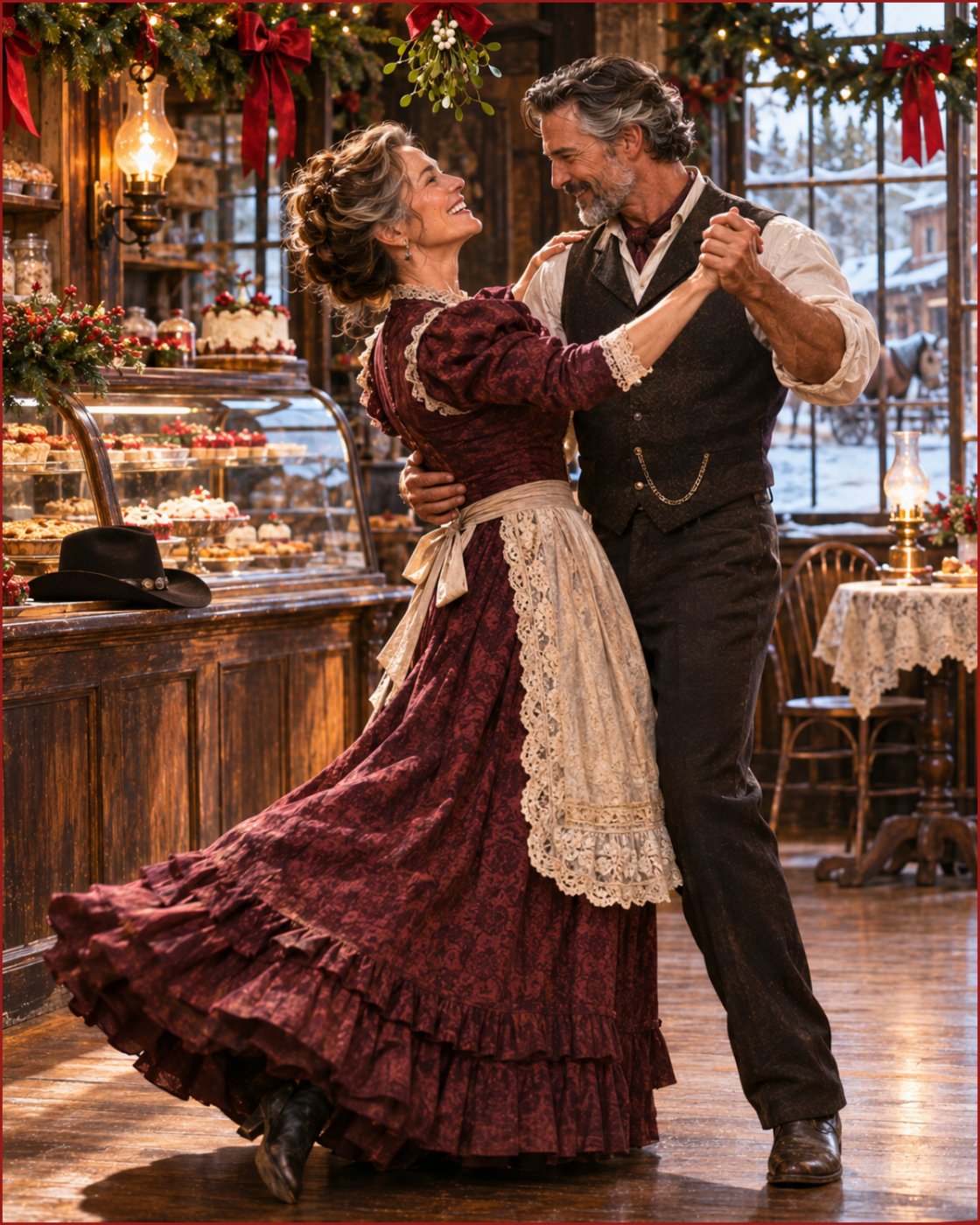
PART 3
Samuel Bennett stood beneath the falling snow, holding Dorothy Whitaker's hands between his own.
Behind them, the little bakery glowed with candlelight. Through the kitchen window, Dorothy could see her daughter Clara moving between the tables, covering the last of the Christmas pies with clean linen.
It was nearly midnight.
The streets of Willow Creek had grown quiet, and the wind carried the distant sound of church bells preparing to welcome Christmas morning.
But Samuel had just told Dorothy there was something about his past she deserved to know.
Something he'd carried alone for years.
She studied his face.
“Samuel, you're frightening me.”
He immediately shook his head.
“There's nothing dangerous, Dorothy. Nothing shameful.”
“Then what is it?”
He looked toward the darkened glasshouse.
For a moment, he seemed to be searching for the right words.
“My wife was named Eleanor.”
Dorothy nodded gently.
He had mentioned her before, though never at length.
“She died eleven years ago,” he continued. “We were married for twenty-three.”
Dorothy squeezed his hands.
“I'm sorry.”
Samuel looked down.
“She was a good woman. Better than I deserved some days.”
A faint smile touched his mouth.
“She could calm a frightened horse with nothing but her voice. Couldn't cook worth a nickel, though. Burned biscuits so badly once that our dog buried one behind the barn.”
Dorothy laughed softly.
Samuel's smile faded.
“We had a daughter.”
Dorothy grew still.
“You never told me.”
“Her name was Rose.”
The wind moved through the bare branches overhead.
Samuel swallowed.
“She was sixteen when she died.”
Dorothy felt her heart tighten.
“Oh, Samuel.”
He looked away.
“It happened on Christmas Eve.”
For several moments, neither spoke.
Then Samuel began telling her the story.
Eleven winters earlier, he'd been working on a cattle ranch near Miles City. The winter had been brutal, with snowdrifts higher than the fences and temperatures that could freeze a water bucket solid before morning.
Rose had been a lively girl who loved horses and Christmas music.
She played the piano badly but enthusiastically, laughed at her father's terrible jokes, and insisted that every Christmas tree needed at least one homemade ornament.
That Christmas Eve, she had gone with her mother to deliver blankets to an elderly neighbor.
The weather had seemed manageable when they left.
But a blizzard swept across the valley before they returned.
Their wagon overturned on an icy slope.
Eleanor survived with a broken arm.
Rose did not.
Dorothy closed her eyes.
Samuel's voice had grown very quiet.
“I found them just before dawn.”
He looked at his hands.
“I carried Rose home myself.”
A tear rolled down Dorothy's cheek.
She understood now why he sometimes grew silent when children laughed outside the bakery.
Why he'd lingered beside the little wooden toys displayed in the general store window.
Why he'd never spoken of Christmas as though it were simply a happy season.
“What happened to Eleanor?” she asked.
Samuel took a slow breath.
“She never recovered from losing Rose. Not really.”
He paused.
“We tried. We kept working. Kept eating supper together. Kept going to church.”
His eyes filled.
“But every Christmas, the house seemed to grow quieter.”
Eleven months after their daughter's death, Eleanor developed a serious illness.
By the following winter, she was gone too.
Samuel stood alone in a house filled with two women's belongings.
A piano nobody played.
A sewing basket nobody opened.
A Christmas ornament made from red ribbon and pinecones.
He couldn't bear to remain.
So he sold the ranch equipment, found work wherever horses needed tending, and spent the next decade moving from one place to another.
“I told myself I liked being alone,” he said.
Dorothy looked at him.
“Did you?”
“Sometimes.”
He smiled sadly.
“Mostly, I got good at pretending.”
She stepped closer.
“Samuel, why didn't you tell me sooner?”
He hesitated.
“Because you made Christmas feel beautiful again.”
Dorothy's eyes filled.
He continued.
“The first morning I came into your bakery, you were singing while you kneaded dough.”
She laughed through her tears.
“I was probably singing off-key.”
“Terribly.”
She gave his arm a playful tap.
He smiled.
“But you were happy. And there were children waiting for cookies, and cinnamon in the air, and a little paper angel hanging above the counter.”
He looked toward the window.
“For the first time in eleven years, Christmas didn't feel like something I had to survive.”
Dorothy could barely speak.
Samuel gently brushed a snowflake from her hair.
“I was afraid that if you knew how much sadness I carried, you'd think I was asking you to fix it.”
She shook her head.
“Oh, Samuel.”
“I don't want you to fix my grief.”
His voice softened.
“I just want to be able to tell you about Rose without feeling that I'm ruining your happiness.”
Dorothy reached up and touched his cheek.
“Then tell me about her.”
He blinked.
“What?”
“Tell me about Rose. About Eleanor. About all the Christmases you shared.”
Her voice trembled.
“I loved Thomas for twenty-six years. I wouldn't want a man who asked me to pretend he never existed.”
Samuel stared at her.
“And I would never ask that of you.”
“Then why should I ask it of you?”
He closed his eyes.
Dorothy slipped her arms around him.
For a moment, he stood motionless.
Then he held her tightly.
Not with the desperate grip of a man seeking rescue.
But with the gratitude of someone who had finally found a safe place to set down his sorrow.
They remained together beneath the snow until Dorothy began shivering.
Samuel immediately stepped back.
“Good heavens. I've kept you outside too long.”
She laughed.
“You certainly have.”
He offered his arm.
“May I escort you inside before your daughter decides I've frozen her mother?”
Dorothy smiled.
“I believe that would be wise.”
They returned to the bakery.
Clara looked up from the counter.
“There you are! I was about to come looking for you.”
Then she noticed Dorothy's tearful eyes.
“Mama?”
Dorothy smiled.
“Everything's all right, sweetheart.”
Clara looked toward Samuel.
He nodded.
“Just having a conversation.”
Clara studied them for a moment.
Then smiled knowingly.
“Well, there's hot tea on the stove.”
Samuel removed his coat.
“That's the finest news I've heard all evening.”
They sat together at the kitchen table.
Clara poured tea while Dorothy sliced the last apple pie.
Samuel insisted he wasn't hungry.
Then ate two pieces.
Dorothy watched him with amusement.
“I thought you only wanted one.”
He looked at the second slice.
“I'm helping you avoid leftovers.”
Clara burst out laughing.
Dorothy shook her head.
“You're a terrible liar, Mr. Bennett.”
“Only where pie is concerned.”
The three talked until the church bells rang midnight.
For the first time in twenty years, Dorothy welcomed Christmas morning with someone sitting across from her.
Not merely someone she had fed.
Not a customer passing through.
But a man who wanted to remain.
When Samuel finally stood to leave, Dorothy accompanied him to the door.
“Will you come back in the morning?” she asked.
He smiled.
“I was planning on it.”
“Good.”
He hesitated.
“Dorothy?”
“Yes?”
He looked at her with the same gentle expression he'd worn beneath the Christmas tree.
“About that kiss I asked for earlier…”
Her cheeks warmed.
Samuel immediately added, “There's no hurry.”
She smiled.
“I know.”
He tipped his hat.
“Then I'll wish you a merry Christmas.”
“Merry Christmas, Samuel.”
He stepped outside.
Dorothy watched him walk toward his horse.
Then she called after him.
“Samuel!”
He turned.
“Yes, ma'am?”
She smiled.
“You'd better not forget to come back.”
He laughed.
“Wouldn't dream of it.”
And as he rode away beneath the stars, Dorothy realized she was smiling so broadly that her cheeks hurt.
Behind her, Clara cleared her throat.
“Mama?”
Dorothy turned.
“Yes?”
Her daughter was grinning.
“I think you like that cowboy.”
Dorothy tried to look offended.
“Clara Whitaker, you're behaving like a schoolgirl.”
Clara laughed.
“And you're blushing like one.”
Dorothy covered her face.
“Oh, mercy.”
Clara stepped forward and hugged her.
“Mama, I'm so happy for you.”
Dorothy held her daughter tightly.
But when they separated, a shadow crossed her face.
“Do you really think it's all right?”
Clara frowned.
“What do you mean?”
“To love someone again.”
Her daughter stared at her.
Then gently took both her hands.
“Mama, Father died twenty years ago.”
Dorothy nodded.
“I know.”
“And you've spent every Christmas since making sure everyone else had something beautiful.”
Clara's eyes filled.
“You sent us packages when you couldn't afford new shoes. You made birthday cakes for children whose mothers were sick. You stayed awake baking bread for neighbors who couldn't pay.”
Dorothy looked down.
“I was glad to do those things.”
“I know.”
Clara squeezed her hands.
“But when was the last time you let someone take care of you?”
Dorothy couldn't answer.
Clara smiled sadly.
“That's what I want for you.”
Her voice softened.
“Not someone to replace Father. Someone to make you laugh when the bakery is quiet.”
Dorothy began to cry.
Clara embraced her again.
“And if Samuel Bennett is that man, then I hope he comes back every morning for the rest of his life.”
Dorothy laughed through her tears.
“That's an awful lot of cinnamon rolls.”
“Then you'd better keep baking.”
They went upstairs together.
Dorothy's bedroom overlooked the snowy street.
Before climbing into bed, she opened Thomas's letter once more.
She read the words slowly.
Laugh again, Dorothy. Dance when there's music.
She pressed the paper against her heart.
“I'm trying, Thomas,” she whispered.
Then she placed the letter in her bedside drawer.
And for the first time in many Christmas Eves, she fell asleep looking forward to morning.
Christmas dawned beneath a clear blue sky.
The storm had passed.
Fresh snow glittered across the rooftops, and smoke rose lazily from the chimneys along Willow Creek's main street.
Dorothy woke to the smell of coffee.
For a moment, she thought she was dreaming.
Then she heard Clara singing downstairs.
She smiled.
Her daughter had always been an early riser.
Dorothy dressed in her favorite burgundy wool skirt and a cream-colored blouse with tiny pearl buttons.
She brushed her silver-brown hair and pinned it neatly at the back of her head.
Then she paused before the mirror.
For twenty years, she'd dressed for practicality.
Aprons.
Work dresses.
Sturdy boots.
She had rarely considered whether she looked pretty.
Now she leaned closer.
There were lines around her eyes.
A few silver strands at her temples.
And the unmistakable softness of a woman who had lived nearly sixty years.
She studied her reflection.
Then smiled.
“Not so terrible,” she murmured.
Downstairs, Clara was arranging oranges beside a small bowl of peppermint candies.
“Merry Christmas, Mama!”
Dorothy kissed her cheek.
“Merry Christmas, darling.”
“Coffee?”
“Please.”
Clara handed her a cup.
Then glanced toward the front window.
“Your gentleman caller is late.”
Dorothy nearly spilled her coffee.
“Clara!”
“What? It's nearly eight.”
“He has horses to care for.”
Clara grinned.
“Of course.”
Dorothy tried not to look toward the door.
She failed.
Every few minutes, her eyes wandered to the window.
Finally, just before nine, she heard sleigh bells.
Clara rushed to look outside.
“Oh, Mama.”
Dorothy set down her cup.
“What?”
Her daughter turned, smiling.
“You'd better come see.”
Dorothy approached the window.
Samuel Bennett stood beside a small sleigh pulled by his gentle chestnut horse.
He wore a dark green scarf and a clean brown coat.
Beside him sat a wicker basket covered with a red blanket.
And in his hands was a little bouquet of evergreen branches tied with white ribbon.
Dorothy laughed.
“Oh, that man.”
Samuel looked up.
When he saw her, he removed his hat.
Even through the window, she could see his smile.
Clara hurried to open the door.
“Good morning, Mr. Bennett.”
“Merry Christmas, Miss Clara.”
He looked past her.
“Merry Christmas, Dorothy.”
She stepped forward.
“Merry Christmas, Samuel.”
He offered the greenery.
“Not exactly roses.”
Dorothy accepted it.
“It's beautiful.”
He smiled.
“Found the branches near the creek. Thought they might look nice in your kitchen.”
“They will.”
Clara peered at the basket.
“And what's that?”
Samuel looked slightly embarrassed.
“Something for breakfast.”
Dorothy lifted the blanket.
Inside were six cinnamon rolls.
Her cinnamon rolls.
She stared.
“Samuel Bennett, did you buy my own baking and bring it back to me?”
He nodded solemnly.
“Thought you might appreciate not having to make breakfast.”
Clara burst into laughter.
Dorothy laughed so hard she had to lean against the doorframe.
“You ridiculous man.”
Samuel grinned.
“Been called worse.”
Then his expression softened.
“Actually, there's something I'd like to show you.”
Dorothy looked curious.
“What?”
He glanced toward the back of the bakery.
“The glasshouse.”
Her heart fluttered.
“Now?”
“If you don't mind.”
Clara immediately reached for her coat.
“I believe I'll go check on the church breakfast.”
Dorothy turned.
“Clara, you don't have to leave.”
Her daughter smiled.
“I know.”
Then she kissed Dorothy's cheek.
“But I think you two might enjoy a little time together.”
She hurried out before Dorothy could protest.
Samuel watched her go.
“Your daughter's a fine woman.”
Dorothy smiled.
“She is.”
He offered his arm.
“Shall we?”
She slipped her hand through it.
“Lead the way.”
They walked through the bakery kitchen and out the rear door.
The snow behind the building had been cleared into a neat path.
Dorothy noticed immediately.
“Samuel, did you shovel all this?”
He looked innocent.
“Somebody had to.”
“You were here before dawn?”
“Had a few things to finish.”
She shook her head.
“You'll wear yourself out.”
He smiled.
“Not likely.”
At the end of the path stood the little glasshouse.
Dorothy had inherited it with the bakery.
Years earlier, Thomas had built it so she could grow herbs and flowers.
After his death, she'd kept a few plants alive for a while.
Then the roof began leaking.
The wooden frame weakened.
And slowly, the glasshouse became a place where she stored empty pots and broken furniture.
She had intended to repair it every spring.
But there was always something more urgent.
A child's school fees.
A sick grandchild.
A bakery expense.
Another Christmas order.
Now she stared at it in amazement.
The broken panes had been replaced.
The wooden frame had been sanded and painted.
A little brass handle gleamed on the door.
And inside, warm light glowed through the glass.
“Samuel…”
He looked nervous.
“Before you say anything, I hope I haven't overstepped.”
She turned toward him.
“Overstepped?”
“You gave me permission to repair it. But I may have gotten a little carried away with the furnishings.”
Dorothy laughed softly.
“May I see?”
He opened the door.
Warm air touched her face.
She stepped inside.
And stopped.
The glasshouse was beautiful.
Not grand.
Not expensive.
But filled with thoughtful details.
A little round table stood near the center, covered with a white lace cloth.
Two china cups rested beside a blue teapot.
A narrow shelf held gardening books.
Along the windows stood pots of geraniums, their red and pink blossoms bright against the winter landscape.