PART 3
The Widow Who Taught a Millionaire That Love Could Never Be Bought
Clara Dawson held the deed in both hands, but the paper felt heavier than anything she had ever carried.
One hundred and sixty acres.
A creek that never ran dry.
A cabin that no one could take from her.
Everything she had prayed for during the long winter nights was suddenly hers.
And the man who had made it possible was standing on her porch, waiting for an answer she was not certain she could give.
“Did you come back because you love us,” she repeated, “or because you needed to buy your forgiveness?”
Henry Walsh removed his hat.
The cold wind moved through his dark hair.
Behind him, the three mounted men waited beside their horses, carefully avoiding Clara's eyes.
“I came back because I was wrong,” Henry said. “And because I couldn't bear the thought of you believing I'd abandoned you.”
Clara looked at the deed.
“You didn't tell me who you were.”
“No.”
“You sat at my table. You ate my children's bread. You let Tommy teach you where to stack the firewood.”
Henry lowered his eyes.
“I did.”
“And all that time, you owned more land than anyone in this valley.”
“Yes.”
Clara's voice broke.
“Why?”
Henry looked toward the small cabin.
The roof needed repairing.
The porch steps leaned to one side.
Smoke rose from the chimney in a thin, uncertain ribbon.
He remembered the first night he had entered that house.
He had been freezing.
Exhausted.
Nearly unable to stand.
But what he remembered most was not the warmth of the stove.
It was the way Clara had looked at him.
Not as a wealthy cattleman.
Not as a powerful landowner.
Not as a man whose decisions could change the lives of hundreds of families.
She had looked at him as someone who needed help.
And she had helped him.
“Because for ten years,” he said quietly, “I haven't known whether anyone cared about me or my money.”
Clara stared at him.
Henry continued.
“My mother died when I was thirty-two. She was the last person who ever asked whether I'd eaten without wanting something in return.”
His voice grew rough.
“After she was gone, every invitation came with a request. Every friendship came with a business proposal. Every woman I met knew exactly how much land I owned before she knew my favorite book.”
Clara said nothing.
“When I came to your door, I had nothing useful to offer you. No coat. No money. Not even enough strength to bring my horse into shelter.”
He looked into her eyes.
“And you opened the door anyway.”
Clara's expression softened, but only slightly.
“That doesn't explain why you kept the truth from me.”
Henry nodded.
“No. It doesn't.”
For a moment, he looked older than his forty-three years.
“I was afraid.”
“Of what?”
“That if you knew, you'd stop looking at me the same way.”
Clara swallowed.
“And now?”
“Now I know I should have trusted you with the truth.”
The lawyer stepped forward.
“Mrs. Dawson, if I might explain—”
Henry raised a hand.
“Not now, Mr. Bell.”
The lawyer stopped.
Henry looked back at Clara.
“The deed is yours regardless of what happens between us. It isn't payment for your kindness. It isn't a proposal. And it isn't something I can take back if you decide you never want to see me again.”
Clara looked down at the document.
“Why give me so much land?”
“Because my company tried to take what was already your home.”
“My husband never completed the claim.”
“Then he made a mistake in the paperwork. That doesn't make what Doyle did right.”
Henry paused.
“I've spent years believing that if something was legal, it must also be fair.”
He looked toward the creek.
“I was wrong.”
Clara pressed the deed against her chest.
For the first time since her husband's death, she possessed something that could not disappear with the next missed payment.
But she was not ready to forgive Henry.
Not yet.
“Thank you for saving our home,” she said.
He nodded.
Then she added, “I need time.”
Henry's face tightened.
“Of course.”
“I don't know whether I can trust you.”
He looked at her for a long moment.
Then he answered, “I understand.”
Clara stepped backward into the doorway.
Henry put on his hat.
“I'll leave you in peace.”
As he turned toward his horse, Lucy appeared behind her mother.
“Mr. Henry?”
He stopped immediately.
The little girl was holding a peppermint candy.
One he had brought her during his last visit.
“Are you leaving again?”
Henry knelt.
“For a little while, sweetheart.”
Lucy frowned.
“But you promised you'd come back.”
He looked toward Clara.
Then back at the child.
“I did.”
“Did you forget?”
“No.”
“Then why did you stay away?”
Henry's throat tightened.
“Because I had something important to put right.”
Lucy considered this.
Then she held out the peppermint.
“You can have this.”
Henry shook his head.
“That one's yours.”
“I know.”
She placed it in his hand.
“But you look sad.”
Henry stared at the candy.
Then he closed his fingers around it.
“Thank you, Miss Lucy.”
She smiled.
“You're welcome.”
He stood.
And as he walked toward his horse, he realized that the little girl had just done what her mother had done during the blizzard.
She had offered him something simply because she thought he needed it.
That night, Clara sat at the kitchen table long after the children had fallen asleep.
The deed lay before her.
Beside it rested the eviction notice.
Two documents.
Both bearing Henry Walsh's name.
One had threatened to destroy her family.
The other had saved it.
She traced the letters of his signature.
Then she looked toward the small Bible resting beside the lamp.
It had belonged to her mother.
Its cover was worn.
Several pages were loose.
But it had traveled with Clara from Missouri to Nebraska, through marriage, childbirth, grief, and poverty.
She opened it to the passage she had read on the night Henry arrived.
“Neither know we what to do, but our eyes are upon thee.”
She whispered the words.
Then she closed her eyes.
“Lord, I asked You for help.”
The room was silent.
“And You sent a man I don't understand.”
She lowered her head.
“I don't know whether he's good or whether I was foolish to trust him.”
A tear fell onto the table.
“But I know my children love him.”
She looked toward their bedroom.
“And I think I do, too.”
The admission frightened her.
For nearly three years, Clara had lived with the consequences of trusting the wrong man.
Her late husband, Jesse Dawson, had not always been cruel.
When she first met him in Missouri, he had been handsome, charming, and full of promises.
He spoke of owning land.
Of raising children beneath wide western skies.
Of building a home where they would never depend on anyone.
Clara had believed him.
Her father had not.
“He's a man who loves his own dreams more than he loves responsibility,” her father had warned.
Clara had married Jesse anyway.
And for the first year, she believed she had proved everyone wrong.
Then the debts began.
Jesse borrowed money for cattle he could not afford.
He gambled away wages.
He disappeared for days.
When Clara questioned him, he accused her of lacking faith in him.
When she tried to save money, he took it.
By the time Tommy was born, Clara had learned to hide small coins inside a flour tin.
By the time Lucy arrived, she had learned that promises meant little without action.
Jesse died after a fever swept through the settlement.
Clara had grieved him.
But she had also grieved the marriage she had hoped they would have.
And afterward, she had made herself a promise.
No man would ever again decide whether her children had food, shelter, or safety.
Now Henry Walsh had entered her life.
He had helped her.
He had laughed with her children.
He had carried wood, repaired the fence, and washed supper dishes without being asked.
But he had also hidden the truth.
Clara stared at the deed.
Was kindness enough?
Was love enough?
Or was she about to make the same mistake again?
Three miles away, Henry sat alone in his enormous dining room.
Twelve chairs surrounded the polished oak table.
Only one was occupied.
A servant had prepared roast beef, potatoes, fresh bread, and blackberry preserves.
Henry had barely touched any of it.
Gus Mercer, his longtime ranch foreman, entered carrying a stack of papers.
“You ought to eat, boss.”
Henry looked up.
“Not hungry.”
Gus glanced at the untouched meal.
“Funny. That widow fed you bread crusts and apple-peel tea, and you ate like a king.”
Henry smiled faintly.
Gus set down the papers.
“Every affected family on Cedar Creek has been contacted. Three claims were improperly challenged. Two others had filing errors. Bell says we can settle everything without throwing anyone off their land.”
“Good.”
“Doyle's gone.”
“Good.”
“And the company men have been told no land purchase goes through without your personal review.”
Henry nodded.
Gus studied him.
“Anything else?”
“No.”
“Then why do you look like somebody buried your favorite horse?”
Henry sighed.
“Clara doesn't trust me.”
Gus pulled out a chair.
“Can't say I blame her.”
Henry looked sharply at him.
Gus shrugged.
“You lied by omission, boss.”
“I know.”
“You let her think you were a wandering ranch hand.”
“I know.”
“And then your own company nearly put her children out in the snow.”
Henry closed his eyes.
“Gus, if you've come to cheer me up, you're doing a poor job.”
“Didn't come to cheer you up.”
Gus leaned forward.
“Came to tell you the truth.”
Henry looked at him.
“You've spent ten years being obeyed. You forgot how to be known.”
The words landed harder than Henry expected.
Gus continued.
“Everybody around here knows what Henry Walsh owns. Few know what Henry Walsh fears.”
Henry stared at the table.
“And what do I fear?”
“Being loved for the wrong reasons.”
Henry said nothing.
Gus nodded.
“Thought so.”
For a long moment, the two men sat quietly.
Then Gus asked, “What did you tell her?”
“That I loved her.”
Gus raised his eyebrows.
“You did?”
“Not in those words.”
“Then you didn't tell her.”
Henry looked up.
Gus leaned back.
“You can give a woman land, boss. You can build her a house. You can buy every cow in Nebraska.”
He paused.
“But none of that tells her whether you'll still be there when the money doesn't solve the trouble.”
Henry looked toward the window.
Snow was beginning to fall again.
He remembered Clara standing in her doorway.
The hurt in her eyes.
The way she had thanked him but refused to let him closer.
“What should I do?”
Gus smiled.
“For once?”
“Yes.”
“Nothing grand.”
Henry frowned.
“Nothing?”
“Be the man she knew before she found out you were rich.”
The following morning, Henry rode to Cedar Creek without an escort.
He wore his old work shirt.
The same one he had worn when he helped Tommy repair the woodshed.
He carried an axe, a small sack of nails, and a bundle of dry kindling.
Clara was outside gathering snow into a bucket when she saw him.
She stopped.
“Henry?”
He dismounted.
“Morning.”
She looked at the tools.
“What are you doing?”
“Your woodshed door still hangs crooked.”
“I can manage.”
“I know.”
He waited.
Then he added, “Would you mind if I fixed it anyway?”
Clara studied him.
“You don't have to work for your forgiveness.”
Henry nodded.
“I know that, too.”
“Then why are you here?”
He looked toward the broken door.
“Because it needs fixing.”
She almost smiled.
Almost.
“Tommy's in the barn.”
“May I say hello?”
Clara hesitated.
Then nodded.
Henry thanked her.
He walked toward the barn, where Tommy was struggling to lift a heavy feed sack.
“Need a hand, son?”
Tommy turned.
His face brightened.
“Mr. Henry!”
Henry smiled.
“Morning.”
Tommy ran toward him.
Then stopped.
“Are you really rich?”
Henry blinked.
“Well…”
“Mama says you own the company.”
“Yes.”
Tommy stared.
“How many cows do you have?”
Henry laughed.
“More than I can count without help.”
Tommy's eyes widened.
“More than twenty?”
“Quite a few more.”
“More than a hundred?”
“Yes.”
Tommy whistled.
Then his expression became serious.
“Why didn't you tell us?”
Henry knelt.
“Because I made a mistake.”
Tommy looked down.
“Mama says people shouldn't hide important things.”
“She's right.”
“Are you going to hide things again?”
Henry shook his head.
“I'm going to try very hard not to.”
Tommy considered that.
Then he pointed toward the woodshed.
“The door's still broken.”
Henry smiled.
“I noticed.”
“Want me to help?”
“I'd be grateful.”
Together, they carried the tools outside.
Clara watched from the kitchen window.
Henry showed Tommy how to remove the damaged hinge.
He let the boy hold the nails.
He corrected his grip on the hammer.
And when Tommy struck his thumb, Henry did not scold him.
He simply handed him a clean cloth and waited until the boy was ready to try again.
Clara felt something inside her soften.
Jesse had never been patient with Tommy.
He had called the boy clumsy.
Weak.
Too slow.
Henry treated him as though every small effort mattered.
And when the woodshed door finally swung straight, Tommy ran into the house shouting, “Mama! We fixed it!”
Clara smiled.
“I see that.”
Tommy looked toward Henry.
“He says I did most of it.”
Henry grinned.
“He did.”
Clara met Henry's eyes.
For a moment, neither spoke.
Then she said, “There's coffee on the stove.”
Henry's smile faded into something gentler.
“Would I be welcome?”
Clara stepped aside.
“For one cup.”
He removed his hat.
“One cup will do.”
The visits continued.
Not every day.
Not even every week.
Henry gave Clara space.
When he came, he asked permission before entering.
Sometimes he brought a broken tool he could repair.
Sometimes he helped Tommy chop wood.
Sometimes he sat on the porch while Lucy explained the complicated adventures of her rag doll, Peppermint.
He never brought expensive gifts.
Clara noticed.
One afternoon, she found him kneeling beside the garden fence, replacing a rotten post.
“You know,” she said, “you could hire someone to do that.”
Henry looked up.
“I could.”
“Then why don't you?”
He smiled.
“Because I like being here.”
Clara folded her arms.
“You could simply visit.”
“I could.”
“Without pretending the fence is falling down.”
Henry glanced at the sturdy rails.
“Reckon you caught me.”
She laughed.
The sound surprised both of them.
Henry stood slowly.
It had been weeks since he had heard her laugh without sadness beneath it.
Clara looked away, embarrassed.
“I'm sorry.”
“For what?”
“Laughing at you.”
Henry smiled.
“Clara, I'd let you laugh at me every day if it meant hearing that sound again.”
Her cheeks warmed.
She turned toward the house.
“Coffee?”
He followed.
“Gladly.”
Inside, Lucy was sitting at the table practicing letters.
She looked up.
“Mr. Henry!”
“Miss Lucy.”
“Can you spell peppermint?”
Henry sat beside her.
“I believe I can.”
She pushed the paper toward him.
“Then show me.”
He wrote the word slowly.
Lucy studied it.
“That's a lot of letters.”
“It is.”
She frowned.
“Why does a candy need so many?”
Henry laughed.
“That's an excellent question.”
Clara watched them.
The kitchen was still small.
The furniture was still worn.
The stove still smoked when the wind came from the north.
But something had changed.
The room no longer felt like a place where three people were simply trying to survive.
It felt alive.
One Sunday, Henry invited Clara and the children to church.
She hesitated.
“People will talk.”
Henry smiled.
“They already do.”
“That doesn't make it easier.”
“No.”
He looked at her.
“But I won't hide my friendship with you.”
Clara studied his face.
Then she nodded.
“All right.”
The following morning, Henry arrived in a modest wagon.
Tommy climbed into the back beside Lucy.
Clara wore her best blue dress.
It was faded at the elbows, but carefully pressed.
Henry helped her onto the seat.
“You look beautiful.”
She lowered her eyes.
“It's an old dress.”
“I wasn't talking about the dress.”
Clara looked at him.
Then she smiled.
At church, the whispers began almost immediately.
Some people recognized Henry.
Others recognized Clara.
Several women stared openly as the wealthy cattleman escorted the poor widow through the doors.
Mrs. Pruitt, whose husband owned the general store, approached them.
“Mr. Walsh,” she said brightly. “How lovely to see you.”
Henry nodded.
“Mrs. Pruitt.”
Her eyes moved toward Clara.
“And Mrs. Dawson.”
Clara smiled politely.
“Good morning.”
Mrs. Pruitt looked at Henry again.
“We've heard you've been spending quite a bit of time at Cedar Creek.”
Henry's expression remained calm.
“Yes.”
She waited.
He said nothing more.
Finally, she smiled stiffly.
“Well. How interesting.”
After she walked away, Clara whispered, “You didn't have to embarrass her.”
Henry leaned closer.
“I didn't.”
“You know what she meant.”
“Yes.”
“And?”
He looked at her.
“I won't apologize for being seen with a good woman.”
Clara's throat tightened.
During the service, Tommy sat beside Henry.
Lucy fell asleep against Clara's shoulder.
When the minister asked the congregation to pray for those facing hardship, Henry bowed his head.
For years, he had avoided prayer.
Not because he hated God.
But because grief had made silence easier.
His mother had been a woman of deep faith.
She had taught him to pray before meals.
To help strangers.
To remember that wealth was a responsibility, not proof of virtue.
After she died, Henry had stopped opening her Bible.
He had continued building his company.
Buying land.
Expanding herds.
Making decisions.
But somewhere along the way, he had forgotten why his mother believed a man should work hard in the first place.
Now he sat beside Clara Dawson.
A woman who had almost nothing.
And he heard her whisper the same words she had spoken during the blizzard.
“Lord, our eyes are upon You.”
Henry closed his eyes.
For the first time in years, he prayed.
Not for profit.
Not for success.
Not for more land.
He prayed for the courage to become a man worthy of the people sitting beside him.
Spring came late.
The snow retreated from the creek banks.
The cottonwood trees began showing green.
Clara planted beans behind the cabin.
Tommy repaired the chicken coop.
Lucy insisted on growing flowers beside the front steps.
Henry visited whenever he could.
Sometimes he arrived with business papers tucked beneath his arm.
Sometimes he came straight from the cattle range, dusty and tired.
But he always stopped at the gate and waited for Clara to welcome him.
One afternoon, she found him standing beside the creek.
He was staring at the water.
“What are you thinking about?”
He turned.
“Your husband.”
Clara stiffened.
“Jesse?”
Henry nodded.
“I've been wondering what he was like.”
She looked toward the current.
For a long moment, she said nothing.
Then she answered, “He was charming when I met him.”
Henry waited.
“He could make anyone laugh. He spoke about the future as though it were already waiting for us.”
She smiled sadly.
“I believed every word.”
Henry said nothing.
“Then the debts came. And the anger.”
She looked down.
“I spent years trying to become the woman who could make him happy.”
Henry's expression tightened.
“Clara…”
“I thought if I worked harder, saved more, complained less…”
Her voice broke.
“Maybe he'd become the man I married.”
Henry stepped closer.
“Did he ever hurt you?”
She looked away.
“Not always with his hands.”
Henry's jaw tightened.
Clara continued.
“He made me feel foolish for wanting ordinary things. A warm house. Food for the children. A husband who came home when he said he would.”
She looked at Henry.
“And after he died, I told myself I'd never depend on another man again.”
Henry nodded slowly.
“I understand.”
“Do you?”
“I think I'm beginning to.”
She looked toward the creek.
“Then you must understand why your secret frightened me.”
He swallowed.
“Yes.”
“I couldn't bear the thought of trusting someone who might decide my life for me.”
Henry stepped closer.
“I don't want to decide your life.”
“Then what do you want?”
He looked into her eyes.
“You.”
Clara stopped breathing for a moment.
Henry continued.
“Not because you need help. Not because your children need someone to chop wood.”
He smiled faintly.
“Though I do enjoy that.”
Clara laughed softly.
He reached for her hand but stopped before touching it.
“I want to know what makes you happy. I want to hear what you think about the world. I want to sit beside you when you're tired and listen when you're afraid.”
His voice grew rough.
“And I want you to know that if you tell me no, I will still respect you.”
Clara's eyes filled.
“Henry…”
He waited.
She stepped closer.
Then she placed her hand in his.
For a long moment, they stood beside the creek without speaking.
Finally, Clara whispered, “I'm still afraid.”
Henry nodded.
“So am I.”
She looked up.
“You?”
He smiled sadly.
“More than you know.”
“Of what?”
“That you'll see all the things I've done wrong and decide I'm not worth loving.”
Clara studied him.
Then she squeezed his hand.
“Perhaps love isn't about finding someone who has never made a mistake.”
Henry looked at her.
“Perhaps it's about finding someone willing to make things right.”
He smiled.
“Then I hope you'll give me the chance.”
Clara rested her head briefly against his shoulder.
“I think I already have.”
But the trouble with Frank Doyle was not finished.
The former company manager had lost his position, his salary, and the influence he had spent years building.
He blamed Henry.
And he blamed Clara.
One evening, Doyle arrived at the general store in Cedar Creek and began spreading rumors.
He claimed Clara had manipulated Henry into giving her valuable land.
He suggested the widow had deliberately welcomed the wealthy cattleman into her home to secure his fortune.
By the following Sunday, half the town had heard some version of the story.
Clara discovered it when Mrs. Pruitt refused to sell her flour on credit.
“I don't believe that will be necessary anymore,” the woman said.
Clara frowned.
“What do you mean?”
Mrs. Pruitt smiled thinly.
“With Mr. Walsh paying your expenses.”
Clara went still.
“He doesn't pay my expenses.”
“Of course.”
The woman's tone said otherwise.
Clara placed her coins on the counter.
“I'll pay in full.”
Mrs. Pruitt counted them.
Then she leaned closer.
“Some women are fortunate enough to attract a wealthy gentleman's attention.”
Clara felt heat rise in her face.
“Mrs. Pruitt, I work for what I have.”
“I'm sure you do.”
Clara gathered her flour.
Then she looked directly at the woman.
“I won't apologize for accepting a friendship I didn't seek for money.”
She turned and walked out.
But the humiliation followed her home.
That evening, when Henry arrived, Clara was unusually quiet.
He noticed immediately.
“What's wrong?”
“Nothing.”
He sat beside her.
“Clara.”
She looked at him.
“People are talking.”
Henry sighed.
“About us?”
“Yes.”
“What are they saying?”
She hesitated.
Then told him.
Henry's expression darkened.
“Doyle.”
Clara nodded.
“I think so.”
Henry stood.
“I'll speak to him.”
“No.”
He stopped.
“Clara—”
“No, Henry.”
She rose.
“I don't want you riding into town and frightening people into silence.”
His jaw tightened.
“They have no right to speak about you that way.”
“I know.”
“Then let me—”
She shook her head.
“That's exactly what frightens me.”
Henry went still.
Clara continued.
“You can make people obey you. You can dismiss a manager. You can buy land and settle debts.”
She looked at him.
“But you can't make people respect me.”
Henry slowly sat down.
She softened.
“I have to live in this town, Henry. My children have to grow up here.”
He looked at her.
“What would you have me do?”
“Stand beside me.”
He nodded.
“Always.”
“And let me speak for myself.”
Henry reached for her hand.
“I will.”
The following week, Cedar Creek held its spring gathering beside the church.
Families brought pies, bread, preserves, and baskets of food.
Children played beneath the cottonwoods.
Men discussed cattle prices and the coming planting season.
Clara attended with Tommy and Lucy.
Henry arrived separately.
For a while, everything seemed peaceful.
Then Frank Doyle approached Clara near the refreshment table.
“Well, Mrs. Dawson.”
She turned.
“Mr. Doyle.”
He smiled unpleasantly.
“I hear you've done rather well for yourself.”
Clara said nothing.
“One hundred and sixty acres. A creek. A wealthy gentleman visiting your home.”
Several people nearby fell silent.
Doyle continued.
“Remarkable what a woman can acquire with a little kindness.”
Clara felt her cheeks burn.
Then she looked directly at him.
“Are you suggesting I stole something?”
Doyle smiled.
“Not at all.”
“Then say what you mean.”
The gathering grew quiet.
Doyle's smile faded.
“I merely wonder whether Mr. Walsh would have been so generous if you'd been an old man instead of a pretty widow.”
Clara's hands trembled.
But she did not look away.
“Mr. Doyle, when Henry Walsh came to my door, I didn't know his name.”
Doyle shrugged.
“So you say.”
“He was freezing.”
Several people turned toward her.
“He had no coat. No money. His horse was exhausted. My children and I had barely enough food to survive.”
Her voice grew stronger.
“I opened the door because he needed help.”
Doyle laughed.
“And now you're a landowner.”
Clara stepped closer.
“The land was given to me because your company tried to take my home through dishonest dealings.”
Doyle's expression hardened.
“You should be careful what you accuse people of.”
Clara lifted her chin.
“I have the papers.”
A murmur moved through the crowd.
Henry appeared beside the gathering.
He had heard enough to understand what was happening.
But he remembered Clara's request.
Stand beside me.
Let me speak for myself.
So he did.
Clara continued.
“You tried to put my children out in the snow because you believed I was too poor to defend them.”
Doyle opened his mouth.
She raised her hand.
“No.”
He stopped.
“You don't get to shame me for surviving what you tried to do.”
The crowd fell silent.
Clara's voice trembled, but she continued.
“I washed clothes. I scrubbed floors. I mended coats. I went hungry so my children could eat.”
She looked around.
“I have nothing to be ashamed of.”
Mrs. Pruitt lowered her eyes.
Several women nodded.
Clara looked back at Doyle.
“And I will not let you turn one man's kindness into something dirty simply because you cannot understand why someone would help without expecting payment.”
Doyle's face flushed.
Henry stepped forward.
“Mrs. Dawson has spoken the truth.”
He looked at the gathering.
“Mr. Doyle was dismissed because he abused his authority and attempted to dispossess families who lacked the money to fight him.”
Doyle stared.
Henry continued.
“The records are available at the county office.”
Then he looked at Clara.
“And this woman owes me nothing.”
For a moment, nobody moved.
Then an elderly farmer stepped forward.
“My family nearly lost our claim, too.”
Another man nodded.
“Mine as well.”
A woman approached Clara.
“I'm sorry, Mrs. Dawson.”
Clara looked at her.
The woman swallowed.
“I believed what people were saying.”
Clara nodded.
“Thank you.”
Henry stood quietly beside her.
He did not take her hand until she reached for his.
When she did, he held it gently.
And for the first time, Clara understood that he was learning to love her in the way she needed.
Not by taking control.
But by refusing to leave her standing alone.
That summer, Henry began spending more evenings at Cedar Creek.
He often stayed for supper.
Sometimes Clara made beans and cornbread.
Sometimes Henry brought fresh vegetables from the ranch garden.
Sometimes Tommy caught fish in the creek, and they cooked them over the fire.
Lucy insisted Henry tell stories.
He was not particularly good at them.
He tended to forget details.
He confused characters.
And he occasionally fell asleep before reaching the ending.
Lucy loved them anyway.
One evening, after the children had gone to bed, Clara and Henry sat on the porch.
Fireflies moved above the grass.
The air smelled of warm earth and cottonwood leaves.
Henry looked toward the creek.
“I've been thinking.”
Clara smiled.
“That sounds dangerous.”
He laughed.
“Probably is.”
She waited.
He took a slow breath.
“Would you come see my house?”
Clara looked at him.
“Your house?”
“Yes.”
“Why?”
Henry hesitated.
“Because I'd like you to know the rest of my life.”
She studied his face.
Then nodded.
“All right.”
The following Sunday, Henry brought a wagon to Cedar Creek.
Tommy and Lucy climbed into the back.
Clara sat beside Henry.
They traveled across rolling pastureland, past cattle herds and long wooden fences.
At last, a large white house appeared on a hill.
Clara stared.
It was bigger than any home she had ever entered.
Wide porches surrounded it.
Tall windows reflected the afternoon sunlight.
A broad staircase led to the front door.
Lucy gasped.
“Mr. Henry, is that a hotel?”
Henry laughed.
“No, sweetheart.”
“Then who lives there?”
He smiled sadly.
“Mostly me.”
Inside, Clara found polished floors, expensive furniture, and rooms large enough to hold several families.
But the house was strangely silent.
No children's laughter.
No hurried footsteps.
No smell of supper cooking.
Only the soft ticking of a clock.
Henry led them into the dining room.
Twelve chairs surrounded the table.
Clara looked at them.
“Do you entertain often?”
He shook his head.
“Not anymore.”
“Then why so many chairs?”
Henry looked away.
“My mother liked having people around.”
Clara nodded.
“She sounds like a good woman.”
“She was.”
He led them into the sitting room.
A framed photograph stood on the mantel.
A gentle-looking woman smiled from behind the glass.
Henry picked it up.
“My mother.”
Clara stepped closer.
“She has kind eyes.”
Henry smiled.
“She did.”
For a moment, he seemed lost in memory.
Then he said, “She used to tell me that a house wasn't measured by its rooms.”
Clara looked at him.
“What was it measured by?”
He smiled sadly.
“How many people felt welcome inside.”
Clara looked around the enormous room.
Then she understood.
Henry had spent ten years building a house that impressed everyone.
But he had forgotten how to make it welcoming.
Lucy tugged his sleeve.
“Mr. Henry?”
“Yes?”
“Can we eat in the kitchen?”
He laughed.
“Why?”
“Because kitchens are nicer.”
Henry looked at Clara.
She smiled.
“I believe she's right.”
That afternoon, they ate sandwiches at a small kitchen table while the enormous dining room remained empty.
Henry laughed more than he had in years.
Tommy told stories about the creek.
Lucy spilled lemonade on the floor.
Clara helped wipe it up.
And when the children ran outside to see the horses, Henry looked at her.
“This is the first time the house has felt alive since my mother died.”
Clara's eyes softened.
“Then perhaps it needed visitors.”
Henry shook his head.
“Perhaps it needed you.”
Autumn brought cooler nights.
The cattle were moved to winter pasture.
The hay barns filled.
Clara harvested the last vegetables from her garden.
And Henry began to realize that he could no longer imagine his future without her.
One evening, he arrived carrying a small wooden box.
Clara was kneading bread.
“What's that?”
He set it on the table.
“Something for you.”
She looked suspicious.
“Henry…”
He smiled.
“Open it.”
Inside was a small, carefully carved wooden frame.
Clara lifted it.
There was no expensive jewelry.
No gold.
No silver.
Only a photograph of her children taken at the spring gathering.
Tommy stood proudly beside Lucy.
Both were smiling.
Clara's eyes filled.
“Where did you get this?”
“Gus knew the photographer.”
She traced the edge of the frame.
“It's beautiful.”
Henry smiled.
“I thought you might like something for the mantel.”
Clara looked at him.
“You remembered.”
“Of course.”
She stepped closer.
Then kissed his cheek.
Henry froze.
Clara laughed softly.
“Have I frightened you?”
He shook his head.
“Only a little.”
She smiled.
“Good.”
He reached for her hand.
“Clara.”
“Yes?”
“There's something I've wanted to ask you.”
Her heart began beating faster.
Henry looked toward the photograph.
Then back at her.
“I don't want to offer you a house.”
Clara smiled.
“That's wise.”
“And I don't want to offer you land.”
“Also wise.”
He took a breath.
“I want to offer you my life.”
Clara went still.
Henry continued.
“I love you.”
Her eyes filled.
“I love the way you laugh when Lucy says something ridiculous. I love the way you listen to Tommy when he talks about horses.”
His voice grew rough.
“I love that you tell me when I'm wrong.”
Clara laughed through tears.
“That happens often.”
“More often than I'd like.”
He smiled.
“And I love that you never let me forget that being a good man matters more than being a wealthy one.”
He reached into his pocket.
Then paused.
“I had a ring made.”
Clara's breath caught.
“But before I show it to you, I need to ask something.”
She nodded.
“Do you want to marry me?”
For a moment, she could not speak.
Henry continued.
“Not because your children need a father. Not because I can give you comfort.”
He stepped closer.
“Because you want to spend your life with me.”
Clara looked at him.
Then toward the little cabin.
The same cabin where she had prayed through hungry nights.
The same cabin where she had feared losing everything.
The same cabin where a freezing stranger had arrived and changed her life.
She thought of Jesse.
Of the promises he had broken.
Of the years she had spent believing that love meant surrendering herself.
Then she looked at Henry.
He was waiting.
Not demanding.
Not bargaining.
Simply waiting.
And she knew her answer.
“Yes.”
Henry stared.
Clara smiled through tears.
“Yes, Henry Walsh. I want to marry you.”
He laughed.
Then he drew her gently into his arms.
For a long moment, they held each other.
When he finally stepped back, he opened a small velvet box.
Inside was a simple gold ring.
Clara looked at it.
“It's beautiful.”
Henry smiled.
“My mother wore it.”
Her eyes filled.
“Henry…”
“She told me once that if I ever found a woman who made me want to become better, I should give it to her.”
Clara began crying.
He slipped the ring onto her finger.
Then kissed her gently.
Outside, the autumn wind moved through the cottonwood trees.
And inside the little cabin, two people who had believed their happiest years were behind them discovered that life could begin again.
They were married the following spring.
The ceremony took place beside Cedar Creek.
Clara insisted on keeping the wedding simple.
Henry agreed.
Tommy stood beside him.
Lucy carried a basket of wildflowers.
Gus served as witness.
Mrs. Pruitt brought a cake and apologized once more for the way she had treated Clara.
Several families from the valley attended.
Some had received corrected deeds.
Others had been compensated for the company's earlier wrongdoing.
Henry had spent months making sure that the mistakes committed under his authority were repaired.
He knew that one good deed could not erase years of carelessness.
But he had begun changing the way he conducted business.
He visited the ranches personally.
He listened to workers.
He reviewed contracts.
And whenever a manager suggested that a poor family could be pressured into selling, Henry remembered the night he had stood freezing on Clara's porch.
He remembered how easily his own company had almost destroyed the people who saved him.
He would not forget again.
When the minister asked whether Henry would love and honor Clara, he answered firmly.
“I will.”
Clara looked at him.
She remembered the first time he had entered her home.
A stranger with no coat.
A man who could barely stand.
Someone the whole town had turned away.
Now he stood beside her, promising to share his life.
When the minister pronounced them husband and wife, Henry kissed her.
Lucy clapped.
Tommy grinned.
And Gus wiped his eyes while pretending he had dust in them.
After the ceremony, Henry knelt beside the children.
“Tommy.”
The boy looked at him.
“Yes, sir?”
“Would you mind if I helped your mother raise you?”
Tommy's eyes widened.
“Like a papa?”
Henry swallowed.
“If you'd like.”
Tommy looked toward Clara.
She nodded gently.
Then the boy threw his arms around Henry's neck.
“I'd like that.”
Henry closed his eyes.
Lucy joined the embrace.
“Me too!”
Henry laughed through tears.
Clara knelt beside them.
And for a moment, the four of them held each other beneath the cottonwood trees.
They were no longer a widow, two fatherless children, and a lonely cattleman.
They were a family.
Henry did not ask Clara to abandon Cedar Creek.
Instead, they divided their time between the ranch house and the cabin.
The children loved the big house.
Tommy enjoyed helping Gus with the horses.
Lucy liked exploring the garden.
But Clara still loved the little cabin.
It was where she had survived.
Where she had prayed.
Where she had learned that poverty did not make her worthless.
Henry understood.
So they kept it.
In summer, they visited the creek.
In winter, they returned to the ranch house when the storms grew dangerous.
And every Christmas, Clara insisted they spend one evening in the cabin.
They lit the stove.
Baked bread.
Drank apple-peel tea.
And remembered the night a stranger had knocked on the door.
One Christmas Eve, several years after their wedding, Tommy asked Henry a question.
“Papa?”
Henry looked up.
“Yes, son?”
“Were you really rich when Mama found you?”
Henry smiled.
“Yes.”
Tommy frowned.
“Then why didn't anybody help you?”
Henry considered the question.
Then he answered carefully.
“Because nobody knew who I was.”
Tommy looked puzzled.
“But Mama didn't know either.”
Henry smiled.
“No.”
“And she helped you.”
“Yes.”
Tommy thought about that.
Then he nodded.
“That's because Mama's good.”
Henry looked toward Clara.
She was helping Lucy arrange small candles along the windowsill.
“Yes,” he said softly.
“She is.”
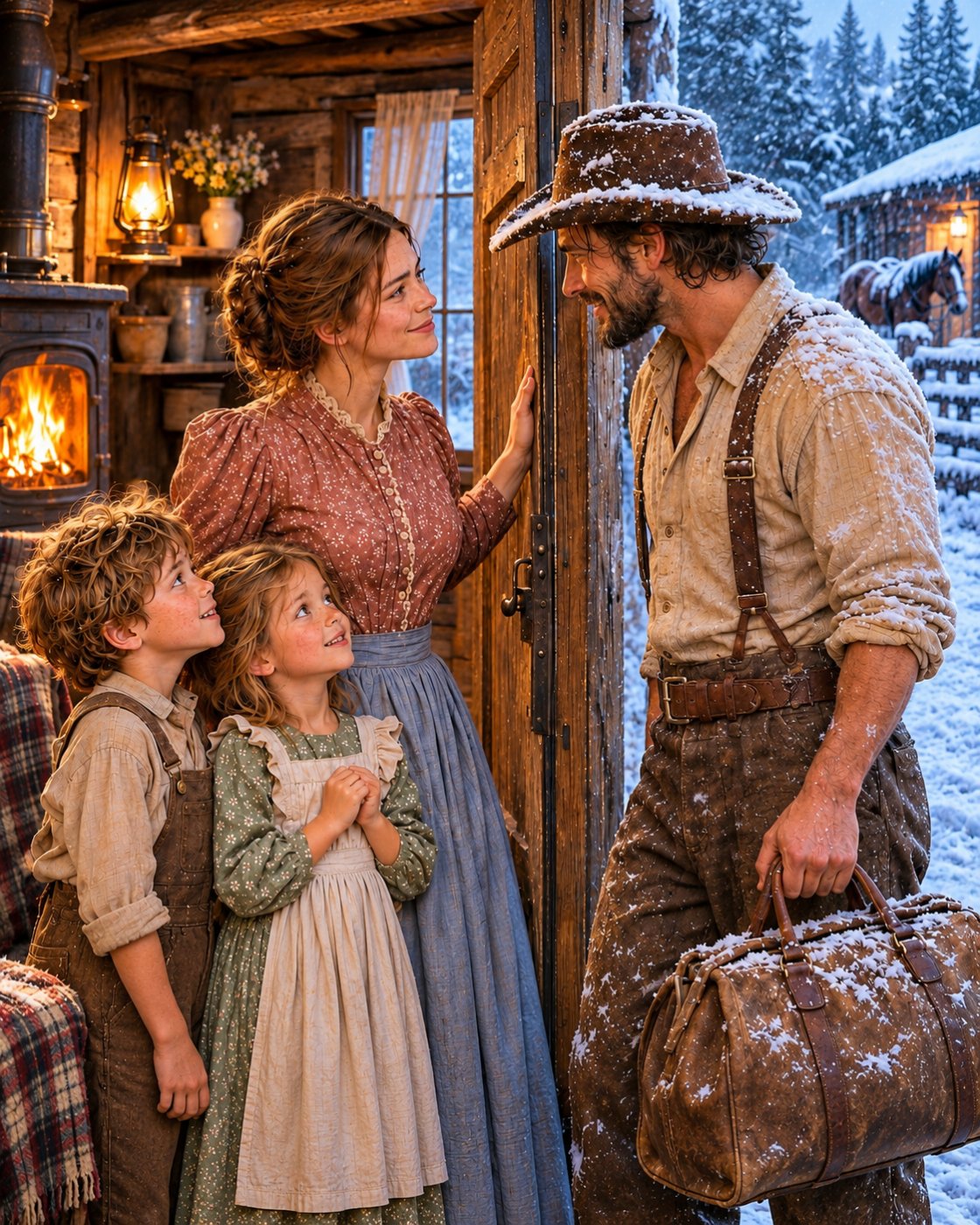
Later that evening, after the children had gone to bed, Clara found Henry standing beside the door.
He was holding the old scarf she had given him during the blizzard.
She smiled.
“You kept it.”
He nodded.
“Of course.”
“It's terribly worn.”
“I know.”
“You have a hundred better scarves.”
“Probably.”
She stepped closer.
“Then why keep that one?”
Henry looked at her.
“Because it reminds me of the night I had everything and nothing.”
Clara's expression softened.
He continued.
“I owned land. Cattle. A company. A house with twelve chairs.”
He smiled sadly.
“But I had no one to come home to.”
Clara reached for his hand.
“And now?”
Henry looked toward the children's bedroom.
Then back at her.
“Now I have everything that matters.”
She leaned against him.
For a long moment, they listened to the wind outside.
It was snowing again.
Not as fiercely as the night they met.
But enough to cover the road and turn the fields white.
Clara looked toward the door.
“Do you remember what you said when I opened it?”
Henry smiled.
“I begged you not to shut it.”
“And I told you nobody paid to get warm in this house.”
He laughed softly.
“You did.”
She looked up at him.
“I had almost nothing to give you.”
Henry shook his head.
“You gave me more than anyone ever had.”
Clara smiled.
“And you gave me a home.”
He kissed her forehead.
“No, Clara.”
She looked at him.
“You already had a home.”
He glanced around the cabin.
“You gave me one.”
Outside, the snow continued falling.
Inside, the fire burned steadily.
The children slept safely.
And the man who had once owned sixty thousand acres but possessed no peace finally understood what his mother had tried to teach him.
A home was not measured by its size.
A man's worth was not measured by his money.
And love could never be purchased with land, cattle, or gold.
Sometimes it began with a single act of kindness.
A poor widow opening her door.
A freezing stranger stepping inside.
And a heel of bread shared when there was barely enough for anyone.
Henry Walsh had spent ten years believing wealth could protect him from loneliness.
But the greatest treasure of his life had been waiting behind a little wooden door on Cedar Creek.
And all he had needed to do was knock.