...
It landed with a heavy, final clink.
Deed, Caleb said.
10 minutes later, Caleb was back in the biting wind.
He shoved the folded parchment deep into his inner pocket, feeling the stiff edge of it against his ribs.
It was his father's land.
He hadn't seen it in 22 years.
Not since the fever took the old man and the bank took the cabin.
Caleb had been 16 then.
He had walked away with nothing but a hunting knife and a burning hatred for towns, banks, and the fragile nature of roots.
He had spent his life moving, living in trapper lean-tos and snow caves, entirely untethered, but a man couldn't run forever.
The winters were getting harder.
His joints ached when the damp set in.
A month ago, a passing freighter at the Fort Benton trading post had casually mentioned the upcoming tax auction in Red Creek.
Caleb had packed his mules the next morning, a dollar to buy back the only piece of earth that ever meant a damn to him.
>> [clears throat] >> He mounted his dun gelding, grabbing the lead rope of his two pack mules.
The animals shifted miserably in the cold.
"Let's go".
Caleb muttered, turning them toward the mountain.
The ride up Oaker's Ridge was a slow, punishing climb.
The timberline was a tangled mess of black pine and spruce, the branches heavy with the season's first serious snow.
The wind picked up as they gained elevation, screaming through the needles with a high, thin pitch.
It was the kind of cold that found the gaps in a man's clothing and settled directly into the marrow.
Caleb dismounted after the first 3 miles.
The trail was exactly as Miller had described, gutted by spring runoffs and choked with fallen timber.
He walked ahead of the gelding, leading the animal by the bit, using his weight to break a path through the knee-deep drifts.
His breath plumed in the gray light.
He didn't think about the past.
He didn't afford himself the luxury of sentimentality.
He thought about firewood.
He thought about chinking the logs.
He thought about whether the old stone hearth had cracked under the weight of a hundred frozen seasons.
Survival in the Bitterroots didn't leave room for nostalgia.
If the roof was entirely gone, he'd have to string canvas and fell trees before nightfall.
It took 4 hours to cover 5 miles.
The sun was a pale dying smudge behind the clouds when the trees finally broke.
Caleb stopped.
The gelding bumped its nose against his shoulder, blowing hot exhaust into the freezing air.
There it was.
The cabin.
It sat in a clearing overlooking the valley.
A low squat structure of peeled logs.
It hadn't collapsed, but it looked bruised.
The cedar shake roof sagged deeply in the middle like a broken spine.
The porch had rotted away.
The single front window was boarded over with gray splintered wood.
It was a dead empty shell waiting to rot back into the earth.
Caleb tied the horses to a sturdy pine at the edge of the tree line.
He unlatched the heavy leather flap of his saddlebag, pulled out his Winchester lever action, and rested it over his shoulder.
Force of habit.
Bears used abandoned cabins for dens.
Drifters used them for graves.
You didn't walk into a dark room in the high country without expecting something to bite back.
He walked across the clearing.
The snow was untracked, a smooth white sheet burying the yard.
There was no smoke rising from the stone chimney.
No sound but the wind groaning against the logs.
He stepped up to the door.
The latch was a heavy iron drop bar, rusted brown.
Caleb pushed it up with his thumb.
It fought him, grinding against the bracket, then finally gave way.
He shoved his shoulder against the heavy timber door.
It swung inward, the rusted hinges shrieking like a dying animal.
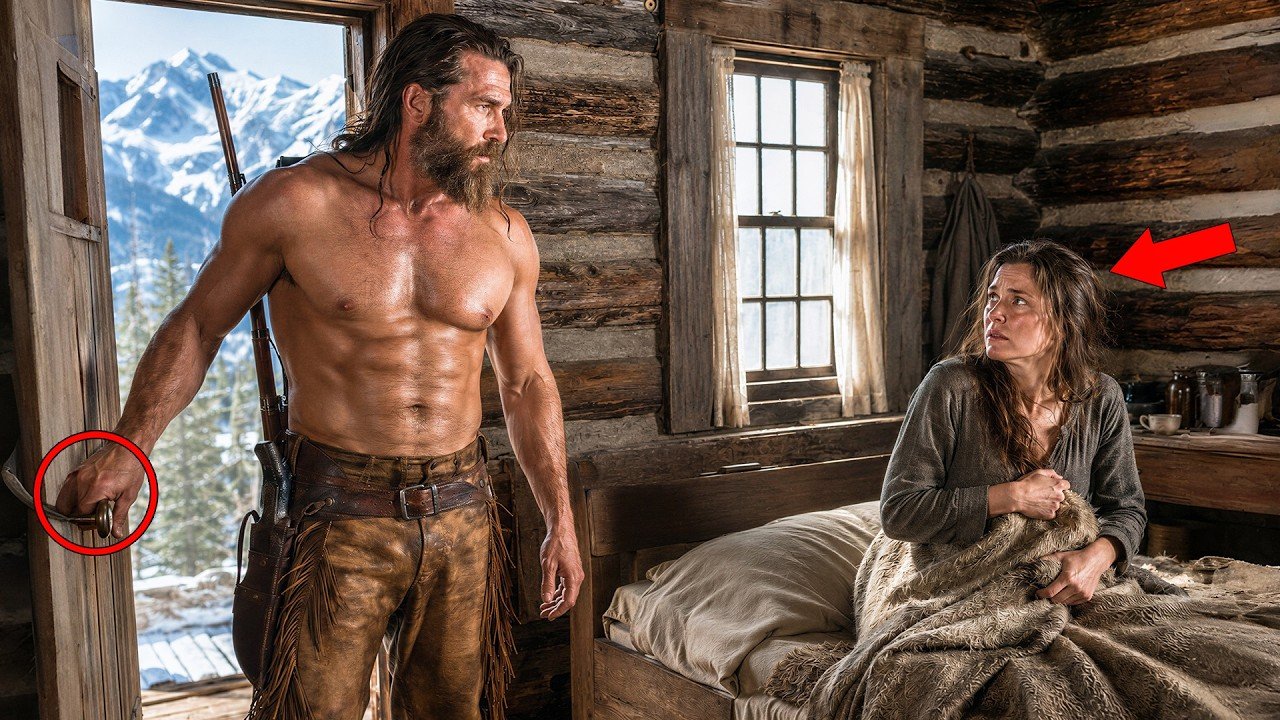
Caleb stood in the threshold, letting his eyes adjust to the gloom.
The smell hit him first.
It wasn't the smell of an empty rotting Beneath the sharp odors of dust, mouse droppings, and damp earth, there was something else.
Dried sage, faint, stale wood ash, and the distinct, unmistakable scent of unwashed wool.
Someone was living here.
He didn't take a step forward.
He shifted his weight to the balls of his feet, his thumb sliding over the hammer of the Winchester.
The light from the open doorway cut a pale rectangle across the dirt floor, illuminating the bottom of the stone hearth and the edge of a crude wooden table.
The corners of the room remained steeped in heavy, suffocating shadow.
Click.
The sound of a rifle hammer locking into place was sharp and metallic.
It came from the darkest corner of the cabin, to the left of the hearth.
"Close the door," a voice said.
It was a woman's voice.
It was cracked, rough as sandpaper, and completely devoid of panic.
It was the voice of someone who had practiced this moment in her head a hundred times.
Caleb didn't move.
He traced the sound.
He could make out a silhouette huddled on a low bed frame.
A thick buffalo robe was draped over her shoulders, but the dull gray metal of a rifle barrel protruded from the furs, pointed directly at his chest.
"I won't tell you twice," she said.
The barrel didn't waver.
Caleb let out a slow breath.
He lowered his Winchester, keeping the muzzle pointed at the floor, but didn't drop it.
He reached out with his left hand and pulled the heavy door shut, leaving it open just a crack to let a sliver of gray light remain.
The wind outside was instantly muted.
The silence inside was heavy, thick with tension.
"You holding that gun because you want to shoot me or because you're scared I'm going to shoot you? Caleb asked.
His tone was flat, conversational.
He had stared down wounded grizzlies and drunken silver miners.
A desperate woman in the dark required caution, but he wasn't going to show fear.
Depends entirely on who you are, she replied.
I'm the man who holds the deed to this hot box, Caleb said.
Bought it two hours ago in Red Creek.
Name is Caleb Cole.
The silence stretched.
He heard the rustle of the heavy hide rope.
Slowly, agonizingly, the metallic snick of the hammer being carefully lowered echoed in the small room.
The rifle barrel dipped toward the floor.
You took your time, she whispered.
The rough edge of her voice broke slightly, betraying a deep, bone-weary exhaustion.
Caleb frowned.
He took a step further into the room, kicking the door wide open again to get more light.
He needed to see her.
She shrank back from the sudden glare, throwing an arm up over her eyes.
She was a ruin of a woman.
Her face was gaunt, the skin stretched tight over her cheekbones, smeared with soot and dirt.
Her hair, a tangled mess of dull brown, hung in greasy, matted strands around her face.
She wore a man's flannel shirt that swallowed her thin frame, layered over a tattered wool dress.
But it was her eyes that caught him.
When she lowered her arm, she looked at him with an intense, burning clarity.
There was no madness there, just sheer, unadulterated survival.
Put the gun on the bed, Caleb commanded.
She stared at him for a second, then complied, laying the rusted Springfield across the blankets.
She kept her hands visible, resting them on her knees.
Caleb walked over, snatched the rifle by the barrel, and checked the chamber.
It was empty.
He looked at her, his jaw tightening.
You were holding an empty iron on me, he said.
Wouldn't be the first time it worked, she said.
She pulled the buffalo robe tighter around her shoulders.
She was shivering, a deep, rhythmic tremor she couldn't control.
I used the last shell a week ago to scare off a bobcat trying to get through the roof.
Caleb leaned the Springfield against the wall.
He looked around the cabin.
It was a miserable sight.
His father's sturdy table was hacked apart, half of it clearly burned for firewood.
The shelves were bare.
There were a few rusted tin cans stacked in the corner, licked clean.
She had been starving in the dark, waiting in a freezing cabin with an empty gun.
You said I took my time, Caleb said, turning back to her.
You don't know me.
I don't know you.
What the hell are you doing in my cabin? Waiting for you, she said simply.
My name is Abigail Hayes.
That means nothing to me.
It shouldn't, Abigail said.
She coughed, a dry, rattling sound deep in her chest.
But your name means something to me.
This was your father's claim.
Silas Cole.
Caleb flinched internally, though his face remained a mask of stone.
Nobody had spoken that name to him in two decades.
He took a step closer, towering over her sitting form.
"How do you know that name?" Abigail pointed a trembling, dirt-stained finger toward the floorboards near the hearth.
"Under the stones, there was a tin box.
Your father left letters, letters he never sent to a son who ran away".
Caleb looked at the hearth.
The stones were disturbed.
He felt a sudden, sharp flash of anger.
A violation of the past he had tried to bury.
He looked back at her, his eyes narrowing.
"You dug up my father's floor.
You read his letters.
And that made you think I was coming back?" "No," Abigail said, her chin lifting defiantly despite her obvious weakness.
"I made you come back.
Two months ago, I gave a wandering trapper my mother's silver locket.
Told him to take a message to the trading posts up north.
Told him to spread the word that lot 44 on Oak Ridge was hitting the tax block.
I knew if the name Caleb Cole was out there, and he heard about it, he wouldn't let strangers take his father's bones".
Caleb stared at her.
The sheer audacity of it left him momentarily speechless.
The rumor at Fort Benton.
The casual mention by the freighter.
It wasn't coincidence.
It was a trap.
A lure cast across hundreds of miles of wilderness by a starving woman in a freezing cabin.
"Why?" Caleb asked.
The single word hung heavy in the frigid air.
"Why go through all that trouble for a stranger?" Abigail looked away, staring at the empty, cold ashes in the hearth.
"Because there's a man in the valley named Wyatt.
He owns everything from here to the river.
He wanted this ridge.
My husband tried to hold a claim 2 miles down.
Wyatt's men beat him so bad he bled internally.
He died a week later.
They burned our tent.
I ran up here to hide.
She looked back at Caleb and the hardness in her eyes was startling.
Wyatt's men won't climb this ridge in the winter.
But come spring, they'll ride up here to claim this lot.
I needed a ghost.
I needed the meanest, hardest man who had a rightful claim to this land to be standing in the doorway when they did.
The letter said you were a mountain man.
A killer.
A man who didn't take kindly to thieves.
She swallowed hard.
I figured you were my best chance.
Caleb looked at her, then turned and walked to the open doorway.
The snow was falling harder now, thick white flakes obscuring the tree line.
The wind was picking up, howling with the promise of a brutal night.
He had bought a quiet place to disappear.
Instead, he had bought a war.
He looked back at the shivering woman in the corner.
Cynicism warred with a begrudging respect.
She had played a desperate hand and she had won.
"I'm [clears throat] bringing the horses in".
Caleb said gruffly.
"You got any dry kindling left or did you burn it all?" "There's some under the bed".
Abigail whispered.
A profound relief finally breaking the tension in her shoulders.
"Get it out".
Caleb ordered.
"We're going to freeze to death before Wyatt gets a chance to shoot us".
The blizzard hit with the malice of a wounded predator.
Within an hour, the world outside the cabin was erased, swallowed by a shrieking wall of white.
The temperature plummeted, freezing the dampness in the timber so rapidly the logs popped and cracked like distant rifle fire.
Caleb worked with a brutal, methodical efficiency.
He led the gelding and the mules into the attached lean-to, an unstable structure of rotting poles that he hastily reinforced with his picket ropes.
He threw heavy wool blankets over the animals, offering them what little heat he could spare.
Then he hauled his heavy canvas packs inside the cabin, slamming the heavy iron-banded door shut, and dropping the heavy crossbar into place.
The finality of the sound echoed in the small space.
They were sealed in.
The cabin was agonizingly cold.
Caleb's breath plumed heavily as he unbuckled his saddlebags.
He glanced over at Abigail.
She had managed to drag a small pile of splintered cedar shingles from beneath the bedframe.
She sat beside the stone hearth, her hands trembling so violently she could barely stack the wood.
Caleb walked over, gently nudging her aside with the side of his knee.
"Let me".
He didn't wait for her to move.
He knelt on the packed dirt floor, his large hands moving deftly.
[clears throat] He shaved a handful of dry curls from a block of pine using his hunting knife, arranged the kindling into a tight teepee over the shavings, and struck a sulfur match against the stone.
The spark caught.
A thin ribbon of yellow smoke curled upward, followed by a fragile dancing flame.
>> [clears throat] >> Caleb fed it slowly, carefully, coaxing the fire to life.
The light flickered across the room, casting long, jumping shadows.
[clears throat] As the heat began to radiate outward, the oppressive gloom of the cabin lifted.
though the tension between the two occupants did not.
Caleb stood up and went to his packs.
He pulled out a cast iron spider skillet, a slab of heavily salted pork wrapped in waxed canvas, and a small sack of dried pinto beans.
Abigail watched him from the floor, pulling the buffalo hide tighter around her chin.
Her eyes tracked the food with a desperate animal hunger.
She tried to hide it, pressing her lips together.
But Caleb saw the way her gaze locked onto the fat of the pork.
"When was the last time you ate?" he asked, slicing thick chunks of the meat into the skillet.
"Three days," she rasped.
"Found some frozen roots before that".
"A week".
Caleb didn't offer pity.
Pity didn't fill bellies.
He set the skillet on the hot coals at the edge of the fire.
The pork began to sizzle almost immediately, the rich, heavy smell of cooking fat filling the cabin.
It was an intoxicating scent, overpowering the lingering smell of decay.
"You're a fool, you know that," Caleb said, his voice a low rumble over the crackle of the fire.
He didn't look at her.
He kept his eyes on the meat, turning it with the tip of his knife.
"You sat up here starving.
You could have walked down the other side of the ridge, made it to Miller's Crossing before the snows closed the pass.
You chose to sit in a rotting box and hope a ghost would come save you".
Abigail let out a short, harsh laugh.
It sounded like tearing paper.
"Walk down to Miller's Crossing, and then what? Beg for scraps outside the saloon? Work on my back for men who smell like cheap whiskey and unwash wool?" She leaned her head back against the stone of the chimney.
I told you.
Wyatt's men killed my husband.
They took everything.
If I left this mountain, I [clears throat] accepted defeat.
I accepted that they get to win just because they have more guns.
Caleb scooped a handful of snow from a bucket he had brought in, tossing it into the skillet to deglaze the pan and create a meager broth for the beans.
The water hissed violently.
So you stayed to spite them, Caleb said.
I stayed because this land doesn't belong to him, she [clears throat] fired back, a spark of genuine anger breaking through her exhaustion.
And I knew you wouldn't sell it to him.
You don't know anything about me, Caleb countered, finally looking at her.
His eyes were cold, assessing.
I left this place 22 years ago.
I hated this cabin.
I hated the dirt it sits on.
I bought it today because it cost a dollar and I needed a roof.
I ain't looking to fight a cattle baron's army for a widow's pride.
Abigail stared back at him, unflinching.
The firelight caught the hollows of her cheeks, making her look like a skull draped in thin skin.
Then why did you come back, Caleb Cole? If you hated it so much, you could have bought a cabin anywhere.
You could have stayed up north.
But you heard the name of this ridge and you came running.
Caleb's jaw tightened.
He turned back to the fire, taking a tin plate from his pack.
He dragged a generous portion of the sizzling pork and beans onto the metal surface, grabbed a wooden spoon, and held it out to her.
Eat, he commanded, ignoring her question.
Eat slow.
Your stomach's shrunken.
You wolf it down, you'll just heave it back up into the ashes.
Abigail hesitated for a fraction of a second, pride warring with starvation.
Starvation won.
She took the hot tin plate with trembling hands.
She ate exactly as he told her, slow, deliberate bites, though her eyes squeezed shut with the sheer, agonizing pleasure of hot food hitting an empty stomach.
Caleb fixed his own plate and sat cross-legged on the opposite side of the hearth.
The fire roared now, casting a solid perimeter of heat that held back the freezing air radiating from the walls.
Outside, the wind battered the structure, rattling the heavy timber door on its hinges.
They ate in silence for a long time.
The only sounds were the scraping of spoons on tin and the violent fury of the storm outside.
Caleb watched her as he chewed.
He was a man who lived by logic, by the hard rules of nature, cause and effect, predator and prey.
But looking at Abigail Hayes, he found a variable he couldn't neatly categorize.
She was broken, half dead, and entirely outmatched by the world.
Yet she had manipulated the Mountain Telegraph, survived alone in hostile territory, and orchestrated a standoff with a man she only knew from old letters.
Where are they? Caleb asked suddenly.
Abigail paused her spoon halfway to her mouth.
She looked up.
Where are what? The letters, Caleb said, his voice flat.
My father's letters.
Abigail carefully set her empty tin plate on the floor.
She reached into the folds of her tattered dress and pulled out a small oilskin pouch.
She didn't hand it to him immediately.
She held it in her lap, her dirty fingers tracing the worn edges of the fabric.
"He wrote them every winter," she said softly, the fight bleeding out of her voice, leaving only a quiet melancholy.
"Every winter after you left, he wrote about the snow, about the roof leaking, but mostly he wrote about you.
He thought you were dead.
Then, a few years before he passed, he heard a rumor about a trapper named Caleb pulling pelts out of the Tetons.
He started writing them to that man, hoping it was you".
She held the pouch out across the space between them.
Caleb stared at the oilskin.
He felt a sudden, suffocating tightness in his chest, a ghost of a 16-year-old boy's anger rising up to choke him.
He didn't want the letters.
He didn't want the guilt.
He had survived by moving forward, never looking back.
He reached out and took the pouch.
It felt heavy in his palm.
"I didn't read all of them," Abigail added quietly.
"Just enough to know who you were and what kind of man you'd become".
"And what kind of man is that?" Caleb asked, his voice rough.
Abigail met his gaze, the firelight reflecting in her tired eyes.
"The kind of man who doesn't walk away from a fight he didn't start.
Wyatt will come, Caleb.
He knows I'm up here.
He sent a rider 3 weeks ago to warn me off before the snow hit.
The rider said they'd be up in the spring with a dozen men to burn this place to the ground with or without me inside it".
Caleb unclasped the oilskin pouch.
He slid a finger inside, feeling the brittle yellowed paper of the envelopes.
He looked around the small, cramped cabin, the logs his father had felled, the hearth his father had built, the dirt his father had died on.
He looked back at Abigail.
She was a stranger, an interloper, but she had kept the hearth warm.
She had held the line.
Spring is a long way off.
Caleb said softly, tucking the oilskin pouch into his coat pocket without looking at the letters.
He picked up his Winchester from the floor and began wiping down the moisture on the barrel with a rag.
We'll see if they have the stomach for it when the ice thaws.
Abigail leaned back against the stone, her eyes drifting shut.
For the first time in months, the rifle wasn't in her hands.
The tension in her battered body finally gave way to sleep.
Caleb sat awake, listening to the wind tear at the roof, the heavy rifle resting easily across his lap.
He had bought a cabin for a dollar, but he knew the real price was yet to be paid.
December came and went without a sound.
The mountain was entombed in 3 ft of packed snow, the pines bowing under the immense, crushing weight of it.
Inside the cabin, survival became a brutal, rhythmic chore.
Time wasn't measured in hours or days, but in cords of wood burned and pounds of salted pork consumed.
Caleb spent the daylight hours outside.
He waded through waist-deep drifts, running a short trap line for martin and fox, mostly to keep his legs from stiffening.
Hunting was a losing game.
The elk had yarded up in the lower valleys, and the deer were ghosts.
When he did manage to drop a snowshoe hare, the meat was lean, tough, and tasted of pine resin.
He brought it back anyway.
Meat was meat.
Abigail remained indoors.
The starvation had taken a heavy toll on her muscles, and the cold air outside triggered violent coughing fits that left her gasping on the floorboards.
But, she was not idle.
As the heavy meals of beans and fat began to fill out the hollows of her cheeks, her fierce, restless energy returned.
She scrubbed the dirt from the floor with snowmelt.
She mended Caleb's torn wool socks with a bone needle and unraveled thread from her own tattered hem.
She kept the fire burning at a steady, efficient roar, carefully rationing the chopped wood Caleb stacked by the door.
They barely spoke.
The silence between them wasn't hostile.
It was the quiet of two feral animals sharing a cage, each cautiously respecting the other's teeth.
One evening in late January, the temperature dropped so low the nails in the roof planks popped with sounds like pistol shots.
Caleb sat cross-legged near the hearth working mink oil into his cracked leather boots.
Abigail was on the bed, wrapped in the heavy buffalo robe, watching him.
"You're wasting the oil," she said quietly.
Caleb paused, his thumb coated in the thick yellow grease.
He looked up.
"The seams are rotting," she clarified, pointing a finger at his left boot.
"Right where the toe cap meets the welt, the oil just softens the rot.
You need pitch.
Pine pitch and ash boiled down.
It hardens like iron".
Caleb looked at the boot.
She was right.
The leather was separating.
He wiped his thumb on a rag.
You learned that from your husband.
I learned that from walking behind a wagon for 600 miles, Abigail said.
Her voice held no self-pity, just a flat recitation of fact.
My husband was a farmer.
He knew dirt.
He didn't know mountains.
That's why Wyatt's men killed him so easily.
Caleb didn't offer condolences.
He reached into his coat pocket and pulled out a small tin of hardened pine resin he used for his traps.
He tossed it to her.
She caught it deftly, slid off the bed, and moved to the fire to melt it down in an empty bean can.
He watched her work.
Her hands were scarred and calloused, moving with unpracticed efficiency.
The grease and soot were gone from her face, revealing a sharp, angular jawline and eyes the color of bruised slate.
She wasn't beautiful in any conventional sense.
She was weathered.
She looked exactly like the land she was fighting for.
Later that night, when the fire had died to a bed of pulsing orange embers and Abigail's breathing had leveled out into deep sleep, Caleb pulled the oilskin pouch from his pack.
He had carried his father's letters for 2 months without opening a single envelope.
He slipped out a brittle piece of paper, leaning close to the embers to catch the light.
The handwriting was a jagged scroll, the ink faded to a rusty brown.
"Bank says they'll take it come spring.
I don't care about the timber.
I don't care about the dirt.
I built this box for your mother.
And when she passed, it became a tomb.
I was too hard on you, boy.
I tried to beat the softness out of you because I knew what this world does to soft things, but I just made you cold.
If you are alive, if you are reading this, don't hold on to this place.
Burn it.
Walk away.
A man needs a fire to warm his hands, not to consume him.
Caleb stared at the words until the lines blurred.
He folded the letter carefully, slipped it back into the pouch, and shoved it deep into his pack.
He didn't burn the letters.
He didn't burn the cabin.
He sat in the dark, listening to the wind, realizing that for the first time in 20 years, he wasn't looking over his shoulder.
He was waiting for the fight to come to him.
Spring didn't arrive with a gentle warming.
It broke the mountain open with violence.
In April, the snowpack began to bleed.
The constant dripping of water echoed through the timberline.
The ice on the roof let go in massive heavy sheets that crashed to the earth, shaking the foundation of the cabin.
>> [clears throat] >> The white world dissolved into an ugly, treacherous expanse of brown mud, exposed granite, and rushing gray water.
Oker's Ridge was waking up, and with the thaw came the reopening of the trail.
The shift in the season changed the air inside the cabin.
The quiet truce of winter evaporated, replaced by a tight, suffocating anticipation.
Every snapping branch in the woods, every hollow crash of a falling deadwood tree, made Abigail jump.
She stopped sleeping through the night.
She paced the small floorboards, her eyes constantly cutting to the heavy wooden bar barring the door.
Caleb responded by working.
He stripped the cabin down to its bones.
He took the few remaining unburned planks from the ruined table and nailed them over the lower half of the front window, leaving a 6-in gap at the top, a firing port.
He moved his heavy supply packs against the weak spots in the lower logs.
One afternoon, he walked outside into the ankle-deep mud and began clearing the brush 50 yards out from the front porch.
Abigail stepped out into the damp, biting air, wrapping a wool blanket tightly over her shoulders.
She watched him hack at a thick patch of manzanita with a hand ax.
"They won't come up the main trail," she called out over the roar of the runoff.
Caleb paused, wiping a mixture of sweat and mud from his forehead with the back of his forearm.
"Why not? Wyatt is arrogant, but his foreman isn't.
Name is Vance.
He's a tracker.
He knows a choke point when he sees one.
He'll swing his men around the east ridge, come up through the timber, and try to catch the cabin in a crossfire from the tree line".
Caleb lowered the ax.
He looked at the dense, dark wall of pines flanking the eastern edge of the clearing.
It offered perfect cover.
He walked back toward the porch, his boots sucking loudly in the mud.
He stopped a few feet from her.
"Why does a cattle baron want a steep, rocky ridge with no grass?" Caleb asked.
Abigail looked away, her jaw tightening.
"Water".
"There's a spring on the back side of this lot.
Feeds directly down into the lower basin.
In a dry year, whoever controls the spring controls the grazing rights for 10 miles.
My husband found out about it.
Tried to file an amendment to our deed.
Wyatt found out first".
Caleb nodded slowly.
Men had died for far less than water in this territory.
He stepped up onto the porch, scraping the mud from his boots on the edge of the boards.
"Come inside".
He said.
When they were back in the gloom of the cabin, Caleb walked to his saddlebags.
He pulled out a spare weapon, an old heavy-barreled Sharps Carbine.
It was a single-shot breechloader, kicked like a mule, but it dropped whatever it hit.
He grabbed a handful of heavy brass cartridges, walked over to the bed where Abigail was sitting, and dropped them onto the blankets.
Abigail stared at the brass, then up at him.
"You know how to use that?" Caleb asked.
"I know how to point it and pull the trigger".
She said, her voice dropping to a whisper.
"That ain't enough".
Caleb said.
He picked up the Carbine.
"Stand up".
She stood.
He handed her the weapon.
The barrel wavered immediately under the heavy weight of the iron.
"Tuck the stock deep into the pocket of your shoulder.
Don't let it sit on the collarbone, or it'll shatter it".
Caleb instructed, stepping behind her.
He placed his large, rough hands on her shoulders, physically shifting her stance.
"Lean into it.
Put your weight on your front foot".
Abigail adjusted.
She felt the solid, immovable heat of his chest inches from her back.
His breath brushed past her ear.
It was the first time they had truly touched since he had pushed past her in the doorway months ago.
A sudden and sharp jolt ran through her, entirely unrelated to fear.
>> [clears throat] >> She gripped the wooden stock tighter, grounding herself.
"Pull the hammer back".
He commanded.
She thumbed the heavy hammer.
It clicked twice, locking into place.
"Now," Caleb said, his voice dropping into a low, steady rumble.
"When they come, you don't aim for the head.
You don't aim for the chest.
You aim for the belt buckle.
The recoil is going to throw the barrel up.
You aim for the waist, you hit the lungs.
You understand?" "Yes," she breathed.
"When it fires, the smoke is going to blind you.
Drop to your knees immediately.
Reload in the blind.
Do not stand back up until you have a fresh shell in the chamber".
He stepped back, breaking the contact.
The cold air rushed back in to fill the space between them.
>> [clears throat] >> Abigail lowered the rifle.
She turned to look at him.
Her eyes were wide, but the panic was gone, replaced by a cold, hardened resolve.
"They're going to kill us, Caleb".
"They're going to try," Caleb corrected.
He walked over to the fire and poured a cup of black, sludgy coffee from the tin pot.
"I've been dead a long time, Abigail.
This is just the first time I've had a reason to mind".
She stared at him.
The weight of his words hanging heavy in the damp air.
She didn't say thank you.
Thank you was a useless word on a mountain.
Instead, she sat back down, broke [clears throat] open the breach of the shotgun and slid a brass cartridge into the chamber.
The metallic snick of the block snapping shut was the only answer she gave.
They didn't come with an army.
They came with three men.
It was the second week of May.
The mud had begun to harden into deep, rutted tracks.
The sun was hanging low over the western peaks, casting long, bruised shadows across the clearing.
Caleb was at the side of the cabin inspecting the logs for rot when the gelding in the lean-to let out a sharp, anxious whinny.
Caleb froze.
He didn't turn around to look.
He slowly let his hand drop to the heavy cult strapped to his thigh.
He listened.
Beneath the sound of the wind moving through the pines, he heard it.
The rhythmic sucking sound of hooves pulling out of deep mud.
Coming from the east tree line.
>> [clears throat] >> Abigail was right.
They hadn't used the main trail.
Caleb slid along the wall of the cabin, keeping his back pressed against the rough bark.
He reached the corner and peered around the edge.
Three riders broke the tree line.
They wore heavy canvas dusters, their horses lathered and blowing hard from the steep climb.
They weren't carrying rifles in their scabbards.
They had them out, resting across their saddle horns.
These weren't men coming to serve an eviction notice.
These were men coming to do wet work.
The lead rider was a thick-necked man with a bowler hat pulled low over his eyes.
He halted his horse 30 yards from the front door.
He didn't see Caleb tucked against the side wall.
"Hayes!" the man bellowed.
His voice was thick with chewing tobacco and arrogance.
"We know you're in there, widow.
Mr. Wyatt says your time on his mountain is up".
Silence from the cabin.
Abigail was inside, positioned at the firing port behind the boarded window, exactly as Caleb had told her.
"Don't make us burn you out, woman!" the rider shouted, spurring his horse a few steps closer.
"You come out now, we let you walk down the hill.
You stay in there, you burn with the rats".
The rider on the left laughed, a sharp, ugly sound.
He pulled a glass bottle from his saddlebag, uncorked it with his teeth, and struck a match.
A rag stuffed in the neck of the bottle flared to life.
Kerosene.
They weren't planning on giving her time to answer.
Caleb stepped out from the corner of the cabin.
He didn't shout a warning.
He didn't ask their names.
He raised the Winchester, smoothly cocking the lever as it came level with his shoulder.
He didn't aim at the man with the bottle.
He aimed at the leader.
Cut off the head of the snake.
The rifle cracked.
The sound was deafening in the clearing, bouncing off the rock walls of the ridge.
The heavy .
44-40 slug caught the lead rider square in the chest.
The impact threw him violently backward over the cantle of his saddle.
His horse reared, screaming in panic, dumping the dead man into the mud.
The other two riders froze for a fraction of a second.
Their brains struggling to process the sudden, violent shift in reality.
They had expected a starving, terrified woman.
They had found a mountain man who shot without flinching.
The man with the kerosene bottle whipped his head toward Caleb, his eyes wide.
He drew his revolver, but before he could level it, a second gunshot tore through the air.
This one was deeper, louder.
The booming roar of the heavy Sharps carbine coming from the cabin window.
The heavy lead ball took the man's horse in the neck.
The animal crumpled instantly, a ton of dead weight collapsing into the earth.
The rider was pinned underneath it, his legs snapping with a sickening crunch.
The kerosene bottle flew from his hand, shattering against a rock and erupting into a localized pool of flame in the mud.
The third rider didn't wait.
He spurred his horse savagely, yanking the reins hard to the left, diving back toward the cover of the tree line.
Caleb jacked another round into the Winchester, tracking the fleeing rider.
But the angle was gone.
The man vanished into the dark pines, the sound of his frantic retreat echoing down the mountain.
Caleb lowered the rifle.
He stood in the settling smoke, his breathing steady, his eyes scanning the tree line for any signs of an ambush.
Nothing moved.
He walked slowly toward the bodies.
The leader was dead, his chest a ruined mess of canvas and blood.
The second man was trapped under his dead horse, writhing in the mud, screaming in agony as the pool of burning kerosene inched closer to his trapped leg.
Caleb walked up to him.
He looked down, his expression completely blank.
He reached down, grabbed the man by the collar of his duster, and hauled him violently backward, dragging him clear of the flames.
The man screamed again as his broken leg was pulled.
"Shut up".
Caleb growled.
He kicked the man's revolver out of reach.
The front door of the cabin swung open.
Abigail stood in the doorway, the heavy sharps clutched in her hands.
Her face was pale, smeared with black powder residue from the breach, but she was standing tall.
She looked at the dead man in the mud.
Then she looked at the wounded man moaning at Caleb's feet.
Caleb turned back to the man on the ground.
"Who are you?" "Go to hell".
The man spat, gritting his teeth against the pain.
Caleb didn't blink.
He placed the heavy heel of his boot directly over the man's broken femur.
He didn't stomp.
He just leaned an inch of his weight forward.
The man shrieked, clawing at the mud.
All right.
All right.
I work for Wyatt.
We all do.
How many more down in the valley? Caleb asked, easing off the pressure just enough to let the man breathe.
A dozen.
>> [clears throat] >> Maybe more, the man gasped, tears of pain cutting tracks through the dirt on his face.
When Vance hears about this, when he sees Jenkins dead, he's going to bring all of them.
They're going to bring dynamite.
You're dead.
You hear me? You're both dead.
Caleb removed his boot entirely.
He looked back at Abigail.
The skirmish was over.
But the war had just started.
The fleeing rider would be back at Wyatt's ranch by nightfall.
By tomorrow morning, an army would be riding up Oakhurst Ridge.
They wouldn't make the mistake of underestimating them again.
Get his horse's tack off, Caleb said to Abigail, pointing at the dead animal.
Bring it to the lean-to.
We need the leather.
Abigail stepped off the porch, her boots sinking into the mud.
She walked past the dead man without looking at him, her eyes locked on Caleb.
What are we going to do? She asked, her voice tight but remarkably steady.
Caleb looked out over the valley, watching the last of the daylight bleed out of the sky.
The cynic in him, the survivor who had lived for 20 years by running, told him to pack the mules, mount the gelding, and ride north into the dark.
Wyatt wanted the land, not the blood.
If they left now, they would live.
He looked down at the mud.
He looked at the cabin his father had built.
He looked at the woman who had held it with nothing but an empty rifle and sheer unyielding spite.
We're going to dig in," Caleb said, racking a fresh cartridge into the Winchester, "and we're going to make them bleed for every inch of dirt they try to take".
They didn't sleep.
The night was a canvas of sharp, agonizing noises.
The snap of settling timber, the wind dragging through the pines, the ragged breathing of the wounded rider Caleb had hog-tied in the lean-to.
Caleb spent the dark hours in the mud.
He didn't build barricades.
Barricades were for men planning to get trapped.
He built a meat grinder.
He took his heavy steel-jawed bear traps, the ones meant for 500-lb grizzlies, and buried them in the narrowest defiles of the eastern timberline.
He unspooled his snare wire, pulling it taut at throat height across the blind corners of the trail.
When he finally stepped back onto the porch, his hands were coated in freezing black mud.
[clears throat] Abigail was waiting just inside the door.
She held out a tin cup of boiling coffee.
He took it, their fingers brushing.
Her skin was warm, calloused, and entirely steady.
"You don't have to die for this," she said quietly.
She looked out at the darkness.
"You could take your horses, ride west.
They wouldn't track you past the river".
Caleb took a slow drink of the bitter coffee.
He looked at the cabin walls.
He thought about the yellowed letters in his pack, the heavy silver dollar he had dropped on a sheriff's desk, and the way Abigail had held an empty rifle on a ghost.
"I paid a dollar for this dirt," Caleb said, his voice a low, gravelly rasp.
"I'm getting my money's worth".
He set the empty cup on the rough-hewn table.
"When they come, you stay away from the window.
You sit in the stone of the hearth.
You only shoot if a man crosses the threshold.
You understand? Where will you be? In the trees.
Dawn broke like a bruise over the bitter roots, painting the low clouds in ugly streaks of purple and gray.
The temperature had dropped again, freezing the mud into jagged, ankle-breaking ruts.
The rumble of horses came just as the sun cleared the peaks.
Caleb was 50 yards out, lying flat on his stomach on a shelf of granite overlooking the choke point in the trail.
He had smeared his face with wet ash.
He barely breathed.
There were eight of them.
They rode in a tight column, their rifles drawn.
At the center of the formation was a man in a pristine black wool coat riding a massive roan stallion.
Wyatt.
The cattle baron hadn't trusted his hired guns to finish the job.
He had come to watch the widow burn.
They hit the choke point.
The lead horse stepped directly into the trigger pan of the hidden bear trap.
The heavy steel jaws snapped shut with a horrific metallic crunch, shattering the animal's cannon bone.
The horse screamed, a terrible, shrill sound that echoed off the canyon walls, collapsing and throwing its rider headfirst into the frozen rocks.
Chaos erupted.
The column bottlenecked.
Horses reared in panic, violently bumping into one another.
Caleb didn't hesitate.
He leveled the Winchester, settling the iron sights on the chest of a man frantically trying to control his mount.
Crack.
The man folded over his saddle horn.
In the rocks, someone screamed.
He's up in the rocks.
They unleashed a volley of blind fire.
Bullets chipped the granite inches from Caleb's head, showering him with sharp, stinging dust.
He didn't flinch.
He racked the lever, shifted his aim, and fired again.
>> [clears throat] >> A third man dropped, his his leg shattered by a heavy lead slug.
They were trapped in a killing funnel, and Caleb was a butcher who knew every bloody inch of the slaughterhouse.
He moved like a phantom, abandoning his position before they could zero in, scrambling through the dense brush to a new vantage point.
Wyatt was screaming orders, his pristine coat now flecked with the blood of his men.
"Push through.
Get to the clearing".
Three riders broke from the terrified mass, spurring their horses savagely toward the cabin.
They hit the edge of the tree line.
The heavy booming roar of the Sharps carbine tore through the morning air.
Abigail hadn't stayed in the hearth.
She was at the firing port.
A thick cloud of white smoke billowed from the boarded window.
The lead rider in the clearing was ripped violently from his saddle, taking a .
50 caliber ball straight to the waist.
The remaining two men yanked their reins hard, their nerve breaking completely.
They didn't return fire.
They whipped their horses around and fled blindly back down the trail, abandoning Wyatt and the wounded.
Suddenly, the ridge was dead quiet.
The only sounds were the groans of the dying and the frantic snorting of riderless horses.
Caleb stepped out from the brush.
He held the Winchester at his hip, the barrel smoking in the cold air.
He walked down the incline, his boots crunching on the frozen mud.
Wyatt's roan stallion was pacing nervously, pinned against a thick pine.
Wyatt was still in the saddle, his revolver drawn, but his hand was shaking violently.
He looked at the bodies of his men.
Then he looked at the massive, ash-covered mountain man walking towards him.
"You Cole".
Wyatt breathed, his arrogance bleeding out into sheer terror.
"Lot 44".
Caleb said.
He stopped 20 ft away.
He didn't raise his rifle.
He didn't need to.
"I hold the deed".
"I have 50 men down in the valley".
Wyatt spat, desperately trying to find his authority.
"You kill me, they'll hunt you to the ends of the earth".
"No, they won't".
Caleb said flatly.
"You pay them $30 a month.
They ain't riding up a mountain to die for a dead man's water rights".
Caleb raised the Winchester, aiming it directly at the roan stallion's chest.
"Get off the horse".
Wyatt swallowed hard.
He slowly uncocked his revolver, dropped it into the mud, and swung his leg over the saddle.
He landed awkwardly in the dirt.
"Take your wounded".
Caleb commanded.
"Walk down my mountain.
You send another man up this ridge, I won't shoot him.
I'll skin him.
>> [clears throat] >> And then I'll come down to the valley and burn your house down with you in it.
Do we understand each other?" Wyatt looked into Caleb's eyes.
He saw no bluff.
He saw an absolute, terrifying vacuum of mercy.
Wyatt nodded once, his face pale.
Caleb watched them leave.
It took an hour for the surviving men to load their wounded onto the remaining horses and limp back down the trail.
Caleb didn't move until the sound of hooves was completely swallowed by the wind.
He turned and walked back across the clearing.
The heavy timber door of the cabin opened.
Abigail stepped out onto the porch.
She was covered in gun smoke, her hair wild, her dress stained with dirt and grease.
She lowered the heavy Sharps carbine, resting the stock on the wooden boards.
Caleb stopped at the bottom of the steps.
He looked up at her.
He had spent 22 years running from the ghosts in this timber.
He had bought it to spite his past, expecting nothing but a quiet place to die.
Instead, he had found a reason to live.
He walked up the steps.
He stopped in front of her, reaching out to gently take the heavy rifle from her aching hands.
"It's over," Caleb said.
Abigail looked out at the scarred, bloody clearing, then back to the man standing in front of her.
The hard, cynical edge in her eyes finally softened, melting into something fiercely profound.
She reached out, her dirty fingers gripping the heavy wool of his coat, anchoring herself to him.
"Roof still leaks," she whispered.
"I'll cut the timber," Caleb replied, his hand resting heavily, solidly against her shoulder.
They stood together on the porch, watching the morning sun finally [clears throat] break through the clouds, casting a warm, golden light over their land.
If you found yourself holding your breath during Caleb and Abigail's fight for survival, hit that like button to support gritty, grounded storytelling.
This wasn't just a story about a shootout.
It was about two broken people finding a reason to stand their ground together in an unforgiving world.
Share this video with anyone who loves a raw, authentic Western romance, and don't forget to subscribe to the channel for more immersive, high-stakes narratives.
Ring the notification bell so you never miss a new tale.
We'll see you on the next trail.