PART 3
“Daughter, I've come to bring you home.”
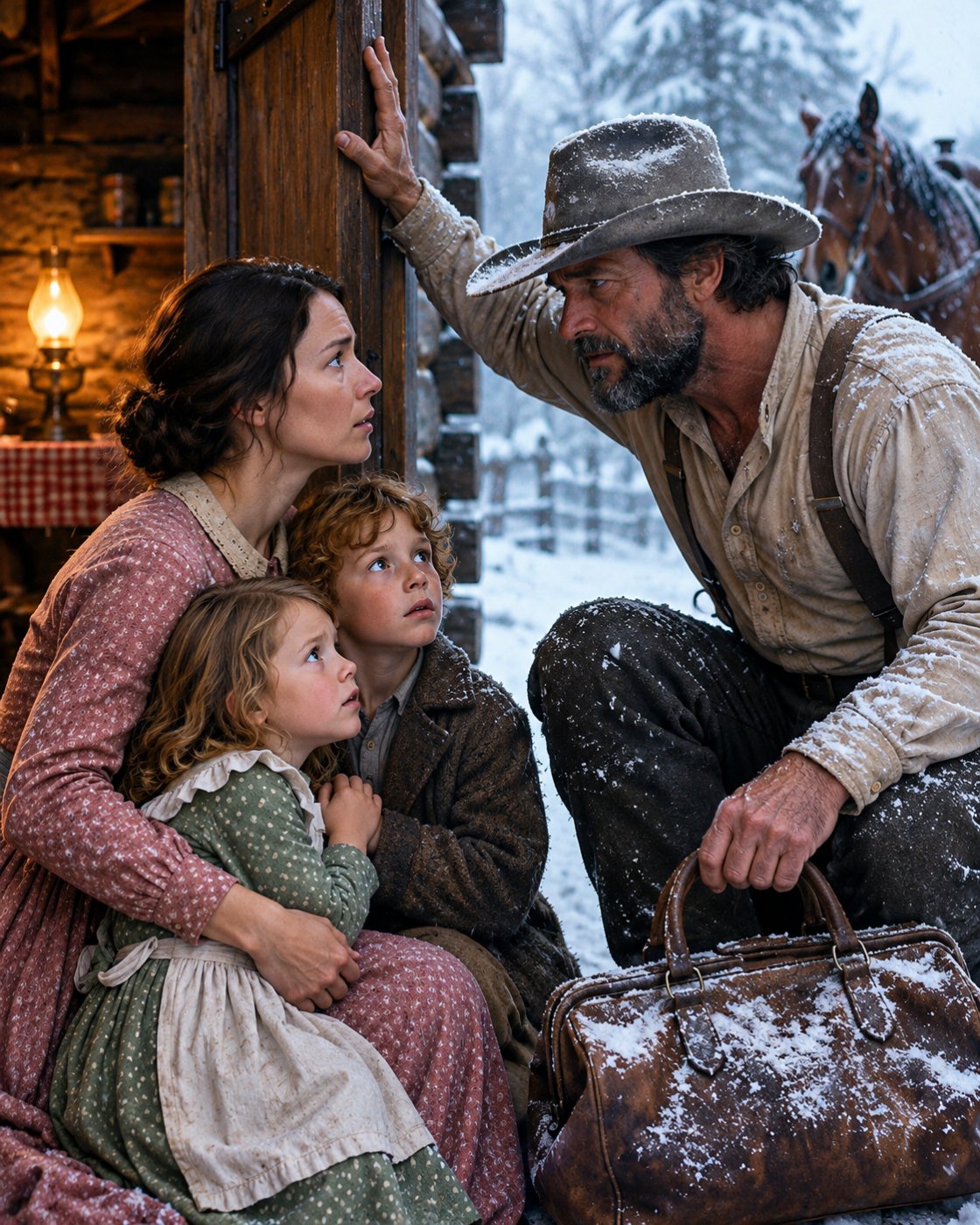
Hannah Whitmore stood motionless on the porch.
The elderly man beside the carriage looked older than she remembered. His once-dark hair had turned almost entirely white, and the shoulders that had seemed impossibly broad during her childhood were now slightly bent.
But his eyes were the same.
Samuel Bennett.
Her father.
The man she had not seen in ten years.
“Papa?”
His lips trembled.
“Hannah.”
For one terrible moment, neither moved.
Then Hannah stepped down from the porch.
Her father opened his arms.
And she ran into them.
He held her tightly, burying his face against her hair.
“My girl,” he whispered. “My beautiful girl.”
Hannah began to cry.
She had imagined this reunion a hundred times.
Sometimes she had pictured herself angry.
Sometimes she had imagined refusing to speak.
And sometimes, during the loneliest nights after Caleb died, she had wished only to hear her father call her name again.
Now he was here.
And all the words she had rehearsed disappeared.
“I'm sorry,” she whispered.
Her father shook his head.
“No, sweetheart. I'm the one who should be sorry.”
He stepped back and studied her face.
“You've grown so thin.”
Hannah laughed through tears.
“It's been a difficult winter.”
“I know.”
He glanced toward Wade.
“Your friend explained some of it.”
Hannah turned.
Wade stood beside the carriage, his hat in his hands.
He looked uncertain.
For a man who commanded twenty ranch hands and owned more land than most people could imagine, he suddenly seemed very uncomfortable.
Hannah wiped her cheeks.
“You wrote to him?”
Wade nodded.
“You told me once that you'd never had the courage to write home.”
She looked down.
“I didn't.”
“I thought perhaps someone should.”
Her father reached into his coat.
He withdrew a folded letter.
“Hannah, I received this four days ago.”
He held it out.
She recognized Wade's handwriting.
Her hands trembled as she opened it.
The letter was brief.
Mr. Bennett,
My name is Wade Kincaid. Your daughter Hannah lives near Cedar Creek in Wyoming Territory with her two children. Her husband passed away two years ago. She has endured great hardship, but she remains one of the kindest and strongest women I have ever known.
I believe she misses you.
If there is still love between you, I hope you will come before another winter passes.
Respectfully,
Wade Kincaid
Hannah lowered the paper.
“You told him about Caleb.”
Wade nodded.
“I thought he should know.”
Her father touched her shoulder.
“I never knew, Hannah.”
She looked at him.
“I wanted to tell you.”
“Then why didn't you?”
Her voice broke.
“Because I thought you hated me.”
Samuel Bennett closed his eyes.
“Oh, sweetheart.”
Ten years earlier, Hannah had married Caleb Whitmore against her father's wishes.
Caleb was charming, handsome, and full of promises.
He spoke of building a ranch in the West.
He promised Hannah a life filled with adventure.
And she believed him.
Her father had seen something different.
He saw a young man who borrowed money without repaying it.
A man who made promises easily and kept them rarely.
A man who loved grand plans more than hard work.
Samuel had begged his daughter to reconsider.
Hannah refused.
Their final argument had been terrible.
She had accused him of wanting to control her life.
He had accused her of throwing away her future.
And when she left, neither knew how to apologize.
Years passed.
Caleb's promises slowly collapsed beneath debt, disappointment, and bad decisions.
He wasn't a cruel man.
But he was careless.
And when illness took his life, Hannah was left with two children and a cabin standing on land he had never properly secured.
She had wanted to write to her father.
She had written the first sentence dozens of times.
Dear Papa…
But she never knew what to say next.
Now he stood before her.
Older.
Tired.
And holding the letter another man had finally sent.
Samuel took her hands.
“I was angry when you left.”
“I know.”
“I thought if I waited, you'd come home.”
Hannah wiped her eyes.
“I thought if I wrote, you'd send the letter back.”
Her father shook his head.
“Never.”
She looked at him.
“Not even after everything?”
He pulled her into his arms again.
“Not even then.”
A small voice interrupted them.
“Mama?”
Hannah turned.
Sam stood in the doorway with Milly beside him.
Both children were staring at the stranger holding their mother.
Hannah smiled through tears.
“Come here, sweetheart.”
Sam approached cautiously.
“This is your grandfather.”
The boy looked up.
“Grandpa?”
Samuel knelt.
His eyes filled.
“You must be Sam.”
The boy nodded.
“Mama says I'm named after you.”
Samuel's face crumpled.
“She did?”
Hannah smiled.
“Yes, Papa.”
The old man opened his arms.
Sam stepped forward.
And Samuel embraced the grandson he had never known.
Then Milly approached, clutching her rag doll.
“I'm Milly.”
Samuel smiled.
“And who's this?”
“Button.”
“A fine name.”
Milly studied him.
“Are you staying for supper?”
Samuel looked toward Hannah.
“I would be honored.”
The little girl smiled.
“Good. Mama makes the best bread.”
Hannah laughed.
“Only when we have enough flour.”
Wade cleared his throat.
“I believe we can arrange that.”
Everyone turned toward him.
For the first time that afternoon, Hannah smiled directly at him.
“Perhaps we can.”
That evening, the cabin was warmer than it had been in months.
Samuel sat beside the fireplace, listening as Sam described the horses on Wade's ranch.
Milly showed him her doll.
And Hannah prepared supper while Wade carried firewood from the lean-to.
When the children were occupied, Samuel stepped outside.
He found Wade stacking logs beside the porch.
“Mr. Kincaid.”
Wade straightened.
“Sir.”
Samuel studied him.
“You own the Bar K?”
“Yes.”
“Sixty thousand acres?”
“Approximately.”
The older man nodded.
“And yet you spend your evenings chopping wood for my daughter?”
Wade looked toward the kitchen window.
“She needs the help.”
Samuel smiled faintly.
“I've known wealthy men who wouldn't carry their own coats.”
Wade shrugged.
“Wood doesn't care how much money a man has.”
Samuel laughed.
Then his expression grew serious.
“My daughter has suffered.”
“I know.”
“She doesn't need another man making promises he can't keep.”
Wade met his gaze.
“I understand.”
“Do you?”
“Yes, sir.”
Samuel looked toward the house.
“Hannah was always generous. Even as a child, she'd give away her supper if someone else was hungry.”
Wade smiled.
“She hasn't changed.”
“No.”
Samuel paused.
“Are you in love with her?”
Wade went still.
For a moment, he considered denying it.
Then he remembered Hannah's face when she discovered the eviction notice.
The hurt.
The disappointment.
And the courage it had taken for her to listen when he returned.
“Yes,” he answered quietly.
Samuel nodded.
“Then be careful with her heart.”
Wade looked directly at him.
“I intend to.”
Over the following weeks, Samuel remained at Cedar Creek.
He helped repair the cabin roof.
He taught Sam how to carve small wooden animals.
And he spent long afternoons telling Milly stories about Hannah's childhood.
The children adored him.
Hannah sometimes stood in the doorway watching them, hardly believing that the family she thought she had lost was sitting together beneath her roof.
But the greatest change came from the land deed Wade had brought.
For the first time since Caleb died, Hannah owned her home without fear of eviction.
She could plant crops.
Keep livestock.
And make decisions about her children's future without wondering whether someone would arrive to order them away.
Wade visited regularly.
Sometimes he brought supplies.
Sometimes he helped repair fences.
And sometimes he came simply because he wanted to see her.
Hannah began looking forward to the sound of his horse approaching.
One afternoon, she found him repairing the broken gate beside the creek.
“You know,” she said, “you don't have to do that.”
Wade smiled.
“It's broken.”
“I can fix it.”
“I know.”
She leaned against the fence.
“Then why are you here?”
He stopped working.
For a moment, he looked almost embarrassed.
“Because I wanted to see you.”
Hannah smiled.
“That's a better answer.”
Wade set down his hammer.
“Hannah, may I ask you something?”
“Of course.”
“Have you forgiven me?”
Her smile faded.
She looked toward the creek.
“I believe you didn't intend to hurt us.”
He nodded.
“But?”
“But you signed papers without reading them because you thought the consequences would fall on strangers.”
Wade lowered his head.
“That's true.”
She turned toward him.
“I need to know that the man who helps my children is the same man who makes decisions at the Bar K.”
He looked up.
“I've changed how the company handles land agreements.”
“I know.”
“I personally review every document now. And the families along Cedar Creek have been given the chance to settle their claims fairly.”
Hannah studied him.
“Good.”
He stepped closer.
“Is that enough?”
She smiled sadly.
“It's a beginning.”
Wade nodded.
“I'll take a beginning.”
Spring came early that year.
The snow melted from the hills.
The creek swelled with clear water.
And green grass returned to the pastures.
Hannah planted a vegetable garden beside the cabin.
Sam helped build a small chicken coop.
Milly insisted that every hen needed a name.
Samuel laughed so often that Hannah sometimes wondered how they had survived so many years apart.
Wade continued visiting.
He never tried to purchase Hannah's affection.
He never suggested that she should be grateful because he had given her the deed.
Instead, he asked what she needed.
And sometimes, when she answered, he simply listened.
One evening, Hannah found him sitting on the porch with Sam.
The boy was holding a small wooden horse.
“Mr. Wade?”
“Yes, son?”
“Do you have children?”
Wade went quiet.
“No.”
“Did you ever want any?”
He looked toward the sunset.
“Once.”
Sam considered that.
“Why don't you have them?”
Wade swallowed.
“Life didn't turn out the way I expected.”
The boy nodded.
Then he held out the wooden horse.
“You can have this one.”
Wade stared.
“Sam, your grandfather made that for you.”
“I know.”
“Then why would you give it away?”
The boy shrugged.
“Because you look sad sometimes.”
Wade's eyes filled.
He accepted the little horse.
“Thank you, son.”
Hannah stood in the doorway, watching.
Something in her chest tightened.
She had seen Wade command ranch hands, negotiate cattle sales, and ride through storms.
But she had never seen him look so vulnerable.
And in that moment, she understood that his wealth had not protected him from loneliness.
A week later, Wade invited Hannah and the children to visit the Bar K Ranch.
Samuel accompanied them.
The journey took them across miles of open grassland.
When they reached the main house, Hannah stopped in astonishment.
It was enormous.
A broad veranda stretched across the front.
Tall windows reflected the afternoon sunlight.
And beyond the house stood barns, corrals, and pastures filled with cattle.
Sam stared.
“Mr. Wade, you live here?”
Wade smiled.
“Most days.”
Milly looked toward the house.
“It's bigger than our whole cabin.”
“Quite a bit bigger,” Wade admitted.
Hannah studied the building.
“It's beautiful.”
He looked at her.
“It's also very quiet.”
They entered.
The rooms were spacious.
The furniture was expensive.
But the house lacked something Hannah couldn't immediately name.
There were no children's drawings.
No toys beside the fireplace.
No boots scattered near the door.
No laughter echoing through the hallway.
It was a grand house.
But it didn't feel lived in.
Wade noticed her expression.
“What do you think?”
Hannah looked at him.
“I think it must be lonely.”
He smiled faintly.
“It is.”
She turned toward him.
“Then why do you stay here?”
“Because it's where I've always lived.”
“That isn't much of an answer.”
He laughed.
“No.”
They walked onto the veranda.
The children were exploring the garden with Samuel.
Wade leaned against the railing.
“My parents died when I was young. I inherited the ranch before I knew what to do with it.”
Hannah listened.
“I spent years trying to prove I deserved it.”
“And did you?”
He shrugged.
“I made it bigger.”
“That wasn't my question.”
Wade looked at her.
“No.”
She stepped closer.
“What would make you feel you deserved it?”
He looked toward the children laughing in the garden.
Then back at Hannah.
“I think I've been asking the wrong question.”
She smiled.
“Perhaps.”
That summer, Wade asked Hannah if he might court her properly.
He came to the cabin wearing a clean shirt and carrying a small bouquet of wildflowers.
Samuel answered the door.
“Mr. Kincaid.”
“Mr. Bennett.”
The older man looked at the flowers.
“Business or pleasure?”
Wade smiled nervously.
“Hopefully both.”
Samuel stepped aside.
“Hannah!”
She appeared from the kitchen.
When she saw Wade, she laughed.
“You look as though you're about to negotiate a railroad contract.”
“I'd rather negotiate ten.”
She smiled.
“What brings you here?”
Wade held out the flowers.
“I'd like permission to court you.”
Hannah stared.
“Properly?”
“Yes.”
“With my father watching?”
“If he'll allow it.”
Samuel folded his arms.
“I'll be watching closely.”
Wade nodded.
“I expected that.”
Hannah laughed.
Then she accepted the flowers.
“Yes, Wade.”
His face changed.
“Yes?”
“Yes. You may court me.”
He smiled so broadly that Milly began giggling.
Their courtship was simple.
Wade took Hannah riding along the creek.
They shared picnics beneath cottonwood trees.
He helped Sam learn to ride.
And he listened patiently while Milly explained the complicated personalities of her chickens.
Sometimes Hannah cooked supper at the Bar K.
Sometimes Wade ate at her little cabin.
And every time he sat at her table, he remembered the night she had fed him her children's last bread.
One evening, he brought a loaf from the ranch kitchen.
Hannah smiled.
“What's this?”
“A debt.”
She laughed.
“Wade, you've repaid that bread a hundred times.”
He shook his head.
“Not the important part.”
She looked at him.
“What part?”
He took her hand.
“You gave me something without asking who I was.”
Hannah smiled.
“You were cold.”
“And you were hungry.”
“Yes.”
“You had almost nothing.”
She nodded.
“And you still shared it.”
Hannah squeezed his hand.
“That's what people are supposed to do.”
Wade looked at her.
“I'd forgotten.”
She touched his cheek.
“Then I'm glad you remembered.”
In September, Wade proposed.
He took Hannah to the hill overlooking Cedar Creek.
The sun was setting behind the mountains.
Below them, the little cabin stood beside the water, surrounded by the garden she had planted.
Wade removed his hat.
“Hannah.”
She smiled.
“You look nervous.”
“I am.”
“Why?”
He took a breath.
“Because I've owned thousands of cattle and sixty thousand acres, but I've never wanted anything as much as I want a life with you.”
Her eyes filled.
He reached into his pocket.
Inside a small box rested a simple gold ring.
“Hannah Whitmore, will you marry me?”
She looked at the ring.
Then at the man who had once arrived at her door half-frozen and penniless.
“Wade…”
He waited.
She smiled through tears.
“Yes.”
He closed his eyes.
Then he laughed softly.
“Thank God.”
She stepped into his arms.
He kissed her.
And for the first time in ten years, the richest rancher in the territory felt that he had finally found something money could never purchase.
They married in October.
The ceremony took place beside Cedar Creek.
Samuel Bennett walked his daughter down a path lined with wildflowers.
Sam carried the rings.
Milly scattered petals from a small basket.
And Wade stood waiting beneath a cottonwood tree.
When Hannah reached him, he whispered, “You look beautiful.”
She smiled.
“You look warmer than the first time we met.”
He laughed.
“Much warmer.”
The minister spoke the vows.
They exchanged rings.
And when Wade kissed his bride, the children cheered.
Afterward, the entire community gathered for supper.
There was roast beef, fresh bread, potatoes, and enough food for everyone.
Hannah stood beside the table, watching the guests laugh and talk.
Wade approached.
“What are you thinking?”
She smiled.
“About the night you came to our door.”
He nodded.
“I remember.”
“We had almost nothing.”
“And you gave me everything.”
She shook her head.
“Only bread.”
He took her hand.
“No, Hannah.”
He looked toward Sam and Milly.
“You gave me a reason to become a better man.”
Her eyes filled.
“And you gave us a future.”
Years later, people still told the story of the poor widow who had fed a freezing stranger.
Some remembered the blizzard.
Others remembered the eviction notice.
And a few remembered the day the richest rancher in the territory rode back to Cedar Creek carrying a deed that saved a family's home.
But Hannah remembered something different.
She remembered the sound of a knock at her door.
The sight of a stranger trembling in the cold.
And the moment she decided that no one should be turned away simply because they had nothing to offer.
One winter evening, many years after their wedding, Hannah and Wade sat together beside the fireplace at the Bar K Ranch.
Sam and Milly were grown.
Samuel had passed away peacefully years earlier.
And the house that had once been so quiet was now filled with grandchildren, laughter, and the smell of fresh bread.
Wade reached for Hannah's hand.
“Do you ever regret opening that door?”
She smiled.
“Sometimes.”
He looked surprised.
“Sometimes?”
“When you leave your boots in the hallway.”
He laughed.
“And when else?”
“When you insist on chopping wood in a snowstorm.”
He grinned.
“Anything else?”
She leaned against him.
“When you pretend you don't need anyone.”
Wade smiled.
“I stopped pretending years ago.”
Hannah kissed his cheek.
“I know.”
He looked toward the fire.
“You saved my life that night.”
She shook her head.
“You were cold. Anyone would have helped.”
“No.”
He turned toward her.
“Not everyone would have shared their children's last meal.”
Hannah smiled softly.
“It was only bread.”
Wade squeezed her hand.
“And it was the first thing anyone had given me in years without wanting something in return.”
She rested her head against his shoulder.
“Then I'm glad I had enough to share.”
Outside, snow began falling across the ranch.
Inside, the fire burned warmly.
And the richest man in the territory sat beside the woman who had loved him before she knew his name.
Because sometimes the greatest treasure a person can give isn't money, land, or gold.
Sometimes it's a piece of bread offered to a stranger.
And sometimes that small act of kindness becomes the beginning of a love that lasts a lifetime.