Part 3 ⚖️
Clara didn’t look at the riders.
She didn’t speed up. She wouldn’t give them the satisfaction of watching her hurry.
“Thank you for the message,” she said pleasantly. “Good evening.”
They fell back into the dark.
At home, she sat at her kitchen table, hands flat on the wood.
She let herself be afraid for exactly two minutes.
Then she stopped.
Harrison Vale had just made the first real mistake of his life.
He had scared Clara Bellamy.
And in thirty years, fear had never once made Clara retreat. It made her immovable.
Wednesday morning, Everett rode up fast.
“Cole got word back. Judge Alderman is coming.”
Weeks earlier, Everett had sent his friend Cole Garrett riding to Billings with two of the most important documents. They went to a circuit judge who wasn’t in Vale’s pocket.
“There’s more,” Everett said. “Alderman’s been investigating Vale for four months. He just needed someone from inside with proof.”
Clara’s eyes widened. “You’re not just a man with a false accusation against him. You’re the witness he’s been waiting for.”
Forty minutes later, Mrs. Hatch knocked on Clara’s door with fresh poison.
“People are saying your Mr. Callahan has a history of targeting lonely widows. A man at the general store said he did it in Colorado.”
Clara’s blood went cold.
Vale wasn’t just trying to win Friday.
He wanted to destroy Everett forever, and he was using her as the proof. The lonely, oversized widow who trusted too much.
When she closed the door, Everett was standing in her kitchen, gray-faced.
“If you want to step back from this, Clara, I’ll understand…”
“Stop,” she said. “Every time you say that, what I hear is you don’t believe I know my own mind. That’s the one thing I have no patience for.”
He swallowed. “Understood.”
“Good. Now who’s the man at the store?”
His name was Declan Crisp, a fixer from Vale’s Wyoming days.
“He doesn’t lie,” Everett said. “He takes true things and twists them. I fixed a widow’s fence in Colorado once. Martha Dunbar. Three weeks. She fed me. That’s all it was.”
Clara went very quiet.
Then she pulled out paper and pen.
That afternoon, she went back to the two ranching families.
May Rourke already had her father’s original land survey wrapped in oilcloth.
“I’ve been waiting two years for someone to walk through that gate who’d actually do something,” May said. “We’ll be there.”
Jacob Ashworth was harder. “If this judge doesn’t rule for us, I’ve stood up against the most powerful man in the county.”
“That’s true,” Clara said. She didn’t soften it. “But whatever happens, you still live next to him.”
His quiet wife, Susan, finally spoke. “My mother’s family lost their land to a man like Vale. Nobody did anything.” She looked up. “We’ll be there.”
On Thursday, Clara walked into town with a market basket.
On top sat two jars of preserves. Underneath was her wooden box with the rest of Everett’s documents.
Nobody stopped her.
The judge’s clerk took the basket and blinked. “The judge would like to meet you. He wants to know who got two frightened families to testify in under 48 hours.”
Judge Alderman was sharp-eyed and precise. Clara told him everything.
“One more thing,” she said, standing to leave. “Crisp doesn’t lie. He reframes. Watch the gap between what he says he saw and what he says it means.”
Alderman nodded slowly. “That’s an extremely useful observation, Mrs. Bellamy.”
Three blocks from the hotel, a hand gripped her arm.
Harrison Vale. He was alone this time, and he wasn’t smiling.
“You went to Alderman.”
She said nothing.
He leaned in, cold and certain. “You’re a widow with no money, no family and no standing. Do you understand what I can take from you?”
Clara looked at him the way she’d looked at everyone who ever tried to shrink her.
“I understand what you think you can take,” she said. “But you made the mistake men like you always make, Mr. Vale. You looked at me and saw everything I don’t have.”
She stepped back.
“You never looked long enough to see what I do.” 🔥
She walked away without hurrying.
Behind her, Vale just stood there.
That night, Everett sat on her porch steps under the huge November sky.
“I’ve been alone a long time,” he said quietly. “Alone in rooms full of people. Then came the letters, and I wasn’t alone anymore. Even before I knew your face.”
He turned to her.
“Whatever happens tomorrow, it’s not the thing I’m most afraid of losing.”
Clara met his eyes.
“I know who you are, Everett. I’ve known for two years. The face is just the face.”
She looked up at the stars.
“I’ve spent my whole life bracing for disaster. I’ve forgotten how to stand in the middle of a good thing and let it be good.” Her voice softened. “This is a good thing.”
Friday morning, Willow Creek Church was packed.
Vale sat in the front row. Eli Marsh and Declan Crisp sat beside him.
Marsh spoke first. He was polished and rehearsed. He told the room Everett had burned a supply depot in Laramie in 1884.
Everett stood up calmly.
“I was in Cheyenne that entire autumn, working a cattle contract for the Henderson outfit. Signed. Dated. Delivery logs for every week. I gave copies to the sheriff three days ago.”
Sheriff Bradley shuffled his papers and found it. His face changed.
Marsh shifted in his seat.
Then Crisp stood.
He was smooth and warm, and he never quite said anything false.
Callahan moves around a lot. Shows up at vulnerable properties. A widow in Colorado. Weeks on her land. “Payment” involved.
He let the silence do the rest.
Clara felt the room turning cold.
“Does anyone wish to speak on Mr. Callahan’s behalf?”
Clara stood up.
Every head turned.
She knew what they saw: a large woman in a brown dress and good boots, standing without permission.
“My name is Clara Bellamy. I have something this room needs to hear.”
She pulled a letter from her bag.
“Mr. Crisp mentioned a widow in Colorado. Her name is Martha Dunbar. She lives in Pueblo. Days ago, I wrote to her.”
The room went dead silent.
“She wrote back. Everett Callahan fixed her fence after her husband died and refused payment. The only money that changed hands was one dollar she forced on him, because his boots wore through while he worked.”
She laid the letter on the sheriff’s table.
“She also says she’s embarrassed for any community that would call a man who helped her without being asked a predator.”
In the front row, Vale flinched.
He had never imagined a lonely widow could reach across state lines in two days.
“And since Mr. Crisp is implying Everett preys on lonely women,” Clara went on, “I’m one of those women.”
She looked straight at the crowd.
“He fixed my fence. Freed my wagon from the mud. Not once did it come with conditions. I was not taken advantage of. I was treated with respect. I’d ask this room to learn the difference.” 💪
Then May Rourke stood.
She laid her father’s original survey on the table. “Harrison Vale moved a line on a map and took forty acres my father built with his own hands.”
Jacob Ashworth stood next. His hands shook and his voice cracked twice.
That’s what made him so powerful.
Then the church door opened.
Judge Alderman walked in.
The whole room straightened without meaning to.
“Sit down, Sheriff. This hearing now intersects with a federal inquiry I’ve been running for four months.”
Crisp started to rise. “Your Honor, if I might…”
“Sit down, Mr. Crisp. I know who you are and who hired you. Everything you say now is on record.”
Crisp sat faster than anyone had ever seen him move.
For twelve minutes, Alderman laid it all out. The stolen survey lines. The letters between Vale and his brother naming the families he planned to push out.
“A sworn statement known to be false,” he said, looking at Marsh, “is perjury.”
Marsh went the color of old paper.
Then Alderman turned to Everett.
“Mr. Callahan. The documents you protected for seven years, at your own risk, are the foundation of this case.”
He didn’t soften the rest.
“You also failed to act once, seven years ago. Both things are true. This won’t erase either one. But the record will be honest.”
Everett nodded.
“Yes, sir. That’s all I ever wanted.”
Before noon, it was over.
Vale sat in silence. Crisp vanished. And Vale’s own men were sent to his ranch to make sure he didn’t leave town. ⚖️
When the church emptied, Everett found Clara by the door.
“You wrote to a stranger in Colorado to prove I was telling the truth.”
“I wrote to a woman who deserved to be asked about her own life,” Clara said. “Helping you was secondary.”
He almost laughed.
Then his face opened completely. It was the look she’d spent two years imagining.
“You said you needed time. Have you had enough?”
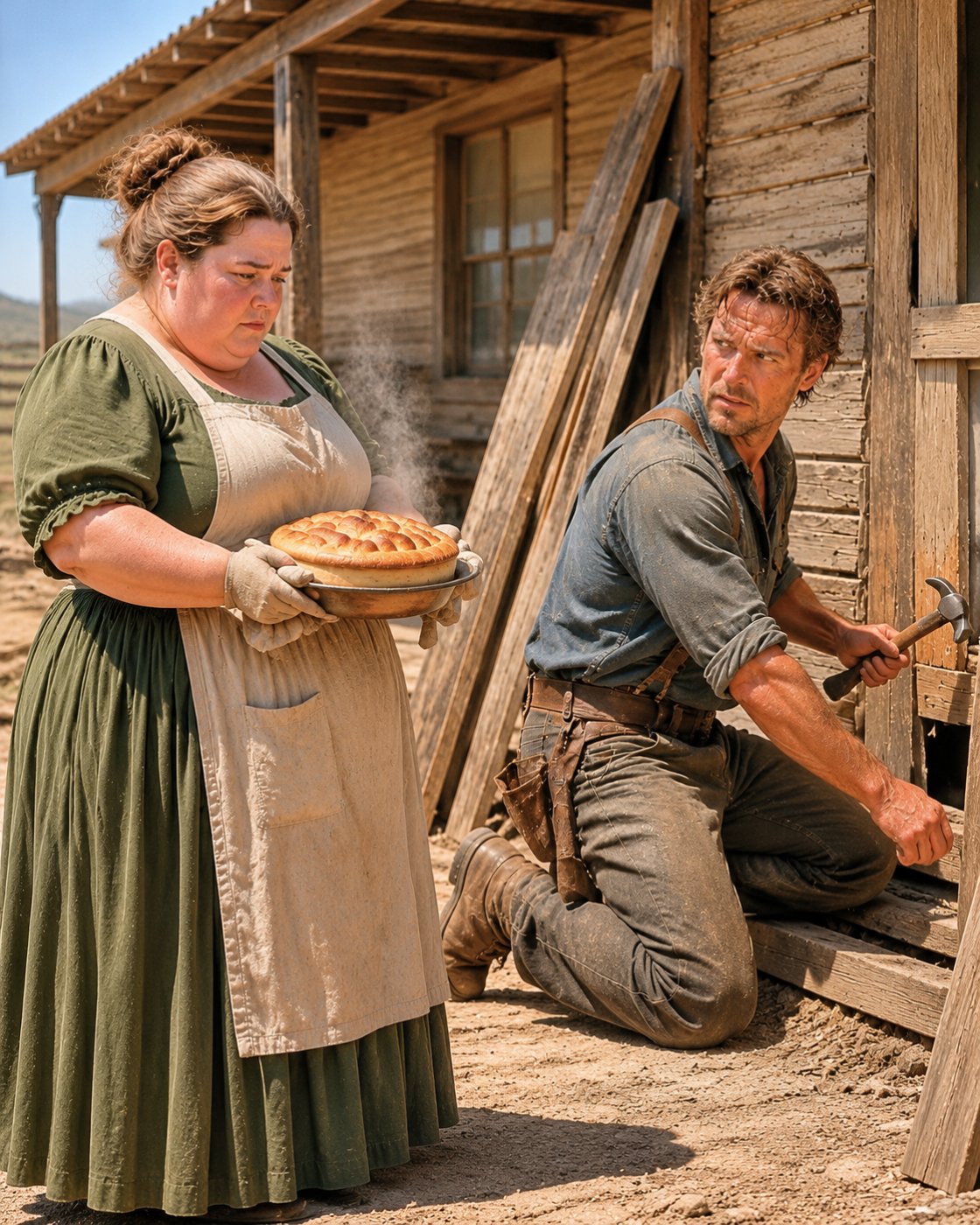
She thought about 47 letters in a wooden box. A pie she swore meant nothing. A man sitting on her porch in the cold because he wasn’t ready to leave.
She thought about all the years she believed she was the kind of woman nobody chooses.
She thought about being wrong.
“Yes,” she said softly. “I’ve had enough time.”
He reached out and took her hand right there in the empty church.
She let him. 🤍
The inquiry took three months.
In February, Alderman ruled.
Vale’s operation was shut down. Stolen land was returned. Eli Marsh was charged with perjury.
Margaret Fairfield, the mother who once stood at Everett’s gate with her two children, was found in Nebraska. She received a settlement.
Everett mailed her a personal letter.
It cost eleven cents.
Clara never asked what it said. She thought she knew.
In March, Mrs. Hatch showed up with a jar of plum preserves.
“I was wrong about him. I wanted you to know I know it.”
Clara poured her coffee and meant it.
One April morning, Clara found an envelope tucked into her door frame.
There was no stamp. Just her name, in that large, uneven handwriting she’d loved before she ever saw the hand behind it.
Clara,
I’ve spent two years writing to you from the wrong side of every distance. I don’t know how to write to someone who is a mile away and still the only person I want to write to.
So I’ll say it plain, the way you taught me.
I’d like to court you properly. Dinners at Mercer’s. Walks on the ridge road. I want to choose you out loud, in front of anyone who’s watching.
You’ve been chosen, Clara. Since long before either of us understood it. I just want you to know it.
— W
P.S. I have the coffee on, if you’d like some.
Clara read it once.
She stood up and laced her good brown boots.
She walked north.
He was waiting on the porch. He’d been watching for her.
“I got your letter,” she said.
“I know.”
“Dinner at Mercer’s is fine. But I’ve been properly courted before. It’s not as impressive as people say.”
“I wasn’t thinking about impressive,” Everett said. “I was thinking about honest.”
She thought about everything that had passed between them. Eleven cents. Forty-seven letters. A pie. A barn in the first snow. A church on a Friday morning.
Honest was the truest word anyone had ever used for what they were.
“Honest is good,” she said.
He held out his hand.
She took it.
They went inside for coffee, and the door closed behind them on a big, quiet Montana morning.
Clara Bellamy had spent years believing she was the kind of woman nobody chose.
She’d been wrong.
And the man who proved it didn’t do it with grand gestures.
He did it with forty-seven letters written in the dark, kept safe across a thousand miles. Even before he knew her face, he understood she was worth keeping. 💌✨
✨ Some love stories begin with a look across a crowded room. The best ones begin with two people brave enough to be honest about being alone.
💬 Do you believe you can fall in love with someone through their words before you ever see their face? Tell us below 👇