PART 3
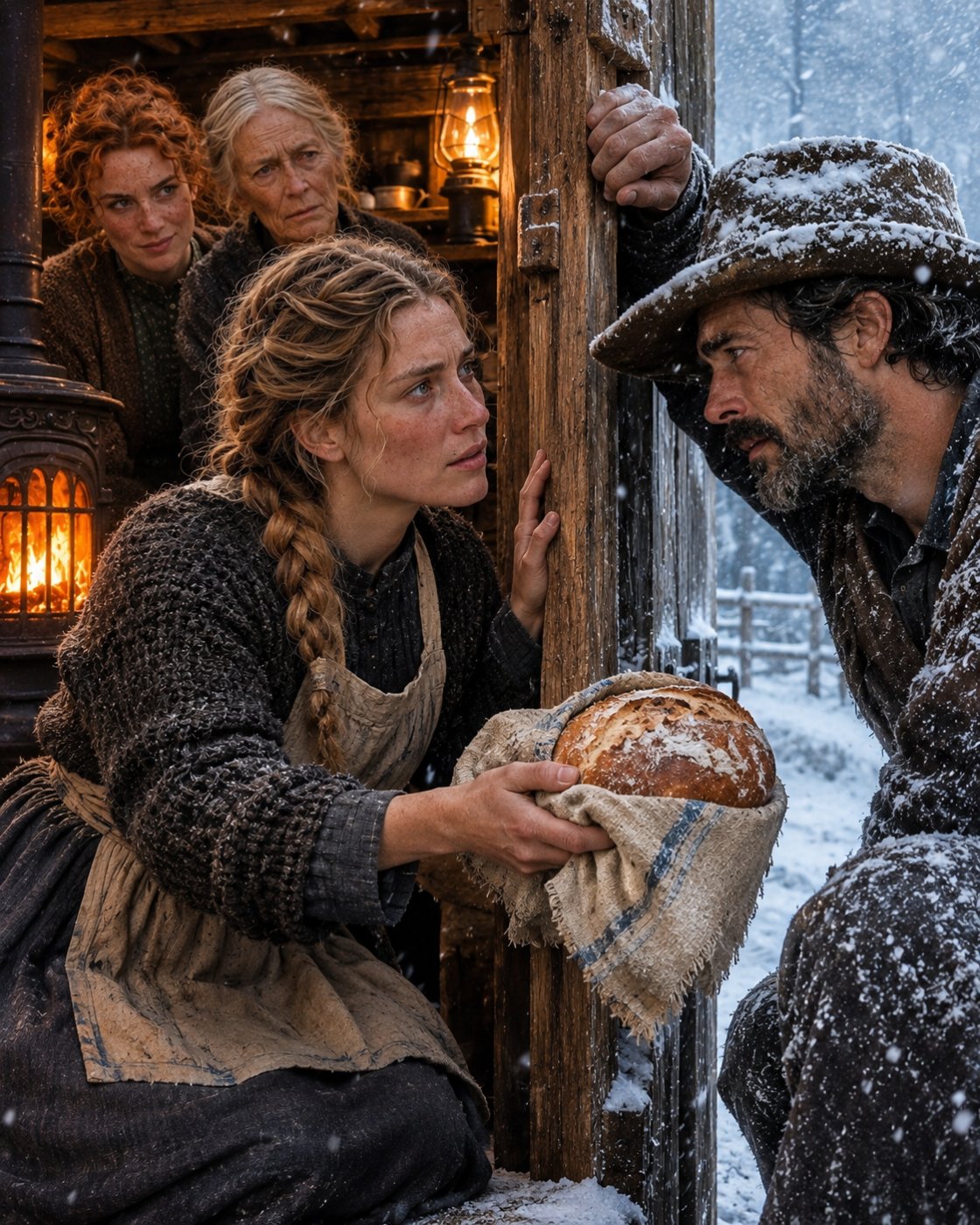
In case you missed it: In the brutal Montana winter of 1887, penniless widow Nora Ames gave her last loaf of bread to a half-frozen stranger who knocked on her door in a blizzard.
He read her a notice saying Gerity Land and Cattle was taking every claim along Sparrow Creek.
Then she prayed for "poor, lonely Mr. Gerity," not knowing the stranger was Wade Gerity himself.
He kept coming back to help, in her late husband's coat, but he couldn't bring himself to tell her the truth.
Then his own lawyer, Mr. Stroud, arrived with an eviction order: five hundred dollars by the fifteenth, or get out.
Nora stood in the doorway of her cabin and read the paper in her hand.
She couldn't read most of it.
It was full of words like whereas and heretofore and pursuant.
But she could read the numbers.
Five hundred dollars.
The fifteenth of February.
And she could read the last line, which was in plain English, in heavy black letters at the bottom: The premises shall be vacated.
"Mr. Stroud," she said.
"I had your paper.
The first one.
It said the thaw.
It said we had until the thaw".
Mr. Herbert Stroud was a thin, neat man of fifty, with a thin, neat mustache and a black overcoat with a fur collar.
He sat his fine bay horse at the edge of her yard and did not get down.
He was smiling slightly.
"That was a courtesy, Mrs. Ames," he said.
"This is the order.
Your husband's claim on this land was never filed with the land office in Helena.
I've checked the records myself.
Daniel Ames never filed, never proved up, never paid the fee.
You've been squatting here seven years".
He touched the brim of his hat.
"Living on our water".
Nora's hand tightened on the doorframe.
"Then let me pay the filing," she said.
"Myself.
Now.
What does it cost?"
"Five hundred dollars," said Stroud pleasantly.
"By the fifteenth.
To the company, which now holds the prior claim.
That's two weeks".
From behind Nora, Bess Ames made a sound like a laugh with no humor in it.
"Five hundred dollars," the old woman said.
"She gets thirty cents a basket for other people's washing, you long drink of water.
Thirty cents.
You do the arithmetic".
Stroud looked at Bess.
His smile didn't change.
"Then she'd best start packing," he said.
"Two weeks.
After the fifteenth, the company needs the logs off this cabin for fence rails along the north line".
He gathered his reins.
"Nothing personal, ma'am.
You're simply in the way of the water".
He turned his horse and rode off down the creek road, at an easy trot, toward the next cabin.
Nora stood in the doorway for a long time after he'd gone.
The cabin behind her had one room and a loft.
Dan Ames had built it with his own hands the summer they came out from Iowa, when she was nineteen and still believed everything he told her.
The chinking was coming out of the logs on the north wall.
The roof leaked in two places, or had, until Wade patched it last week.
There was a cookstove that drew badly, a table Dan had made of split pine, two chairs, one bed for Bess, and a pallet by the fire for Nora.
It wasn't much.
It had never been much.
But it was hers.
Every scrubbed floorboard.
Every patched curtain.
Every jar on the shelf.
For seven years, through Dan's drinking and Dan's gambling and Dan's lies and, at the last, Dan's dying, she had held this place together with her two hands.
She had held it together after the funeral.
She'd held it together with washing at thirty cents a basket, and scrubbing other people's floors, and pretending to eat at the Hollisters' when she hadn't eaten at all.
And it was all going to come down for fence rails.
"Nora," said Bess quietly behind her.
"Come in out of the cold, child".
Nora came in and shut the door.
She sat down at Dan's pine table and put the paper in front of her and looked at it.
"Five hundred dollars," she said.
She didn't cry.
She hadn't cried since the funeral.
She had found out the night they buried Dan that if she started, she might not be able to stop.
So she'd simply stopped starting.
Instead, she got up and went to the shelf above the bed.
She took down a small wooden box.
She opened it.
Inside, on a scrap of faded blue velvet, lay a gold ring.
It wasn't her wedding ring.
Dan had pawned that in the second year, in Helena, for a stake in a card game.
He'd never redeemed it.
This one was older and finer, a thin band of rose gold engraved inside with two sets of initials and a date.
H.
W.
and M.
W.
1849.
It had been her mother's.
Her father had given it to her mother on their wedding day in Ohio.
When her mother died, the winter Nora was fifteen, her father had taken it off his own finger, where he'd worn it on a ribbon, and put it in Nora's hand.
"For your wedding day, Nora," he'd said.
"From both of us".
Then she'd married Dan Ames against his every word.
And she'd left Iowa without saying goodbye.
She'd never written.
Not once in nine years.
But she'd kept the ring.
She sat at the table with it in her palm for a long time.
The next morning, she walked into Tibbs's Mercantile and laid the ring on the counter.
Calvin Tibbs picked it up between his thumb and finger.
He held it up to the window.
He bit it.
He turned it over and read the inscription.
"Three dollars," he said.
Nora stared at him.
"Mr. Tibbs.
It's gold.
Rose gold.
It was my mother's".
"I know it's gold, Mrs. Ames.
That's why I'm offering three dollars and not two".
He set it down on the counter.
"And that's Christian of me".
"It's worth thirty if it's worth a penny".
"Then take it to Helena," said Tibbs.
"If you can find a ride.
And find somebody in Helena who wants a dead woman's ring with somebody else's initials in it".
He shrugged.
"Three dollars".
Nora looked at the ring on the counter.
Five hundred dollars, and two weeks, and three dollars.
"Keep it, ma'am," Tibbs said, with a small, unpleasant smile.
He pushed it back across the counter toward her.
"Keep it.
You'll want something to remember the place by".
She picked it up and walked out of the store without a word.
Wade came that evening, as he had every evening, with a sack of flour on his shoulder.
He found Nora sitting at the table with the paper in front of her.
She didn't get up.
She didn't say hello.
She just pushed the paper across the table toward him, the same way she had the first night.
"They're putting us out, Wade," she said.
"Two weeks".
He read it.
He read it slowly, all the way to the bottom.
And as he read it, Nora watched his face go gray.
"This is dated last week," he said.
"Does it matter?"
He looked at the date again.
February first.
Three days after he'd stood in Stroud's office and said, Hold it.
Nothing goes out until I say.
"It matters," Wade said quietly.
"It's not only us," said Nora.
She got up and went to the window.
"Bess went down the creek this afternoon.
To the Hollisters.
To the Pruitts.
The Nakamuras.
The Lindgrens.
It's every family on Sparrow Creek, Wade.
Nineteen families.
All the same paper.
All the same date.
Two weeks".
She pressed her hand against the cold glass.
"Mrs. Hollister has five children.
Old Mr. Pruitt is seventy-eight.
The Nakamuras just buried their baby in October.
Where are they going to go? In February? In Montana?"
Wade didn't answer.
"Everything I've held together," said Nora.
Her voice was very flat.
"Seven years.
Everything.
Two weeks".
He stood up and came across the little cabin and stood behind her at the window.
"Nobody's taken this house yet, Nora," he said.
She turned around and looked at him.
"You've got a borrowed coat," she said, "and a good heart, Wade.
I know that.
I'm grateful for it.
But they've got lawyers.
They've got a paper with a seal on it.
They've got the biggest cattle company in Montana Territory".
She shook her head.
"What can a man who can't split wood do against that?"
Wade looked down at her.
"Give me until the fifteenth," he said.
"That's all I'm asking.
Just trust me until then".
She looked up at him for a long time.
Something moved in her face.
Hope, maybe.
Or the fear of it.
"You're the only friend I've got left," she said quietly.
"Besides Bess".
She paused.
"Whatever you are, mister, now would be the time".
He couldn't say it.
He opened his mouth, and he looked at her face, and he couldn't say it.
Not now.
Not with her standing in front of him with that paper in her hand, about to lose everything, because of his signature.
"Until the fifteenth," he said again.
And he went out into the dark.
Eli Brand was waiting for him at the Gerity headquarters, three hours later, in the big stone house on the bench above the Yellowstone.
He was sitting in the dark kitchen with a cup of coffee gone cold, the way he'd been sitting for eleven years whenever his boss rode out alone at night.
Wade came in and slapped the eviction notice down on the table in front of him.
"February first," he said.
"Three days after I told Stroud to hold it".
Eli read it.
He didn't look surprised.
"Boss," he said slowly.
"I been meaning to tell you something for a while".
Wade sat down across from him.
"I was in the front office this morning, when Stroud was talking to the Chicago men," said Eli.
"The buyers.
From the packing company".
He set his cup down.
"He told them the creek would be ours free and clear by the first of March.
Every claim.
Thirty thousand dollars a year in water rights, once the valley's fenced.
He said it like it was already done".
"And the families?"
Eli looked at his coffee.
"He called her a washerwoman, boss.
Mrs. Ames.
He said, 'And there's some washerwoman sitting right on the best piece, at the creek mouth.
' He said they'd pull her cabin down for fence rails".
Eli's jaw tightened.
"One of the Chicago men asked about you.
Said wasn't Mr. Gerity holding off on the creek? And Stroud laughed.
He said, 'The boss signs whatever I put in front of him.
'"
The kitchen was very quiet.
Wade Gerity sat at his own kitchen table and looked at his own signature on the bottom of the paper.
Large and black and careless.
W.
J.
Gerity.
"One wire ends this, boss," said Eli quietly.
"One wire to Helena, and Stroud's done, and every one of those papers is torn up by the end of the week.
She'd never have to know who you are.
You could keep on coming down there in Dan Ames's coat and splitting toothpicks for the rest of your life, and she'd never have to know".
Wade was quiet for a long time.
"That's how I got here, Eli," he said at last.
"Not knowing.
Not reading.
Not looking.
Letting other men put papers in front of me and signing my name without asking what was in them".
He looked up.
"How many of these did I sign? In the last five years? Without reading them?"
Eli didn't answer right away.
"All of them, boss," he said finally.
"Pretty near all of them.
Since Mrs. Gerity passed".
Wade closed his eyes.
His wife, Margaret, had died in the spring of '81.
Five years and nine months ago.
And after the funeral, he'd come back to this big stone house and shut her Bible in the bottom drawer of his desk, where his mother's Bible already lay, and he'd stopped reading anything at all.
Letters.
Ledgers.
Contracts.
Newspapers.
He'd ridden the range and worked his cattle and bought more land, and more, and more, and left the papers to Stroud.
He'd told himself it was because he trusted Stroud.
It wasn't.
It was because he didn't care.
He hadn't cared about anything in five years.
Until a woman with flour on her hands had given him her last bread, and prayed for him by name, and called him lonely.
"Nineteen families," he said.
"On Sparrow Creek.
I don't know one of their names, Eli.
Not one.
They've been on my creek seven years, some of them, and I couldn't tell you a single name".