PART 3
The flames climbed higher than the fence posts.
For one terrible moment, Eli Wade stood motionless in the dark, staring at the orange light spreading across Clara Baines's cornfield.
The crackling stalks sounded like the prairie grass that had burned seventeen years earlier.
He could almost hear Davey calling his name.
His younger brother had been seventeen when the fire swept through their camp. Eli had been drinking in a saloon miles away, convincing himself that he had plenty of time to return.
By the time he reached the camp, the fire had already taken everything.
For years, that memory had followed him.
Now it was happening again.
The smoke.
The heat.
The terrible knowledge that someone he loved might be trapped beyond his reach.
"Eli!"
Clara grabbed his shoulders.
He barely heard her.
"Eli, look at me!"
His breathing came in short, painful gasps.
"Davey," he whispered.
Clara understood.
She placed both hands against his face and forced him to meet her eyes.
"You're not there anymore."
The flames roared behind them.
"You're here, Eli. With me."
He blinked.
"Clara..."
"You're not too late this time."
Something changed in his expression.
She tightened her grip.
"I need you here now."
Eli looked toward the farmhouse.
Birdie was standing beside the porch, terrified.
The barn was only a few yards from the burning field.
And the wind was pushing the flames directly toward them.
Eli drew a sharp breath.
Then he moved.
"Birdie!" he shouted. "Get on my horse and ride to the neighbors. Wake everyone. Tell them we need water, shovels, and every able-bodied man they can send!"
Birdie ran.
"What about you?"
"I'm staying with your mother!"
The girl hesitated.
Eli looked directly at her.
"Go, little bird. Now!"
She mounted and galloped into the darkness.
Eli turned toward Clara.
"We need wet sacks along the yard. I'll plow a firebreak between the corn and the house."
Clara stared at him.
"There's not enough time!"
"Then we'll make time."
He grabbed a shovel.
"And if the fire reaches the last rows, we'll burn a strip ahead of it."
Clara's eyes widened.
"Set fire to my own field?"
"Fire can't eat what has already burned."
She looked toward the dry corn.
Months of work.
Their only hope of paying Josiah's debt.
Everything she had struggled to preserve.
Then she looked toward the farmhouse.
The place where Birdie had been born.
The place where she had buried her dreams after Josiah died.
"Do it," she whispered.
Eli nodded.
Together, they began fighting for the home that neither of them was ready to lose.
The first neighbors arrived twenty minutes later.
Then more followed.
Lanterns bobbed along the road as men came running with buckets and shovels.
Women carried wet blankets.
Hester Quill arrived in her nightdress beneath an old wool coat, furious at being awakened but determined to help.
"Where's Clara?" she shouted.
"By the barn!"
Hester hurried toward her.
Birdie had ridden from house to house, screaming until every family within reach knew what was happening.
By the time the church bell began ringing, half the town was awake.
Eli had already cut a narrow firebreak along the western edge of the property.
His hands were blistered.
His coat was blackened with soot.
But he refused to stop.
"More water!" he shouted.
A line of men formed between the well and the burning field.
Buckets passed from hand to hand.
Clara worked beside them, her face streaked with ash.
At one point, a burning branch fell near the barn.
Eli ran toward it.
For an instant, the flames rose around him.
His body stiffened.
The old terror returned.
Then he heard Clara calling.
"Eli!"
He looked back.
She was standing beside the well.
Alive.
Waiting.
He grabbed the burning branch and dragged it into the cleared earth.
The flames died beneath a blanket of wet soil.
He wasn't too late.
Not this time.
By dawn, the fire was under control.
Several acres of corn had been destroyed, but the farmhouse, barn, and most of the harvest remained standing.
Exhausted townspeople sat along the fence, drinking water and staring at the blackened field.
Clara stood beside Eli.
Neither spoke.
Then she reached for his hand.
He looked down.
"You saved our home," she whispered.
Eli shook his head.
"We saved it."
Clara's eyes filled.
For years, she had believed that surviving meant doing everything alone.
She had endured Josiah's drinking, his cruelty, and the debts he left behind.
She had learned to distrust kindness because kindness had so often come with a price.
But Eli had asked for nothing.
He had simply stayed.
And when the worst night of her life arrived, he had stood beside her.
Clara squeezed his hand.
"Thank you."
Eli smiled faintly.
"You're welcome, ma'am."
She laughed.
"After everything we've been through, are you still calling me ma'am?"
He looked at her.
"Old habits."
"Then perhaps you should learn some new ones."
Before he could answer, a commotion rose near the road.
Two men were dragging a third toward the farmhouse.
It was Creel, Pike Rollins's hired hand.
His face was covered in soot, and his clothes smelled of smoke.
Hester Quill marched beside them.
"I found this fool hiding behind my chicken coop," she announced.
Creel struggled.
"I didn't mean for anybody to get hurt!"
The crowd fell silent.
Eli stepped forward.
"Who paid you?"
Creel looked toward the road.
Nobody answered.
Eli repeated the question.
"Who paid you to set the fire?"
Creel swallowed.
Then he whispered:
"Rollins."
Clara closed her eyes.
She had known.
Deep down, she had known the merchant was capable of something terrible.
But hearing his name spoken aloud made her stomach turn.
"How much?" Eli asked.
"Twenty dollars."
A murmur spread through the crowd.
Creel began shaking.
"He said nobody would get hurt. He said the widow would have to marry him if the crop was gone."
Hester stepped forward.
"And you believed him?"
Creel lowered his head.
"I needed the money."
Hester's expression hardened.
"Then you should have earned it honestly."
Pike Rollins was arrested that afternoon.
The sheriff had received statements from Creel, Birdie, Hester, and several neighbors who had witnessed suspicious activity near the field.
Rollins protested loudly.
He claimed the accusations were lies.
He insisted Clara was trying to escape her husband's debt.
But the evidence was too strong to ignore.
As the sheriff prepared to take him away, Rollins turned toward Clara.
"You still owe me three hundred dollars."
Clara stood beside Eli.
"I know."
Rollins smiled.
"And your crop is damaged. How do you intend to pay?"
Eli stepped forward.
"I've got one hundred and eighty dollars in my saddlebag."
Rollins laughed.
"The note is three hundred."
"I know what the note says."
"Then you're short."
Eli's expression remained calm.
"I wasn't offering you a bargain."
Rollins frowned.
"What?"
"I was offering to pay part of what Clara owes, if she chooses to accept it."
Clara looked at him.
"Eli..."
He turned toward her.
"It's your land. Your debt. Your decision."
For a moment, she couldn't speak.
Josiah had never asked what she wanted.
Rollins had tried to buy her future with money.
But Eli was standing beside her, offering help without demanding ownership.
Clara shook her head.
"Keep your money."
Eli looked surprised.
She smiled through her tears.
"We'll pay the debt properly. Every cent. And we'll do it without giving that man another thing he can use against us."
Hester nodded.
"That's the Clara I remember."
Rollins's smile disappeared.
As the sheriff led him toward the wagon, Clara stood straight.
For the first time in years, she wasn't afraid of him.
Sunday morning arrived beneath a clear blue sky.
The smell of smoke still lingered over the fields.
The farmhouse stood untouched, though blackened earth stretched along the western fence.
Eli had spent the previous evening packing his saddlebag.
His horse's hoof had healed enough for the journey.
There was no longer any reason to stay.
At least, that was what he kept telling himself.
He stood beside the stable when Birdie appeared.
"Are you leaving?"
Eli looked at her.
"Your mother asked me to go when the work was finished."
Birdie frowned.
"But you saved the farm."
"Your mother helped save it."
"You love her."
Eli smiled sadly.
"That's a mighty big word for a little girl."
Birdie crossed her arms.
"I'm ten and a half."
"Then I suppose you know everything."
"Not everything."
She looked down.
"But I know you don't want to leave."
Eli didn't answer.
Birdie stepped closer.
"Would you really have married Mama without ever seeing her?"
He looked toward the farmhouse.
"I would have spent the rest of my life trying to deserve the woman in those letters."
Birdie's eyes filled.
"She's still there."
Eli looked at her.
"The woman who wrote them."
Birdie wiped her nose.
"She just forgot how to come out."
Eli knelt before her.
"Your mama is stronger than either of us knew."
Birdie nodded.
"But strong people get lonely too."
He couldn't argue with that.
The preacher arrived shortly before noon.
Reverend Collins stepped down from his wagon and looked around the yard.
"I was told there was to be a wedding."
Eli removed his hat.
"No, Reverend."
Birdie gasped.
Eli continued.
"I gave my word I'd tell you myself. There's no wedding."
The preacher looked confused.
"Has something happened?"
Eli glanced toward the farmhouse.
"Mrs. Baines never agreed to marry me. The letters were written by her daughter."
Reverend Collins blinked.
Then he looked at Birdie.
"Is that true?"
Birdie nodded.
"Mostly."
"Mostly?"
"I copied Mama's words."
The preacher sighed.
"Child, marriage requires two people who have actually agreed to it."
Birdie considered that.
Then she asked:
"Can you marry two people who haven't said yes yet?"
Reverend Collins smiled.
"Not until they say it. That's the whole of my job."
Birdie looked toward the farmhouse.
"Then perhaps you'd better wait."
Eli shook his head.
"Birdie..."
But the girl was already running.
Clara had spent the morning staring at the empty chair beside her kitchen table.
She knew Eli intended to leave.
She had heard him saddling his horse.
She had watched him fold his clothes and pack his belongings.
And she had done nothing.
For years, she had convinced herself that needing someone was dangerous.
Josiah had taught her that lesson painfully.
When sober, he had been charming.
He had made promises, bought flowers, and spoken of the wonderful life they would build.
But when he drank, he became cruel.
He mocked her music.
He accused her of spending too much.
He sold her belongings to pay his debts.
And slowly, Clara stopped speaking.
She stopped playing the piano.
She stopped laughing.
She learned that silence was sometimes safer than honesty.
After Josiah died, she promised herself she would never depend on another man.
Then Eli Wade rode into her yard.
He was awkward, scarred, and far from perfect.
He didn't know how to husk corn.
He couldn't dance.
He had a terrible history he was ashamed to remember.
But he had never lied to her.
Even when the truth might cost him everything, he told it.
Clara sat down.
For the first time, she understood the difference.
Josiah had demanded her trust.
Eli had earned it.
Birdie burst through the kitchen door.
"Mama!"
Clara looked up.
"What is it?"
"He's leaving!"
"I know."
"Then stop him!"
Clara closed her eyes.
"Birdie..."
The girl placed a folded sheet of paper on the table.
"Write him a letter."
Clara stared at it.
"What?"
"You wrote fourteen without sending them. Write one that actually goes somewhere."
Clara looked at the paper.
Then she began to write.
Her hand trembled.
She crossed out the first sentence.
Then the second.
Finally, she stopped trying to sound brave.
She wrote the truth.
Dear Mr. Wade,
My daughter has written you fourteen letters in my name.
This is the fifteenth, and the first one from me.
I don't know how to ask a man to stay.
For years, I have been afraid of trusting anyone with my heart.
But you have shown me kindness without demanding anything in return.
You have listened when I could barely speak.
You have stood beside my daughter when she needed someone to believe her.
And when the fire came, you stayed.
I don't know what the future holds.
I only know that I cannot watch you ride away without telling you the truth.
I have come to love you.
Clara.
She read the letter twice.
Then she folded it.
Birdie held out her hand.
"I'll take it."
Clara hesitated.
"Don't add anything."
Birdie smiled.
"I wouldn't dream of it."
Eli was tightening his saddle when Birdie reached him.
"Mail!"
He looked down.
"Mail?"
"From Mama."
She handed him the letter.
Eli unfolded it slowly.
As he read, his expression changed.
He looked toward the farmhouse.
Clara stood on the porch.
For several seconds, neither moved.
Then Eli walked toward her.
Birdie followed at a careful distance.
Eli stopped at the bottom of the steps.
"Clara..."
She looked at him.
"Did you read it?"
"Every word."
He held up the letter.
"Did you mean it?"
Clara nodded.
"Yes."
Eli took a breath.
"Then I have something to ask you."
She smiled through her tears.
"I think I know what it is."
He stepped closer.
"Clara Baines, would you marry me?"
She laughed softly.
"You've already ridden six hundred miles to ask."
"I reckon I have."
"And you've already worked my cornfield."
"Badly."
"You've already argued with my daughter."
"Frequently."
"And you've already seen me at my worst."
Eli shook his head.
"No, ma'am."
Clara frowned.
"What's that supposed to mean?"
"It means I've seen you frightened, exhausted, angry, and grieving."
He took her hand.
"But I've never seen anything about you that made me want to leave."
Clara began crying.
Eli smiled.
"So I'll ask again."
He lowered himself onto one knee.
"Will you marry me?"
Clara looked at the man who had traveled six hundred miles because of letters she never knew existed.
The man who had helped her harvest corn.
The man who had believed Birdie when nobody else did.
The man who had faced his greatest fear to protect her home.
And the man who had never once asked her to become smaller so he could feel important.
"Yes," she whispered.
Eli looked up.
"What was that?"
She laughed.
"Yes, Eli."
Birdie screamed.
"She said it!"
The preacher stepped forward.
"Then I believe we have a wedding after all."
They married beneath the cottonwood tree beside the farmhouse.
Hester Quill brought flowers.
The neighbors gathered in their Sunday clothes.
Birdie stood between Clara and Eli, grinning as though she had personally arranged the entire ceremony.
Which, in a way, she had.
When Reverend Collins asked whether anyone objected, Birdie raised her hand.
Everyone turned.
The preacher looked alarmed.
"Child?"
Birdie smiled.
"I just want it known that I found him first."
Laughter swept through the crowd.
Clara covered her face.
Eli laughed so hard that he nearly dropped the ring.
The preacher shook his head.
"Very well. Let the record show that Miss Bernadette Baines takes full credit."
Birdie beamed.
Then the ceremony continued.
When Eli kissed Clara, the neighbors cheered.
For the first time since Josiah died, Clara didn't feel that happiness was something she had to hide.
She laughed.
And Birdie, standing beside Hester, whispered:
"There it is."
Hester looked down.
"What?"
"Mama's laugh."
Several weeks later, Eli returned from town carrying a large wooden crate.
Clara met him on the porch.
"What have you brought?"
Eli smiled.
"Something that belongs here."
He opened the crate.
Clara gasped.
Inside was her grandmother's piano.
The same piano Josiah had sold to Pike Rollins to pay his debts.
The instrument Clara had played since childhood.
The one thing that had once made her feel completely herself.
She stared at it.
"Eli..."
He scratched the back of his neck.
"I made a trade."
"What kind of trade?"
He hesitated.
Clara narrowed her eyes.
"Eli Wade."
He sighed.
"I sold my saddle."
Her mouth fell open.
"Your saddle?"
"It was a good saddle."
"Your best saddle!"
He nodded.
"Yes, ma'am."
Clara looked from the piano to her husband.
"How will you ride?"
Eli smiled.
"A man doesn't need a saddle if he isn't leaving."
Clara began crying.
Then she laughed.
Then she threw her arms around him.
"You impossible man."
Eli held her close.
"I've been called worse."
Birdie appeared in the doorway.
"Can Mama play it?"
Clara wiped her eyes.
"I don't know if I remember how."
Birdie grinned.
"Play it loud, Mama."
She pointed toward the windows.
"Make them sing."
Clara sat at the piano.
Her fingers rested on the keys.
For a moment, she hesitated.
Then she began to play.
The first notes were uncertain.
The next were stronger.
Soon music filled the farmhouse.
Birdie danced around the room.
Eli leaned against the doorway, watching Clara with an expression she had never seen on a man's face before.
Pure happiness.
And for the first time in years, Clara played without fear of being told to stop.
That autumn, the farm produced enough corn to pay the remaining debt.
With Rollins facing the consequences of his crimes, Clara arranged repayment through the proper legal channels.
The land remained hers.
Eli never asked to put his name on the deed.
When Clara offered, he shook his head.
"You fought for this place long before I came along."
She smiled.
"It's our home now."
"Yes," he said.
"But it will always be your land."
Clara kissed him.
And Eli discovered that being loved by a strong woman didn't make him any less of a man.
It made him grateful.
One winter evening, Birdie sat at the kitchen table writing another letter.
Eli approached.
"Who are you writing to now?"
Birdie covered the page.
"Nobody."
Eli raised an eyebrow.
"That sounds familiar."
She sighed.
"All right. It's a letter to Davey."
Eli went still.
"My brother?"
Birdie nodded.
Clara looked up from the stove.
"Birdie..."
But Eli gently shook his head.
"Let her finish."
Birdie cleared her throat.
Then she read aloud.
Dear Davey,
Your brother is safe with us now.
He laughs out loud, even at Mama's cooking.
He doesn't drink, and he doesn't look so sad anymore.
Sometimes he still gets quiet when he sees fire, but Mama holds his hand, and then he's all right.
He taught me how to ride, and I taught him how to husk corn.
He says I'm trouble, but the good kind.
You can stop worrying about him now.
Your friend,
Birdie Wade.
Eli stared at her.
For several seconds, he couldn't speak.
Then he knelt beside her chair.
"Birdie Wade?"
She smiled shyly.
"I'm practicing."
He laughed through his tears.
"You're mighty good at writing other people's names."
Birdie threw her arms around his neck.
Eli held her tightly.
Across the room, Clara watched them with tears in her eyes.
She had once believed that her family was broken beyond repair.
Now she understood something different.
A family could carry grief and still make room for joy.
A man could have a painful past and still become someone worthy of trust.
And a little girl with fourteen stolen diary entries could change three lives forever.
Years later, people in the little frontier town still told the story of the Texas cowboy who rode six hundred miles to marry a woman who had never written him.
Some laughed at the foolishness of traveling so far for a stranger.
Others remembered the terrible fire and the courage it took to save the farm.
But Birdie remembered the letters.
She remembered the lonely nights when her mother sat beside the stove, writing feelings she was too afraid to speak.
She remembered stealing those words and sending them into the world because she believed someone, somewhere, might understand them.
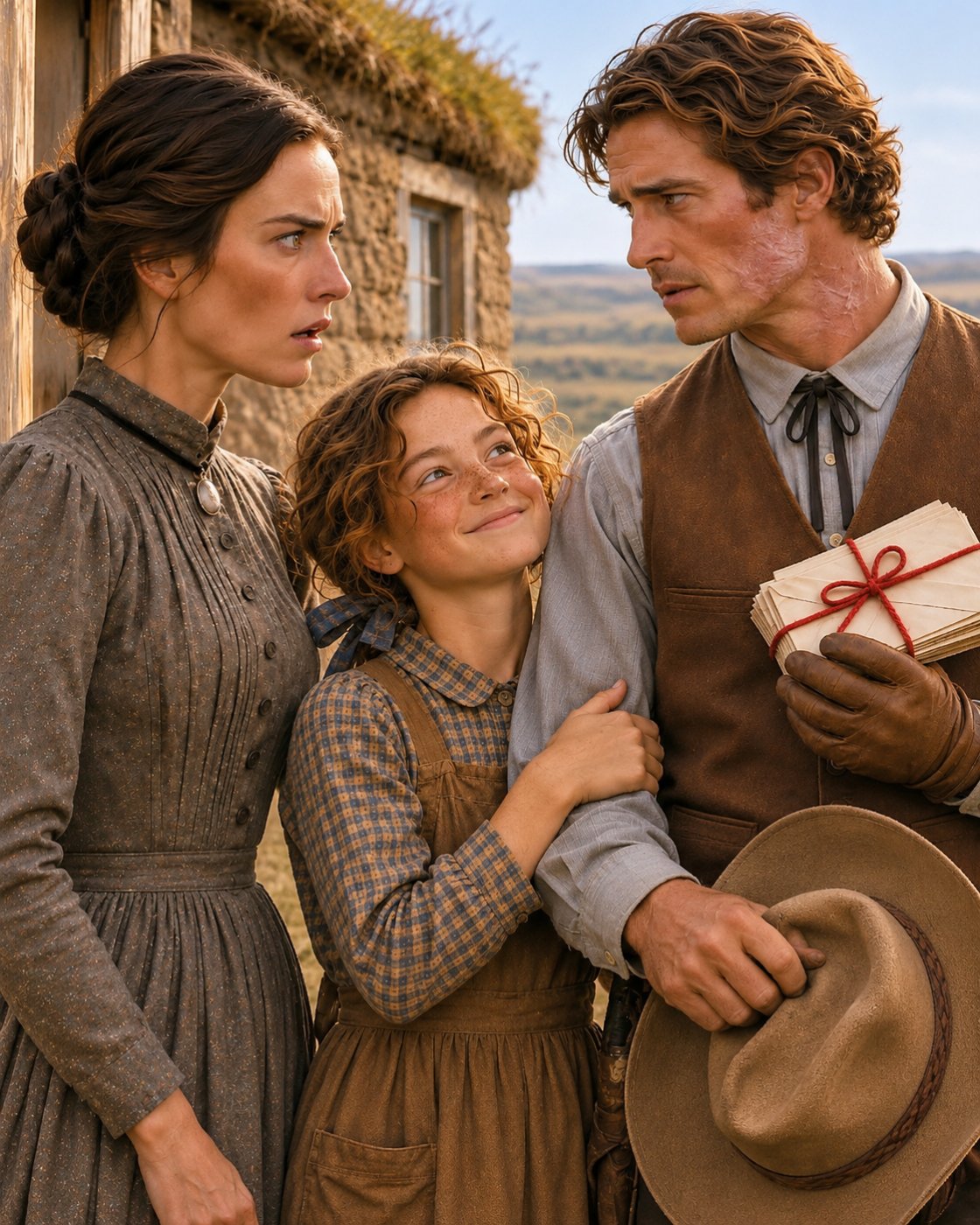
And she remembered the day a scarred cowboy appeared at their door carrying fourteen letters and a heart that had been waiting for a home.
When Birdie grew older, she kept writing.
But she never again pretended to be someone else.
She had learned that the truth was powerful enough on its own.
And every time she saw her mother laughing beside Eli, she knew that sometimes love arrived in the most unexpected way.
Not because someone planned it perfectly.
Not because life had been kind.
But because two wounded people found the courage to believe that happiness was still possible.
Eli had ridden six hundred miles searching for a wife.
Clara had spent years believing she would never trust another man.
And Birdie had simply wanted to hear her mother laugh again.
In the end, all three found something they hadn't known they were missing.
A family.
A future.
And a place where nobody had to hide their heart anymore.
Because sometimes the greatest love stories begin with a mistake.
And sometimes, the person who brings two hearts together is a ten-year-old girl who refuses to believe that her mother will never smile again.